In short
AI is better than traditional recruitment at the first conversation with every applicant. People are still better at judging fit, selling the role and making the decision, so the working setup is AI for the first interview and a person for the call.
Tracy AI Interviewer interviews every applicant on click, at any hour, asks follow-ups in the person's own field, and gives a reviewer the recording, transcript and what each person said, per question.
In a randomised field experiment of 70,884 applications, AI-led interviews produced 12% more job offers and 18% more starts than human-led ones, with recruiters still deciding.
Next: run one role through Tracy and compare it with your current first screen.
Whether AI is better than traditional recruitment depends on the step. For the first conversation with a large applicant pool, AI is better: it reaches everyone, at any hour, with the same questions. For deciding who to hire, negotiating and persuading a candidate, people are better and the evidence supports keeping them in charge. The question for a hiring team is where to put each, and the rest of this page works through the steps and the numbers behind them.
Is AI better than traditional recruitment?
Step by step, the split looks like this.
| Step | Traditional | With AI |
|---|---|---|
| First conversation | A recruiter calls the first few CVs | Every applicant interviewed on click |
| Scheduling | Calendar back and forth | Applicant picks the hour, in the browser |
| Follow-up | Depends on who calls and when | Asked on each answer, in the person's field |
| Record | Notes written after the call | Recording and timestamped transcript |
| Decision | A recruiter or hiring manager | Still a person, from the evidence |
Where traditional recruitment and an AI-led first interview differ, step by step.
AI takes the repetitive early work and hands a person a better record. It does not take the decision. In the Pew Research Center's survey of 11,004 US adults, fielded in December 2022 and published in April 2023, 71% opposed AI making final hiring decisions.
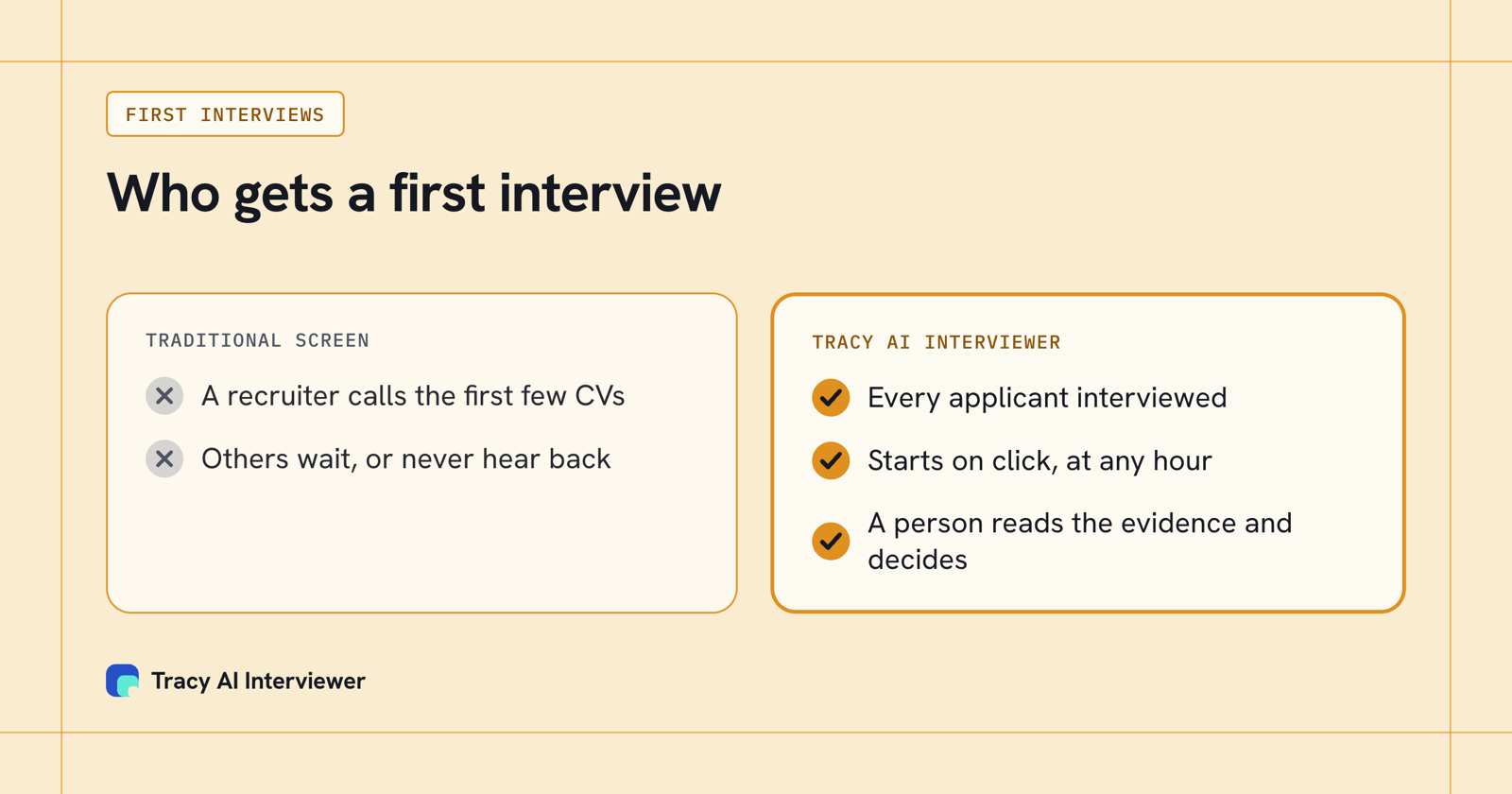
The difference is coverage: a traditional screen reaches a few applicants and an AI-led one reaches all.
Where does AI help in hiring?
AI helps most where volume and timing hurt a human process.
- Reach: a recruiter cannot call a thousand applicants. An AI interviewer can interview all of them.
- Hours: in a Tengai analysis of 20,291 AI screening interviews in Sweden between January 2025 and September 2026, 44% started outside work hours and 15% fell on weekends. People apply when they can, and a calendar slot can miss them.
- Consistency: the same questions go to everyone, which makes answers comparable and a review easier to defend.
- Record: a recording and transcript replace notes written from memory.
What the research shows on outcomes comes from one large field experiment. Jabarian and Henkel randomised 70,884 applications for entry-level customer service jobs in the Philippines, for 43 client accounts, to a human recruiter, an AI voice agent or the applicant's choice. AI-led interviews produced 12% more job offers, 18% more job starts and 17% more 30-day retention, and human recruiters still made the decisions. When applicants chose, 78% picked the AI recruiter. The setting is one country and one job family, so treat it as one strong data point.
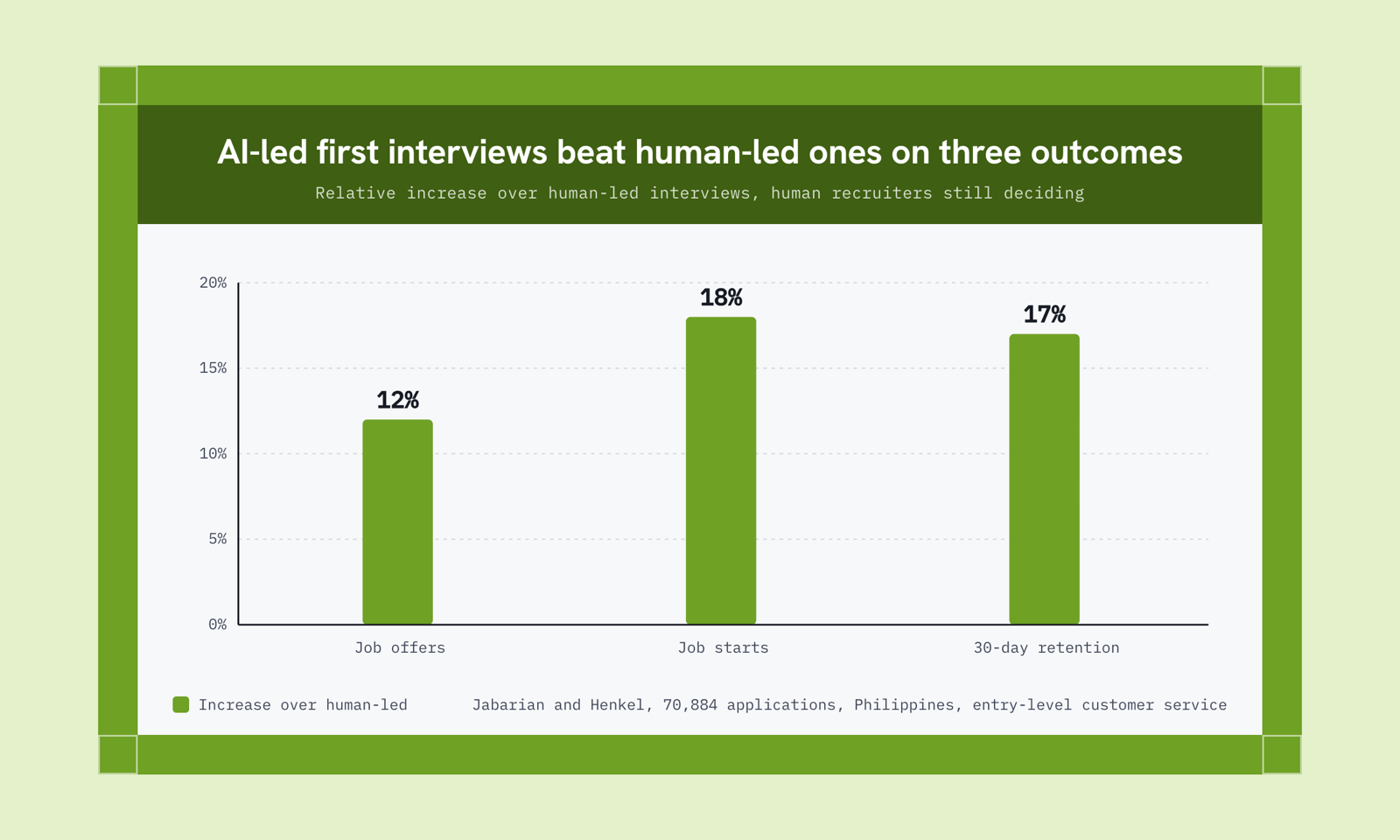
In one randomised test, AI-led first interviews improved offers, starts and retention over human-led ones.
Does AI reduce bias in recruitment?
It can, and it can also add bias. The answer depends on the tool and on how you check it.
The evidence points both ways. In the Jabarian and Henkel experiment, applicants in AI-led interviews reported less gender discrimination: 3.30% against 5.98% in human-led interviews. In Pew's survey, 47% of US adults thought AI would be better than humans at treating all applicants the same way and 15% thought it would be worse. Against that, a University of Washington audit of three text embedding models used for resume screening found they favoured White-associated names in 85.1% of cases and female-associated names in 11.1%. That study tested resume ranking, which is a different job from interviewing, but it shows why a vendor's claim of fairness needs evidence.
Whichever way the evidence points, test each step that turns people away with a selection-rate check, as described in the four-fifths rule guide, and keep a person on the decision, which the EEOC guidance explainer shows matters when a vendor's tool is involved.
Where traditional recruitment still wins
- Judging fit: team chemistry, motivation and the unwritten parts of a role are read best by a person.
- Selling the role: a strong candidate with two offers wants to talk to someone who can answer for the team.
- Rare, senior hires: with a handful of candidates, a recruiter's network and judgement beat any pipeline.
- Candidates who want a person: some people will not speak to an AI, and a human route has to exist. In the Jabarian and Henkel experiment, 5% of applicants ended the interview because they were unwilling to speak to an AI.
How Tracy AI Interviewer fits the AI half
Tracy covers the first interview. You share one link and each applicant starts when ready, with no calendar. She asks your questions, or drafts them from the role, and follows up on what each person said. A sample high-volume screen shows the shape: asked why this role, the applicant says "I want regular hours, close to home," and Tracy asks which hours suit best. Hundreds of those end up as short, comparable notes a person can read in a sitting.
The reviewer receives a recording, a timestamped transcript and a written summary of what each person said, per question. Tracy does not score, rank or reject anyone. A recruiter reads the evidence and decides. One customer cut its average time to hire from 44 days to 7, and Tracy did the work of 53 full-time recruiters in one month.
Your ATS stays where it is: results can be written back to it, and the interview and the report are both shared as links.
Which path fits you
- Hundreds of applicants per role: high-volume recruitment and how to run a mass hiring process.
- Time to hire: time to hire statistics.
- What candidates feel: how candidates rate AI interviews.
- The wider picture: AI in HR statistics and recruitment automation.
Common questions
Is AI better than traditional recruitment?
Where does AI help in hiring?
Does AI reduce bias?
Will AI replace recruiters?
Interview every applicant, decide with evidence
A first-round interview starts on click, at any hour, and follows up on each answer. Your first 3 results are free.
Try it free (opens in a new tab) Book a demo (opens in a new tab)
Your first 3 results are free. No card needed.
Sources
- Jabarian and Henkel, Voice AI in Firms: A Natural Field Experiment on Automated Job Interviews (working paper, 18 August 2025), retrieved 18 Nov 2026.
- Pew Research Center, AI in Hiring and Evaluating Workers: What Americans Think (20 April 2023), retrieved 18 Nov 2026.
- Tengai, Four in ten AI interviews in Sweden happen outside office hours (6 October 2026), retrieved 19 Nov 2026.
- Wilson and Caliskan, Gender, Race, and Intersectional Bias in Resume Screening via Language Model Retrieval (2024), retrieved 19 Nov 2026.
- Tracy AI Interviewer home page, retrieved 22 Nov 2026.