In short
A mass hiring process breaks at the first call: a few recruiters, hundreds of applicants and a calendar of phone screens. This page gives a 30-day pilot that replaces that call for one role family.
In Tracy AI Interviewer every applicant gets a video interview with follow-ups on each answer. Your reviewer gets a recording, a transcript and a summary of what was said to each question.
Your recruiters make every decision. Five measures tell you after 30 days whether to extend the pilot.
Say a retailer posts forty seasonal roles on a Monday. By Friday two recruiters hold 1,900 applications and a diary full of phone screens. The ones who get a call are the ones who applied first. Everyone else waits.
That is the usual mass hiring process, and the first conversation is where it fails. The pilot below swaps that conversation for one that every applicant gets. Tracy AI Interviewer lets each applicant begin from a link without booking a slot, asks the next question from what they just said, and hands your reviewer evidence to read instead of a pile of CVs. It takes four weeks and one role family, and it ends with a decision you can defend. For the wider picture, see high volume recruitment.
A mass hiring process fails at the first call
The usual first round has three weak points. Every phone screen needs a slot, a reminder and a no-show chase, and a recruiter can hold only so many in a day. With no time to hear everyone, recruiters call people in the order they applied, or in the order a filter ranked them. And each recruiter writes what they remember, so two people who said the same thing are recorded differently.
The funnel makes the cost plain. In Gem's data for June 2021 to May 2025, reported in its 2026 Recruiting Benchmarks Report, only 8% of applicants advance past initial screening and just 0.5% receive an offer. Most of the people who applied were never heard in any depth. For the numbers on how many applicants a role draws, see how many applicants per job.
What a mass hiring process must capture in round one
Before you pick a tool, write down what the first round has to settle. For most mass hiring drives it is these six things, asked of every applicant in the same words.
- Availability: which shifts or start dates they can take, and which they cannot.
- Location: whether the commute or the site works for them.
- One job example: a time they did the core task of the role, in their own words.
- A judgment call: what they would do when the job throws up the usual problem.
- Motivation: why this role, asked so the answer says something.
- Anything they want to add, so nobody is cut off by the question list.
Six questions take about twenty minutes. Asked the same way of everyone, they give a hiring manager a record that takes a minute to read and compares with the next one.
Where Tracy takes over the first round
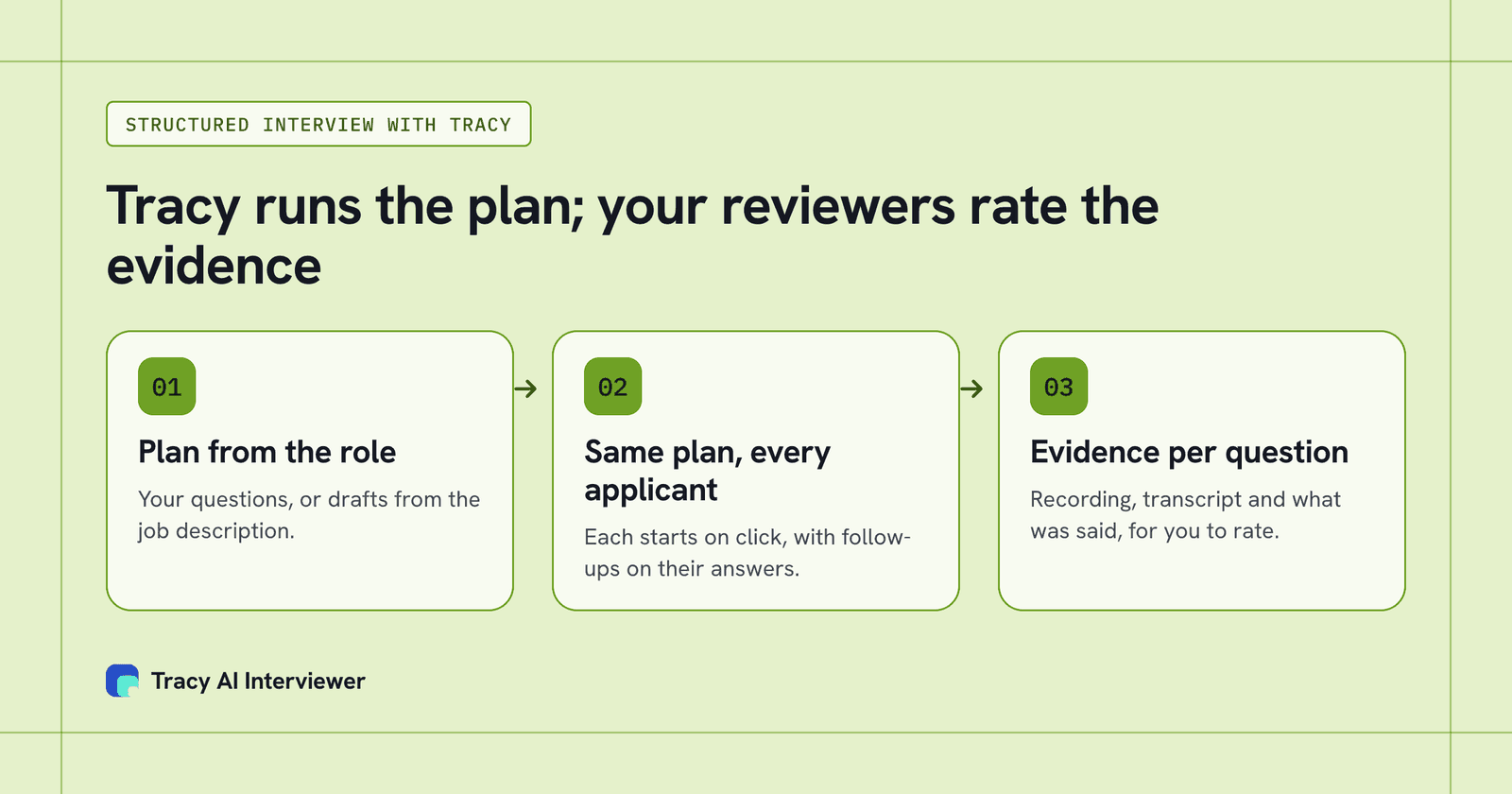
01 Start from the role
Tell Tracy about the role and it drafts questions from your description. Edit them or bring your own six from the list above.
02 One link, every applicant
Share one link, in a job post or a message. An applicant opens it in the browser when ready, at any hour, with no account and no calendar. A dropped applicant can rejoin within 10 minutes and gets a reminder after a day, and both are set per customer.
03 Follow-ups in their field
When an answer is thin, Tracy lets the applicant finish and then asks about the gap. A vague answer about a shift gets a question about the shift.
04 A result you can check
Your reviewer gets a recording of both sides, a timestamped transcript and a summary of what was said to each question, with the applicant's words behind each. Video interviews also show integrity signals with their evidence, to a person to review. The join screen tells applicants the call is recorded and transcribed.
Scoring, ranking and rejecting stay with your team. A person decides from the report. To see what a result holds per question, read what a Tracy result shows for each question.
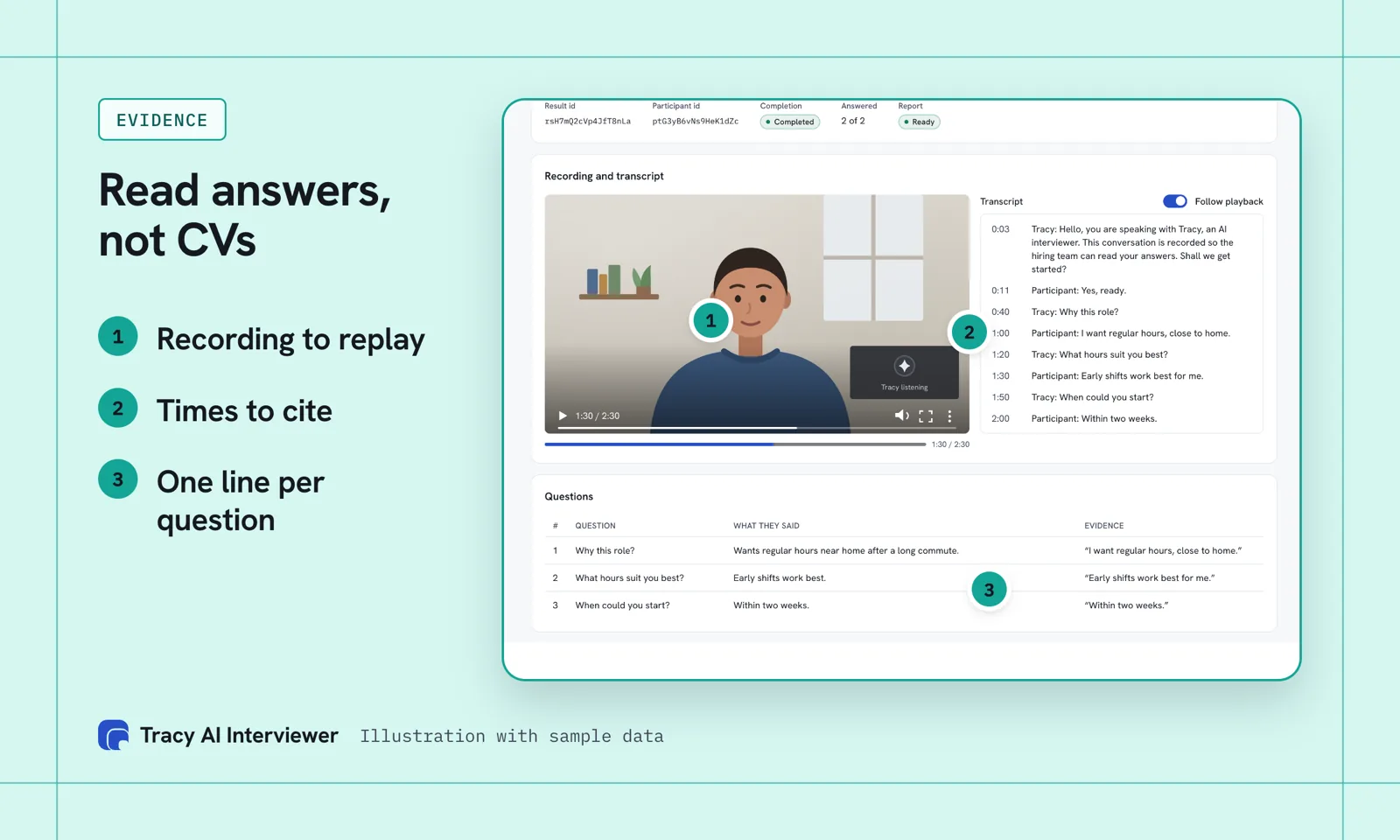
The reviewer reads what each applicant said to each question, with the time and a recording to check.
What the reviewer reads instead of 1,900 CVs
A hundred short interviews end up as the same short notes, so a person can read them in a sitting. The note below is a sample for a high volume screen, as the reviewer sees it, with invented data.
The first question was "Why this role?" The summary reads: wants regular hours near home after a long commute. In their words, at 01:00: "I want regular hours, close to home." The follow-up Tracy built from that answer was "What hours suit you best?" Two fields come out of it: start date, within 2 weeks (the start-date question, at 02:00), and preferred hours, early shifts (the follow-up, at 01:30).
The recruiter sees an answer, a time to check it at and a follow-up that settled the shifts.
What stays with your recruiters
The pilot moves the first conversation. These stay with people.
- Deciding who goes to the next round, and who does not.
- Right-to-work and background checks, which follow your own process and local rules.
- Judgment on borderline applicants, where the recording and transcript let two people look at the same evidence.
- Telling every applicant what happens next.
- The offer.
A recruiter can look at any result and move the applicant forward or invite them to interview again.
Run the 30-day pilot for your mass hiring process
Pick one role family, such as store associates in one region, and name one owner who will read the results every day. Write down the current numbers first: days from application to first conversation, and recruiter hours per hundred applicants.
- Week 1: write the six questions and set up the interview from the role. Run three interviews with colleagues, which uses the free results. Fix any question that draws a vague answer. Write the message applicants get with the link.
- Week 2: open the link to every applicant for the role. The owner reads the reports each morning and moves people forward the same day.
- Week 3: check a sample. Take 20 results and play the recording at the times cited, to confirm the notes match what was said. Compare the first numbers with the baseline.
- Week 4: hold the readout. Decide whether to extend to a second role family.
Stop the pilot if applicants who start do not finish at a rate the owner can accept, or if reviewers cannot act on the reports. Agree the figure with your hiring managers in week 1.
A pilot of 200 interviews of 20 minutes costs $200 at $1 per credit, and the first 3 results are free. In one customer's case, average time to hire fell from 44 days to 7 and Tracy covered the work of 53 full-time recruiters in a month. For larger drives, Enterprise is priced to your volume: book a demo.
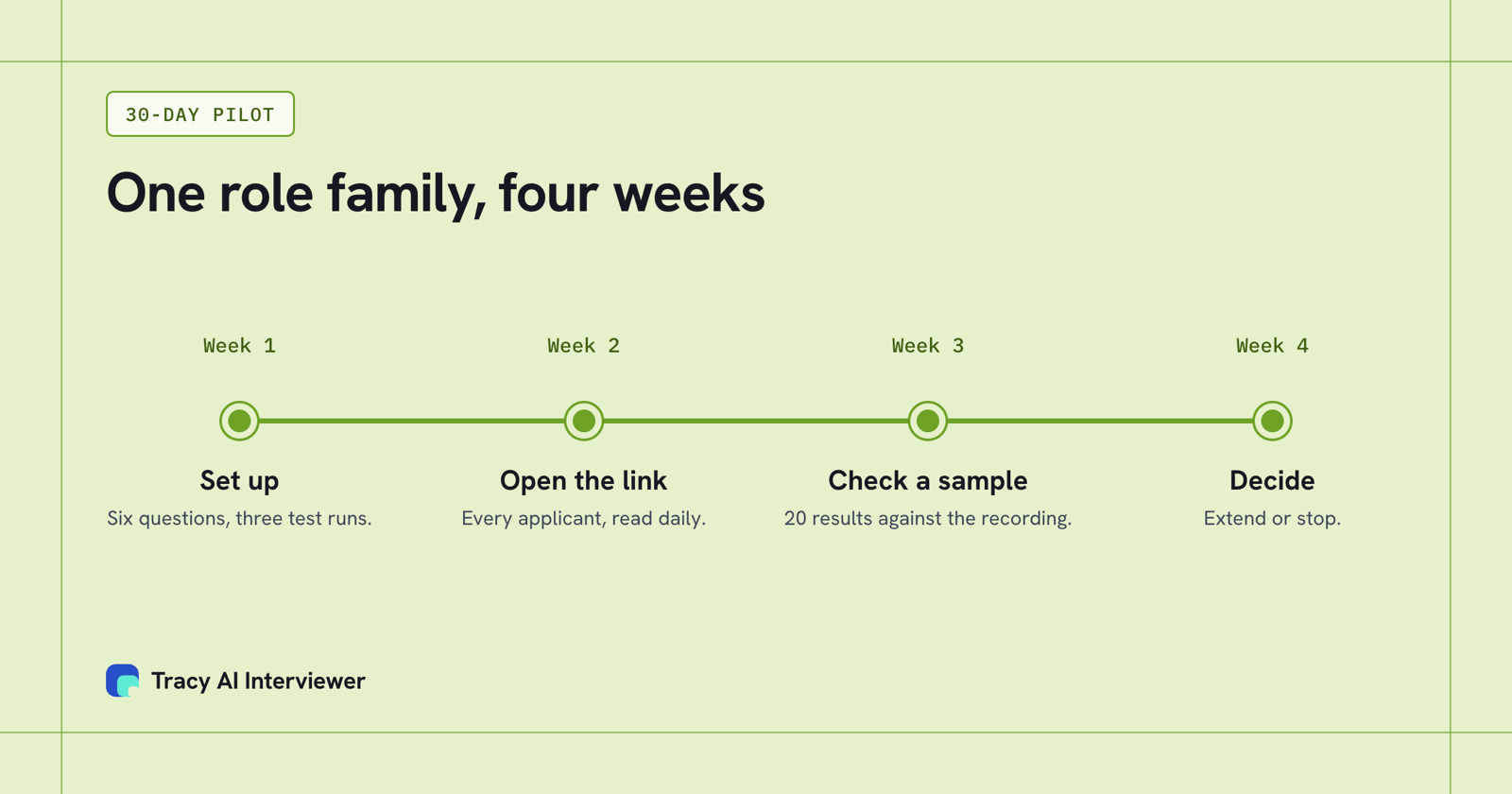
Four weeks, one role family, a decision at the end.
Five measures that show the mass hiring process works
Pick five and read them weekly.
- Share of applicants interviewed: out of everyone who applied, how many had a conversation.
- Applicants who finish: the share who start and complete the interview.
- Time from application to a reviewed result: the clock the applicant feels.
- Recruiter minutes per applicant reviewed.
- Share of interviewed applicants moved forward, checked against the sample in week 3.
Applications received is a poor guide: it counts people who applied, not people you heard from. Leave it off the dashboard. For the clocks behind time to hire, see the time to hire benchmark.
Which path fits you
- Hiring many people into one role: interviewing at volume for one role.
- Screening hundreds of applicants with a small team: how to screen hundreds of applicants.
- Defining the first round before you pilot it: what a first-round interview is.
- Pricing a bigger drive: what an AI interview costs per candidate.
Common questions
What is a mass hiring process?
How do you run a mass hiring process?
How long should a mass hiring pilot run?
What should you measure in a mass hiring pilot?
Can Tracy decide who gets hired?
Interview every applicant, not just a few
Run one role: every applicant interviewed from a link at any hour, with follow-ups on thin answers. Your first 3 results are free.
Try it free (opens in a new tab) Book a demo (opens in a new tab)
Your first 3 results are free. No card needed.
Sources
- Key takeaways from the 2026 Recruiting Benchmarks Report, Gem, retrieved 18 Nov 2026.
- Tracy AI Interviewer Connect page, retrieved 11 Nov 2026.