
TLDR Do candidates like AI interviews? Candidates rate Tracy 92 on NPS.
Candidates open a browser link, see a notice that the conversation is recorded and transcribed, and get follow-ups on their own answers.
A person reads the evidence and decides, and a candidate who drops can rejoin within 10 minutes.
Next step: take an interview yourself, as a candidate would.
We make Tracy AI Interviewer.
Do candidates like AI interviews?
Some do and some do not, and the answer depends on the process around the interview as much as on the AI. The only candidate data on this page is Tracy's own NPS, so what follows is advice for employers, not a claim about how candidates feel in general.
Tell candidates who reads the result and what is recorded. Say whether there is a timer. Let them start when it suits them and give them a way back in if a connection drops. That makes candidate experience a design question for the employer, and this guide explains what a candidate meets, in order, and what to check before you send the link.
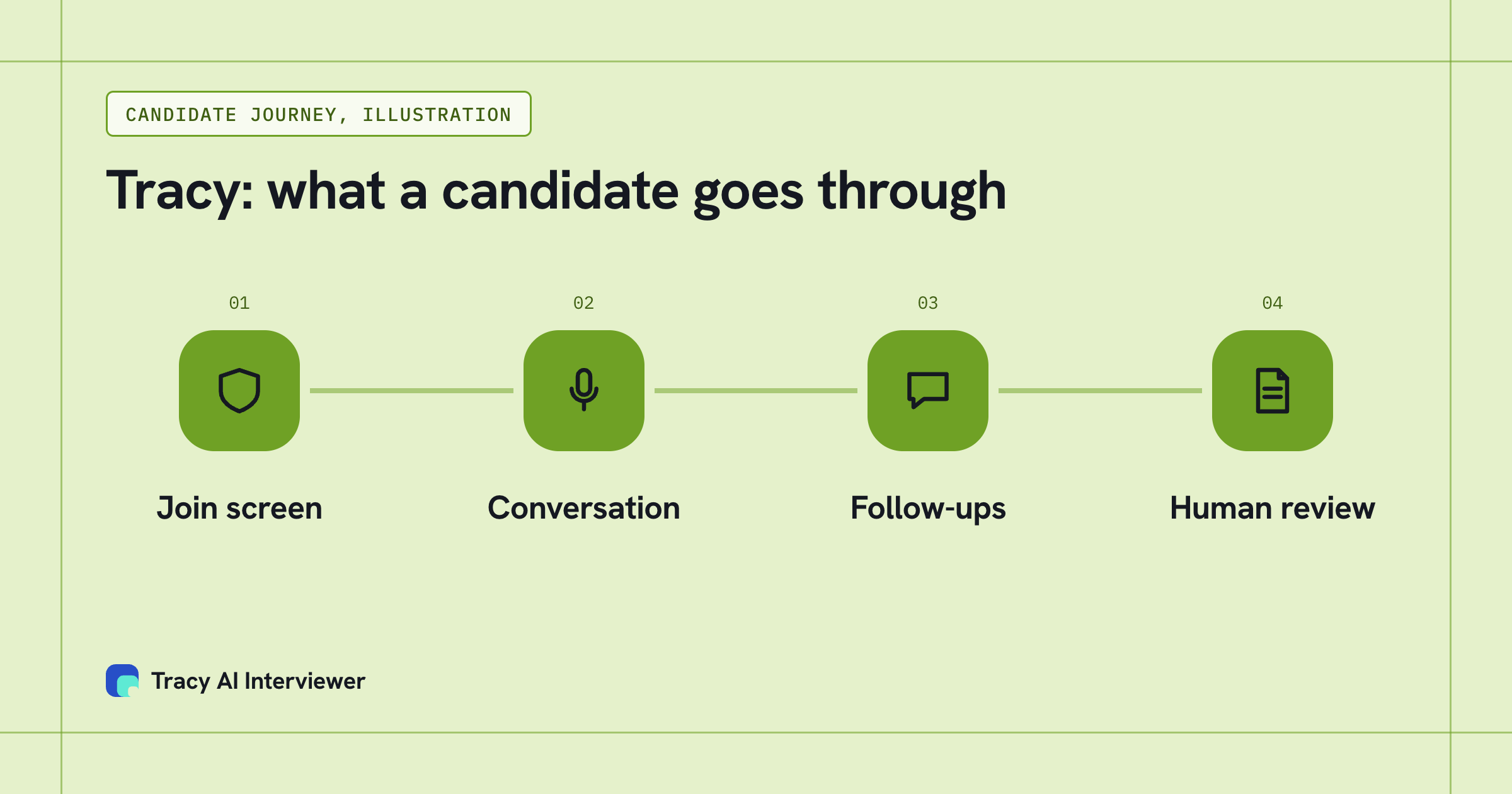
A candidate sees a notice first, talks, gets follow-ups and a person reviews the result.
What a candidate sees, step by step
The participant experience page is the guide to what a candidate sees. In short:
- A browser link. The candidate opens it and starts. There is no account to create and nothing to install.
- A notice on the join screen. It says the conversation is recorded and transcribed. Nothing is hidden before the first question.
- A start on click, at any hour. There is no scheduling and no recruiter present. The interview is ready in under 10 seconds, so a candidate can do it after work or on a weekend.
- Questions in their own field. Tracy reads the CV when the CV check is on, asks about the work the person has done, follows up on what they said and waits for the answer.
- A way back in. A candidate who drops can rejoin within 10 minutes, a limit the customer can configure. A reminder goes out after a day, and failed interviews are chased automatically.
How the interview itself runs is covered in how AI interviews work, and the first-round format in AI screening interviews.
Three real screens follow: the device check before the camera and microphone are allowed, the same check when it is ready, and the page a candidate sees at the end. The end page says the answers are saved and that Tracy does not decide anything.
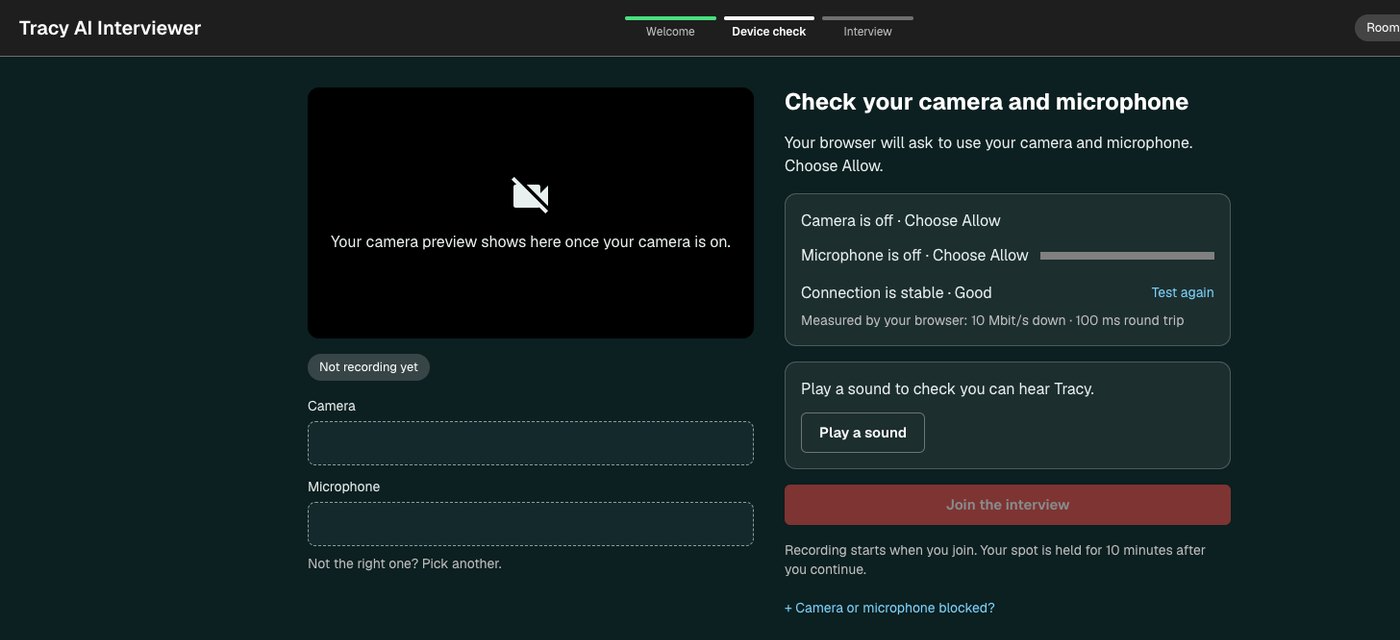
Device check with camera and microphone off, Choose Allow, and a note that recording starts on join.
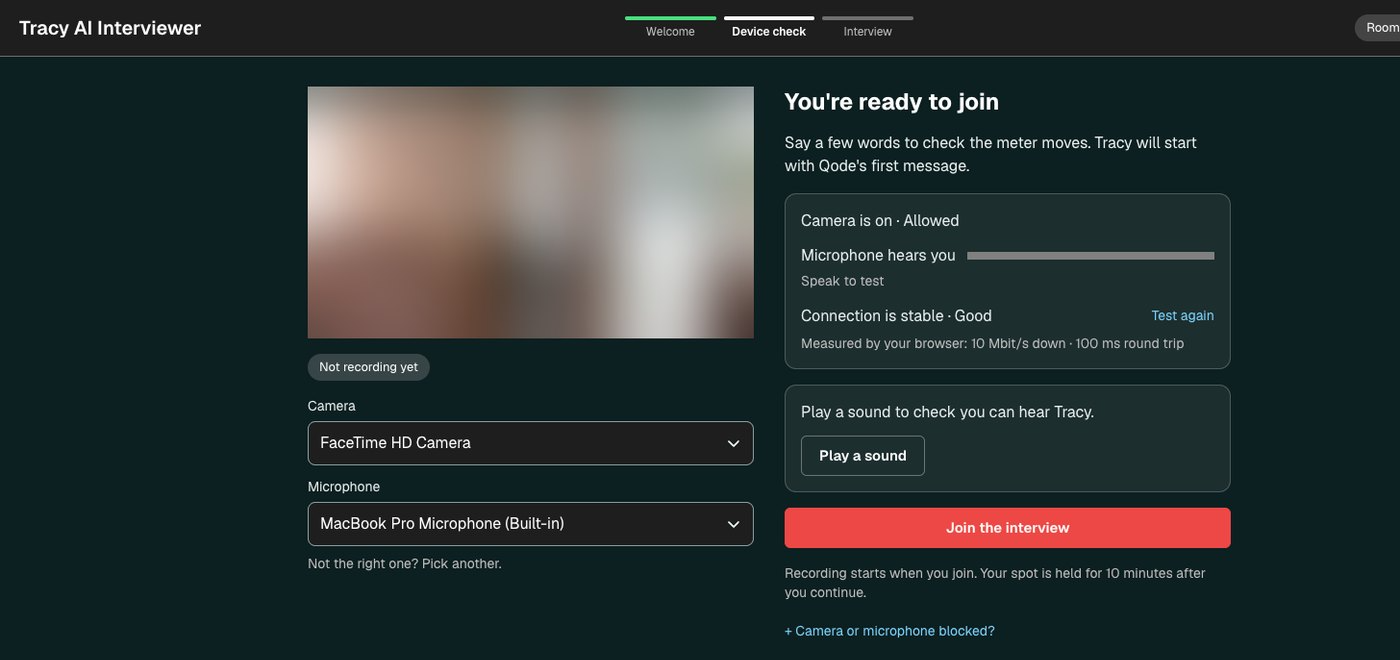
Device check ready: blurred camera preview, microphone meter, Join the interview button, spot held 10 minutes.
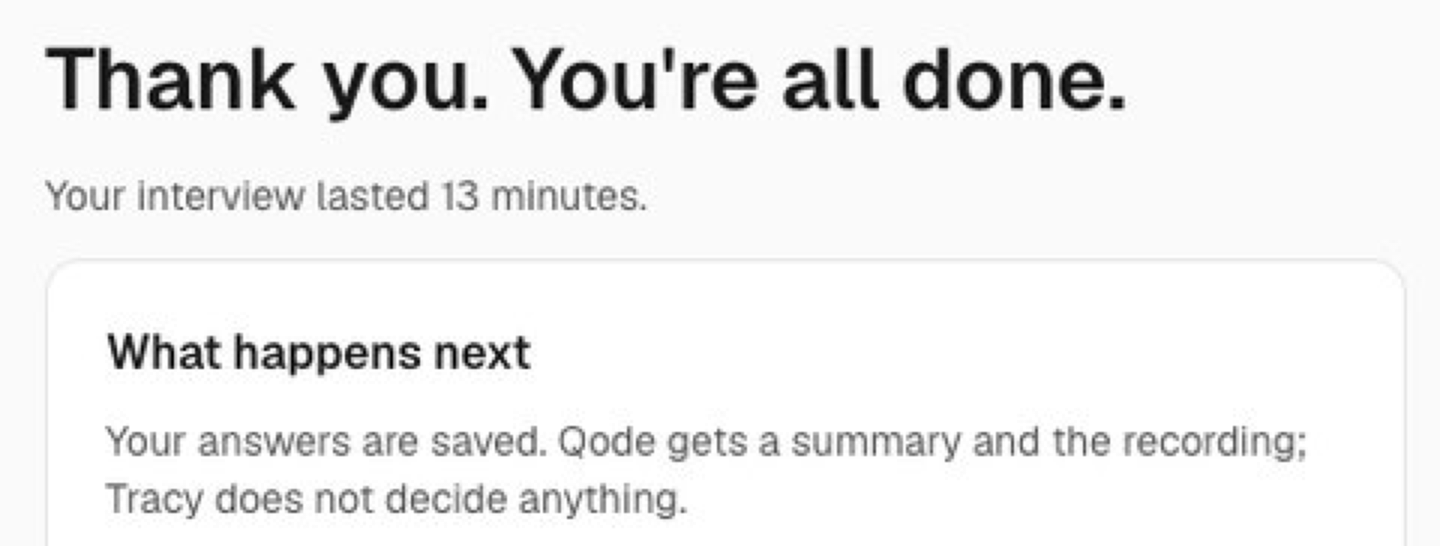
End page: Thank you, you're all done, and a What happens next note saying Tracy does not decide anything.
What candidates say
Steven Perry, Account Executive at IT Resources, an IT staffing firm in Tampa, US, describes the experience from the employer side: "By the time they finish with this platform, they're even laughing and joking." That is one customer's observation.
What candidates should know before they start
If you have been sent an AI interview link, these points answer most worries.
- It is recorded and transcribed. The join screen tells you. Both sides are kept, so the employer can review what was said.
- A person decides. The interview produces a report. A recruiter can override a rejection, move you forward or invite you to interview again, and the history stays on the record.
- Answer in your own words. Follow-up questions come from what you said, so a specific example works better than a general claim.
- Check your connection first. If you drop, rejoin within 10 minutes. The employer sets the limit, so read the invitation.
- You can ask the employer. If something is unclear, such as how the recording is used, ask the person who sent the invitation.
For the rules that apply to employers using automated tools, see AI interview rules in 2027.
What should employers check about candidate experience?
A weak experience costs you completed interviews and the people you wanted. Before you send the link, test each point as a candidate would.
The table lists each check, why it matters to the candidate and how Tracy handles it.
| Check | Why it matters to the candidate | How Tracy handles it |
|---|---|---|
| Join-screen notice | They know the conversation is recorded before they speak | The join screen says it is recorded and transcribed |
| Access | An account or an install loses people before question one | A browser link, no account |
| Timing | Evening and weekend candidates need a start that suits them | Starts on click, at any hour, no scheduling |
| Dropped connection | A lost connection should not end the application | Rejoin within 10 minutes, configurable per customer |
| Question quality | Generic questions feel like a form | Questions in the person's field, with follow-ups |
| Who decides | Candidates want a person behind the result | A person decides; the recruiter can override |
| Evidence | A result you cannot check cannot be defended | Evidence per result: recording, transcript, written assessment per question |
Create an interview for one role and take it as a candidate would.
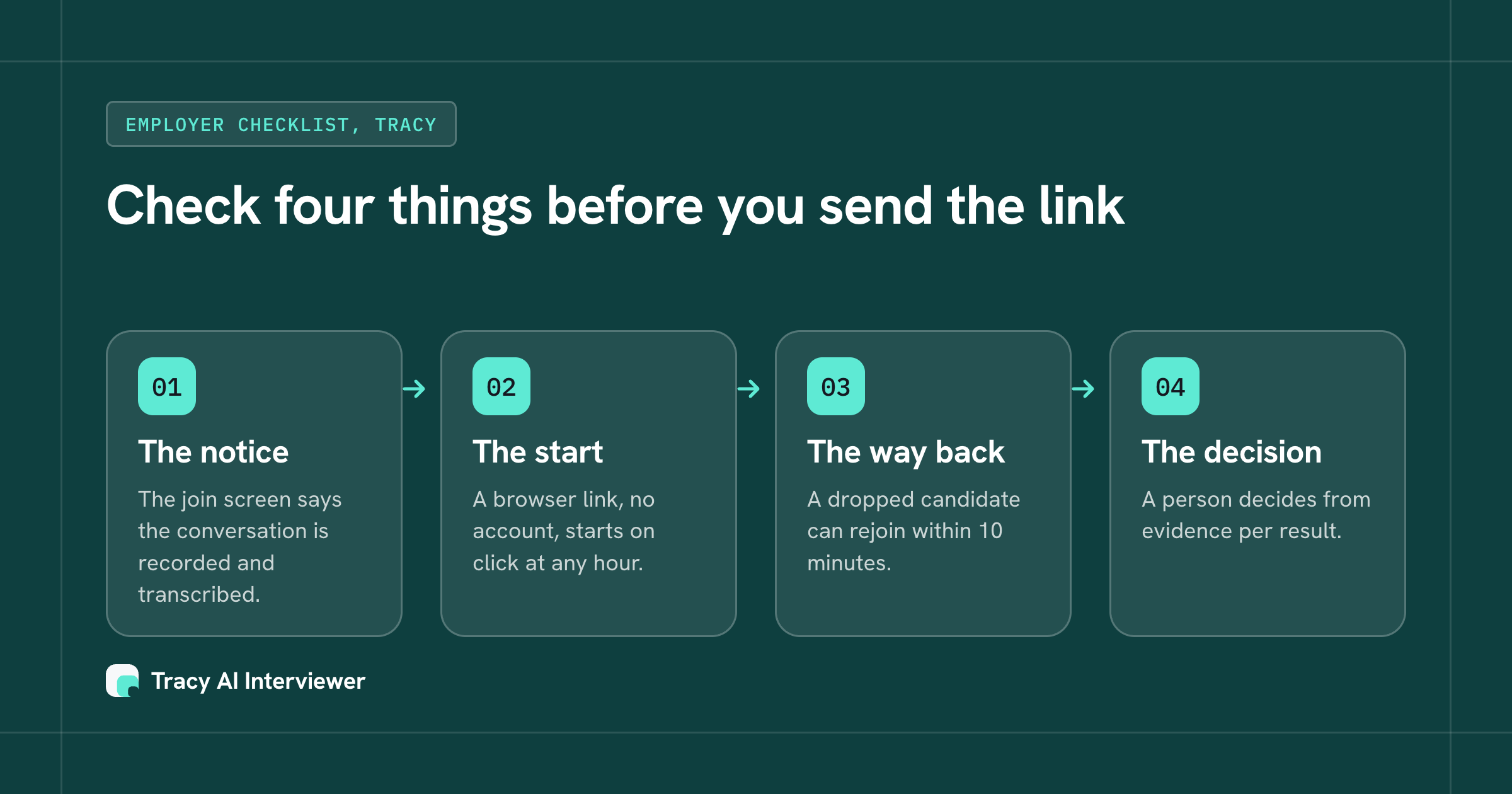
Four checks cover the notice, the start, the way back and the decision before you send the link.
Why a person deciding matters
Tracy does the interview and the report. The customer decides, and a recruiter can reverse a rejection or invite a candidate back. Tracy publishes no bias audit, so the safeguard on offer is the evidence: a recording of both sides, a timestamped transcript and a written assessment per question with its reasoning, which a second reviewer can check.
Integrity signals follow the same rule. Tracy captures tab changes, gaze, live face detection, delay before answers, fullscreen exits and external screens, and shows them as evidence for a person to interpret. They are not proof of anything and nothing is decided in the interview. See AI interview cheating detection for how to read them, and AI interview vs human interview for what each does best.
Candidate experience at volume
Volume is where scheduling queues, silence after the application and long waits can hurt experience. A start on click removes the queue, and a candidate can finish while still interested.
Which path fits you:
- Hiring at volume: volume hiring
- Screening applications: applications
- Cost of the first interviews: pricing
For the steps around the interview, see how to screen candidates.
Questions
Do candidates like AI interviews?
Do job candidates dislike AI interviews?
Is an AI interview recorded?
What if a candidate's connection drops?
Do candidates need an account or an app?
Can candidates use AI in an interview?
Create an interview for one role and take it as a candidate would. You get the interview plan, built in days, with a recording and report you can check. The first 3 results are free, with no card. Try it free · Book a demo
Sources
- Tracy AI Interviewer home page, customer quotes, retrieved 9 Nov 2026.
- Tracy AI Interviewer participant experience, retrieved 9 Nov 2026.
- Tracy AI Interviewer pricing, retrieved 5 Nov 2026.
- Tracy AI Interviewer Connect page, retrieved 5 Nov 2026.