In short
The EEOC took its AI hiring guidance off eeoc.gov in January 2025, but the statute it applied, Title VII, still stands. The 2023 document said an employer may be liable even when an outside vendor built or ran the tool.
Tracy AI Interviewer gives every applicant the same interview and follow-ups, and puts a recording, a timestamped transcript and what each person said, per question, in front of a reviewer. A person decides; Tracy does not score, rank or reject.
Tracy is SOC 2 Type II attested, which covers security and says nothing on employment law.
This page explains the rules and is not legal advice. Next: ask each AI vendor the five questions below.
Employers who use AI in hiring still answer for the effect of the tools they choose, including tools they bought. The EEOC explained how Title VII applies to AI selection tools in a May 2023 document and then removed its AI pages in January 2025. This page sets out what the document said, what the statute says in its own words, and what employers can do about it. It is general information for hiring teams. Ask your counsel which rules apply to you.
Is the EEOC AI guidance still in effect?
The EEOC's AI pages are no longer on its site. The National Law Review reported on 31 March 2026 that the EEOC removed its AI employment guidance from eeoc.gov in January 2025, and that the pages were still down at that date. The same article states that Title VII of the Civil Rights Act of 1964 "remains fully in force."
The removed documents explained how the statute applies to new tools. The statute is the source of the duty, so taking the explanation offline does not remove the duty. Employers who relied on the 2023 document as a checklist should keep the underlying questions and run them from the statute and counsel's advice.
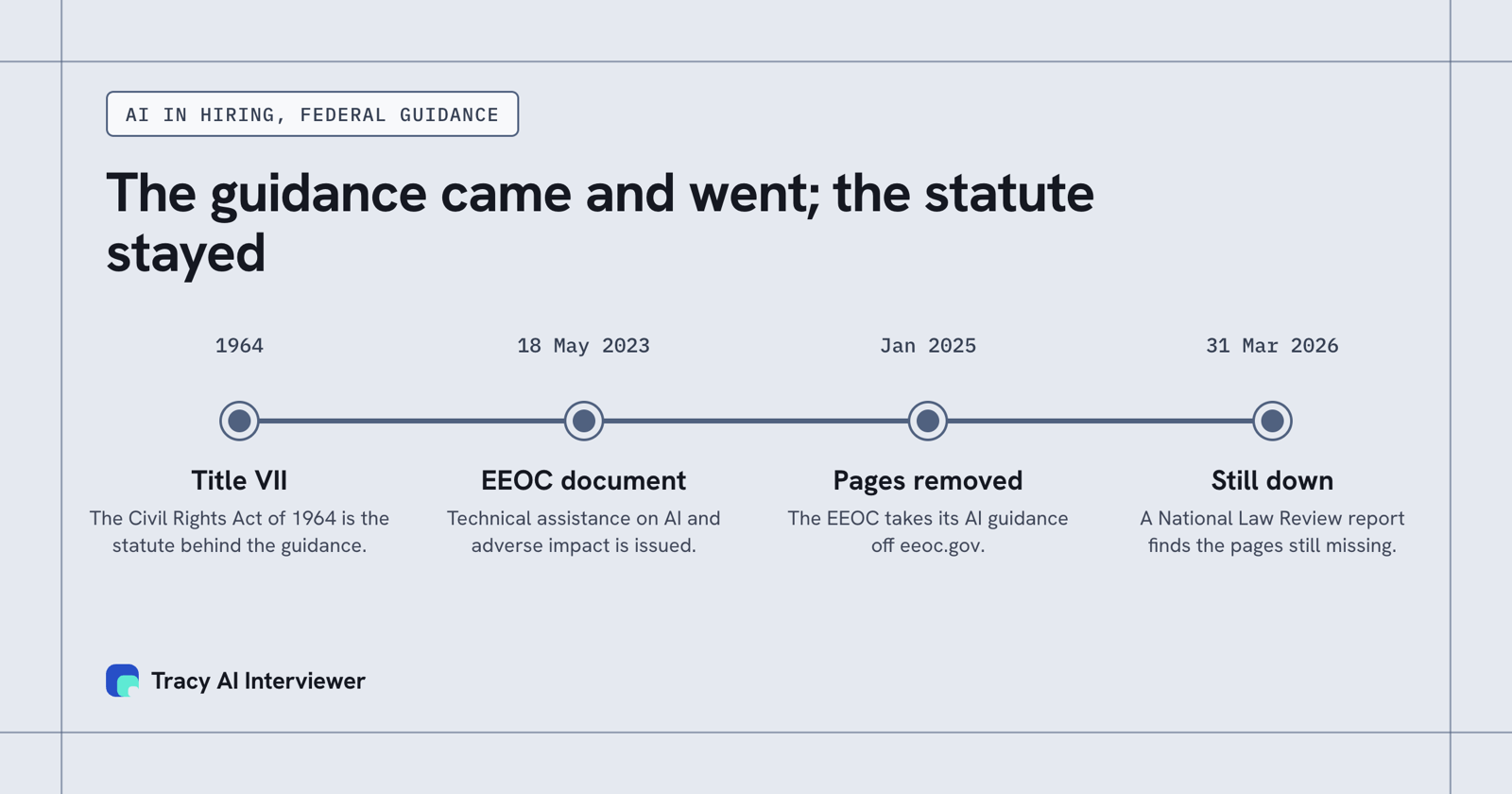
The guidance was issued in 2023 and removed in 2025, while the statute stayed the same.
Is an employer liable for vendor AI tool bias?
It can be. Littler's summary of the EEOC's 18 May 2023 document quotes it as saying that "an employer may be liable even if the test was developed or administered by an outside vendor," and that where a vendor is wrong about adverse impact, "the employer may still be liable." A vendor's assurance that a tool is fair is not a defence.
The statute points the same way. Section 703(k) of Title VII, which Cornell's Legal Information Institute publishes as 42 U.S.C. 2000e-2, says an unlawful practice based on disparate impact is established when "a complaining party demonstrates that a respondent uses a particular employment practice that causes a disparate impact on the basis of race, color, religion, sex, or national origin and the respondent fails to demonstrate that the challenged practice is job related for the position in question and consistent with business necessity." The respondent is the employer that uses the practice.
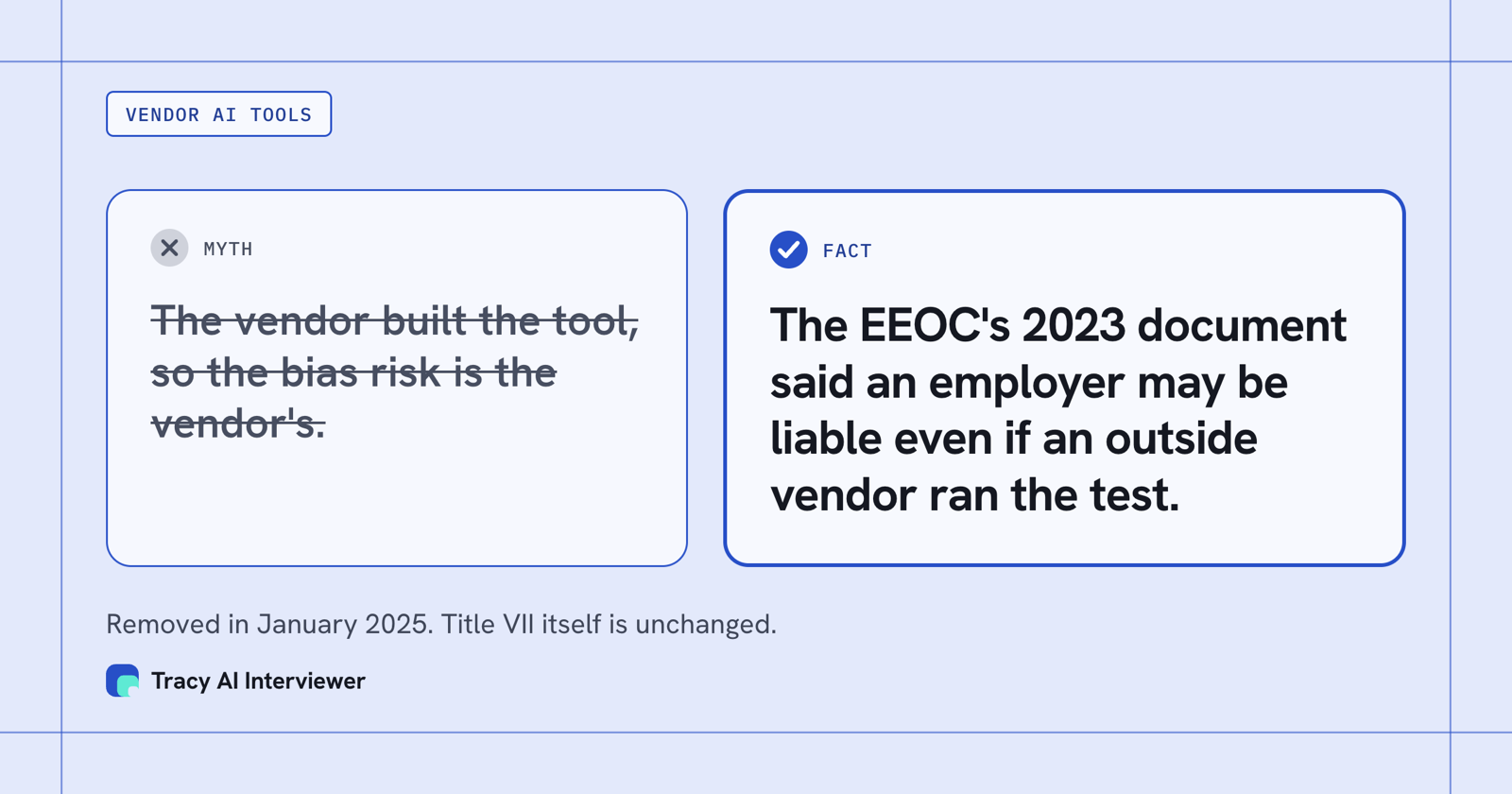
Buying a tool from a vendor does not move the employer's responsibility to the vendor.
What is the four-fifths rule?
The four-fifths rule is a way to spot adverse impact: if one group's selection rate is under 80% of the highest group's rate, agencies generally read it as a flag. Littler reports the EEOC's 2023 document as calling it a "rule of thumb" and not an absolute indicator of disparate impact, so a ratio under 0.8 starts a closer look and does not settle the question. Our guide to the four-fifths rule works through the calculation with an example.
Run the check at every step that turns people away, not only the final hire. A first-round interview that decides who moves on is one of those steps.
What do state and city rules add?
Several jurisdictions now write AI hiring duties into law. The National Law Review listed these on 31 March 2026. Confirm the current status of each with counsel, because dates in this area have already moved once.
| Rule | Effective date as listed |
|---|---|
| California, Civil Rights Council automated decision systems regulations | 1 October 2025 |
| Illinois, HB 3773 amending the Human Rights Act | 1 January 2026 |
| Texas, TRAIGA (HB 149) | 1 January 2026 |
| Colorado, SB 24-205 | 30 June 2026, delayed from 1 February 2026 |
State AI hiring laws and their effective dates, as listed by the National Law Review on 31 March 2026.
New York City's Local Law 144 asks for a bias audit by an independent auditor before certain automated tools are used. The city's Department of Consumer and Worker Protection set out the process in its FAQ of 29 June 2023.
What should employers do now?
None of this needs a lawyer to start. These steps give counsel something to review.
- Keep a person on every decision that turns someone away. A tool can gather evidence. A named reviewer decides.
- List each step that screens people and run a selection-rate check at each one.
- Ask each vendor five questions. What does the tool capture? Does it show the evidence behind a result? Who sees it and who decides? Can a person overrule it? Has an independent party audited it, and what exactly did they test?
- Tell candidates what happens. They should know before they start that the conversation is recorded and who will read it.
- Keep the record. Store what was asked, what was said and what the reviewer decided, so a second person can check the decision later.
Where Tracy AI Interviewer fits
Tracy does not make hiring decisions and does not score, rank or reject anyone. She runs the interview and a person decides from what comes back. Every applicant is asked the questions you set or edited, starts on click at any hour, and gets follow-ups that depend on what they said. Applicants are told on the join screen that the conversation is recorded and transcribed.
The reviewer receives a recording, a timestamped transcript and a written summary of what each person said, per question. In a sample report for a skills-based role, the summary reads: "Organised volunteer events for four years, without a formal course," with the time of the quote beside it. That record is what you keep for step 5, and a second reviewer can open the same moment. Results can be written back to your ATS.
Tracy is SOC 2 Type II attested, and the report is available on request at hello@tracyinterview.ai. The attestation covers security and does not speak to whether any employer's process meets Title VII.
Which path fits you
- Testing a screening step: the four-fifths rule, with an example.
- Same questions for everyone: how to run a structured interview.
- Many applicants: high-volume recruitment and what an AI interview report contains and how to check it.
- What candidates think: do candidates like AI interviews.
Common questions
Is an employer liable for vendor AI tool bias?
What is the four-fifths rule?
Is the EEOC AI guidance still in effect?
Does Tracy decide who gets hired?
Interview every applicant, keep a person deciding
Each applicant starts on click, at any hour, and a reviewer reads what they said, question by question. Your first 3 results are free.
Try it free (opens in a new tab) Book a demo (opens in a new tab)
Your first 3 results are free. No card needed.
Sources
- Littler, EEOC Issues Guidance on Use of Artificial Intelligence Tools in Employment Selection Procedures Under Title VII (May 2023), retrieved 23 Nov 2026.
- National Law Review, the federal government removed its AI hiring guidance and four states are writing their own (31 March 2026), retrieved 23 Nov 2026.
- 42 U.S.C. 2000e-2, Unlawful employment practices (Legal Information Institute), retrieved 23 Nov 2026.
- NYC Department of Consumer and Worker Protection, Automated Employment Decision Tools: Frequently Asked Questions (29 June 2023), retrieved 18 Nov 2026.
- Tracy AI Interviewer home page, retrieved 22 Nov 2026.