In short
Ashby's customer data puts median time to hire at 30 days for business roles and 40 for technical roles, counted from application to hire, for hires in Q2 and Q3 2025. Greenhouse's US customers averaged 62 days to fill a role from January to August 2026. The two figures start their clocks in different places and answer different questions.
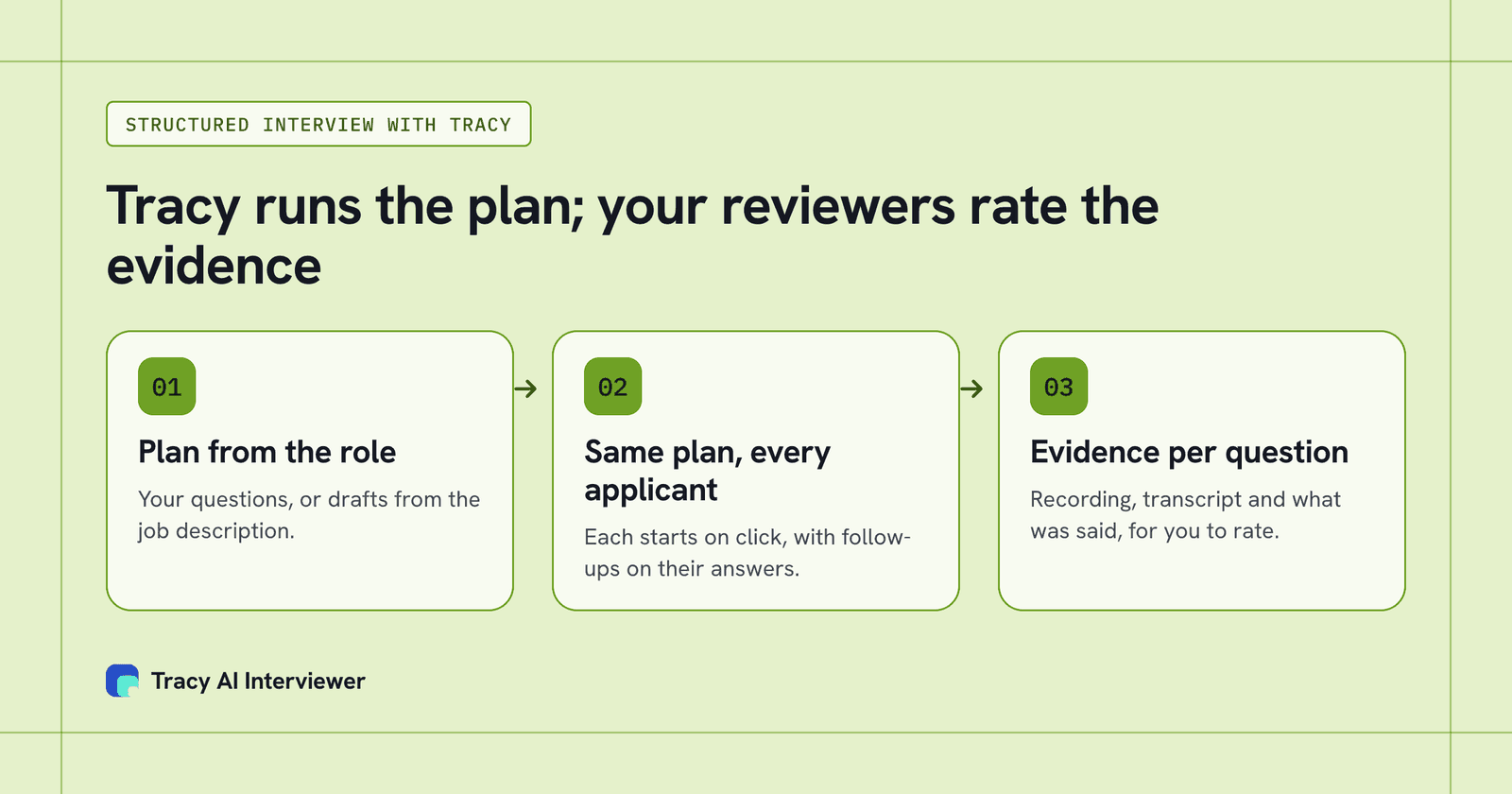
Tracy AI Interviewer takes the booking out of the first round: each applicant starts from a link at any hour, Tracy follows up on the answers, and your team reads the report.
For one Tracy customer, average time to hire went from 44 days to 7, and over a single month its interviews took on the workload of 53 full-time recruiters.
Next step: pick one role and run its first round through Tracy.
Time to hire statistics disagree because the clock starts and stops in different places, and because some sources report a median and others an average. The wait between an applicant arriving and a first conversation is the part a hiring team can shorten fastest. The time to hire benchmark covers which clock to set a target on.
What is the average time to hire?
It depends on the definition and on who is counting. Median time to hire is 30 days for business roles and 40 for technical roles at Ashby's customers, and Gem's customers averaged 41 days in 2024. The table lists the main figures.
Which number counts what?
Publisher, definition and period differ by row, so no two rows can be compared directly. Sources: Ashby (2026), Greenhouse (2026), Gem (January 2025), SHRM (2025), Bullhorn (February 2026).
| Measure | Number | Who counted, how, when |
|---|---|---|
| Median time to hire, business roles | 30 days | Ashby, application to hire, Q2 and Q3 2025 |
| Median time to hire, technical roles | 40 days | Ashby, same measure and period |
| Median time to first fill, business roles | 56 days | Ashby, job opening to first fill, January 2021 to March 2026 |
| Median time to first fill, technical roles | 76 days | Ashby, same measure and period |
| Days to fill a role | 62 days | Greenhouse, US, January to August 2026 |
| Average time to hire | 41 days | Gem customers, 2024 (33 days in 2021) |
| Median days to fill, nonexecutive roles | 44 days | SHRM, 2,371 US members, 2025, requisition to accepted offer |
| Highest-growth staffing firms with average placement under 10 days | 56% | Bullhorn, about 2,300 recruiters, November and December 2025 |
What is the difference between time to hire and time to fill?
In general, time to fill starts when the job opens or the requisition is approved and ends when someone is hired or accepts. Time to hire usually starts when the candidate applies, so it leaves out the days a job sits open before anyone applies. Ashby reports both for the same customers: 30 days from application to hire against 56 days from opening to first fill for business roles, and 40 against 76 for technical roles. The 30 and 40 days cover hires in Q2 and Q3 2025, while the 56 and 76 days cover January 2021 through March 2026, so the pairs are two clocks over different windows, not a like-for-like subtraction.
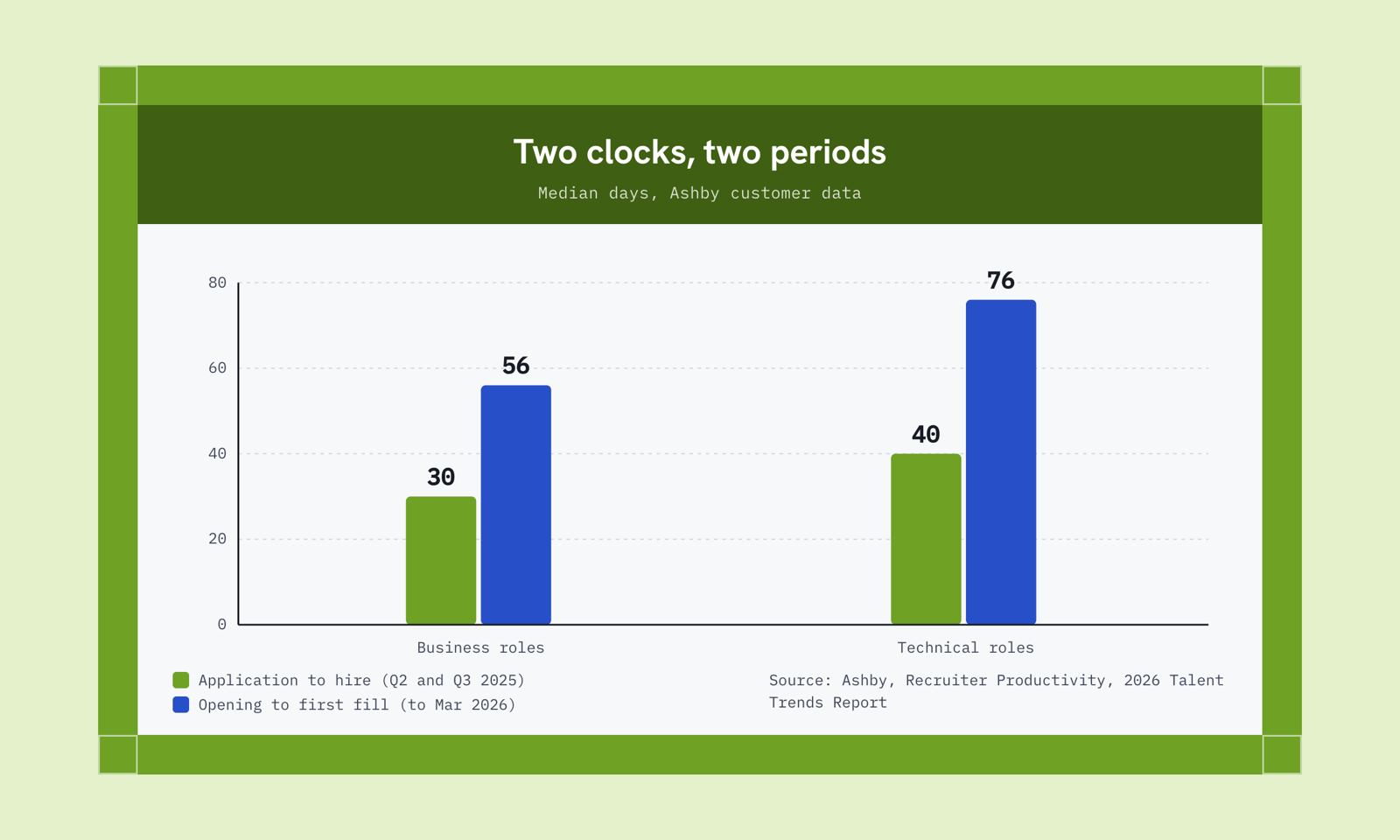
Ashby's median time to first fill is 56 days for business roles and 76 for technical roles, against 30 and 40 days from application to hire.
How does time to hire vary by role and company?
Role type shows the largest gap in these sources. Ashby's median time to hire is 10 days longer for technical roles than for business roles, and its 2026 operations report (customer data from January 2021 to March 2026, published May 2026) finds senior roles take 37 percent longer to fill than junior ones. Recruiter involvement matters at startups too: Ashby's startup report, covering startups under 25 employees, mostly in 2025 and worldwide, found time to hire fell almost 30 percent when a recruiter was involved, from 62 days to 42.
Has time to hire got longer?
Gem's customer data says yes. Average time to hire rose from 33 days in 2021 to 41 in 2024, while interviews per hire rose from 14 to 20. Few teams measure it: CIPD's 2026 survey of 1,014 UK HR professionals found only 31 percent of organisations track time to hire, up from 21 percent in 2024. Fieldwork ran from 2 April to 2 May 2026, and the figures are UK employers only.
Where does the time go in a first round?
Ashby customers using its Auto Schedule confirm interviews 26 percent faster than those scheduling by hand, with a median of 3.7 hours against 5 (customer data to March 2026, published May 2026). Tracy's first round has no calendar slot to wait for: an applicant opens the link when they are ready and nobody from your team joins. Tracy picks each next question from the applicant's last answer, and a person reads the recording, the transcript and what each applicant said to every question, then decides.
A sample note, with invented data, shows one applicant's first round: a project that cut onboarding from five steps to two, a follow-up asking what was measured afterwards, and the hard part of persuading legal to drop a step, each with its time in the recording.
One hundred interviews of up to 20 minutes cost up to $100: $1 buys a credit, and a credit covers each started 20 minutes.
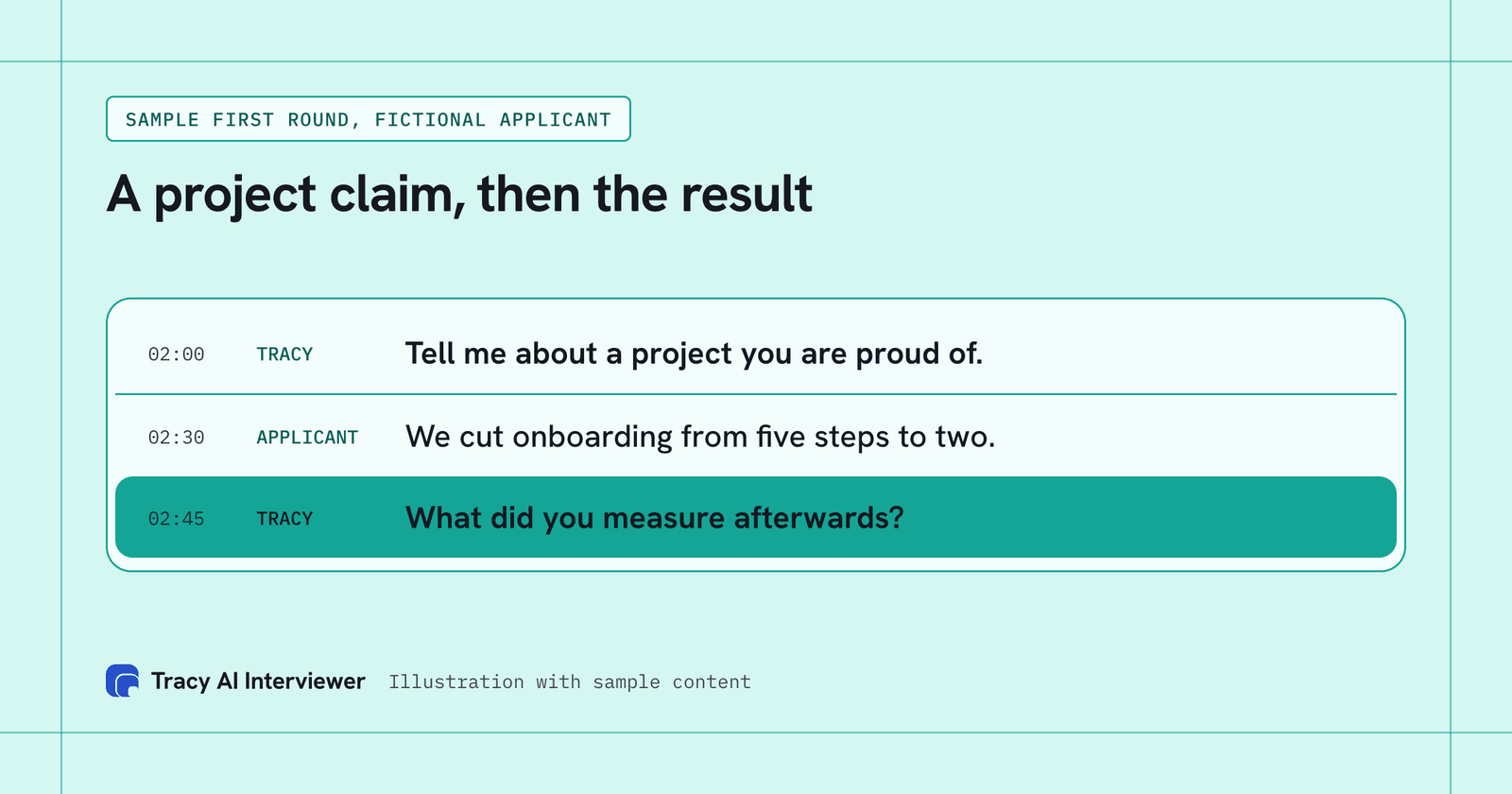
A first-round applicant is asked what they measured afterwards, so a project claim comes with a result.
Which path fits you?
- Choosing a target: what a time to hire benchmark has to specify.
- Studying the top of the funnel: how many applicants a job draws.
- Running a first round at volume: high-volume recruitment.
- Cutting the booking step: interview scheduling.
- Checking the result of speed: what quality of hire is.
Volume hiring with Tracy follows a role from the first link to the report.
Common questions
What is the average time to hire?
Does a recruiter shorten time to hire at a startup?
What is the difference between time to hire and time to fill?
How much has time to hire grown since 2021?
How can you shorten time to hire?
Run your first round on click
Open a role in Tracy and applicants start their first round on click, with a follow-up on each answer. The first 3 results are free.
Try it free (opens in a new tab) Book a demo (opens in a new tab)
Your first 3 results are free. No card needed.
Sources
- Ashby: Recruiter Productivity, Talent Trends Report, retrieved 18 Nov 2026.
- Ashby: Recruiting Operations Benchmarks, 2026 Talent Trends Report, retrieved 18 Nov 2026.
- Ashby: The State of Startup Hiring, 2026 Talent Trends Reports, retrieved 18 Nov 2026.
- Greenhouse: The Hire Standard, fall 2026 US benchmark report, retrieved 18 Nov 2026.
- Gem: 2025 Recruiting Benchmarks Report, retrieved 18 Nov 2026.
- SHRM: 2025 Recruiting Executives Benchmarking data brief, retrieved 9 Nov 2026.
- Bullhorn: GRID Industry Trends Report press release, 25 February 2026, retrieved 18 Nov 2026.
- CIPD with Omni RMS: Resourcing and talent planning 2026, retrieved 18 Nov 2026.
- Tracy AI Interviewer: Pricing, retrieved 11 Nov 2026.