In short
The four-fifths rule says that when one group's selection rate is under 80 percent of the highest group's rate, US federal agencies generally treat it as evidence of adverse impact.
It is a rule of thumb from federal guidelines. Test it at each step that turns people away, starting with the first screen.
Tracy AI Interviewer asks every applicant the same questions, follows up on what each person said, and gives the reviewer a recording, a transcript and what the person said to each question. People make every decision.
Next: run one role through Tracy and read its first reports.
The four-fifths rule is a quick test for adverse impact in hiring: divide each group's selection rate by the highest group's rate, and if the result is below 0.8, or 80 percent, federal agencies in the US generally read it as evidence of adverse impact. It comes from the Uniform Guidelines on Employee Selection Procedures (29 CFR part 1607) and covers any step that decides who moves forward, including a screen or a structured interview.
What is the four-fifths rule?
The rule rests on two terms from the Uniform Guidelines. A selection rate is the proportion of applicants or candidates who are hired, promoted or otherwise selected. Adverse impact is a substantially different rate of selection that works to the disadvantage of members of a race, sex or ethnic group. The four-fifths rule puts a number on "substantially different": a rate below four-fifths of the highest group's rate.
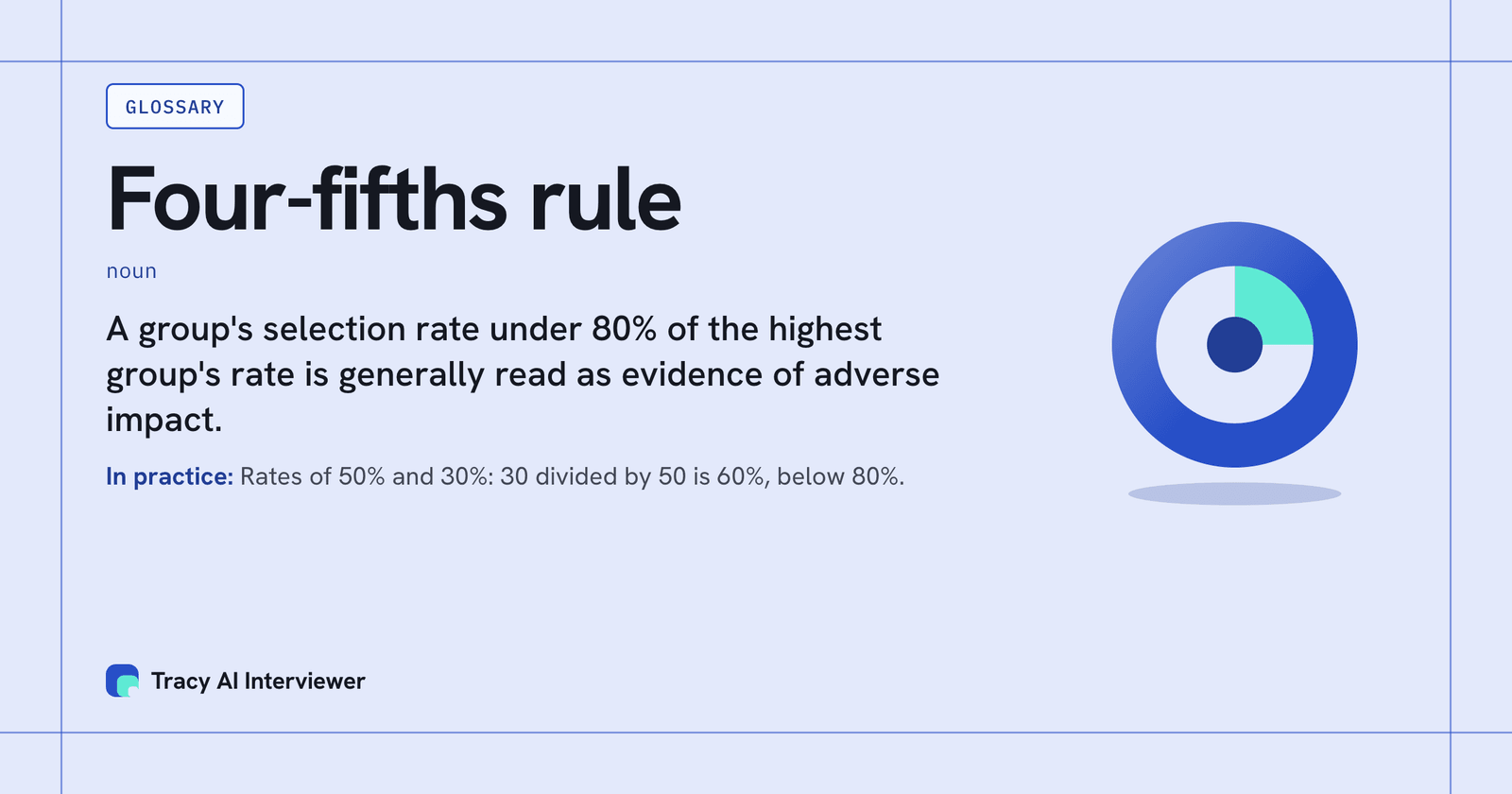
The rule is one division: a group's rate over the highest group's rate, compared with 80 percent.
How do you calculate the four-fifths rule?
Calculate it for one hiring step at a time.
- Count the applicants in each group who reached the step, and how many of them were selected to move on.
- Divide selected by applicants for each group. That is the selection rate.
- Divide each group's rate by the highest group's rate.
- Compare the result with 0.8. Below 0.8 is a flag to investigate. At or above 0.8 is generally not read as adverse impact.
In an invented example, 200 applicants in Group A reach the screen and 100 move on, a 50 percent rate. In Group B, 100 reach the screen and 30 move on, a 30 percent rate. Dividing 30 by 50 gives 0.6, which is below 0.8, so the screen is flagged. Had 45 of Group B moved on, the rate would be 45 percent, the ratio 0.9, and no flag.
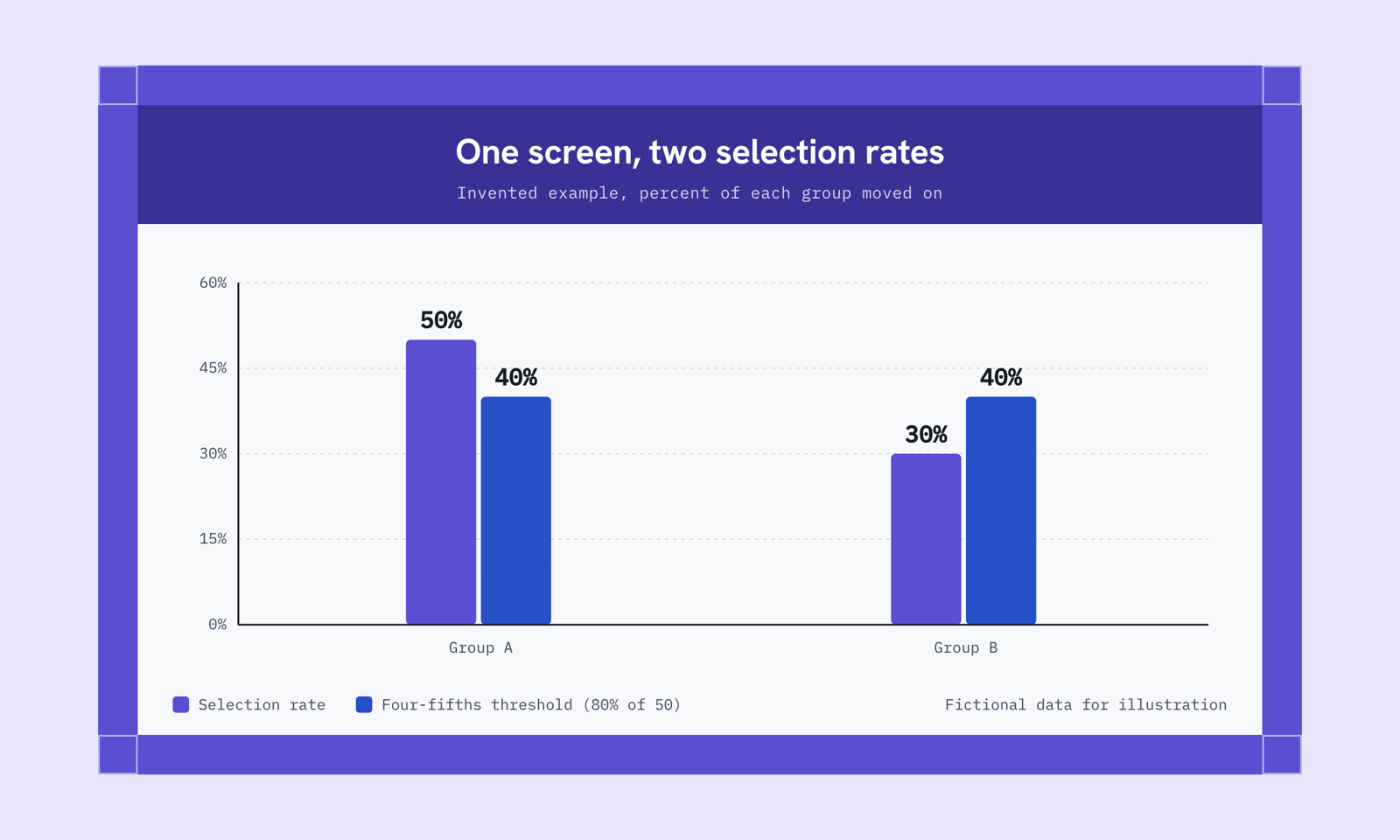
Group B's selection rate of 30 percent sits below the four-fifths threshold of 40 percent, which is 80 percent of Group A's 50 percent.
Is the four-fifths rule a legal requirement?
Not on its own. The four-fifths rule is a guideline that agencies use as a rule of thumb. The Uniform Guidelines say a rate of less than four-fifths of the highest group's rate will generally be regarded as evidence of adverse impact. Smaller differences can still count when they are significant in statistical and practical terms, and larger ones may be set aside when they rest on small numbers. The legal duty sits one step away: the Guidelines treat a selection procedure with adverse impact as discriminatory unless it has been validated or the Guidelines' other provisions are met.
Some local laws add a duty to measure. New York City's Local Law 144 requires a bias audit by an independent auditor that calculates selection or scoring rates and impact ratios, but its enforcement guidance of 29 June 2023 says the law does not require any specific action based on the results. This page is general information. Ask your counsel which rules apply to you.
What does the rule leave out?
- A ratio below 0.8 does not prove discrimination, and a ratio above 0.8 does not prove its absence.
- It is unstable with small groups. A difference of one hire can swing the ratio.
- It says nothing about why the rates differ.
- It covers one step. Run it at each step that turns people away, not only on the final hire.
Does the four-fifths rule apply to interviews?
Yes. The Guidelines define a selection procedure as any measure, combination of measures, or procedure used as a basis for any employment decision, from tests through "informal or casual interviews and unscored application forms". A first-round interview that decides who moves on is a selection procedure.
The first screen is where Gem's data shows most applicants drop out. In Gem's customer data from June 2021 to May 2025, only 8 percent of applicants advanced past initial screening. A ratio calculated only on final hires would miss that step entirely.
How does Tracy AI Interviewer fit when you test a hiring step?
Tracy does not calculate the ratio, and it does not score, rank or reject anyone. Your own records hold the group data, and your team runs the test at each step.
What Tracy changes is the evidence behind the first step. Every applicant is asked the same questions, the ones you set or edited, and starts on click, at any hour, with no scheduling. Follow-ups vary with what each person said, so the record shows both the fixed questions and the probing. The reviewer receives a recording, a timestamped transcript and a written summary of what each person said, per question. Applicants are told on the join screen that the conversation is recorded and transcribed, a person reviews each report, and nothing is decided automatically.
A sample from a structured interview:
Tracy: How do you prioritise when everything is urgent?
Applicant (sample): I ask what happens if it waits a day.
Tracy: What if both say the same thing?
The sample report records the method (ask the cost of a one day delay) with its quote and time, so a second reviewer can read the same answer. This is an illustration with sample content. To see the evidence a second reviewer would get, run one role through Tracy and read the first reports.
Where to go next
Which path fits you:
- Same questions for everyone: the case for asking every applicant the same questions and how to run one.
- Checking what an AI interview report contains: how AI interview scoring works and how to check it.
- Many applicants at one screen: screening a large applicant pool and what candidate screening is.
- How candidates feel about it: do candidates like AI interviews.
Common questions
What is the four-fifths rule?
How do you calculate the four-fifths rule?
Is the four-fifths rule a legal requirement?
Does the four-fifths rule apply to AI interviews?
Test the first step on real interviews
Run one role through Tracy and read what each person said, per question, before you test that step. Your first 3 results are free.
Try it free (opens in a new tab) Book a demo (opens in a new tab)
Your first 3 results are free. No card needed.
Sources
- 29 CFR 1607.4, Information on impact (Uniform Guidelines on Employee Selection Procedures, Legal Information Institute), retrieved 22 Nov 2026.
- 29 CFR 1607.3, Discrimination defined (Legal Information Institute), retrieved 22 Nov 2026.
- 29 CFR 1607.16, Definitions (Legal Information Institute), retrieved 22 Nov 2026.
- NYC Department of Consumer and Worker Protection, Automated Employment Decision Tools: Frequently Asked Questions (29 June 2023), retrieved 18 Nov 2026.
- Gem, key takeaways from the 2026 Recruiting Benchmarks Report, retrieved 18 Nov 2026.
- Tracy AI Interviewer home page, retrieved 22 Nov 2026.