
In short
SHRM's 2026 research found 39% of organizations use AI in their HR functions, and HireVue's 2025 report puts HR professionals' AI use at 72%. One counts organizations and the other people, so there is no single share of HR teams using AI.
Tracy AI Interviewer runs check-ins and exit interviews for people teams, and a vague answer gets a kind, sharper follow-up.
Few teams measure the results, since 56% of HR functions do not formally track what their AI delivers (SHRM).
Next step: run one check-in and read the answers yourself.
AI in HR statistics disagree on adoption because each survey asks a different person about a different tool. SHRM asks HR professionals about their function, HireVue asks about their own use, and LinkedIn asks recruiting leaders about generative AI in hiring. The figures below come with who was counted and when, so you can quote the one that matches your question. Numbers about candidates and screening sit on AI in hiring statistics, and recruitment automation statistics covers the sourcing and screening workflow.
How many HR teams use AI?
It depends on the survey. SHRM reports that 39% of organizations use AI in their HR functions, and HireVue reports that 72% of HR professionals were using AI in 2025, up from 58% the year before. The first counts organizations and the second counts people. The table sets each figure beside its base.
Which AI adoption number counts what?
Each row has its own base and date, so no row stands in for another. Sources: SHRM (April 2026), HireVue (February 2025), LinkedIn (2025), Resume Builder (October 2024).
| Measure | Number | Who counted, how, when |
|---|---|---|
| Organizations using AI in HR functions | 39% | SHRM, 1,908 HR professionals, State of AI in HR 2026 |
| Organizations using AI in talent acquisition | 27% | SHRM, same survey; HR technology 21%, learning and development 17% |
| HR professionals using AI | 72% | HireVue, more than 4,000 HR leaders and employees worldwide, 2025 (58% in 2024) |
| Confidence in AI systems | 51% | HireVue, same survey (37% in 2024) |
| Using or testing generative AI in hiring | 37% | LinkedIn, 1,271 recruiting leaders in 23 countries, September 2024 (27% a year earlier) |
| US companies using AI in hiring | 51% | Resume Builder, 948 US business leaders, October 2024 |
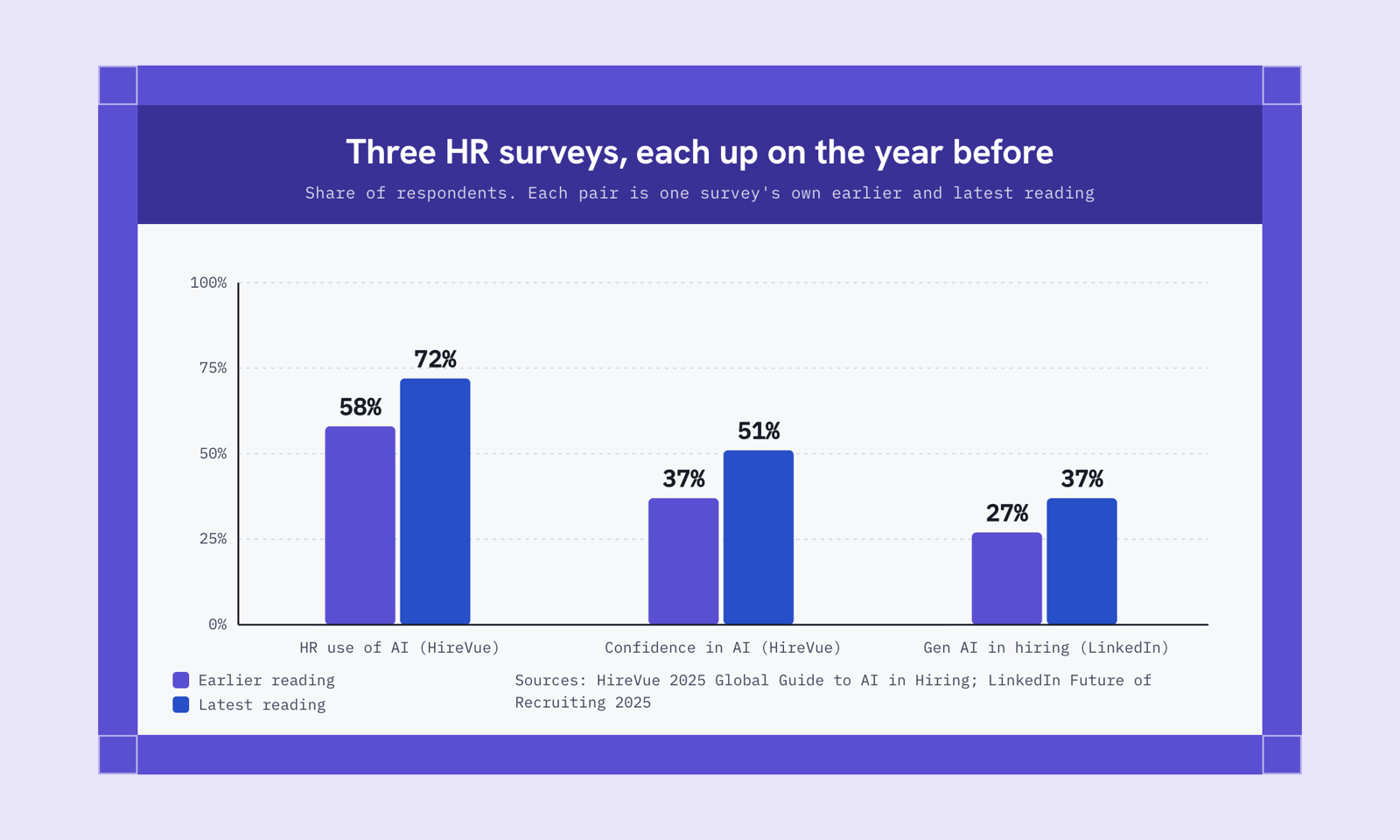
Each survey shows more AI use or more confidence than its earlier reading, but the three measure different things.
What share of companies use AI resume screening?
No source here gives one market-wide share. Resume Builder surveyed 948 US business leaders in October 2024 and found that 51% of companies used AI in hiring. Among those that did, 82% used it for resume review, 64% for reviewing candidate assessments and 40% for candidate chatbots. SHRM's figure for AI in talent acquisition as a whole is 27% of organizations. The two surveys use different bases, since Resume Builder asked managers and above at companies of more than 21 employees, so the figures are not added or multiplied.
Does AI help HR, and is anyone measuring it?
HR professionals say it does. SHRM's research reports that 87% see improved efficiency and 75% improved work quality, and HireVue's report has 63% of HR leaders reporting greater productivity. All of these are self-reports. SHRM also found that 56% of HR functions do not formally measure the success of their AI investments and only 16% use ROI as a metric.
Manager skills lag as well. In a Gartner survey of 114 HR leaders in July and August 2025, only 8% believed their managers have the skills to use AI effectively, and only 14% of organizations had given managers support on bringing generative AI into daily tasks.
What do candidates and employees think of AI in HR?
Candidates are warier than HR teams. In Pew's survey of 11,004 US adults, fielded in December 2022, 66% said they would not want to apply for a job where AI helps make the hiring decision and 32% said they would. Gartner reported in July 2025 that 26% of job candidates trust AI to evaluate them fairly.
One field experiment points the other way for interviews. Brian Jabarian and Luca Henkel assigned about 70,000 applicants at a Philippine recruitment firm to a human recruiter, an AI voice interviewer or a choice between them. When offered the choice, 78% chose the AI recruiter, and AI-led interviews raised job offers by 12%, job starts by 18% and 30-day retention by 17%. Humans made the hiring decision. It is a working paper on one firm hiring customer service staff, so it shows what happened there.
Where does AI fit on the people side of HR?
Most of these numbers are about hiring, yet people teams also hold conversations that never reach a dashboard: a 30-day check-in with a new hire, a question about engagement, a leaver's last word. Tracy AI Interviewer runs them from a brief. Describe what you want to learn, edit the questions Tracy drafts or bring your own, and send one link. Each person talks on video when ready, after hearing who Tracy is, what happens next and that the session is recorded. A vague answer gets a kind, sharper question. What comes back is what each person said to each question, with the recording and transcript, and the decision stays with a person, since Tracy does not score or rank anyone.
Take a 30-day check-in with invented data. A new hire credits a buddy for a first project, Tracy asks what more they would like from that buddy, and a later answer shows they do not know who approves purchase requests. Each point is timestamped.
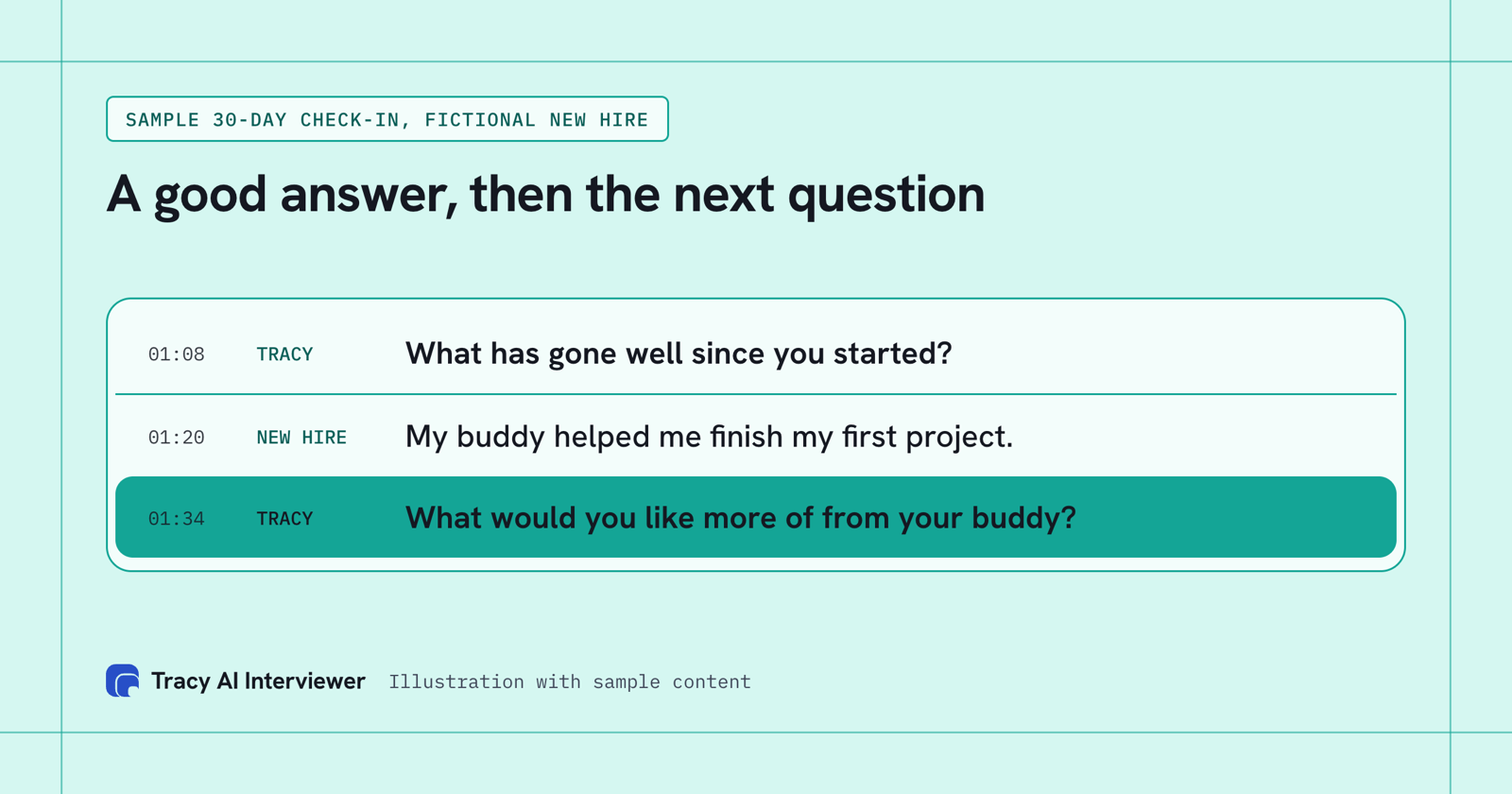
A check-in answer that goes well still gets a next question, so the people team learns what would help.
Which path fits you?
- Running conversations with your own people: AI interviews for people teams.
- Checking in on new hires: 30-60-90 day check-in questions.
- Learning from leavers: how to conduct an exit interview.
- Choosing tools: AI tools for HR compared.
- Checking the rules: AI interview rules.
See the people teams use case for the whole route from link to report.
Common questions
How many HR teams use AI?
What share of companies use AI resume screening?
What are the main uses of AI in HR?
How big is the AI in HR market?
Is AI in HR improving results?
Run one check-in and read the answers
Create a 30-day check-in, send the link and read what each new hire says in their own words. The first 3 results are free.
Try it free (opens in a new tab) Book a demo (opens in a new tab)
Your first 3 results are free. No card needed.
Sources
- SHRM: AI in HR 2026, From Hype to Measured, Human-Centered Impact, retrieved 23 Nov 2026.
- SHRM: The State of AI in HR in 2026, 5 Critical Insights for CHROs, retrieved 23 Nov 2026.
- HireVue: 2025 Global Guide to AI in Hiring press release, retrieved 23 Nov 2026.
- LinkedIn: The Future of Recruiting 2025, retrieved 18 Nov 2026.
- Resume Builder: 7 in 10 companies will use AI in the hiring process in 2025, retrieved 18 Nov 2026.
- Gartner: Only 8% of HR leaders believe their managers have the skills to use AI, retrieved 19 Nov 2026.
- Gartner: Just 26% of job applicants trust AI will fairly evaluate them, retrieved 19 Nov 2026.
- Pew Research Center: AI in Hiring and Evaluating Workers, retrieved 18 Nov 2026.
- Jabarian and Henkel: Voice AI in Firms, a natural field experiment on automated job interviews, retrieved 18 Nov 2026.
- Grand View Research: Artificial Intelligence in HR Market, retrieved 18 Nov 2026.