In short
AI recruitment pays off when it asks and reports and a person decides. It backfires when a tool ranks or rejects applicants by itself.
Tracy AI Interviewer interviews each applicant on video, starting on click at any hour, follows up in their own field, and gives the reviewer what each person said, question by question, with the transcript behind it.
In a field experiment on 70,884 applications, AI-led interviews produced 12% more job offers than human-led ones, and 5% of applicants quit because they would not speak to an AI.
Next step: run one role and read the follow-ups yourself.
The pros and cons of AI recruitment depend on the job you hand the AI. Given the first conversation, it can hear from every applicant and write down what each one said. Given the ranking, it can copy bias, push out people who could do the work, and lose candidates who were never told it was there. This guide sets the two sides next to each other, with the evidence for each, for a talent lead who gets more applicants than anyone can read.
If your funnel looks like the one in high-volume recruitment, the first conversation is where AI helps most. It is the job Tracy AI Interviewer is built for: it runs the first-round interview on video, asks follow-ups in the applicant's own field, and leaves the decision to a person.
What are the pros of AI recruitment?
The pros are real when the AI does the asking and the writing-up.
- More applicants get a conversation. A link that starts on click, at any hour, needs no calendar and no recruiter on the call, so the person who finds the role at 10 p.m. is interviewed that night.
- Every applicant meets the same first questions, so a reviewer reads comparable answers instead of CVs formatted to look alike.
- Follow-ups reach the detail, because Tracy listens, waits for the end of the thought and asks for what is missing, so a short answer about a project gets a question about the first problem the person hit.
- The reviewer reads instead of retyping. Each result carries a recording of both sides, a timestamped transcript and a written summary of what the person said to each question.
The strongest outside evidence is a field experiment by Brian Jabarian (University of Chicago Booth) and Luca Henkel (Erasmus University Rotterdam). In a working paper dated 18 August 2025, they randomised 70,884 applications for entry-level customer service jobs in the Philippines to a human recruiter, an AI voice interviewer or the applicant's own choice. AI-led interviews produced 12% more job offers, 18% more job starts and 17% more 30-day retention, and human recruiters still made the hiring decisions. Offered the choice, 78% of applicants picked the AI interviewer. It is one study of one kind of job in one country, and the interviewer was a voice agent, so it shows that the first conversation can be automated without hurting outcomes. Other roles may see a different result.
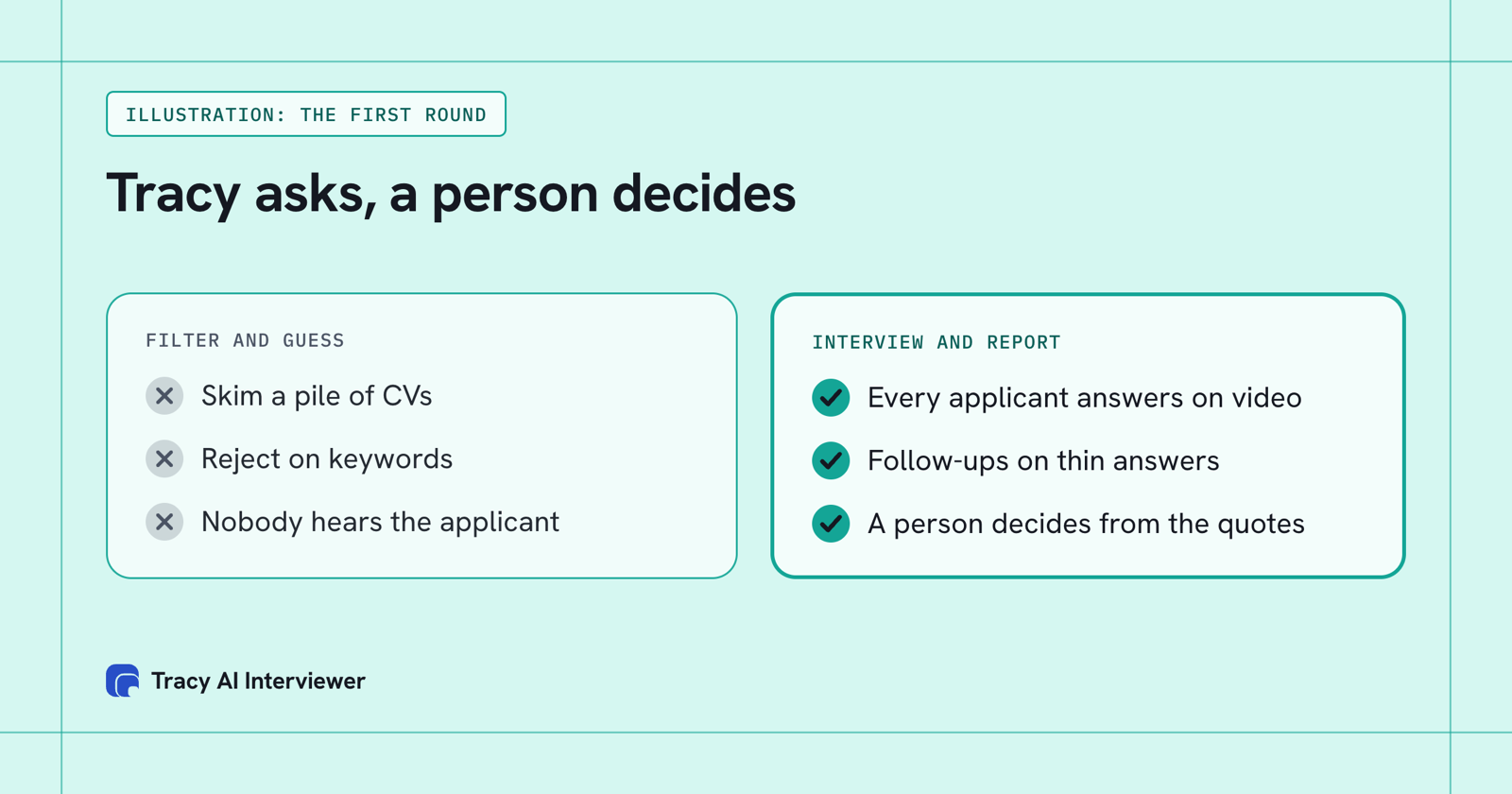
The first round can ask and report, and a person still decides who moves forward.
What are the cons of AI recruitment?
The cons come from where the AI sits in the process and how applicants meet it.
- It can inherit bias when it ranks. The next section covers the evidence.
- It can filter out people who could do the job. See the section after that.
- Some applicants will not talk to it. In the same field experiment, 5% of applicants ended the interview because they were unwilling to speak to an AI, and the voice agent had technical difficulties in 7% of cases.
- Many candidates do not trust it. A Gartner release of 31 July 2025 reports that 26% of job candidates trust AI to evaluate them fairly.
- The person checking the AI can lean on it. In a 2025 experiment with 528 people and 1,526 resume screening scenarios, researchers at the University of Washington and Indiana University found that people who saw biased AI recommendations favoured the AI's preferred group up to 90% of the time, while people without AI picked candidates at equal rates. A ranked list can anchor the very person meant to check it.
- The rules are tightening. The EU AI Act lists AI systems used for the recruitment or selection of people as high risk (Annex III, point 4(a)). For hiring in the US, start with the EEOC's AI hiring guidance. This is general information, not legal advice.
Does AI reduce hiring bias?
Not by itself. The evidence shows AI screening can reproduce bias, and a person reading its ranking can follow it.
Wilson and Caliskan at the University of Washington audited three text embedding models used to retrieve resumes. Across more than 500 public resumes, 500 job descriptions and 120 names, the models favoured White-associated names in 85.1% of cases and female-associated names in 11.1%. The paper does not state a region, so read it as an audit of those models, not of every tool.
The step those tests probe is the ranking. Tracy does not rank, weigh or reject anyone. It reports what each person said, with the evidence behind it, and the reviewer decides, which leaves the judgement with someone who can be asked to explain it. The reviewer can still be biased, so use the same questions for every applicant for a role, and have a second person read the quotes on close calls.
Does AI miss good candidates?
Yes, when it filters on exact criteria. In Harvard Business School and Accenture's 2021 study Hidden Workers: Untapped Talent, 88% of employers agreed that qualified high-skills candidates are vetted out of the process because they do not match the exact criteria in the job description. The figure was 94% for middle-skills workers. The survey covered 2,275 executives in the US, UK and Germany, and more than 90% of the employers used their recruitment management system to filter or rank candidates at the start.
A conversation changes what the first step can catch. Someone with a gap on their CV or an unusual route can still answer a question about their own work, and the reviewer reads the answer. AI vs traditional recruitment compares the two first steps in more detail.
What a first-round AI interview gives the reviewer
This is the report for one applicant. Each field states what the person said, quotes their words with the time, and links back to the question it came from. The panel on the right shows integrity signals. They point to moments worth a look in the recording and are not a verdict.
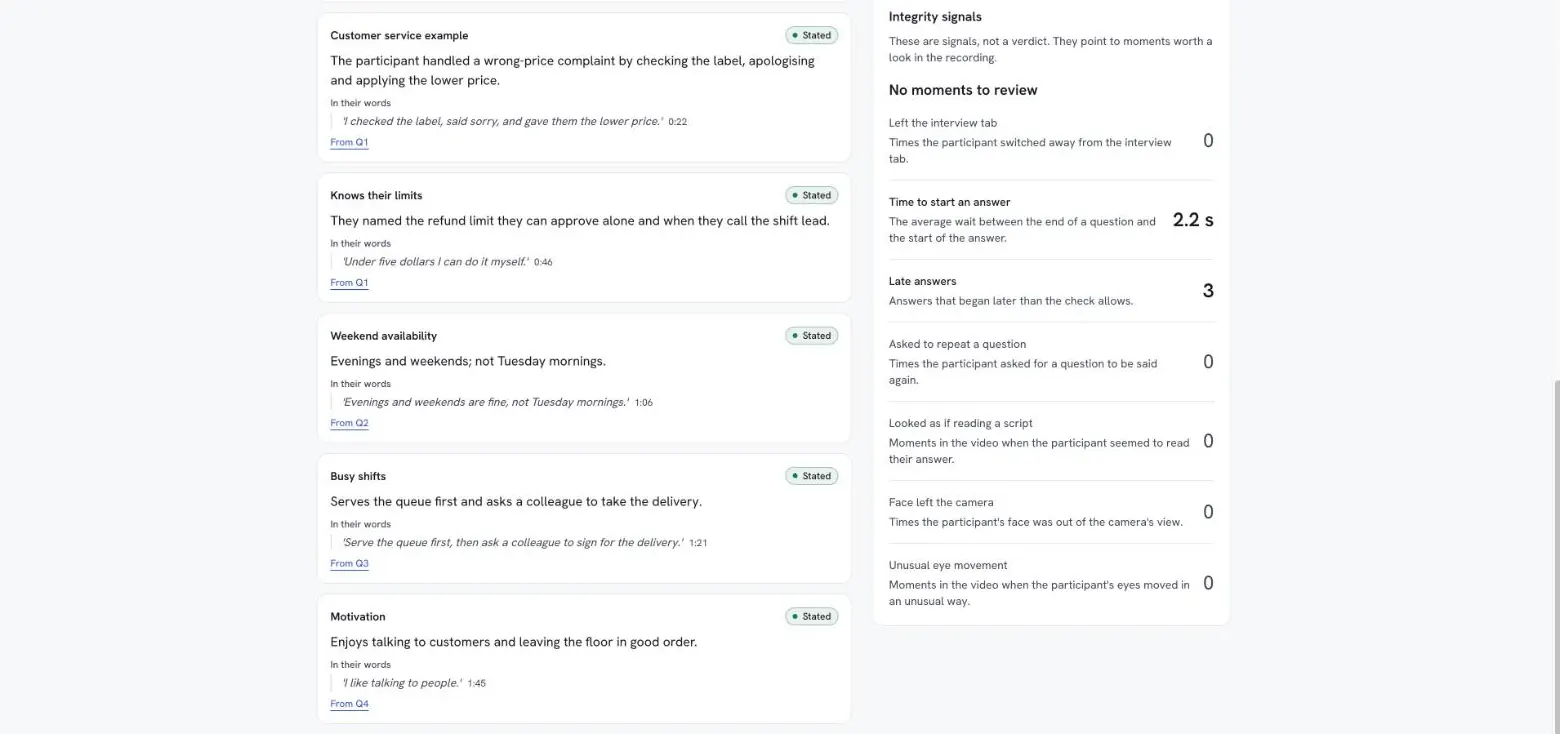
Each field carries the person's own words, the time and the question they came from.
In a sample first-round interview, the applicant says, "We cut onboarding from five steps to two." Tracy asks, "What did you measure afterwards?" and the report keeps the answer with its time, 02:30, under the field Project outcome. A second field, cross-team work, quotes the answer at 05:00: "The hard part was persuading legal to drop a step." The hiring team reads the same first-round answers from every applicant before it chooses who gets a live round. The sample uses invented data.
Video interviews also run integrity signals unless they are turned off. Leaving full screen and the face leaving the frame are shown to the reviewer next to the recording. Applicants are told the conversation is recorded, a signal is never proof, and a person decides.
How to get the pros without the cons
- Give the AI the conversation, not the verdict. Pick tools that report what people said and leave ranking and rejection to a person.
- Tell applicants what is recorded and who reads it.
- Ask every applicant for a role the same questions, and read quotes rather than a ranked list.
- Offer another route to applicants who will not speak to an AI. In the field experiment, 5% stopped for that reason.
- Check the rules in your market before you roll out. The EEOC guidance page is the US starting point.
If your team reads fewer applicants than it receives, add the first interview before you add a filter.
Which path fits you?
- Screening many applicants for one role: hiring at volume.
- Who scores in an AI interview: AI interview scoring.
- Reading what each person said: AI interview summaries.
Common questions
What are the pros and cons of AI recruitment?
What are the disadvantages of using AI in recruitment?
Does AI reduce hiring bias?
Does AI miss good candidates?
Do candidates accept AI interviews?
Interview every applicant, then compare answers
Tracy interviews each applicant on video, at any hour, and follows up on thin answers. Your first 3 results are free.
Try it free (opens in a new tab) Book a demo (opens in a new tab)
Your first 3 results are free. No card needed.
Sources
- Jabarian and Henkel: Voice AI in Firms, a natural field experiment on automated job interviews (working paper, 18 Aug 2025), retrieved 23 Nov 2026.
- Harvard Business School and Accenture: Hidden Workers, Untapped Talent (2021), retrieved 23 Nov 2026.
- Wilson and Caliskan: Gender, Race, and Intersectional Bias in Resume Screening via Language Model Retrieval, retrieved 18 Nov 2026.
- Wilson, Sim, Gueorguieva, Caliskan: No Thoughts Just AI, biased LLM hiring recommendations alter human decision making, retrieved 18 Nov 2026.
- Gartner: Survey shows just 26% of job applicants trust AI will fairly evaluate them (31 Jul 2025), retrieved 19 Nov 2026.
- Regulation (EU) 2024/1689, Annex III point 4(a), retrieved 23 Nov 2026.
- Tracy AI Interviewer: Pricing, retrieved 11 Nov 2026.