In short
Recruitment automation hands repeatable hiring tasks to software: posting, sorting, messaging, scheduling and stage moves. Many teams still run the first conversation with each applicant by hand.
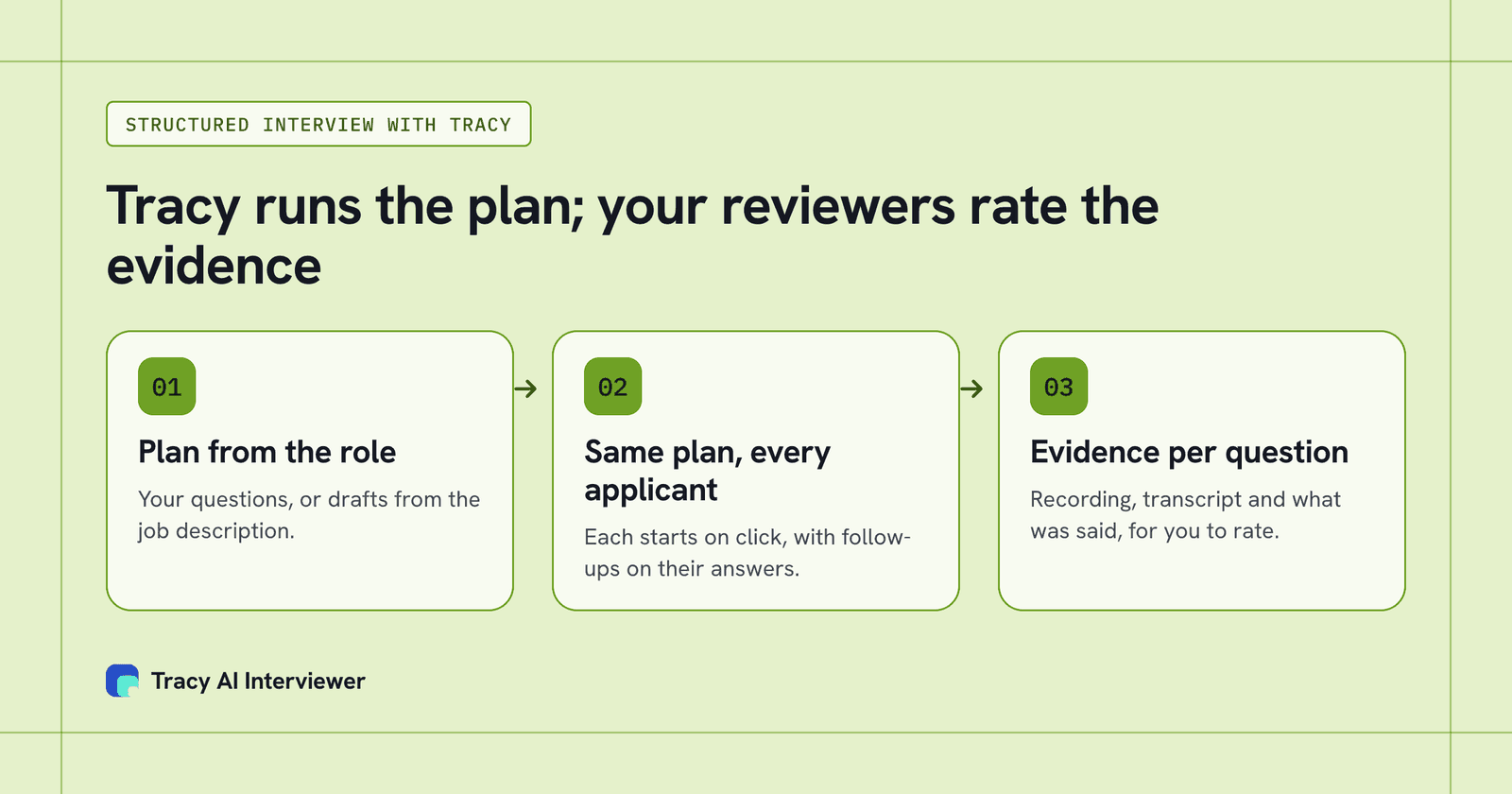
Tracy AI Interviewer automates that step. Applicants start from a link, Tracy asks in their own field and follows up on each answer, and your reviewer gets a recording, a transcript and what they said to each question.
At one customer, average time to hire fell from 44 days to 7, and Tracy covered the workload of 53 full-time recruiters in a month. Automate the first round for one role and keep the decision with your team.
What is recruitment automation?
Recruitment automation is software doing the repeatable steps of hiring without a person starting each one: publishing a job, sorting applications, sending messages, booking calls and moving candidates between stages. Many teams automate the work around the interview and still hold the first conversation by hand.
Resume Builder's survey of 948 US business leaders (October 2024, run by Pollfish) reported 82% of companies using AI to review resumes, 64% to review assessments and 40% for candidate chatbots.
What can be automated in recruiting?
Six hiring steps, what software can take over and what a person keeps.
| Step | Software does | A person keeps |
|---|---|---|
| Job posting | Publishes the role to boards and your careers page | Writes the role and the must-haves |
| Sorting | Reads CVs and applies your filters | Sets the filters and checks edge cases |
| Messages | Sends confirmations, reminders and updates | Writes the templates and answers replies |
| Scheduling | Offers open slots in a booking link | Runs the live rounds |
| First interview | Tracy interviews each applicant and reports what was said | Reads the reports and decides |
| Offer | Sends documents for signature | Makes the offer and negotiates |
What are the benefits of recruitment automation?
- Applicants hear back sooner, because nobody has to start each message by hand.
- Every applicant goes through the same steps in the same order.
- Recruiters spend their hours on conversations and decisions instead of moving records.
Gem's 2025 benchmarks, drawn from its customer data, put the average recruiting team at 31 recruiters in 2022 and 24 in 2024. In Greenhouse's 2025 AI in Hiring Report, 50% of US recruiters and hiring managers said AI has improved hiring overall, mainly by saving time on screening and scheduling. For the scheduling step, see interview scheduling.
Where does recruitment automation fall short?
A tool that sorts CVs works from documents. The first conversation adds what the applicant said to each question, in their own words, with the recording and transcript behind it.
Pew Research Center's survey of 11,004 US adults, fielded in December 2022, found 71% opposed employers using AI to make final hiring decisions. So a person stays on the decision: Tracy reports what was said, with the evidence, and your reviewer decides.
Where should you start with recruitment automation?
Start with the step that takes the most hours for the least judgement, and automate that one before the rest. Say a role draws 200 applications and each gets a 20-minute first call: that is about 67 hours of calls before anyone is shortlisted. In that example the first conversation is where the hours sit, while messages and scheduling can be automated without anyone sitting in a call.
Pick one open role, change one step, and compare the hours your recruiters spent on it with a role handled the old way. If the hours drop and your reviewers still trust what they read, repeat it on the next role. Interview scheduling covers the booking step, if that is where your hours go.
What does an automated first round look like?
Put one link in your confirmation message. The applicant opens it in the browser at a time that suits them, and nobody from your team joins. If the connection drops, they can rejoin within 10 minutes. Tracy asks in the applicant's own field and builds each next question from the answer before it. Before it starts, the join screen notes that the call is recorded and transcribed, and a person on your team reads the result before anyone moves on.
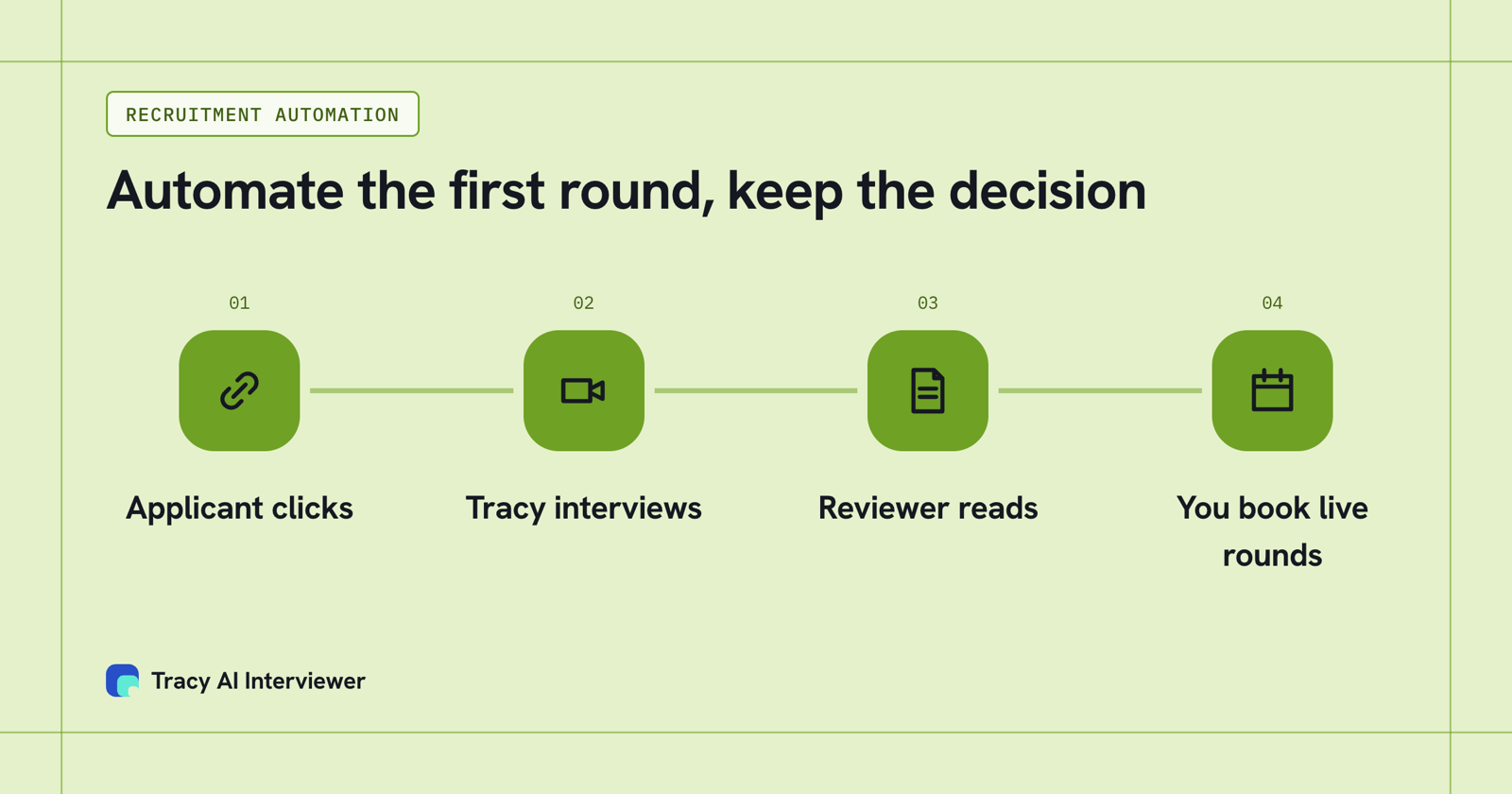
The first round runs on its own, and a person reads the result before booking live rounds.
What does the reviewer receive from an automated interview?
Every interview leaves your reviewer three things: the recording of both sides, a timestamped transcript and a per-question account of what the applicant said. Here is an excerpt for a finance analyst role, invented for this page:
Question 1. How do you check a forecast before sharing it?
What they said. Compares to last quarter's actuals, checks that totals tie across tabs and asks one colleague to review.
Quote at 02:40. "I tie the totals across tabs and ask a colleague to look."
Follow-up. What error did that catch most recently?
Field, forecast checks. Actuals comparison, tie out, peer review (evidence: question 1, 02:40).
The reviewer reads the same fields for every applicant, so comparing 200 of them means reading notes instead of sitting through calls.
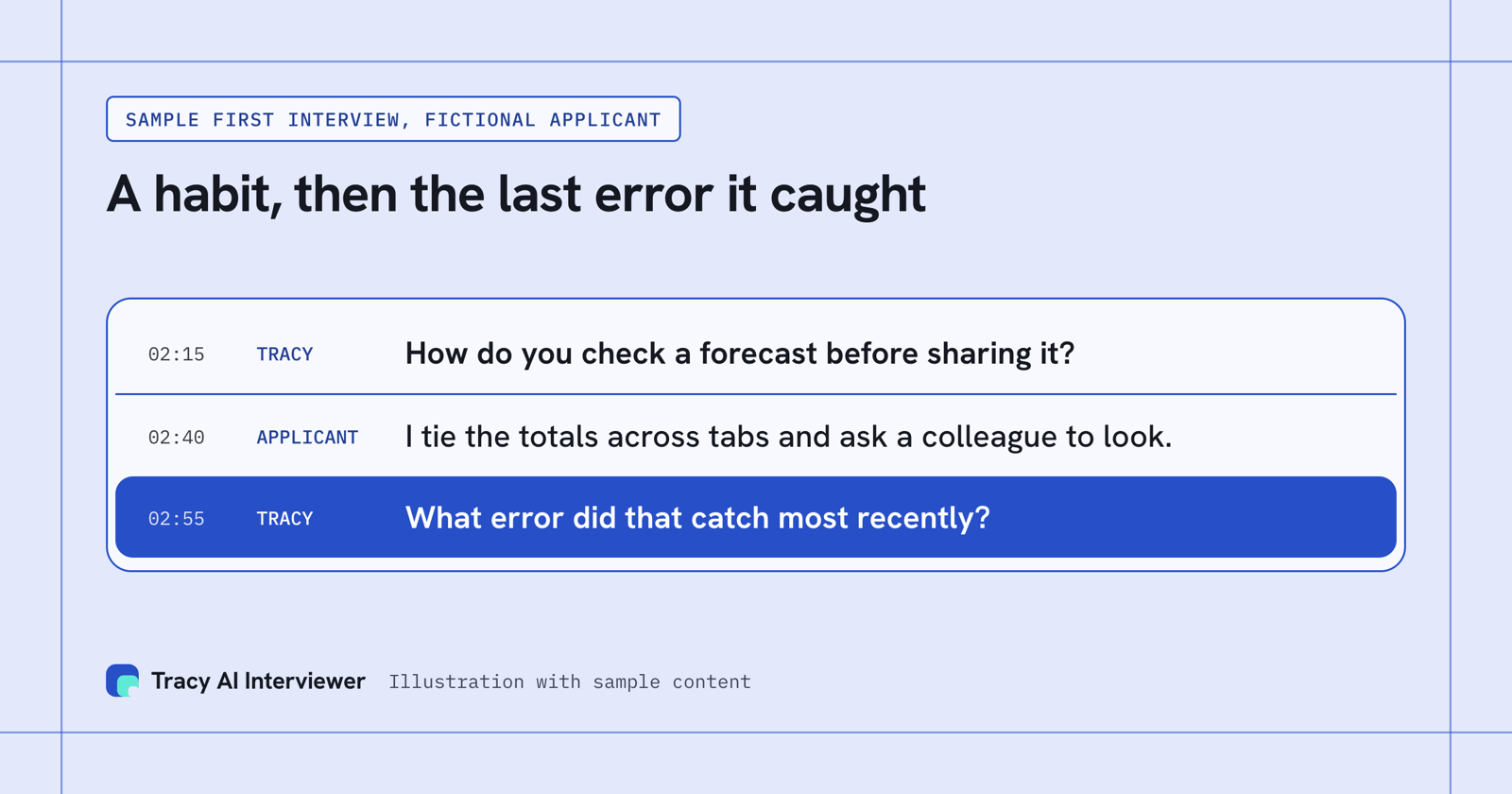
One follow-up asks for the most recent error the check caught, a specific case instead of a stated habit.
How does Tracy fit a recruiting stack?
Tracy works beside your ATS and can write results back to it. A developer can have your own system request an interview through the API, ChatGPT and Claude can set up interviews and read results over MCP, and Zapier, the Workable and Breezy HR connectors and the Greenhouse, Ashby and Lever guides are on the connect page. See recruiting MCP for the chat route.
Pricing follows results: $1 per credit, one credit per started 20 minutes, and the first 3 results are free. Applying the first round to one role takes a link, a list of questions or a job description, and your own reviewers. For the whole process, mass hiring process and high-volume recruitment go step by step.
What mistakes undermine recruitment automation?
- Automating a broken process, which only speeds up the damage.
- Letting software reject applicants with no human review.
- Adding tools that do not share data, so recruiters re-enter records by hand.
- Skipping candidate notice about recording and automated steps.
- Automating every step except the first conversation.
Which path fits you
- Booking the live rounds: interview scheduling.
- Hiring many people for similar roles: high-volume recruitment and hiring at volume.
- Adding an AI agent to a recruiting workflow: an AI agent for recruiting.
- Choosing tools stage by stage: the best hiring tools.
Common questions
What is recruitment automation?
What can be automated in recruiting?
What are the benefits?
Does recruitment automation replace recruiters?
Automate the first conversation too
Start with one role: send the link, read what each applicant said to each question, and decide. First 3 results free.
Try it free (opens in a new tab) Book a demo (opens in a new tab)
Your first 3 results are free. No card needed.
Sources
- Resume Builder, 7 in 10 companies will use AI in the hiring process in 2025 (Oct 2024), retrieved 18 Nov 2026.
- Gem, 2025 Recruiting Benchmarks Report, retrieved 18 Nov 2026.
- Greenhouse, 2025 AI in Hiring Report (19 Nov 2025), retrieved 18 Nov 2026.
- Pew Research Center, AI in Hiring and Evaluating Workers (20 Apr 2023), retrieved 18 Nov 2026.
- Tracy AI Interviewer: Connect, retrieved 11 Nov 2026.
- Tracy AI Interviewer: Pricing, retrieved 11 Nov 2026.