In short
An AI recruiter is software that does a recruiting task a recruiter would otherwise do, from sourcing and outreach to screening and interviewing. Indeed describes its Talent Scout as an AI-powered virtual recruiter that helps source and engage candidates.
Tracy AI Interviewer covers the interview step: it follows up in the applicant's own field and gives your team a written summary of what each person said, with the words and timestamps behind it. A person makes every hiring decision.
In a randomised field experiment with 70,884 applications, AI-led interviews produced 12% more job offers than human-led ones, with human recruiters still deciding.
Next step: run one open role through Tracy and read the summaries.
An AI recruiter is software that carries out part of the recruiting process, and the name covers very different products. Some find and message candidates, some screen applications, some schedule, and some interview. This guide explains what each does, what the evidence says about AI-led interviews, and where a person has to decide. For product comparisons, see AI recruiting assistants compared.
What is an AI recruiter?
An AI recruiter is software that does a recruiting task on its own and hands the result to a person. Vendors also say AI recruiting assistant and AI-based recruiter. In practice "assistant" usually means software that helps a recruiter with a task, and "recruiter" means software that does the task itself, but vendors use the words loosely.
On Indeed, the term points to Talent Scout, announced on 10 September 2025 with other hiring products. Indeed's release says it "acts as an AI-powered virtual recruiter that helps source and engage candidates." That is the sourcing end of the work. Other tools sit at the screening, scheduling or interview end, so the first question for a buyer is which stage needs the help.
Which stage does an AI recruiter take on?
Stages of recruiting and what software can take on at each; the last column says who makes the decision.
| Stage | What the software does | Who decides |
|---|---|---|
| Sourcing | Finds and messages candidates, as Indeed describes Talent Scout | Recruiter |
| Screening | Reads applications or profiles and sorts them for review | Recruiter |
| Interviewing | Tracy runs a video interview with follow-ups and reports what was said | A person reads the report and decides |
| Offer and hire | Stays with people | The hiring team |
What does an AI recruiter do well?
The strongest public evidence is for AI-led interviews. Jabarian and Henkel (University of Chicago Booth and Erasmus University Rotterdam, working paper, 18 August 2025) ran a natural field experiment with 70,884 applications to 48 job postings for entry-level customer service roles in the Philippines, for 43 client accounts of one firm. Applicants were randomly assigned to a human recruiter, an AI voice agent, or a choice between them.
AI-led interviews raised job offers by 12%, job starts by 18% and 30-day retention by 17% among all applicants, with human recruiters still making the hiring decision. When applicants could choose, 78% picked the AI recruiter. The experiment covers one firm, one kind of role and a voice agent, so it shows what is possible for high-volume first rounds, not a result for every search.
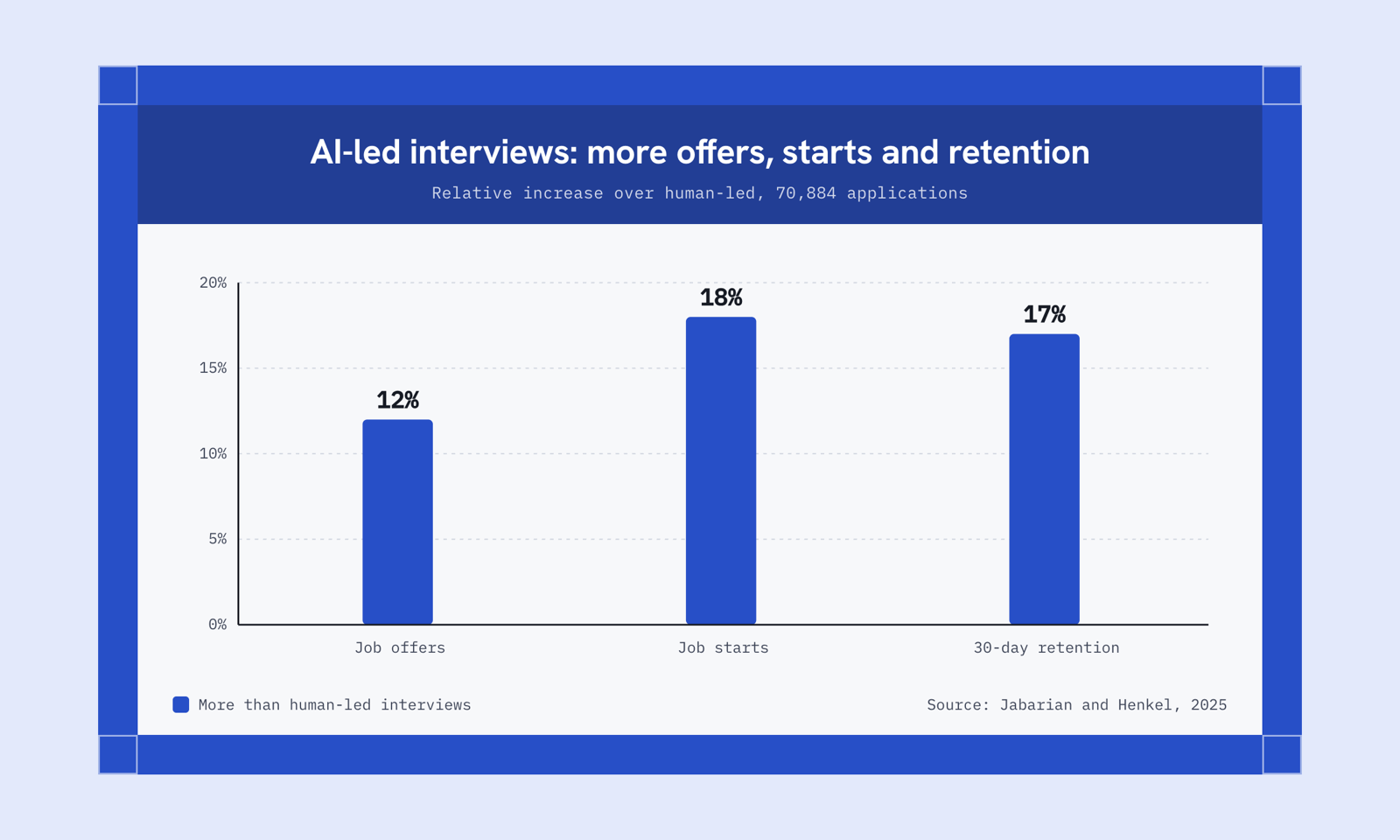
In one randomised experiment, AI-led interviews beat human-led ones on offers, starts and 30-day retention.
Where does an AI recruiter stop?
It stops at the decision. The same experiment left the offer to human recruiters, and the EU AI Act lists AI systems intended to be used for the recruitment or selection of natural persons among its high-risk uses in Annex III. A recruiter who relies on software for a judgement still owns the judgement. For the U.S. side, see EEOC guidance on AI in hiring.
The interview has limits of its own. In the AI condition, 5% of applicants ended the interview because they were unwilling to speak to an AI, and in 7% of cases the voice agent had technical difficulties. A hiring team should plan a way back to a person for those applicants.
Tracy AI Interviewer reports what each person said, with the evidence behind it, and does not score, rank or reject anyone. Candidates are told before the interview begins, a person reviews the result, and no decision is automated. Where video interviews run integrity signals, they go to the reviewer as signals with evidence, never as proof.
Which AI recruiter fits which job?
Match the tool to the stage that is costing you time.
- Finding people who have not applied: a sourcing agent such as Indeed's Talent Scout.
- Narrowing a large inbox: AI candidate screening tools, with a person reviewing the sorted list.
- Talking to every applicant in the first round: an AI interviewer such as Tracy, so a recruiter reads summaries instead of running phone calls. See AI phone screening for recruiting.
- Weighing the whole category: AI recruiting software compared.
How does Tracy work as an AI recruiter?
Tracy is an AI interviewer, so it takes the first conversation off a recruiter's calendar and leaves sourcing and the offer with your team. You write the role brief or bring your own questions, share one link, and each applicant starts when ready, at any hour, in the browser. Tracy listens, waits for the end of the thought and asks for the missing detail in the applicant's own field. Your recruiters get the recording and a timestamped transcript, plus a written summary of what each person said to each question. Results can be written back to your ATS, and the API and MCP connections let your own tools start interviews.
A sample phone-screen note, with invented data, shows the shape: an applicant says they want more ownership and a team that ships weekly, Tracy asks what ownership means to them, and the recruiter reads the answer with its time. Candidates rate Tracy 92 on NPS. To judge the method, run one open role through it and read the summaries next to your own phone-screen notes.
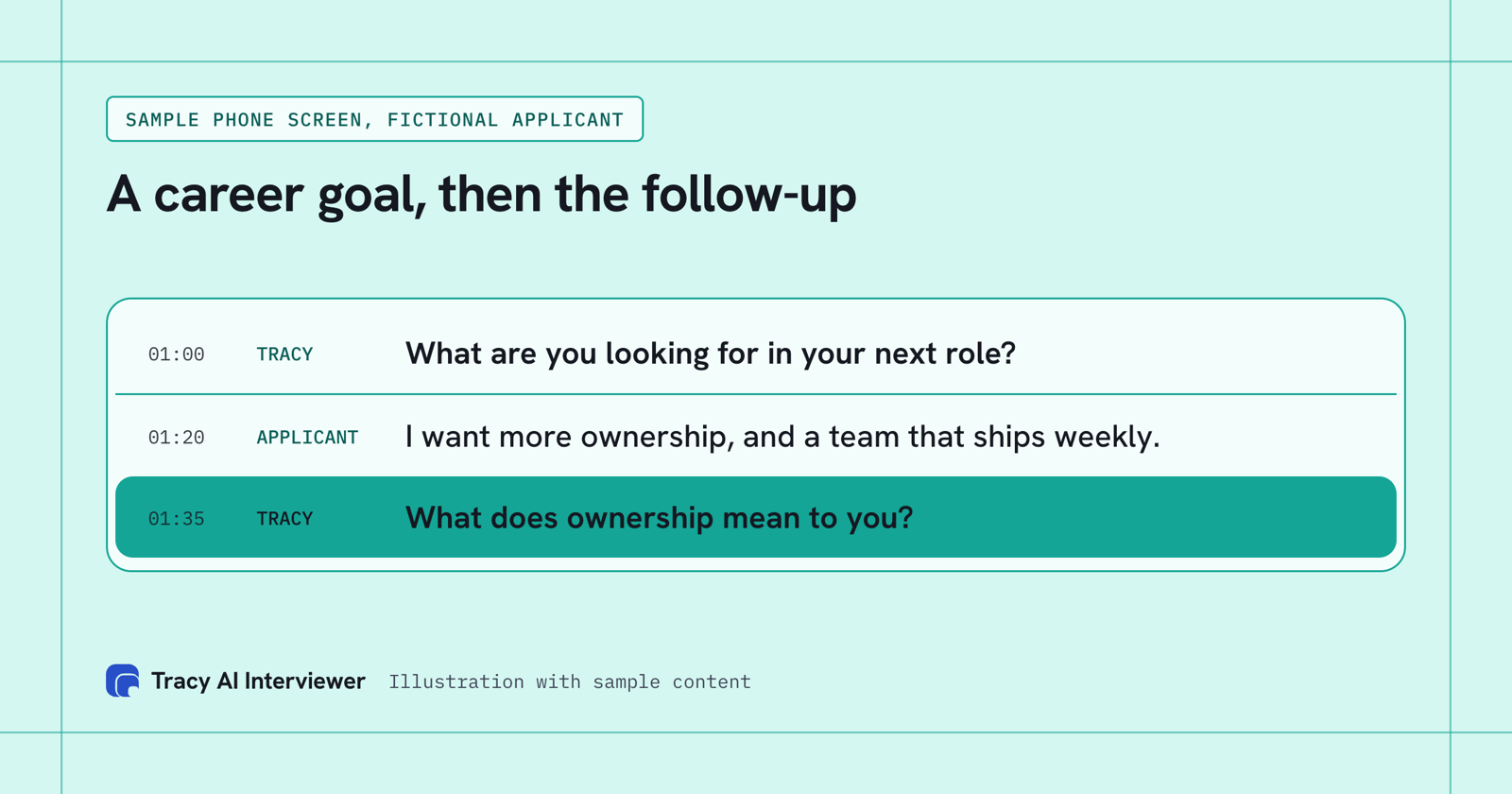
A short answer about a career goal gets a follow-up that makes it usable.
Which path fits you?
- Comparing humans and software: AI vs traditional recruitment.
- Understanding the first interview: what a first-round interview covers.
- Judging how candidates react: candidate experience of AI interviews.
- Seeing the conversational approach: conversational AI for hiring.
Volume hiring with Tracy follows a role from the first link to the report.
Common questions
What is an AI recruiting assistant?
What is an AI-based recruiter?
What is AI recruiter on Indeed?
Do AI recruiters make the hiring decision?
Do applicants accept AI interviews?
See the method in one interview
Create one interview for a role you are hiring, run it with a few applicants, and read the summaries. The first 3 results are free.
Try it free (opens in a new tab) Book a demo (opens in a new tab)
Your first 3 results are free. No card needed.
Sources
- Indeed: new suite of hiring products, 10 September 2025, retrieved 23 Nov 2026.
- Jabarian and Henkel: Voice AI in Firms, working paper, 18 August 2025, retrieved 18 Nov 2026.
- Regulation (EU) 2024/1689, Annex III point 4(a), retrieved 18 Nov 2026.