In short
An AI phone interview is an automated first-round screen: software asks each applicant your standard questions out loud and writes up what was said, so no recruiter sits on the line.
Tracy AI Interviewer runs that step on video from a link, with no number to dial. It follows up on each answer, and your reviewer gets a recording, a transcript and what each person said to each question.
In a field experiment on 70,884 applications, AI-led voice interviews produced 12% more job offers than human-led ones, and human recruiters still decided. Try it on one role before you widen it.
What is an AI phone interview?
An AI phone interview is an automated first-round screen in which software asks an applicant a set of questions out loud, listens to the answers and writes up what was said. It stands in for the qualifying call a recruiter makes before anyone meets the team. Vendors also call it AI phone screening, an AI voice interview or an automated phone screen.
Ashby's customer data, covering January 2021 to March 2026, shows recruiter screens passing about 35% of candidates while handling the highest volume of any early stage. A team that books and runs each of those calls by hand spends its week on the step that sorts the most people.
Tracy AI Interviewer runs this step as a two-way video interview that the applicant opens from a link in a browser. There is no number to dial and no slot to book. The guide to high-volume recruitment covers the steps around it.
How does an AI phone screen work?
Most tools follow the same five steps:
- The applicant gets an invitation, either a call placed to their number or a link they open.
- The software asks the first question and the applicant answers aloud.
- It decides whether the answer is complete and asks a follow-up if it is not.
- When the interview ends, the tool writes a report for the reviewer.
- A person reads the report and decides who gets a live conversation.
The difference between tools sits in steps 1 and 3. A tool that dials out reaches people on their phones, and a tool that sends a link lets them choose the moment. A tool that moves down a fixed list collects answers, while a tool that builds the next question from the answer just given collects the detail a recruiter would have asked for. That second kind is what Tracy does: it listens, waits for the end of the thought and asks for the missing piece in the applicant's own field.
For the call itself, what a phone screen is sets out its purpose, and the phone screening script gives the questions recruiters ask by hand.
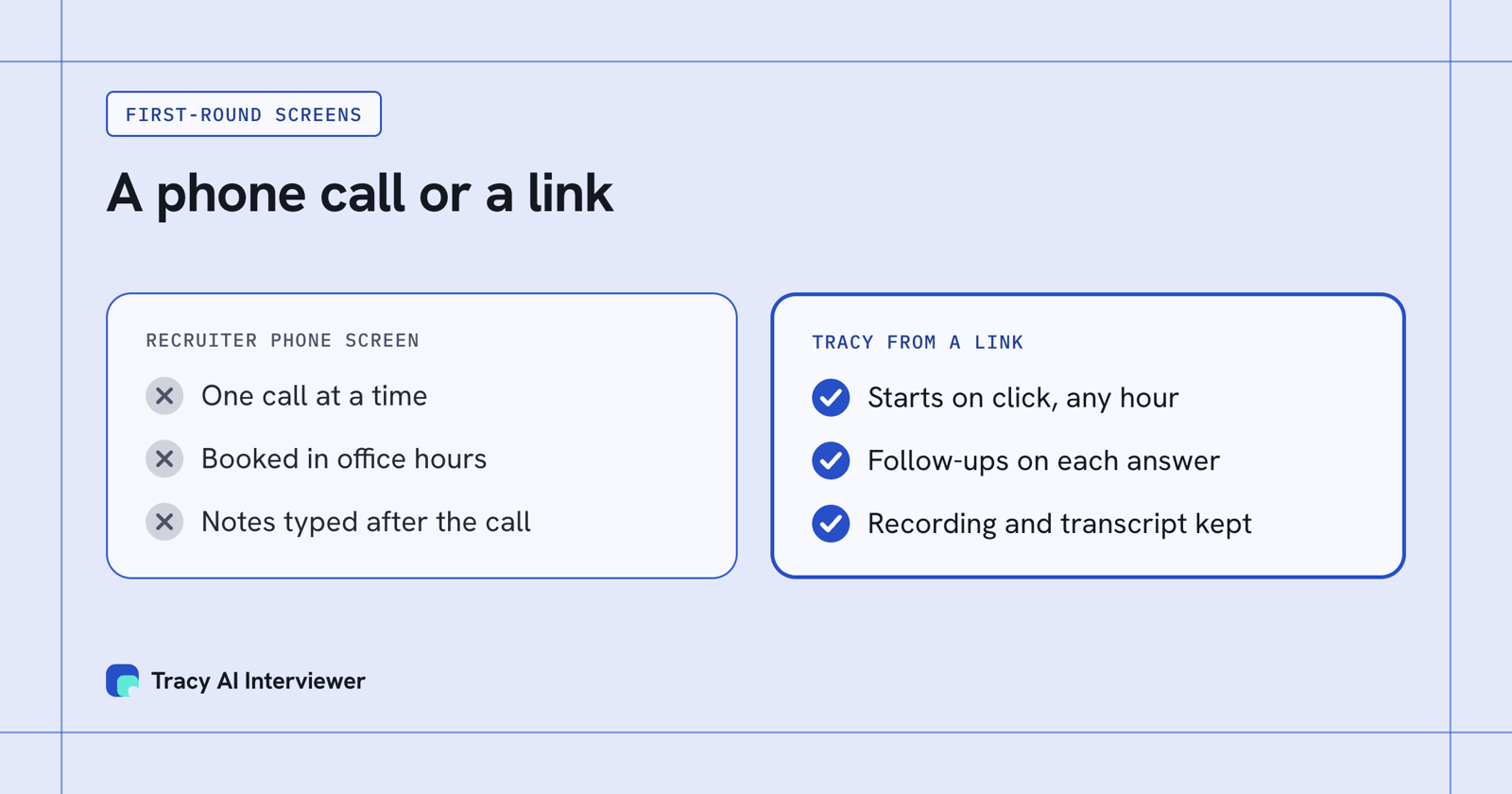
A link replaces the booked call, and the interview leaves a recording and transcript instead of typed notes.
What does the evidence say about AI voice interviews?
The strongest public evidence comes from a field experiment by Jabarian and Henkel (University of Chicago Booth and Erasmus University Rotterdam, working paper, August 2025). It randomised 70,884 applications for entry-level customer service jobs at 43 client accounts in the Philippines to a human recruiter, an AI voice agent or the applicant's choice. AI-led interviews produced 12% more job offers, 18% more job starts and 17% more 30-day retention, and applicants rated their interview experience about the same. Of those who had an AI interviewer, 5% ended the interview because they did not want to speak to an AI, and in 7% of cases the voice agent had technical difficulties. Human recruiters still made the hiring decisions. The agent in that study is not Tracy, and the jobs were one kind of entry-level role in one country.
Candidate attitudes are less settled. In Greenhouse's 2026 candidate survey, 38% of US candidates said they had withdrawn from a hiring process because it included an AI interview, and 70% said no one had clearly told them in advance that AI would evaluate them. The notice and the human decision are covered below.
When does an AI phone screen fit, and when should a person call?
An AI screen fits when many people apply for similar roles, when applicants are spread across shifts or time zones, and when you want every applicant asked the same questions. A person should make the call when the first conversation is also the sales pitch, as for a senior hire, and for anyone who asks to speak with a person. Offer that route in the invitation.
A reasonable split for a first trial is one open role with plenty of applicants. Let the screen run for it, have a recruiter read the reports and compare the shortlist with the one a call would have produced. Mass hiring process walks through running a whole campaign this way.
What does the reviewer receive from the screen?
The reviewer gets three things for every applicant: a recording of both sides, a timestamped transcript and a written account of what the person said to each question. Here is an excerpt for a call-centre role, invented for this page:
Question 1. Tell me about a difficult call.
What they said. A caller was upset about a late delivery; the agent stayed calm, found the parcel location and gave a clear new date.
Quote at 01:30. "I stayed calm, found where the parcel was, and gave a new date."
Follow-up. What did you say to open the call?
Field, night shift availability. Yes, from 10 p.m. (evidence: question 2, 03:20).
The applicant's first answer was a summary of the call. The follow-up asked for the part a recruiter would have probed on a phone line, the opening words.
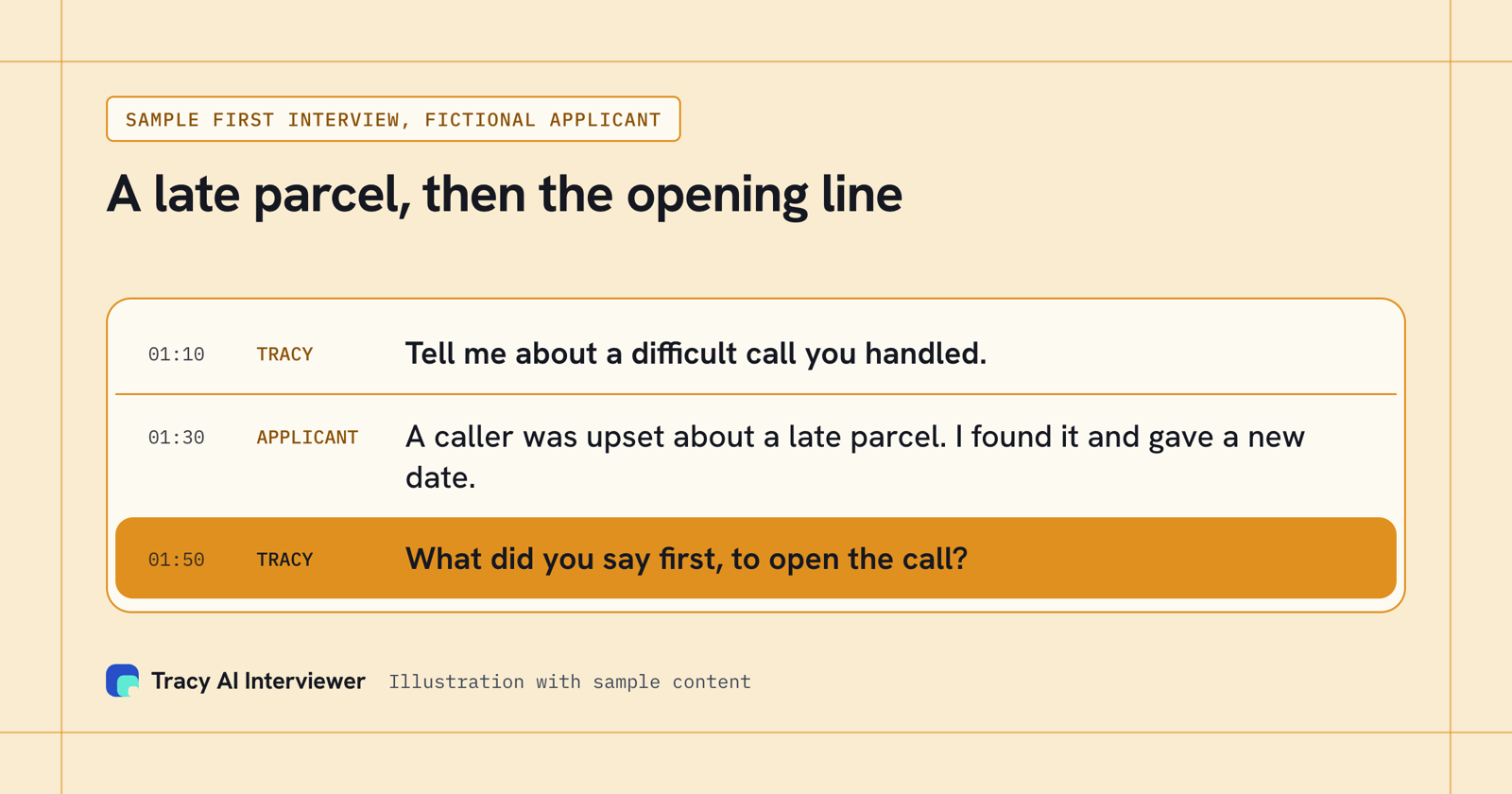
One follow-up turns a general story into the first line the applicant actually said.
What do applicants need to be told?
Tell them before the interview starts that it is run by AI, that it is recorded and transcribed, and that a person reads the result. Tracy's join screen says the conversation is recorded and transcribed, and your invitation can say the rest. Rules on calling and recording differ by country and state, so check them with your counsel before you place calls or store audio.
Video interviews on Tracy also show the reviewer signals such as leaving the full-screen window. They are for a person to look at, never proof of anything, and the decision stays with your team. The report states what was said, and choosing between applicants stays with your reviewer.
How does Tracy fit a phone-screening workflow?
Share the interview link wherever applicants already are: email, a careers page, or a WhatsApp message. Each interview is ready in under 10 seconds when the applicant clicks, and someone who drops out can rejoin within 10 minutes. Tracy writes results back to your ATS, and the API and MCP connections let your own system or Claude and ChatGPT set up interviews and read results. The connect page lists the tools.
Pricing follows results: $1 per credit, one credit per started 20 minutes, no seats, and the first 3 results are free. At one customer, average time to hire fell from 44 days to 7, and Tracy did the work of 53 full-time recruiters in one month. To compare other tools, see AI tools for interviewing candidates.
Which path fits you
- Writing the questions for the first call: phone screening script.
- Reaching applicants on messaging apps: WhatsApp recruiting.
- Running the whole round at scale: hiring at volume.
- Comparing how a conversational screen differs from a form: conversational AI for hiring.
Common questions
What is an AI phone interview?
Does AI phone screening replace recruiters?
Is an AI phone screen the same as a one-way video interview?
Do applicants have to be told it is AI?
How much does an AI screen cost with Tracy?
Run one screen without the phone call
Create one interview for a role you screen by phone today, then read the report. First 3 results free.
Try it free (opens in a new tab) Book a demo (opens in a new tab)
Your first 3 results are free. No card needed.
Sources
- Jabarian and Henkel, Voice AI in Firms: A Natural Field Experiment on Automated Job Interviews (Aug 2025), retrieved 19 Nov 2026.
- Ashby, Recruiting Operations Benchmarks, 2026 Talent Trends Report (7 May 2026), retrieved 19 Nov 2026.
- Greenhouse, 2026 Candidate AI Interview Report (1 May 2026), retrieved 19 Nov 2026.
- Tracy AI Interviewer: Pricing, retrieved 11 Nov 2026.
- Tracy AI Interviewer: Connect, retrieved 11 Nov 2026.