In short
Conversational AI for hiring runs from chatbots that answer questions to interviewers that ask and follow up. The second kind gives a reviewer what each applicant said to judge.
Tracy AI Interviewer is the second kind: each applicant starts from a link, Tracy asks in their field and follows up on each answer, and your team gets a recording, a transcript and what they said to each question. A person decides.
Try it on one open role: send one link and read the first results.
What is conversational AI in recruiting?
Conversational AI in recruiting is software that talks with candidates in their own words, by text or voice, instead of handing them a form. IBM defines conversational AI as technologies, such as chatbots or virtual agents, that users can talk to, using large volumes of data, machine learning and natural language processing to imitate human interactions.
The table splits it into three kinds, which give you very different things.
Three kinds of conversational AI in hiring and what each produces.
| Kind | What it does | What it produces |
|---|---|---|
| FAQ chatbot | Answers candidate questions about the role and process | A reply to the candidate in chat |
| Scheduling assistant | Offers slots and confirms bookings | A booked slot on the calendar |
| AI interviewer | Asks questions, listens and follows up on each answer | A recording, transcript and what was said to each question |
Does conversational AI reduce time to hire?
It can when it removes waiting, and the longest wait is often the first conversation. One Tracy customer's average time to hire fell from 44 days to 7 after it moved the first conversation to Tracy, which covered the workload of 53 full-time recruiters in a month. Applicants start the interview when they click, so nobody waits for a recruiter to be free (interview scheduling covers what is left to book).
Does conversational AI reduce bias?
No tool is bias-free, and the evidence is thin. In a field experiment by Jabarian and Henkel (University of Chicago Booth and Erasmus University Rotterdam, working paper, August 2025), applicants who answered a candidate experience survey reported discrimination at 3.30% after AI-led interviews and 5.98% after human-led ones (p = 0.02). The study is one setting, entry-level customer service jobs in the Philippines, and the figure is what applicants reported.
What conversational AI can do is ask every applicant the same kind of question and keep the evidence, while a person reads the results and decides. Tracy reports what was said and does not score, rank or reject anyone.
Will AI interviewers replace recruiters?
No. A person reads the evidence and decides, and in the Jabarian and Henkel experiment human recruiters kept the hiring decision too. What changes is the first conversation, which an AI interviewer can hold with every applicant, so recruiters spend their hours on the people the reviewer moves forward.
How do candidates react to a conversational interview?
In the same experiment, 70,884 applications were randomised to a human recruiter, an AI voice agent or a choice, and 78% of applicants offered the choice picked the AI voice agent. AI-led interviews produced 12% more job offers, 18% more job starts and 17% more 30-day retention than human-led ones among applicants randomised to one or the other. The agent in the study is a voice agent from the research setting, not Tracy. The paper also reports that 5% of applicants ended the interview because they did not want to speak to an AI, and that the voice agent had technical difficulties in 7% of cases.
A Non-STEM candidate said Tracy "did well with figuring what to ask when I didn't give a clear answer." For more, read do candidates like AI interviews.
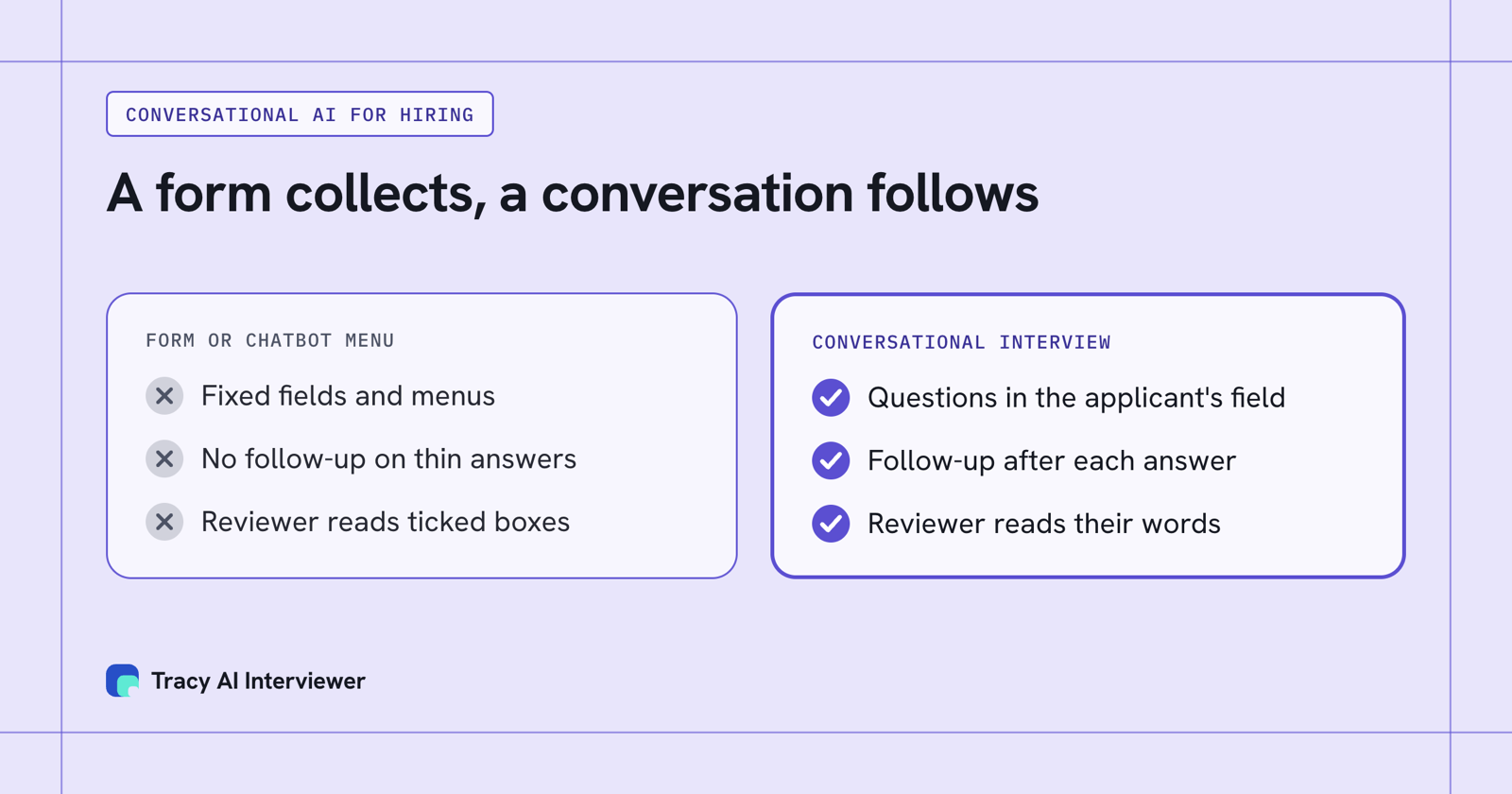
A form collects fixed answers, while a conversational interview follows each one.
What does a conversational first round look like?
Each applicant gets one link, opens it in the browser and talks with Tracy on video. Tracy asks about the applicant's own line of work, lets each answer finish and then asks about what it left out. Before the call starts, the applicant reads that it is recorded and transcribed. The reviewer then reads a note like this one for an HR generalist role. The applicant and the excerpt are invented:
Question 1. Tell me about a hard conversation with an employee.
What they said. Met an employee about repeated lateness, listened first, found a childcare issue and agreed a shifted schedule.
Quote at 02:50. "I listened first. It turned out to be childcare."
Follow-up. How did you record the agreement?
Question 2. Which HR policies have you written?
Quote at 06:10. "A remote work policy and a leave policy, for 140 people."
Field, company size supported. 140 people (evidence: question 2, 06:15).
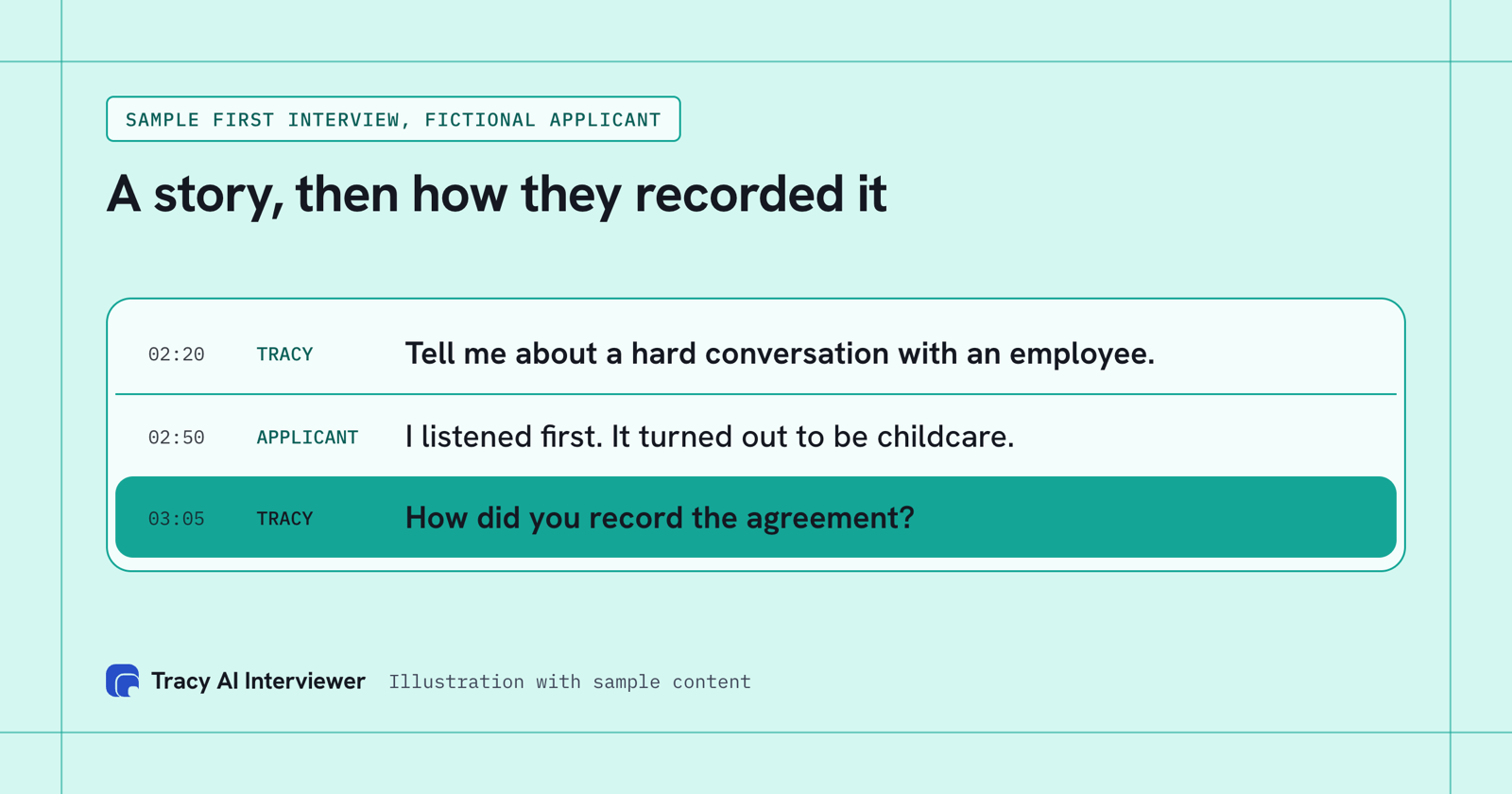
The follow-up asks how the agreement was recorded, which turns a story into a practice the reviewer can check.
What should a reviewer check before moving someone on?
Read the answer next to the question it answers, then open the quote and its timestamp to hear it in the applicant's own voice. A field such as "company size supported" is only as good as the evidence line beside it, so check that the quoted words say what the field says.
Look at the follow-up too. If the applicant gave a short answer and the follow-up got a concrete one, you have more to go on than a headline. If a result shows an integrity signal, such as the applicant leaving the full-screen window, treat it as a reason to ask the applicant about it in a live round. Tracy reports the signal and a person judges it, and nothing is decided automatically.
How do you choose conversational AI for hiring?
Ask each vendor five things:
- Does it follow up on a thin answer, or move to the next question?
- What does the reviewer receive: a score, or the recording, the transcript and what was said?
- Who decides?
- Is the applicant told about recording and automated steps?
- Which systems does it connect to, and can you start an interview from your own?
Tracy follows up on the applicant's own work, keeps a recording and transcript behind every result, leaves the decision to a person and tells the applicant up front that the call is recorded. It can write results back to your ATS, and its API and MCP connections are on the connect page. Recruitment automation shows where this step sits among the others, and what a first-round interview is defines it.
Which path fits you
- Screening many applicants: high-volume recruitment and hiring at volume.
- Adding an agent to your recruiting workflow: an AI agent for recruiting.
- Comparing screening tools: AI candidate screening tools.
- Cost before you start: Tracy's pricing.
Common questions
What is conversational AI in recruiting?
Does it reduce time to hire?
Does it reduce bias?
Will AI interviewers replace recruiters?
Try one conversational interview
Send a single link for an open role, then read what each applicant answered. First 3 results free.
Try it free (opens in a new tab) Book a demo (opens in a new tab)
Your first 3 results are free. No card needed.
Sources
- IBM, What is conversational AI? (28 Sep 2021), retrieved 22 Nov 2026.
- Jabarian and Henkel, Voice AI in Firms: A Natural Field Experiment on Automated Job Interviews (working paper, Aug 2025), retrieved 18 Nov 2026.
- Tracy AI Interviewer: Connect, retrieved 11 Nov 2026.
- Tracy AI Interviewer: Hiring at volume, retrieved 5 Nov 2026.