
In short
A screening interview is an early, short conversation that checks whether an applicant meets a role's basic requirements, usually 15 to 30 minutes, before anyone spends time on later rounds.
Tracy AI Interviewer runs that first conversation on video: every applicant starts on click at any hour, gets the same questions and is followed up on what they say.
The reviewer opens a recording, a transcript and what each person said to each question, and decides who goes forward.
Next: create one screening interview from your role and read the first results.
A screening interview is the first live conversation an applicant has with an employer, after the CV or form and before any panel or technical round. Its job is narrow: find out whether the person meets the minimum requirements for the role, such as experience, availability, salary range and start date, so the later rounds only see people who fit. The format is often a phone call, which is why the term overlaps with the phone screen, but it can also be a video call or a recorded or automated interview.
A screening interview is short, early and checks the basics.
How long is a screening interview?
AIHR's guide puts a typical screening interview at 15 to 30 minutes and recommends between six and ten questions. Wikipedia's overview of job interviews describes earlier rounds, sometimes called screening interviews, as involving fewer staff and being much shorter and less in-depth than later ones. Plan for the lower end of that range when the role draws a lot of applicants, because every minute is multiplied by every person you speak to.
What questions are asked in a screening interview?
The questions check fit with the basics of the job. AIHR's examples include "Can you tell me about yourself?", "Why are you looking for a new job?", "What salary range are you looking for?" and "If hired, when can you start?". They fall into four groups:
- Background: what the person has done and why they are moving.
- Skills: one or two examples tied to the role's key requirement.
- Practical fit: pay expectations, start date, location, shifts.
- Motivation: why this role and this employer.
Keep the wording the same for every applicant, so differences between people come from their answers and not from how each was asked. Screening question ideas by role gives wording you can adapt, and a fixed list is what makes a screen structured, as the structured interview guide explains.
Who runs a screening interview, and in what format?
A recruiter or HR professional usually runs it, and for a technical role a team member may help write or ask the questions. Phone calls are the long-standing format, and Wikipedia calls telephone interviews an increasingly common initial interview approach. Video calls and recorded interviews are the other two common formats, and an AI interviewer is a fourth. The choice comes down to who asks the questions and when the applicant can answer. A live call needs a diary slot on both sides. A recorded or AI-led interview does not, which matters when the applicant is in another time zone or has a shift pattern.
What happens after a screening interview?
The interviewer records what was said, compares it with the requirements and decides whether the person moves to the next round. Three things make that decision easier to defend later:
- Notes taken per question, not one overall impression written afterwards.
- The same questions for every applicant, so two people can be compared on the same ground.
- A reason written next to the decision, in the applicant's own words where possible.
The applicant also needs to hear back. A screening interview that ends in silence leaves a poor impression of the employer, even when the answer is no. Say what the next step is and when it will happen before the call ends, and then keep to it.
What goes wrong in a screening interview?
Screens go wrong in familiar ways. Calls drift to 40 minutes because there is no fixed list. The recruiter's mood on the day changes what gets asked. Notes are written from memory at the end of the afternoon. Wikipedia's overview notes that unstructured interviews are the most common form but are highly unreliable, or inconsistent between interviews, while structured ones use a predetermined list of questions and are usually more accurate predictors. A fixed list of six to ten questions, asked the same way each time, removes most of the drift.
The other common failure is asking for too much. A screen is not the place for a full case study or a long technical task. Keep it to the requirements that would end the process if missing, and leave depth for the round that follows.
Why does the screening interview bottleneck at volume?
It is the stage that sees the most people. Ashby's 2026 benchmark report, drawn from customer data covering January 2021 to March 2026, found that early stages such as recruiter screens pass about 35 percent of candidates and handle the highest volume of candidates. Each of those conversations needs a recruiter, a slot and a set of notes, so the stage grows with the applicant pool.
Timing also works against live calls. In a Tengai analysis of 20,291 AI screening interviews in Sweden, from January 2025 to September 2026, 44 percent started outside work hours, defined as before 8 am or from 5 pm on weekdays, or at weekends. That is data from one vendor's interviews in one country, but it shows when applicants choose to answer when they can choose. For the wider pattern, see running first-round screens at volume.
How does Tracy AI Interviewer run a screening interview?
Describe the role and Tracy drafts the questions. You edit them or bring your own. Share one link, and each applicant starts when ready, in the browser, with no account and no calendar. Tracy asks the question, listens, waits for the end of the thought and asks for the missing detail, so a short answer becomes a specific one.
The reviewer receives a recording, a timestamped transcript and a written summary of what each person said, per question. Tracy does not score, rank or reject anyone, and the decision about who moves on stays with a person. Applicants are told on the join screen that the conversation is recorded and transcribed. A sample from an operations manager screen:
Tracy: Where did you find the biggest waste in a process?
Applicant (sample): Orders waited a day. A 9 a.m. batch cut it to two hours.
Tracy: How did the approvers react?
In the sample report the answer, the follow-up and the time (02:40) sit together, so the next person reads the same evidence. This is an illustration with sample content.
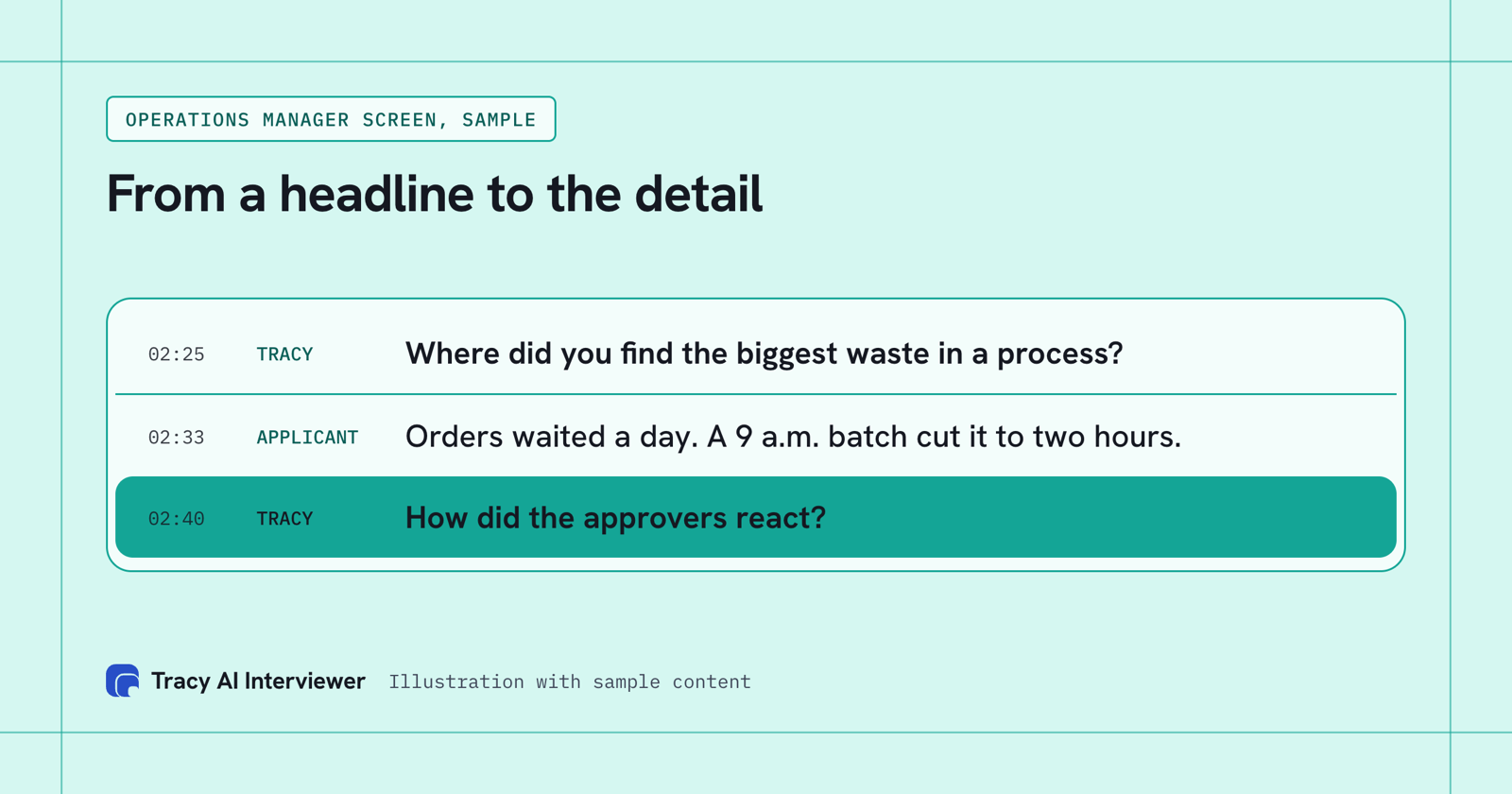
The follow-up turns a one-line answer into a specific one.
Where to go next
Which path fits you:
- Phone-based first calls: the phone screening process and what AI changes.
- The round that follows: what a first-round interview is.
- Screening before any conversation: what pre-screening covers.
- A large pool of applicants: the hiring-at-volume use case.
Common questions
What is a screening interview?
How long is a screening interview?
What questions are asked in a screening interview?
Can an AI run a screening interview?
Interview every applicant, not just a few
Create one screening interview from your role. Every applicant starts on click and gets follow-ups, and your first 3 results are free.
Try it free (opens in a new tab) Book a demo (opens in a new tab)
Your first 3 results are free. No card needed.
Sources
- AIHR, Screening Interview: A Complete Guide for HR, retrieved 23 Nov 2026.
- Job interview (Wikipedia), retrieved 23 Nov 2026.
- Ashby, Recruiting Operations Benchmarks, 2026 Talent Trends Report (7 May 2026), retrieved 18 Nov 2026.
- Four in ten AI interviews in Sweden happen outside office hours (press release, 6 October 2026), retrieved 18 Nov 2026.