
In short
The adverse impact ratio is one group's selection rate divided by the highest group's rate. A result under 0.8 is the usual signal to look closer at that hiring step.
Tracy AI Interviewer asks every applicant the same questions, follows up on each answer and keeps a recording and transcript, so the first step leaves evidence a second reviewer can read.
Your own records hold the group data and your team runs the ratio. Tracy does not calculate it, and a person makes every decision.
Next: run one role through Tracy and read the first reports.
The adverse impact ratio, often shortened to AIR, tells you whether one group moves through a hiring step less often than another. For each group, divide the number selected by the number who applied. That is the selection rate. Then divide each group's rate by the rate of the group selected most often. A ratio of 1.0 means the group does as well as the top group, and a ratio below 0.8 is where US federal agencies generally start to see evidence of adverse impact, as set out in the four-fifths rule and its legal status.
How is the adverse impact ratio calculated?
Take one step at a time, such as a screen, an interview or a test, and work through four moves.
- Count how many people in each group reached the step and how many of them were selected.
- Divide selected by reached to get each group's selection rate.
- Pick the highest rate. That group is the reference.
- Divide every group's rate by the reference rate. The results are the impact ratios.
Here is an invented example of a screen with three groups. In Group A, 80 of 200 applicants move on, a rate of 40 percent. In Group B, 54 of 150 move on, 36 percent. In Group C, 24 of 100 move on, 24 percent. Group A is the reference, so its ratio is 1.00. Group B is 36 divided by 40, which is 0.90. Group C is 24 divided by 40, which is 0.60, below 0.8, so that group's result at this step needs a closer look.
The ratio is one division per group: that group's rate over the top group's rate.
What is the 80% threshold?
The 80 percent line is the four-fifths guideline in the Uniform Guidelines on Employee Selection Procedures. It says a selection rate for any race, sex or ethnic group that is less than four-fifths of the rate for the group with the highest rate is generally regarded by federal enforcement agencies as evidence of adverse impact. The same section adds two limits. Smaller differences may still count as adverse impact when they are significant in statistical and practical terms, and larger differences may not count when they rest on small numbers.
That makes 0.8 a trigger for questions and a poor place to stop. With 12 applicants in a group, one extra selection can move the ratio across the line. Read the ratio together with the counts behind it, and over a longer period when a group is small.
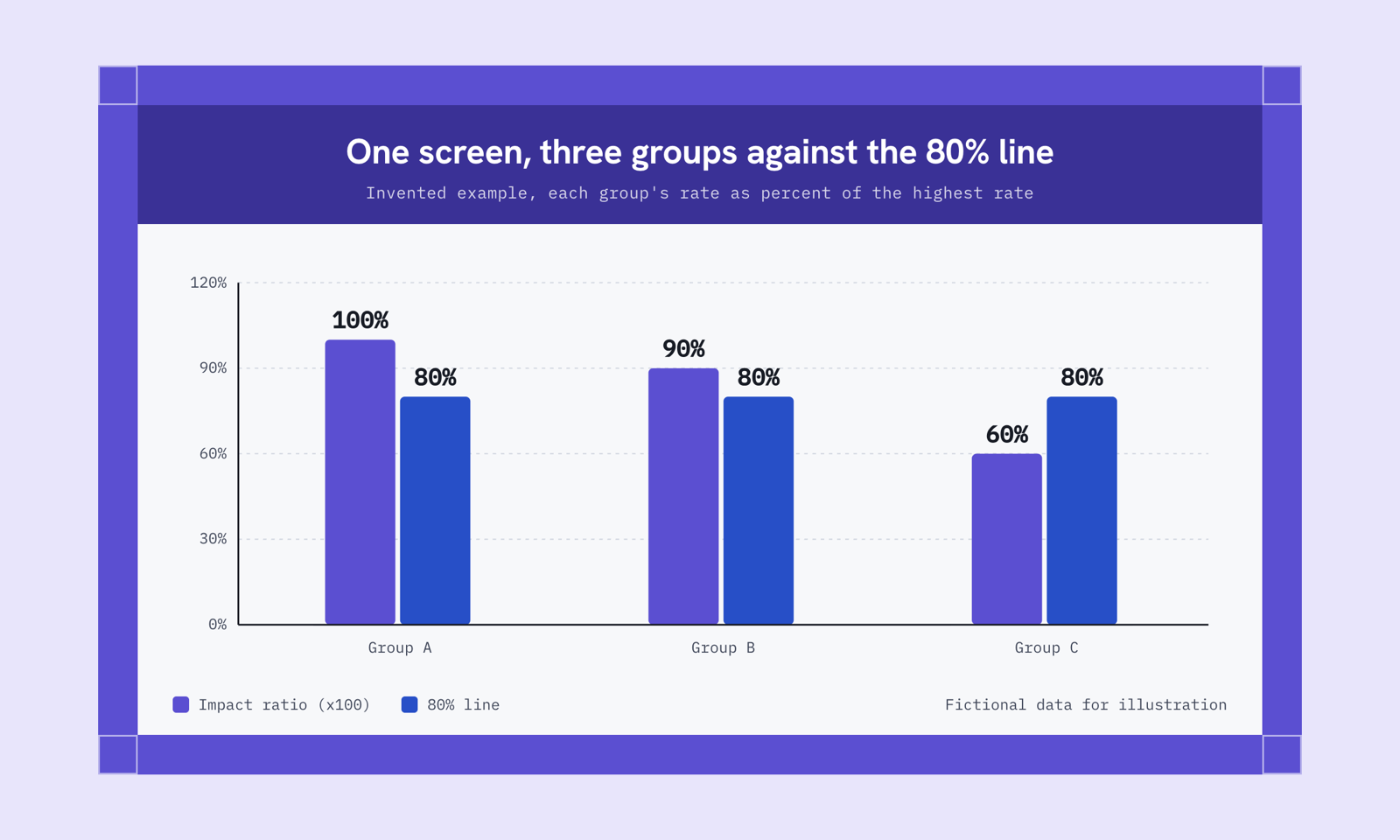
Group C's impact ratio of 0.60, shown as 60 percent, is the only one under the 80 percent line.
What counts as adverse impact?
Adverse impact is a substantially different rate of selection in hiring, promotion or another employment decision that works to the disadvantage of members of a race, sex or ethnic group. The ratio is a screening measure for it, and the measure alone does not settle the question. A low ratio can come from the applicant pool, the job requirements or the step itself, and a ratio above 0.8 does not show the step is fair.
The Guidelines also say where to look. If the whole selection process shows adverse impact, its separate steps should be examined, and users should keep records of impact by group. With very large applicant volumes, those records may be kept on a sample basis if the sample fits the applicant population and is large enough. This page is general information, not legal advice. Ask your counsel which rules apply to you.
Where else do impact ratios appear?
New York City's Local Law 144 brings the same arithmetic to automated tools. A bias audit under that law must be an impartial evaluation by an independent auditor that calculates selection or scoring rates and impact ratios across sex, race and ethnicity categories. The city's guidance of 29 June 2023 says the law defines an employment decision broadly enough to include screening, and also says it does not require any specific action based on the audit results.
Some local laws also require employers to publish ratios for tools that screen people. Which rules apply to a given hiring step depends on where you hire and what tool makes the decision, so ask counsel.
How does Tracy AI Interviewer help when you measure a step?
Tracy does not calculate the adverse impact ratio, and it does not score, rank or reject anyone. The group data sits in your applicant records, and your team runs the ratio.
Tracy runs a first-round step with the same structure for everyone. You set or edit the questions once, each applicant starts on click at any hour, and Tracy asks follow-ups based on what that person said. The reviewer gets a recording, a timestamped transcript and a written summary of what each person said, per question, so a second reviewer can check the same answer. Applicants are told on the join screen that the conversation is recorded and transcribed, and nothing is decided automatically.
A sample from a project manager screen:
Tracy: How do you keep a project on track when a dependency slips?
Applicant (sample): I tell the sponsor early and we write down the new date.
Tracy: Who owned the dependency in that case?
The sample report keeps the answer, the follow-up and the time (02:30) together. This is an illustration with sample content. When the interview is the step you measure, those records show what every applicant was asked.
Where to go next
Which path fits you:
- Asking everyone the same questions: what a structured interview is.
- Reading an AI interview report: how AI interview results are produced and checked.
- Big applicant pools at one screen: running first-round screens at volume.
- The regulator's view on AI in hiring: EEOC guidance on AI hiring tools.
Common questions
How is adverse impact ratio calculated?
What is the 80% threshold?
What counts as adverse impact?
Does the adverse impact ratio apply to interviews?
Interview every applicant, not just a few
Tracy starts each applicant on click and follows up on every answer, so everyone gets the same first step. First 3 results free.
Try it free (opens in a new tab) Book a demo (opens in a new tab)
Your first 3 results are free. No card needed.
Sources
- 29 CFR 1607.4, Information on impact (Uniform Guidelines on Employee Selection Procedures, Legal Information Institute), retrieved 23 Nov 2026.
- 29 CFR 1607.16, Definitions (Legal Information Institute), retrieved 22 Nov 2026.
- NYC Department of Consumer and Worker Protection, Automated Employment Decision Tools: Frequently Asked Questions (29 June 2023), retrieved 18 Nov 2026.
- Tracy AI Interviewer, Connect page, retrieved 23 Nov 2026.