
In short
A job description lists what the person will do. A job specification lists the skills, background and traits a person needs to do it. Both come out of job analysis.
Tracy AI Interviewer can start from your job description: it drafts the interview questions, you edit them, and each applicant is asked about the requirements in their own field, with follow-ups.
The reviewer gets a recording, a transcript and what each person said to each question, ready to check against the specification.
Next: paste one role into Tracy and read the first reports.
People use the two terms loosely, and some employers publish one document that does both jobs. The split is still useful. A job description answers "what will this person do?" with duties, responsibilities and working conditions. A job specification answers "what must this person bring?" with qualifications, skills, experience and personal qualities. Job analysis, the work of identifying what a job involves, produces both. If your hiring bar rests on skills rather than degrees, the specification is the document that holds it.
What is the difference between a job specification and a job description?
The description is about the work and the specification is about the worker. The description changes when the job changes, and the specification changes when the bar for the person changes.
| Job description | Job specification | |
|---|---|---|
| Answers | What will they do? | What must they bring? |
| Holds | Duties, responsibilities, working conditions | Skills, experience, qualifications, traits |
| Written about | The role | The ideal person for the role |
| Used to | Advertise the role and set expectations | Shortlist and interview |
The two often share a page. A posting with "Responsibilities" and "Requirements" headings is a job description and a job specification in one document. "Responsibilities" alone is only part of a job description: it leaves out reporting lines, working conditions and the purpose of the role.
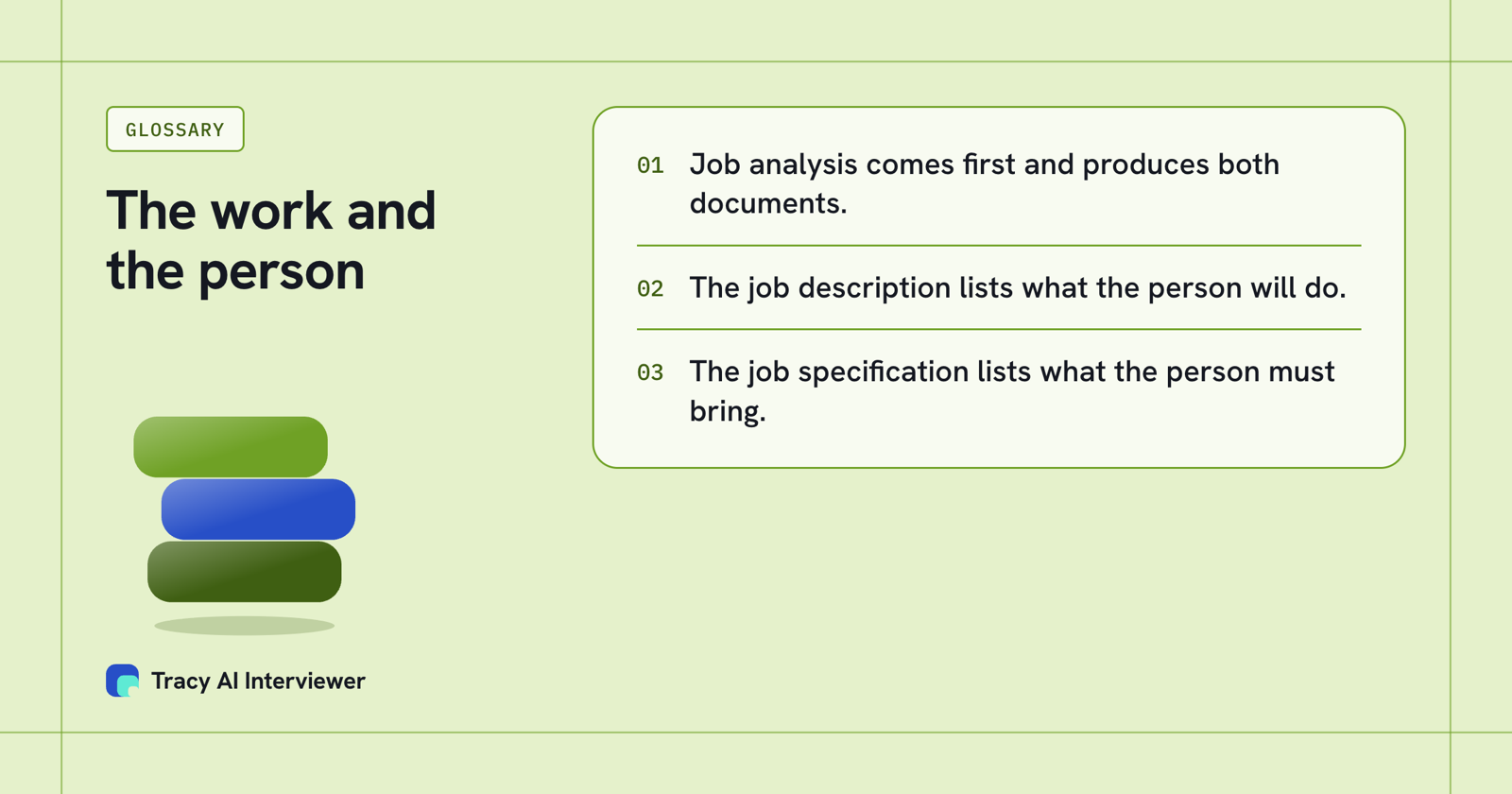
The description covers the work; the specification covers the person.
Which comes first, the job description or the job specification?
Job analysis comes first. The description and the specification are its two outputs, and the source for this page states no order between them. In practice many teams write the description first, because the duties tell you which skills the job needs, and then draw the specification from them. That order is reasoning, not a rule.
The description also matters outside hiring. Under the US Americans with Disabilities Act regulations, evidence of which functions are essential includes the employer's judgment and written job descriptions prepared before advertising or interviewing applicants for the job. So write the description before the posting goes out, and keep it accurate. This is general information, not legal advice.
What does a job specification include?
A working specification has five parts:
- Qualifications the job needs, such as a licence or a degree where one is required.
- Skills, written as things a person can show, for example "writes SQL joins across three tables".
- Experience, in the kind and amount you can defend.
- Personal qualities that the work calls for, such as handling a sponsor who will not decide.
- Conditions of the job that a person must accept, such as shift pattern or travel.
Separate required from preferred. A line that nobody can test in an interview, such as "strong communicator", is better turned into the situation you want to hear about. Every requirement should be something you can ask a person to talk through.
What do the two look like for one role?
Here is an invented example for a customer support agent, to show where each line belongs.
| Line | Belongs in |
|---|---|
| Answer chat and email tickets within the team's response targets | Job description |
| Report to the support team lead, on a rota that includes weekends | Job description |
| Explains a technical problem in plain words to a customer who is upset | Job specification |
| Two years in a customer-facing role | Job specification |
| Can work evenings from 6 pm | Job specification (a condition of the job) |
Notice the third line. "Explains a technical problem in plain words" is a skill, and it is only useful in the specification if someone can ask about it. The matching interview question is "Tell me about a time you explained something technical to an upset customer."
What goes wrong when the two are mixed up?
Three problems are easy to run into. A duty gets listed as a requirement, so a posting asks for "managing the weekly report" as if every applicant should already have done it. A wish list gets treated as a bar, and strong people screen themselves out of a role because they lack three of twelve "requirements". Or the document is written once and never revisited, so the description still names a tool the team dropped last year.
A short review each time a role opens fixes most of this. Read the description against what the person will do in the first month, then read the specification against the description and cut every line that no duty needs.
How does Tracy AI Interviewer use both documents?
The job description is the input and the specification is the test. Describe the role, or start from your job description, and Tracy drafts the interview questions for it. You edit them or bring your own. Each applicant then starts on click, at any hour, and Tracy asks follow-ups in that person's own field.
That turns the specification into something you can check. Where it says "gathers requirements from people who disagree", the interview asks how the person did that, and the follow-up asks what happened when it got stuck. The reviewer receives a recording, a timestamped transcript and a written summary of what each person said, per question. Tracy does not score, rank or reject anyone, so the reviewer compares each answer with the specification. A sample from a business analyst screen:
Tracy: How do you gather requirements from people who disagree?
Applicant (sample): I write the conflict as two options and ask the sponsor to pick.
Tracy: What did you do when the sponsor would not choose?
The sample report keeps the answer, the follow-up and the time (02:50) together. This is an illustration with sample content.
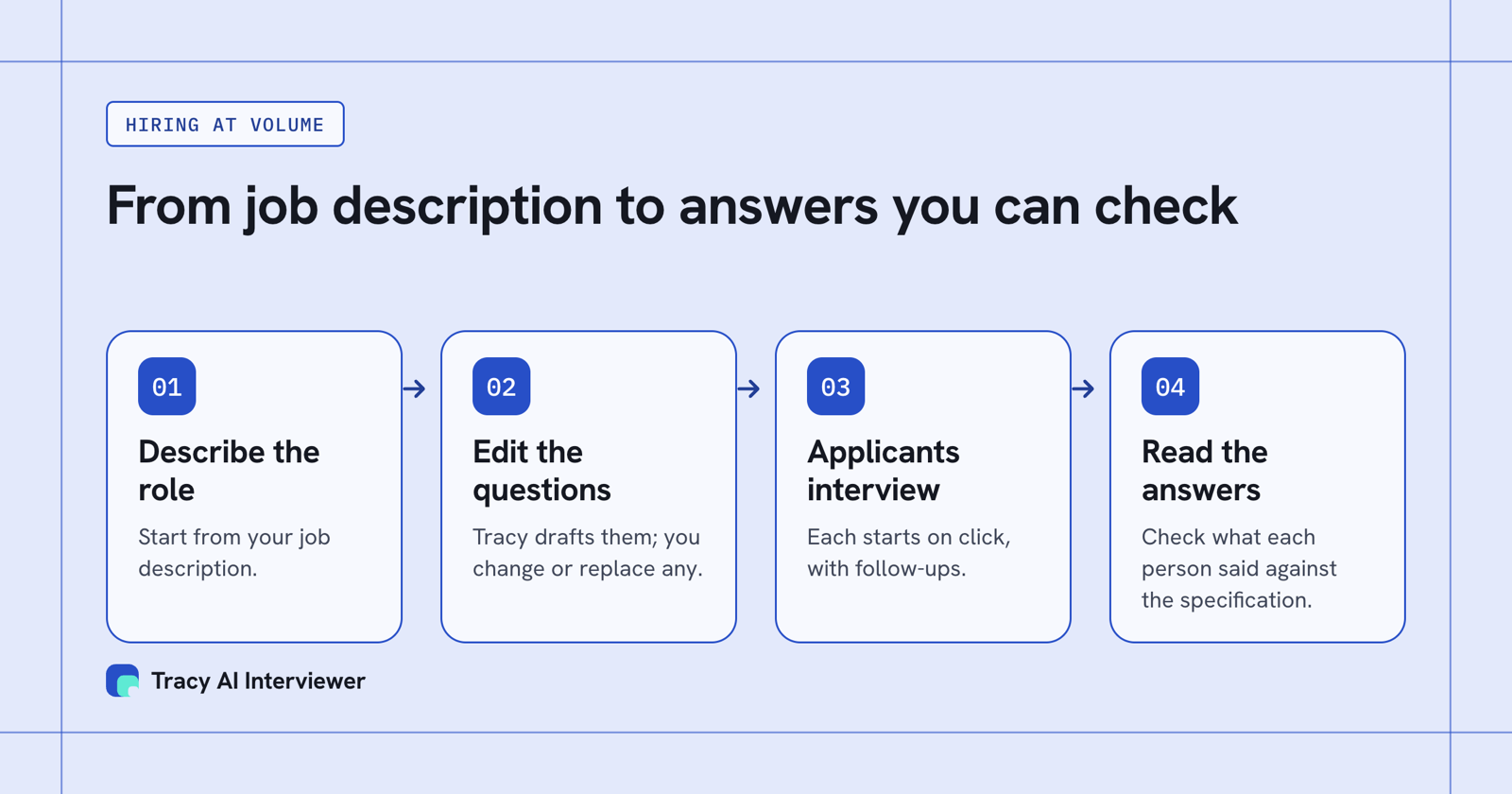
The job description becomes interview questions, and the answers are read against the specification.
Where to go next
Which path fits you:
- Same questions for every applicant: how a structured interview works.
- Writing the first-round questions: first-round interview questions to adapt.
- Early filtering at scale: what candidate screening covers.
- Many roles, many applicants: the hiring-at-volume use case.
Common questions
What is the difference between a job specification and a job description?
Which comes first, a job specification or a job description?
What does a job specification include?
How is a job description different from job responsibilities?
Turn the job description into interviews
Start from one job description and Tracy drafts the questions, then asks follow-ups on every answer. Your first 3 results are free.
Try it free (opens in a new tab) Book a demo (opens in a new tab)
Your first 3 results are free. No card needed.
Sources
- Job analysis (Wikipedia), retrieved 23 Nov 2026.
- 29 CFR 1630.2, Definitions, paragraph (n) essential functions (Legal Information Institute), retrieved 23 Nov 2026.