In short
A talent acquisition strategy sets which roles you fill, by which route, how each applicant is interviewed and what you measure. Most plans leave the first conversation out.
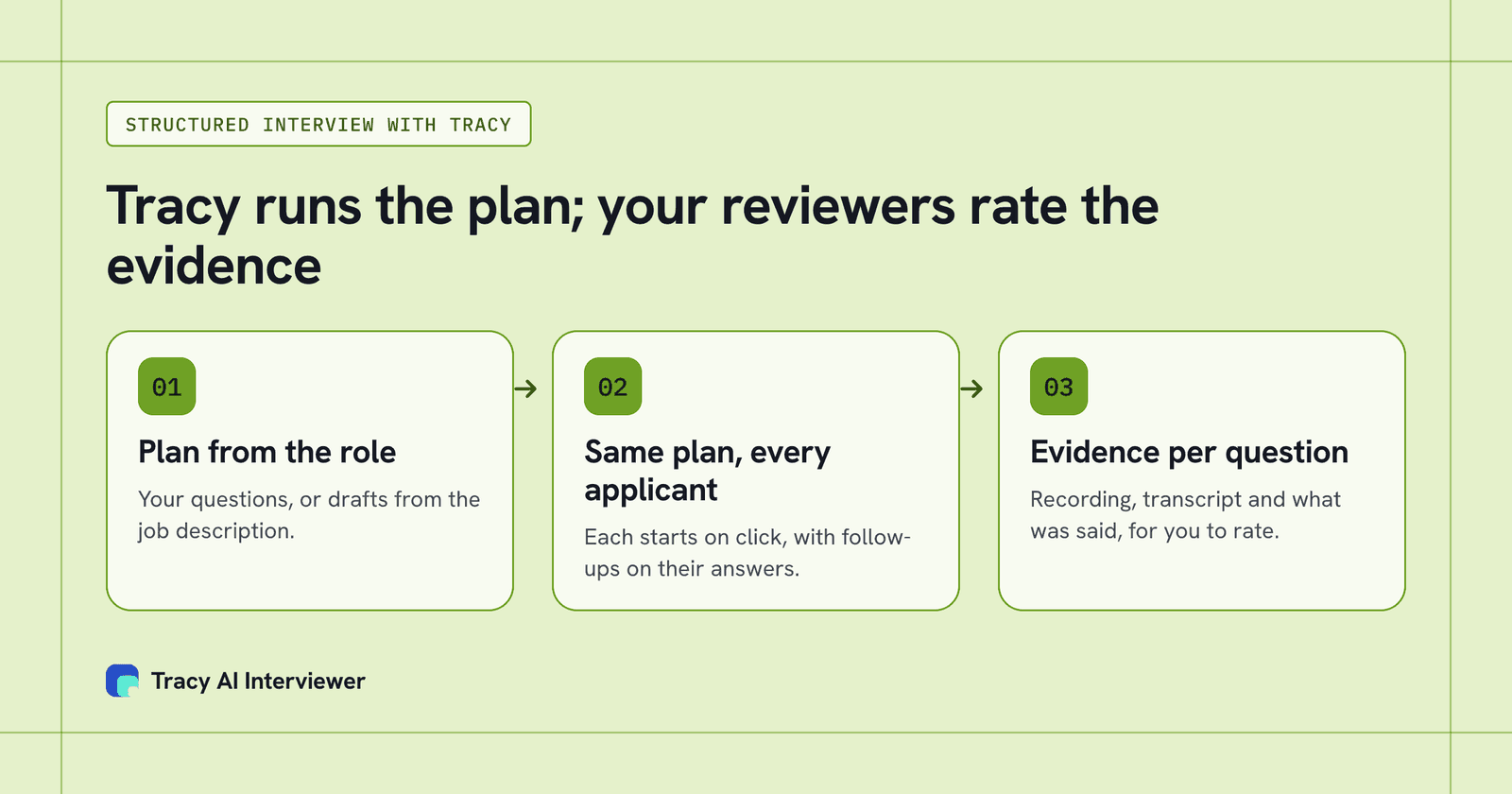
Tracy AI Interviewer runs that stage: every applicant starts on click, at any hour, Tracy follows up in their field, and a reviewer reads what each person said, per question.
One customer cut its average time to hire from 44 days to 7.
Next: pick one role family and run its first round through Tracy.
Greenhouse customers received 161.8 million applications in the first eight months of 2026, and only 32 of every 1,000 reached a first interview. The other 968 did not get one. Most strategies list channels, headcount and a budget, then say nothing about that stage.
This guide shows how to build a strategy in six steps, what the 4 B method adds, which numbers to track and where a first-round interview belongs. Tracy AI Interviewer is built for that stage. Every applicant can start an interview on click, Tracy asks follow-up questions in the applicant's own field, and a person reads the evidence and decides.
How do you build a talent acquisition strategy?
Start from the hires the business needs and end with a review of the numbers. Six steps cover it.
- Count the hires by role family and quarter. Split the headcount plan into families that are hired the same way, such as support, engineering, warehouse or graduates. A strategy per family is more useful than one for the whole company.
- Choose a fill route for each family. Hire from outside, develop people inside, bring in contractors or widen what current staff do. The 4 B method below names the four routes.
- Set a target for each stage. Applicants to first interview, interview to offer, offer to acceptance, and days from application to hire. Use your last two quarters as the starting point and outside benchmarks as a check.
- Decide how every applicant is assessed. The same questions in the same order, and a record a second person can read. Our guide to structured interviews explains why.
- Choose tools by gap. Your applicant tracking system holds the records, sourcing tools find people, and one tool holds the first conversation. Do not buy for a stage that is not the bottleneck.
- Review each quarter. Drop a route that did not fill roles and put the budget where the numbers moved.
What is the 4 B method?
The 4 B method is Build, Buy, Borrow and Bridge: four routes to fill a skills need. AIHR describes each one and when it fits, and says there is no single best mix.
The four routes and when each fits
The four routes as AIHR describes them. The right mix depends on the organisation.
| Route | What it means | When it fits, per AIHR |
|---|---|---|
| Build | Develop talent in-house through early-career programmes, school partnerships and learning | Specialist talent is hard to find in the market |
| Buy | Hire from the external market | Needs change fast and reaction time is short; early-stage and rapidly growing companies |
| Borrow | Use part-time, freelance, contract or temporary workers, or partners | Unique or short-term needs; staffing companies |
| Bridge | Broaden existing employees into adjacent skills | Retention; stable organisations |
Buy and Borrow both bring in people you have never spoken to, so the first conversation matters most there.
Where does the funnel narrow?
Three studies, three scopes, so keep them as separate facts. In Greenhouse's US data for January to August 2026, covering 161.8 million applications across 9,473 companies, 32 of every 1,000 applications reach a first interview. In Gem's customer data from June 2021 to May 2025, over 165 million applicants, only 8 percent advance past initial screening and 0.5 percent receive an offer. Ashby's 2025 data on venture-backed startups with under 300 employees shows 15 applicants interviewed for every hire.
Source mix tells the same story. In Gem's 2024 data, job boards and social sites supplied 49.0 percent of applications and 24.6 percent of hires.
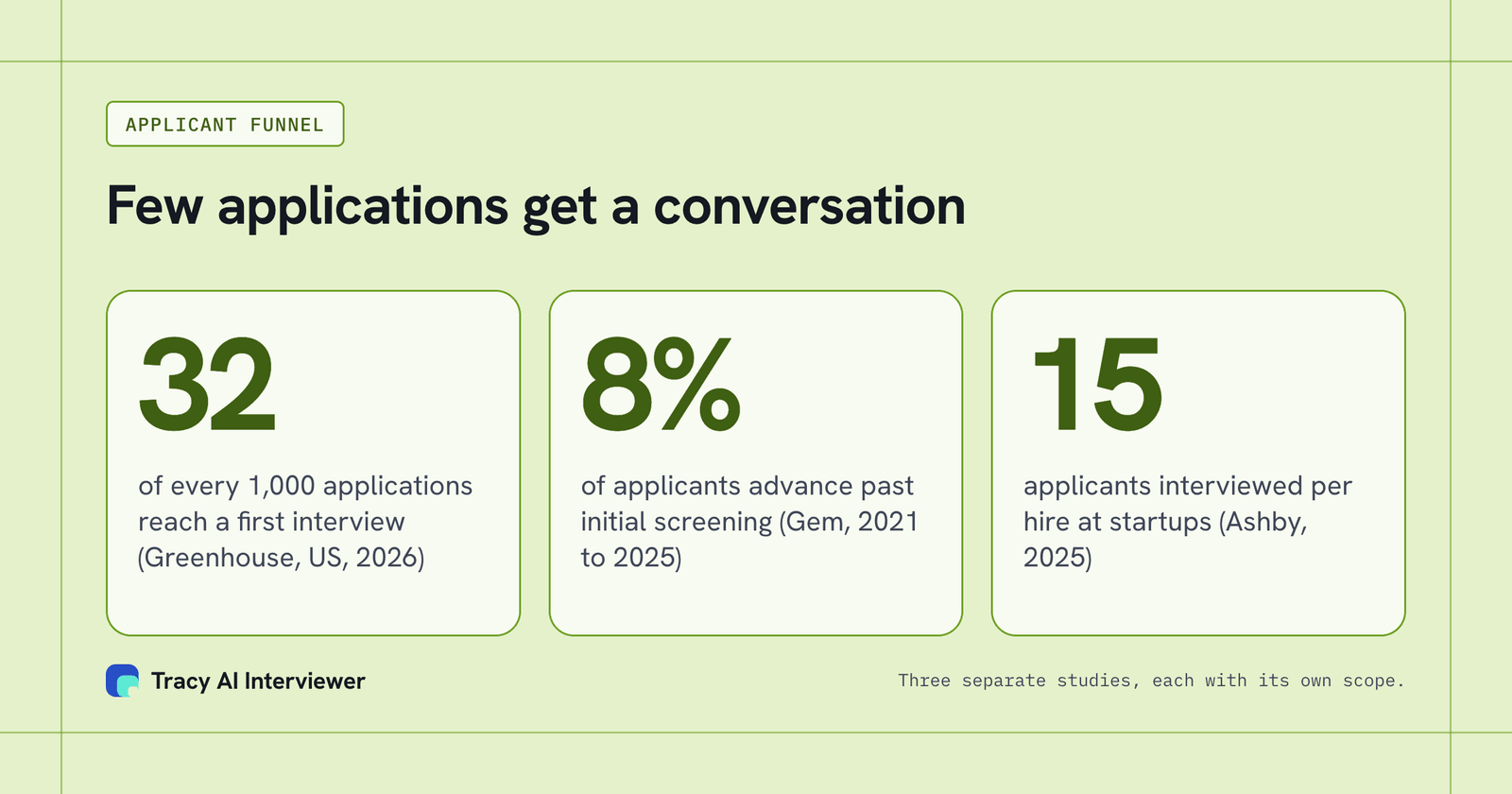
Most applications never reach a conversation, so the first interview is where a strategy decides who is heard.
What does a first-round interview add to the strategy?
Step 4 is where plans go vague, and it is the step Tracy covers. You describe the role or paste your own questions, and Tracy drafts the interview for you to edit. You share one link. Each applicant starts when ready, in a browser, at any hour, with no account and no calendar, and is told on the join screen that the conversation is recorded and transcribed. Tracy reads the CV when the CV check is on, asks in the applicant's own field and waits for the end of the thought before asking for the missing detail.
The reviewer receives a recording of both sides, a timestamped transcript, a written summary of what each person said to each question, and integrity signals with their evidence. Tracy does not score, rank or reject anyone, and a person decides who moves forward.
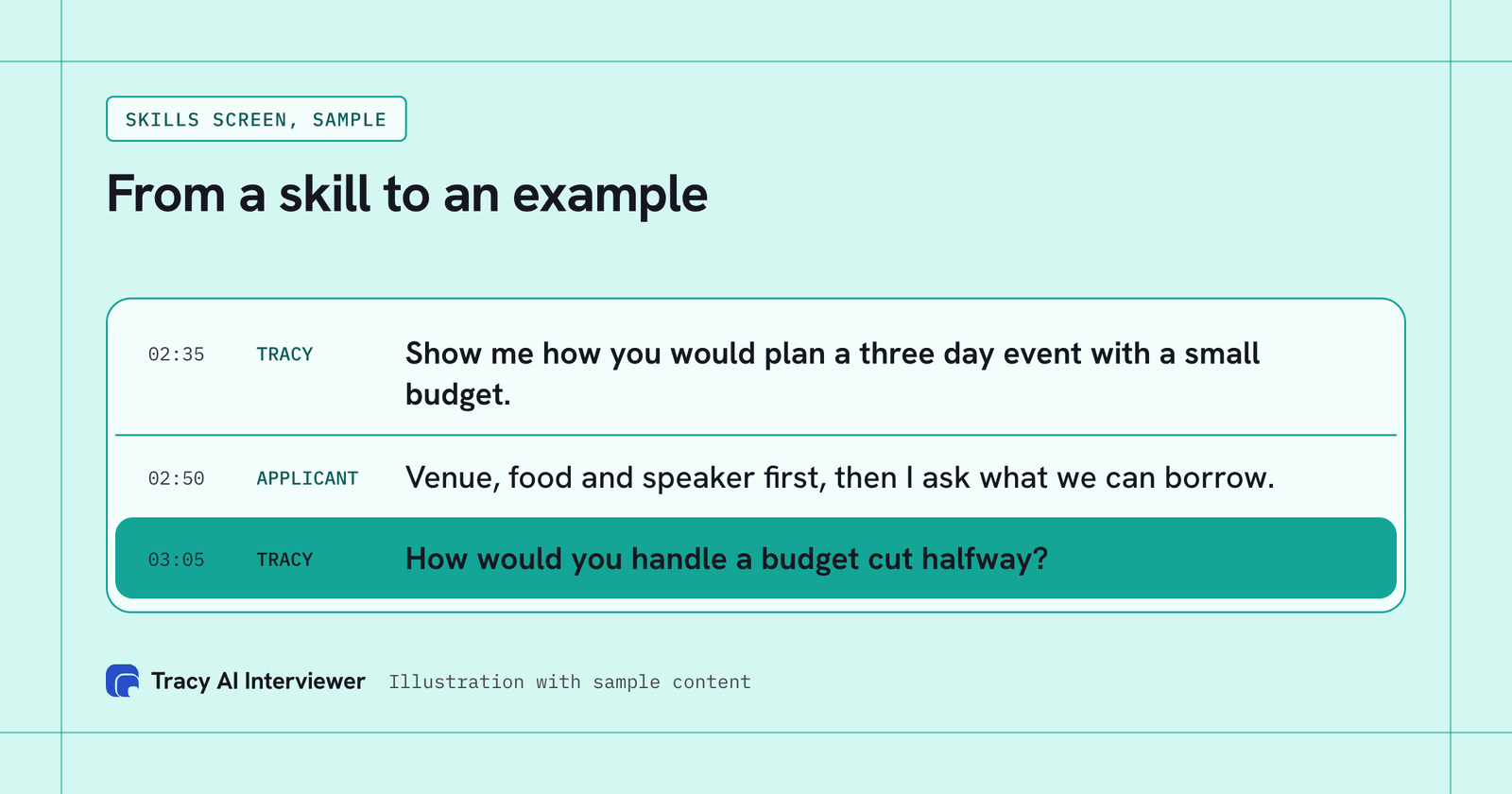
A skill stated on a form becomes an answer the reviewer can judge, because Tracy asks what happened next.
How do you measure a talent acquisition strategy?
Pick five or six measures close to the real bottleneck. Applications received is not one of them, because it rises whenever you post more.
- Applicant to first interview rate. The stage where most people are lost. Compare it with your own last quarter first.
- Days from application to hire. See time to hire statistics for what each published clock counts, and time to fill for the requisition view.
- Source of hire against source of application. The Gem split above, 49.0 and 24.6 percent, is the gap to look for in your own data.
- Cost per hire. Appcast measured average job ad spend per hire at $851 across US employers at the end of 2024. That covers advertising only, so add recruiter and interviewer hours.
- Offer acceptance. In Gem's customer data from June 2021 to May 2025, 82 percent of candidates at the offer stage accepted. A low rate points to the offer. A very high rate with slow hiring can mean good people left earlier in the process.
- Quality of hire. Retention and manager rating after the first year. What quality of hire is covers the formulas.
What stays with your team
People choose the routes, set the targets, write what a strong answer sounds like and make every offer. Candidates are told about the recording, a person reviews each report, and nothing in the process is an automated decision. Integrity signals are shown to the reviewer as signals with their evidence, and never as proof.
For a handful of hires a year, a structured conversation run by your own team is enough.
Pilot step 4 of the strategy on one role family
Take one of the stage targets from step 3 and test it on one role family for four weeks, with a named owner.
- Pick the family where your applicant to first interview rate is lowest, and write four skills with what a strong answer sounds like.
- Create the interview from the job description, edit the questions and put the link in the job post.
- Have the owner read the reports for the applicants your CV screen would have set aside.
- At the end, compare the family's applicant to interview rate, days from application to hire and reviewer hours per hire with the step 3 target.
- If the owner would not move any of those applicants forward, drop the pilot and keep the route that worked.
Which path fits you:
- One role with a flood of applicants: the volume recruitment playbook.
- Sizing the funnel: how many applicants a job gets.
- Filling many seats in waves: the mass hiring process.
- Skills as the test: skills-based hiring.
- Interviewing every applicant at scale: Tracy for volume roles.
Common questions
How do you build a talent acquisition strategy?
What is the 4 B method?
How do you measure a talent acquisition strategy?
Where does a first-round interview fit in the strategy?
Run your first round on every applicant
Pick one role family and create its interview from the job description. Applicants start on click, at any hour. Your first 3 results are free.
Try it free (opens in a new tab) Book a demo (opens in a new tab)
Your first 3 results are free. No card needed.
Sources
- Greenhouse, Recruiting Benchmarks (January to August 2026), retrieved 18 Nov 2026.
- Gem, key takeaways from the 2026 Recruiting Benchmarks Report, retrieved 18 Nov 2026.
- Gem, 2025 Recruiting Benchmarks Report, retrieved 18 Nov 2026.
- Ashby, The State of Startup Hiring, Talent Trends Report, retrieved 18 Nov 2026.
- Appcast, average cost per hire (2024 job ad data), retrieved 18 Nov 2026.
- AIHR, Build, Buy, Borrow and Bridge: A New Way of Channeling Your Hiring, retrieved 22 Nov 2026.
- Tracy AI Interviewer home page, retrieved 22 Nov 2026.