In short
Tracy AI Interviewer runs the first round of a structured interview for every applicant on click, from your questions or ones she drafts from the job description, and follows up on each answer.
Each result keeps a recording, a timestamped transcript and what the person said to each question, so your reviewers rate evidence they can check.
To conduct one yourself, follow the seven steps below, then run one role in Tracy and read the result.
To conduct a structured interview, decide what the job needs before you meet anyone, write the questions and the rating scale, ask everyone the same way, and rate each answer before you talk to anyone else about it. Most of the work happens before the first candidate joins.
This guide is for heads of talent and recruiting leads who interview many people for the same role. If you hire at volume, the hundredth interview is the hard one: the questions drift and each interviewer starts rating on a different scale. If you are new to the term, start with what a structured interview is.
Tracy AI Interviewer asks the same planned questions of every applicant, in the browser, whenever they choose to start. That makes the first round the easiest one to keep consistent.
What is a structured interview?
A structured interview asks all candidates the same predetermined questions in the same order and evaluates every response on the same rating scale, against the same standards for an acceptable answer, as the US Office of Personnel Management describes it on its structured interviews page (read 22 November 2026). For the longer definition, see the full definition of a structured interview.
How do you conduct a structured interview, step by step?
Seven steps cover it. Steps 1 to 4 happen before any interview; steps 5 to 7 are the interview and what follows.
- Start from the job. List the three to five things a person must do well in the first six months, in plain words. "Handles an upset customer without a manager" is a competency you can ask about. "Good communicator" is not.
- Write the questions. Ask one to two questions for each competency, and use the same wording for every candidate. Four to eight questions fit a 20 to 30 minute first round. Mix questions about what they did with questions about what they would do in a described situation.
- Set the rating scale. Use a scale of one to five, and write down what a one, a three and a five sound like for each question. The anchors keep two reviewers aligned.
- Decide the follow-up rule. Say what the interviewer may ask after the first answer: for an example, for the result, for the person's own part. The rule is written down, so the follow-up depends on the answer and not on the interviewer's mood.
- Brief whoever runs the interviews. Share the questions, the anchors and the rule, and agree that nobody improvises new questions or changes the order.
- Ask every candidate the same way. Same questions, same order, same follow-up rule. Take notes in the candidate's words, not in impressions such as "seemed sharp".
- Rate before you compare. Each reviewer rates each answer against the anchors alone, then the group meets and compares ratings. Decide on the evidence you wrote down.
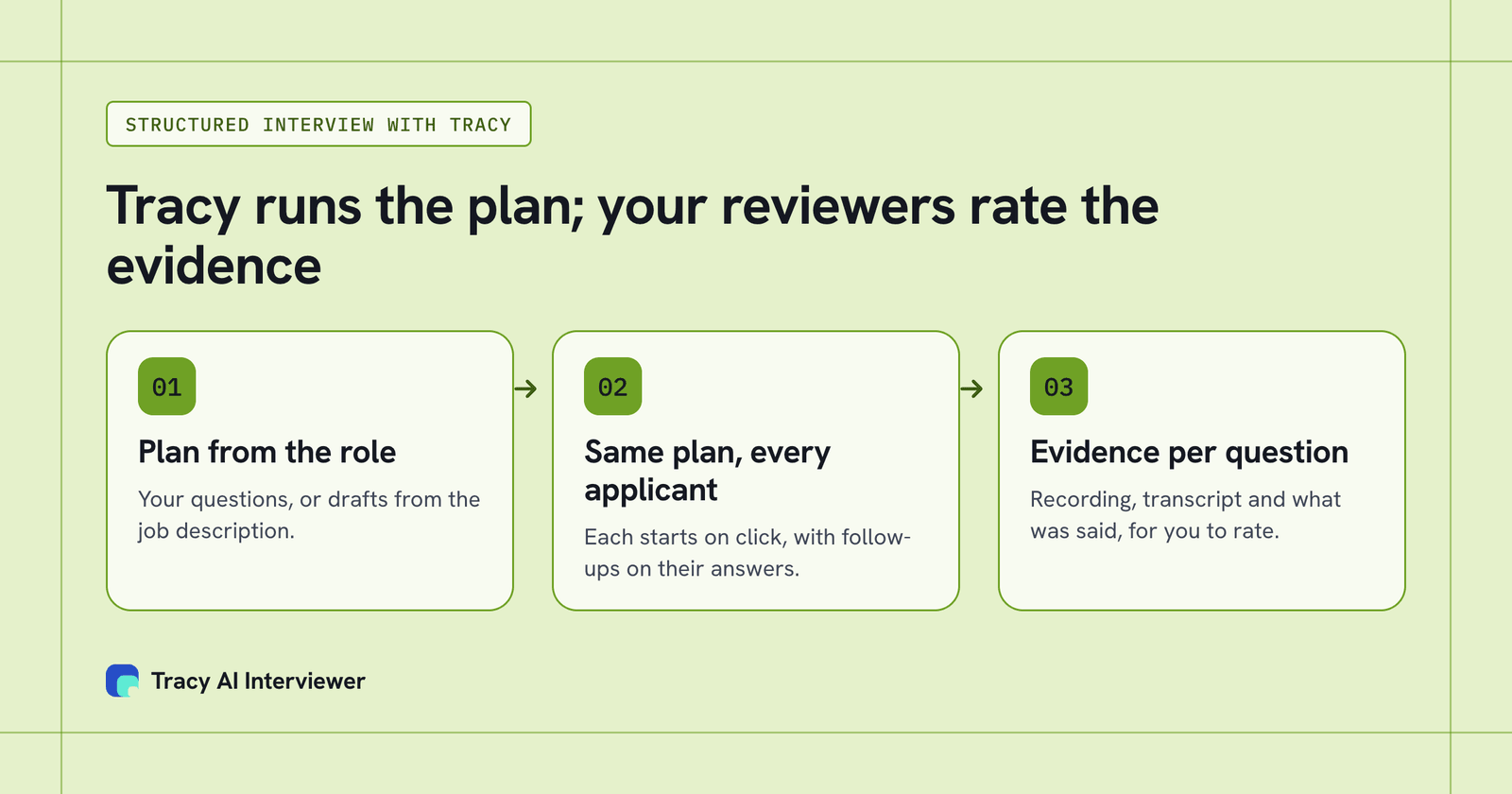
Tracy drafts the questions, asks every applicant the same plan and returns evidence per question for your reviewers to rate.
How do you score answers with a rubric?
A rubric is a short table: for each question, what a weak, an acceptable and a strong answer contain. The reviewer, not the tool, gives the rating. Write the strong answer as things you could hear, such as a named example, a number and the person's own part in it.
Take the question "How do you gather requirements from people who disagree?" A rating of 5 might need a specific session they ran, how they wrote the conflict down and what the sponsor decided. A 3 names a method but no case. A 1 says "I keep everyone aligned". To test an anchor, have two reviewers rate the same transcript against those lines alone. If their ratings sit more than a point apart, the anchor is vague and needs rewriting.
Do you ask the same questions in the same order?
Yes for the planned questions. The order matters because an early question can change how someone answers a later one, and a fixed order keeps that effect the same for everyone.
Follow-ups are where structured interviews differ. Some versions fix them too, and others allow a follow-up tied to the competency being tested. In Tracy the questions and criteria are set once for the role and every applicant gets them. When an answer lacks an example or a result, she asks for it, whoever the applicant is.
How does Tracy help you run a structured interview at volume?
Applicants start the interview on click, at any hour of the day, and nobody has to book a slot or sit in on the call. You paste in your own questions, or describe the role and edit the ones Tracy drafts. She works through the same plan with each person and follows up on what they said.
A customer cut its average time to hire from 44 days to 7, and Tracy did the work of 53 full-time recruiters in one month. For your reviewers, each interview ends with a recording of both sides, a timestamped transcript and what the person said to each question. Here is a sample note, with invented data, from a business analyst screen.
Question: How do you gather requirements from people who disagree?
Summary: Runs a short session with both groups, writes the conflict down as two options and asks the sponsor to choose.
In their words (02:50): "I write the conflict as two options and ask the sponsor to pick."
Follow-up asked: What did you do when the sponsor would not choose?
Field: Requirement conflicts, documented as options for the sponsor. Evidence: question 1, at 02:50.
The rating stays with your reviewers, who apply your anchors to the evidence, and a person makes the call. Tracy does not rate or rank anyone. Pricing is $1 a credit, with a credit used per started 20 minutes, and the first 3 results cost nothing.
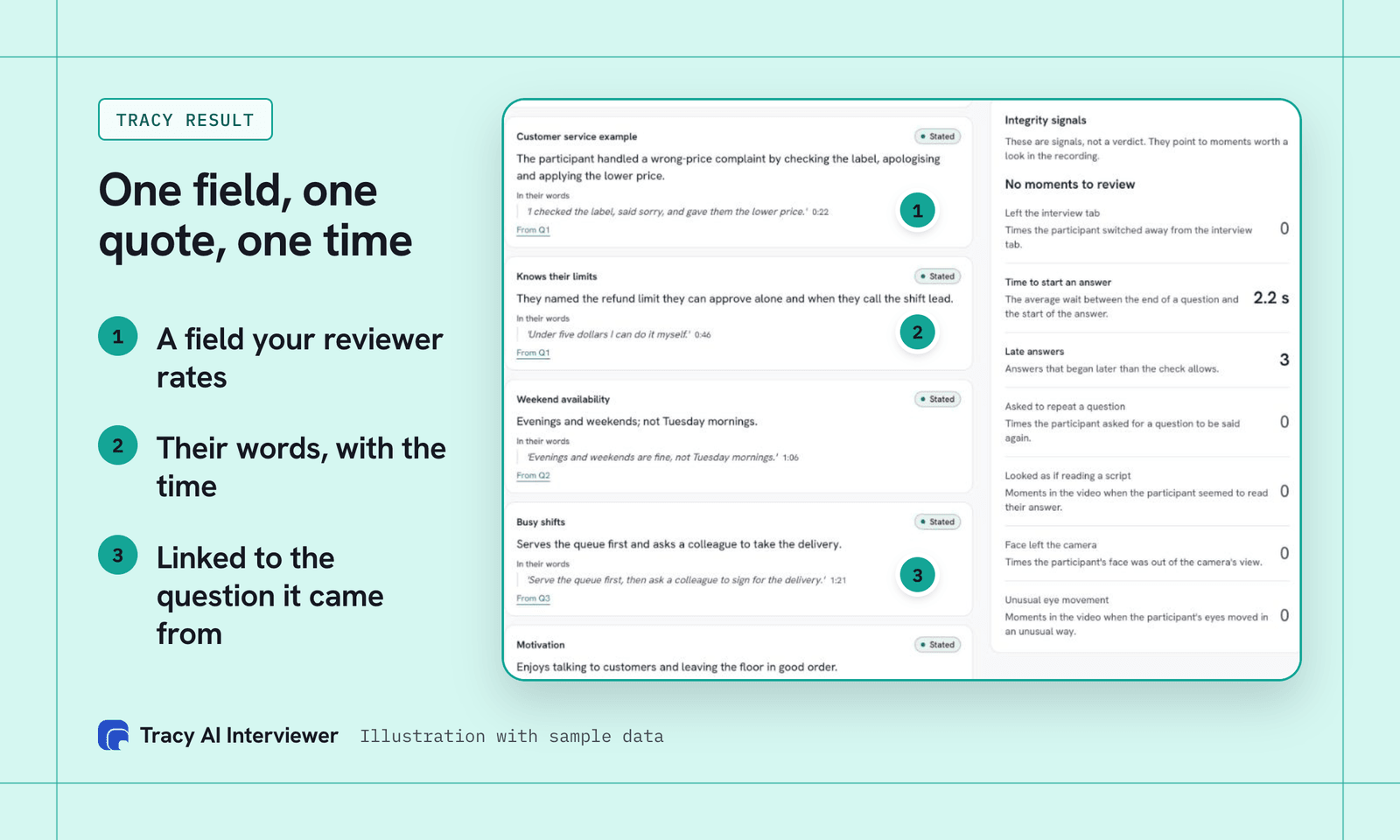
Reviewers rate fields that each carry a quote and the time it was said.
What mistakes spoil a structured interview?
Five mistakes spoil most structured interviews:
- Writing questions but no anchors, so ratings drift toward gut feel.
- Changing a question midway through a round, so the first twenty candidates and the last twenty were asked different things.
- Rating after a group discussion, which lets the loudest voice set everyone's number. Rate alone first.
- Asking too many questions to answer well. Six good questions with follow-ups beat fifteen with none.
- Treating structure as a guarantee. It narrows the room for bias without removing it, and a person still decides.
Where you screen many candidates, see how to screen candidates, and for ready-made wording, the interview guide template and interview scorecard template.
Which path fits you?
- Hiring many people for the same role: how Tracy handles volume hiring.
- Hiring engineers: technical interviews with Tracy.
- Writing the questions first: first round interview questions.
- Turning ratings into a decision: structured interview scoring.
Common questions
What is a structured interview?
How do you score answers with a rubric?
Do you ask the same questions in the same order?
How many questions should a structured interview have?
Can Tracy run a structured interview?
Run your structured first round in Tracy
Tracy runs the first-round interview on click, at any hour, and follows up on each answer. Your first 3 results are free.
Try it free (opens in a new tab) Book a demo (opens in a new tab)
Your first 3 results are free. No card needed.
Sources
- US Office of Personnel Management: Structured Interviews, retrieved 22 Nov 2026.
- Tracy AI Interviewer pricing, retrieved 22 Nov 2026.