
In short
About 9 to 10% of U.S. job postings offered remote work at least one day a week in mid-2026, up from about 3.5% in 2019 (Dallas Fed working paper, August 2026). Only 4% were fully remote in Q3 2026 (Robert Half).
Remote roles can draw applicants from anywhere, which puts the first round under pressure. Tracy AI Interviewer starts each applicant's interview from a link at any hour, follows up on the answers, and gives your team a written summary of what each person said.
For one Tracy customer, average time to hire went from 44 days to 7, and over a single month its interviews took on the workload of 53 full-time recruiters.
Next step: open one remote role in Tracy and read the first results.
Remote hiring statistics depend on what you count as remote. A posting that allows one day a week at home, a posting that is fully remote and a worker who did some work at home on a given day give three different numbers for the same labour market. This page lists each one with its publisher, period and definition. If your role is open to applicants everywhere, the volume question follows in high-volume recruitment.
What share of jobs are remote?
About 9 to 10% of job postings in Australia, Canada and the U.S. offered remote work at least one day a week as of mid-2026, and nearly 17% in the U.K., according to a Federal Reserve Bank of Dallas working paper from August 2026 that classified nearly 600 million postings. That count pools hybrid and fully remote roles. Before the pandemic the U.S. figure was about 3.5%, so it has risen more than three-fold.
Counting only fully remote postings gives a much smaller number. Robert Half's analysis of U.S. postings from TalentNeuron found 85% fully on-site, 11% hybrid and 4% fully remote in Q3 2026. The two counts use different posting data and different classification, so read them as two measures of one market.
Which remote number counts what?
Each row uses its own definition and period, so the rows are not additive. Sources: Federal Reserve Bank of Dallas (2026), Robert Half (2026), U.S. Bureau of Labor Statistics (2026), Jobgether (2026).
| Measure | Figure | Who counted, how, when |
|---|---|---|
| Remote day offered | About 9-10% | Dallas Fed, U.S. postings stating at least one remote day a week, mid-2026 |
| Same measure, 2019 | About 3.5% | Dallas Fed, U.S. postings, 2019 |
| Fully remote postings | 4% | Robert Half, TalentNeuron U.S. postings, Q3 2026 (11% hybrid) |
| Could work at home | 36.9% | BLS American Time Use Survey, wage and salary workers, 2024-2025 average |
| Did work at home | 33.6% | BLS American Time Use Survey, same workers and period |
| Workdays at home | One quarter | Full U.S. workdays in 2025, as the Dallas Fed paper cites the Stanford-led SWAA |
| Applications per post | 8.8 times | Jobgether estimate, worldwide-open remote posting against its average, Sept 2026 |
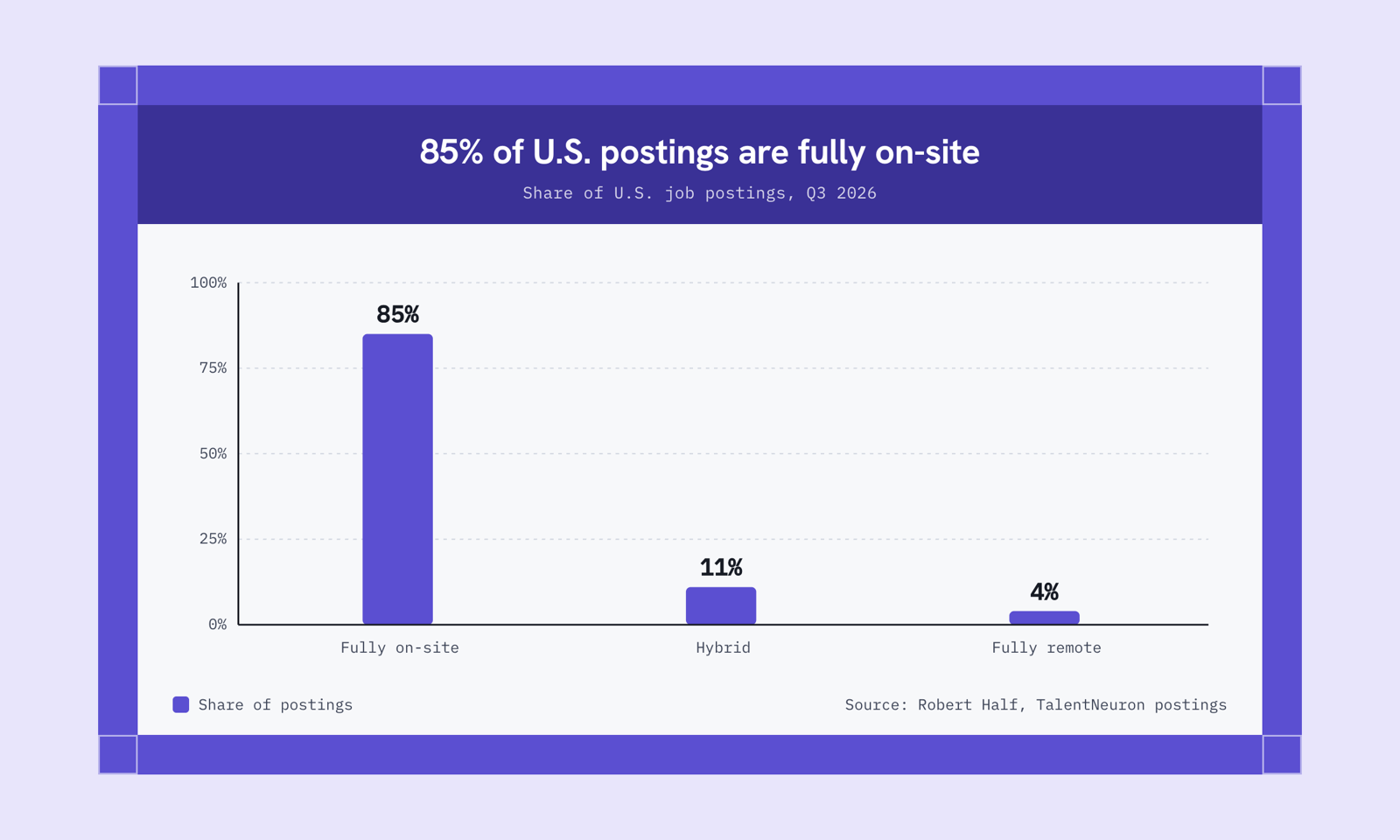
More than four in five U.S. postings are fully on-site, and fully remote postings are 4%.
How many people work from home?
The U.S. Bureau of Labor Statistics reports that 36.9% of wage and salary workers could work at home and 33.6% did, averaged over 2024 and 2025 in the American Time Use Survey. The share of workers who work at home is larger than the share of postings that say so. The Dallas Fed paper explains that postings describe the flow of new jobs rather than all existing ones, and that the remote share of postings is smaller than the remote share of employment. The paper also cites survey data that put one quarter of full U.S. workdays at home in 2025.
Occupation shapes the pattern, with finance, insurance, information and communications showing especially high remote shares in the Dallas Fed data.
Do workers prefer remote work?
Many job seekers say flexibility matters. Robert Half reports that 46% of professionals are already looking or plan to look for a new role in the second half of 2026, that nearly 2 in 5 (39%) say finding a job with more remote flexibility is a primary motivation, and that 64% of workers say work-life balance and remote work options would motivate them to change jobs. Robert Half describes the surveys as developed by Robert Half and conducted by independent research firms.
Jobgether, which tracks remote postings on its platform, estimated that a new worldwide-open remote posting drew 8.8 times the average applications on its platform in September 2026, and that only 4.0% of new remote postings on it were open worldwide. The figures describe who applies on Jobgether, not the whole market, but they suggest that the more open the location, the larger the applicant pool.
What does a remote applicant pool do to the first round?
A pool drawn from many cities and time zones is hard to screen by phone. Booking phone screens across time zones adds a wait before anyone has spoken to an applicant.
Tracy AI Interviewer takes the booking out. You write the role brief or bring your own questions, share one link, and each applicant starts when ready, at any hour, in the browser. Tracy listens, waits for the end of the thought and asks the follow-up that the answer calls for, so a polished line gets a second question. Your team reads a written summary of what each person said to each question, with the words and timestamps behind it, and decides who moves on. Tracy reports what was said and does not rank applicants.
A sample note with invented data shows the shape: an applicant describes finding a replacement supplier the same afternoon a plan changed, and Tracy asks how the guests were told. The reviewer sees both answers with their times. To see it on your own pool, run one remote role through Tracy and compare the summaries with your phone screens.
Cost follows results: $1 per credit, one credit per started 20 minutes, so 100 interviews of up to 20 minutes cost up to $100.
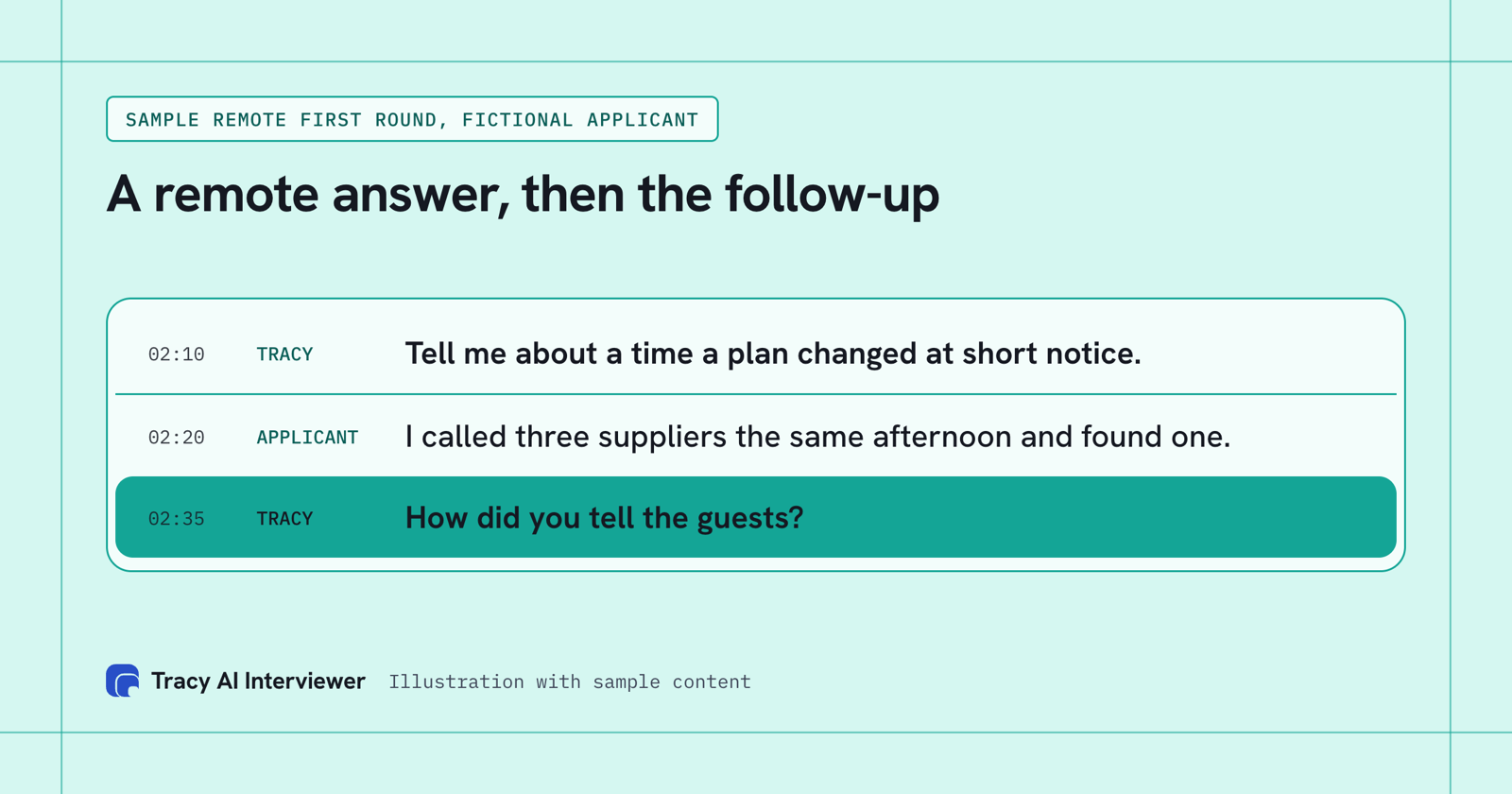
A remote applicant answers when it suits them and still gets the follow-up a live interviewer would ask.
What about interview fraud in remote hiring?
In January 2025 the FBI's Internet Crime Complaint Center said North Korean IT workers had been observed using artificial intelligence and face-swapping technology during video job interviews, and advised completing as much of the hiring and onboarding process as possible in person. Remote hiring cannot always meet that advice, so teams look at what the interview itself can show.
Tracy's video interviews run integrity signals unless you turn them off: leaving the full-screen window, the face leaving the camera, and a pop-up when the face leaves the frame. The signals and their evidence go to a human reviewer. They are never proof, candidates are told before the interview, and a person makes every decision. For the wider picture, see candidate fraud statistics and how to spot a fake candidate.
Which path fits you?
- Planning a remote search: how to run remote hiring.
- Measuring speed: time to hire statistics.
- Absorbing a large pool: high-volume recruitment.
- Checking that an applicant is who they say: what interview fraud looks like.
- Seeing how candidates treat waiting: candidate ghosting statistics.
Volume hiring with Tracy follows a role from the first link to the report.
Common questions
What share of jobs are remote?
Do workers prefer remote?
How many people work from home in the U.S.?
Why do remote job statistics disagree?
Do remote jobs get more applications?
Interview every applicant, not just a few
Tracy interviews each applicant from a link at any hour and follows up on every answer. Your first 3 results are free.
Try it free (opens in a new tab) Book a demo (opens in a new tab)
Your first 3 results are free. No card needed.
Sources
- Federal Reserve Bank of Dallas: Remote Work Across Jobs, Companies and Space, Working Paper 2629, August 2026, retrieved 23 Nov 2026.
- Robert Half: remote work statistics and trends, retrieved 23 Nov 2026.
- U.S. Bureau of Labor Statistics: workers who could work at home, did work at home, 2024-2025, retrieved 23 Nov 2026.
- Jobgether: remote hiring trends, September 2026, retrieved 23 Nov 2026.
- FBI IC3: public service announcement I-012325-PSA, 23 January 2025, retrieved 23 Nov 2026.