
In short
Ghosting runs both ways, and the count depends on who is asked. LiveCareer's March 2026 survey found 25% of job seekers had ghosted an employer, Indeed's 2019 survey of nearly 900 employers found 83% had been ghosted by a candidate, and Greenhouse's 2024 survey found 61% of job seekers had been ghosted after an interview.
For hirers who watch applicants vanish, Tracy AI Interviewer starts each first-round interview on click, at any hour, and follows up on every answer, so nobody waits for a calendar slot.
Next step: open one role and see how many applicants start.
Candidate ghosting statistics are really two sets of numbers. One counts job seekers who stop replying to employers, and the other counts job seekers who say employers went quiet on them. The surveys below differ in year, country and wording, so each figure comes with its source. How long hiring takes shapes both sides, and time to hire statistics sets out the clocks.
How many employers are ghosted by candidates?
The only employer-side count in these sources is Indeed's 2019 survey of nearly 900 employers, in which 83% said they had been ghosted by a candidate. Indeed's matching survey of more than 4,000 job seekers found 18% admitted ghosting an employer. More recently, LiveCareer's March 2026 survey of more than 1,000 US workers found 25% had ghosted a potential employer. The table lines up the main figures.
Which ghosting number counts what?
Each row has its own publisher, base, country and year, so read them one at a time. Sources: LiveCareer (2026), Indeed (2019), Greenhouse (2024), CandE (2025).
| Measure | Number | Who counted, how, when |
|---|---|---|
| Job seekers who ghosted an employer | 25% | LiveCareer, more than 1,000 US workers, published March 2026 |
| Job seekers who ghosted an employer | 18% | Indeed, more than 4,000 job seekers, August 2019 |
| Employers ghosted by a candidate | 83% | Indeed, nearly 900 employers, August 2019 |
| Workers ghosted during hiring | 45% | LiveCareer, 1,008 US employed adults, April 2026 |
| Job seekers ghosted after an interview | 61% | Greenhouse, 2,500 workers in the US, UK and Germany, late 2024 |
| Candidates with no reply 1 to 2+ months on | 31% | CandE, North American candidates, 2025 (29% in 2024) |
Where do candidates stop replying?
Candidates go quiet early more often than late. Of the job seekers who had ghosted, LiveCareer reports that 15% stopped responding after applying, 13% after a screening call or interview and 8% after an offer. The release does not state the base for these shares. Indeed's 2019 job seekers who ghosted said half skipped a scheduled interview, 46% stopped replying to recruiters or hiring managers, 22% did not show up for their first day and 19% accepted a verbal offer and then disappeared.
The employers in that survey saw the same moments from the other side: 84% of those who had been ghosted had candidates miss interviews and 65% had first-day no-shows. Seventy percent were moderately or extremely frustrated, and 29% had strategies to stop ghosting before it started.
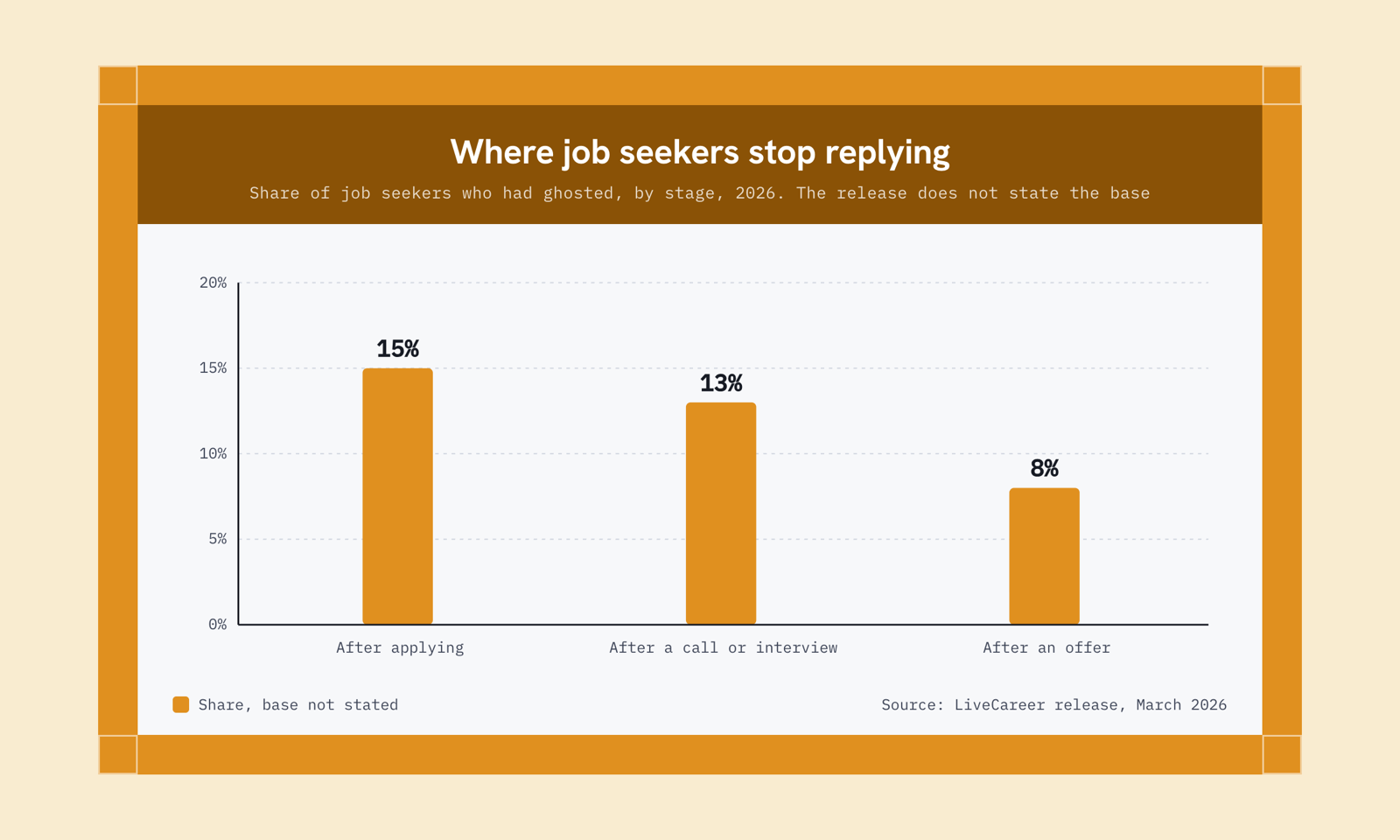
Candidates are about as likely to go silent after applying as after a first conversation.
Why do candidates ghost?
Mostly because something else came along or the job stopped looking right. In LiveCareer's survey, 51% of those who went silent had taken a different job, 32% had lost interest in the role or company, 23% cited a negative interview or poor communication, 23% said pay or benefits were uncompetitive, 19% said the job differed from its description and 12% said the process felt too automated or impersonal. Indeed's 2019 respondents gave a similar picture: over half decided the job was not right, 40% had another offer, and 26% were not comfortable telling the employer they had changed their mind.
How common is employer ghosting?
Between 31% and 61% of candidates, depending on the survey and the stage. LiveCareer's April 2026 survey of 1,008 US employed adults found 45% had been ghosted during the hiring process, and 48% would not apply to that company again. Greenhouse found 61% of job seekers in the US, UK and Germany had been ghosted after an interview in late 2024, up nine points since April 2024. In CandE's North American data, 31% of candidates in 2025 had heard nothing 1 to 2 months or more after applying, against 29% in 2024.
What can a hiring team do about the silence?
A candidate who applied last week and has no date for a screening call is the one who takes the other job, and waiting is the part a team controls. Tracy AI Interviewer removes the booking step from the first round: each applicant gets a link, starts when ready at any hour, and Tracy follows up on each answer in the applicant's own field. A dropped applicant can rejoin within 10 minutes, and the window is set per customer. Your team reads the recording, the transcript and what each person said to every question, and decides who goes forward.
One Tracy customer brought its average time to hire from 44 days down to 7, and over a month Tracy handled the work of 53 full-time recruiters.
In an invented sample, a call centre applicant describes a difficult call, Tracy asks how they opened it, and a second answer confirms night-shift availability, each timestamped.
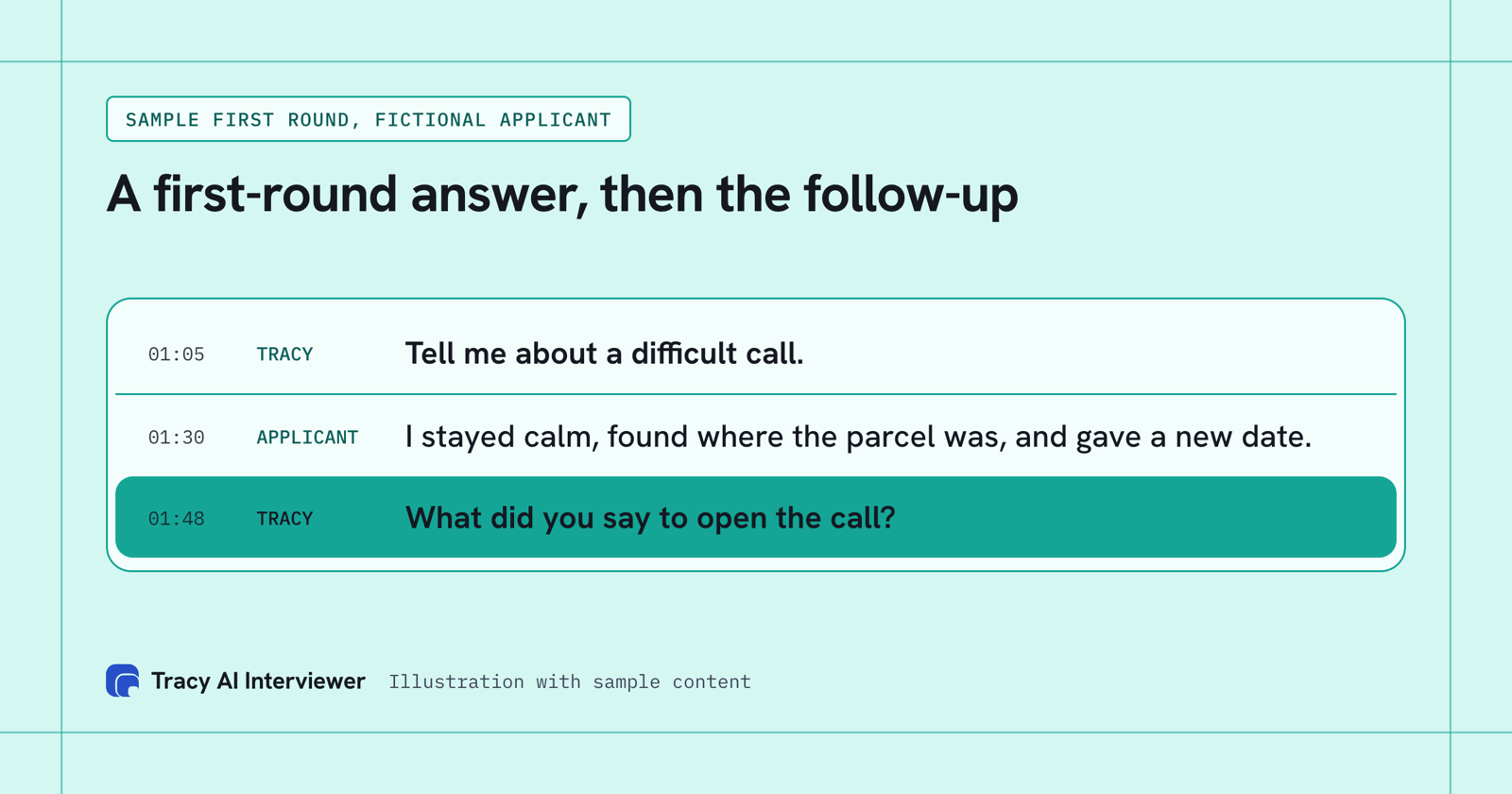
An applicant gets a real first-round question and a follow-up at once, without waiting for a calendar slot.
Which path fits you?
- Sizing the top of the funnel: how many applicants a job draws.
- Keeping applicants engaged: candidate engagement.
- Running a first round for many people: high-volume recruitment.
- Comparing tools: candidate engagement AI tools.
- Checking the applicant's side: candidate experience audit.
Hiring at volume with Tracy traces a role from first link to report.
Common questions
How many employers are ghosted by candidates?
Why do candidates ghost?
How common is employer ghosting?
Does ghosting hurt the employer?
At what stage do candidates ghost most?
Interview every applicant, not just a few
Open one role in Tracy and each applicant starts a first-round interview on click, with follow-ups. The first 3 results are free.
Try it free (opens in a new tab) Book a demo (opens in a new tab)
Your first 3 results are free. No card needed.
Sources
- LiveCareer: One in Four Job Seekers Have Ghosted a Potential Employer (March 2026), retrieved 23 Nov 2026.
- LiveCareer: 48% of workers would not apply again after being ghosted (survey of 14 April 2026), retrieved 23 Nov 2026.
- Indeed: The Ghosting Guide (August 2019), retrieved 23 Nov 2026.
- Greenhouse: 2024 State of Job Hunting report, retrieved 18 Nov 2026.
- CandE Benchmark Research 2025 key statistics (Survale fact sheet), retrieved 18 Nov 2026.