
In short
The counts depend on who is asked: 40% of US managers say they interviewed someone later found to use a fake identity (Checkr, September 2026), 6% of 3,000 candidates admitted interview fraud (Gartner, 2Q25), and Gartner forecasts one in four candidate profiles will be fake by 2028.
Tracy AI Interviewer runs the video interview and shows a reviewer integrity signals (leaving full screen, face out of frame) next to the recording and transcript, so a person can judge them.
Next step: run one expert screen and read the signals and the follow-ups yourself. The first 3 results are free.
Nobody can count fake candidates directly, so every figure on candidate fraud comes from someone's report: a manager recalling an interview, a candidate admitting it, a vendor's detection data or an analyst's forecast. For an expert-network or AI-lab team, a CV and a pass on a screen do not show who sat the interview, which is why Tracy AI Interviewer shows a reviewer the evidence behind each result. What interview fraud is defines the term.
How many job candidates are fake?
No survey measures that. The closest figures are 40% of US managers who say they interviewed a candidate later found to use a fake identity, and 6% of surveyed candidates who admitted interview fraud. The table sets out the main numbers with their scope.
Which number counts what?
Each row has its own publisher, population and period, so the rows are not comparable with one another. Sources: Checkr (fielded September 2026, published October 2026), Greenhouse (November 2025), Gartner (July 2025), CodeSignal (February 2026).
| Measure | Number | Who counted, where, when |
|---|---|---|
| Managers who interviewed a fake identity | 40% | Checkr, 3,000 US managers, September 2026 (31% in 2025) |
| Managers who confirmed or strongly suspected an interview proxy | 67% | Checkr, same survey: 34% confirmed, 33% strongly suspected |
| Managers who met AI-generated or deepfake interview content | 38% | Checkr, same survey |
| Organizations with at least one type of hiring fraud | 86% | Checkr, same survey, past year |
| US recruiters who spotted candidate deception | 91% | Greenhouse, US subsample of 665 recruiters and managers, November 2025 |
| Candidates who admitted interview fraud | 6% | Gartner, 3,000 job candidates, 2Q25 |
| Fraud attempts on assessments | 35% in 2025 | CodeSignal platform data, release of 25 February 2026 (16% in 2024) |
| Candidate profiles that will be fake | 1 in 4 by 2028 | Gartner forecast, worldwide, not a measurement |
How common is hiring fraud?
Checkr, a background-check provider, surveyed 3,000 employed US managers involved in hiring between 11 and 16 September 2026. It reports that 86% of organizations experienced at least one type of hiring fraud in the past year, and 38% of managers reported AI-generated or deepfake interview content. Greenhouse's November 2025 report says 91% of US recruiters it surveyed had spotted candidate deception and 65% of hiring managers had caught applicants using AI deceptively, with 18% naming deepfakes.
Identity checks tend to come late: Checkr found only 29% of companies verify identity as soon as someone applies, 49% wait until after at least one live interview and 18% wait until the final interview or later. Checkr also found that only 23% of managers are extremely confident their process would catch a fraudulent candidate.
What do assessment platforms see?
CodeSignal, an assessment vendor, said cheating and fraud attempts on its proctored assessments rose from 16 percent in 2024 to 35 percent in 2025. For entry-level assessments it reported a rise from 15 percent to 40 percent, and attempt rates of 48 percent in Asia-Pacific against 27 percent in North America. The release does not state the base for the entry-level and regional rates, so read them as CodeSignal's own detection data.
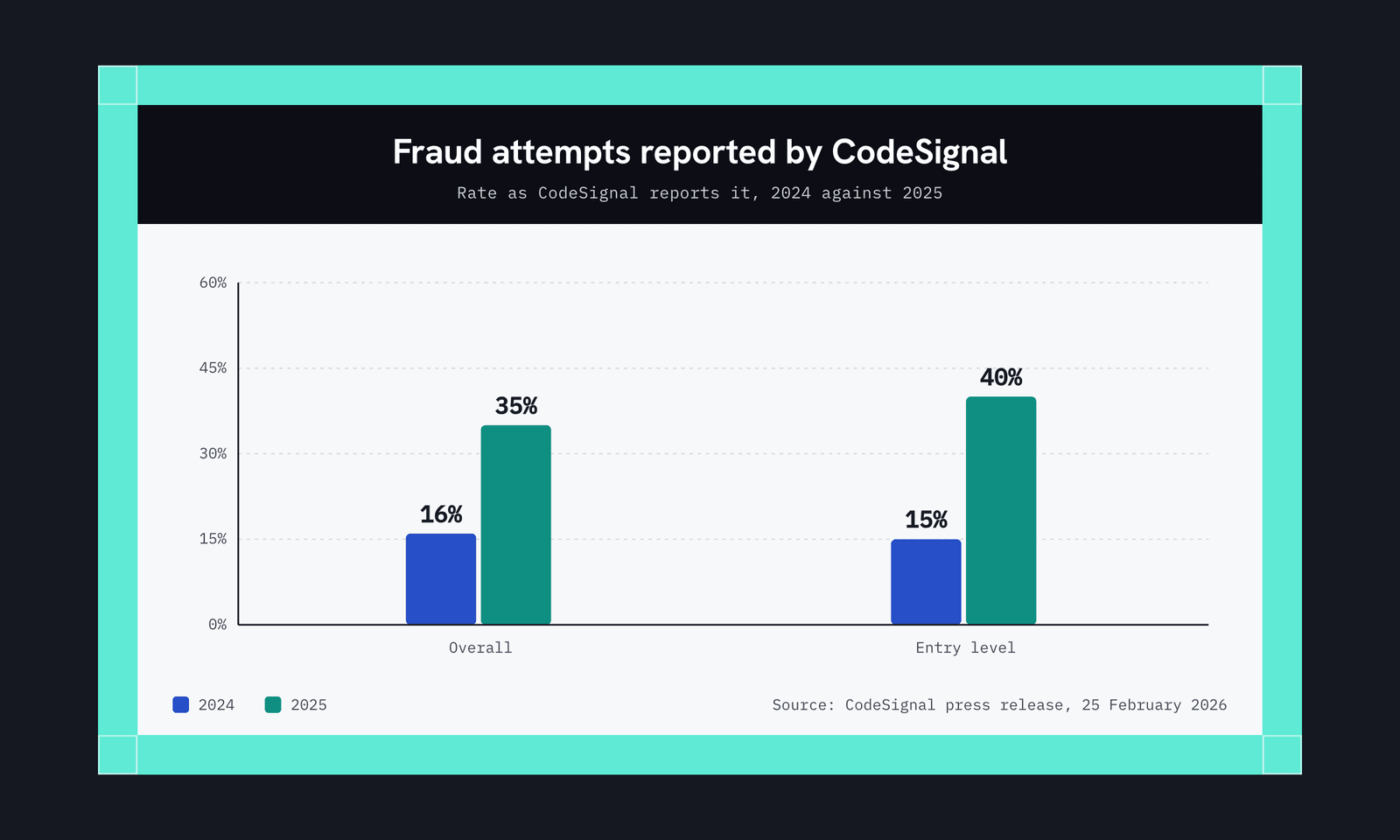
CodeSignal reports fraud attempts more than doubled between 2024 and 2025, from 16% to 35% overall and from 15% to 40% at entry level.
What do law-enforcement sources say?
The US Justice Department's June 2025 actions included searches of 29 known or suspected laptop farms across 16 states, with more than 100 US companies targeted and more than 80 US persons' identities compromised in schemes involving North Korean remote IT workers. The FBI's alert of 13 October 2026 says such workers pay Americans for services such as interviewing on someone's behalf. Its January 2025 alert described AI and face-swapping technology used in video job interviews. These are enforcement counts and investigators' findings, not a rate of fraud among candidates.
What does this mean for an expert screen?
Surveys like these count fraud after the fact. For an expert screen the practical question is what you can see during the interview itself. Tracy runs the video interview, so each candidate gets the same questions and a follow-up in their own field. A thin answer gets asked for the detail behind it.
Tracy also runs integrity signals unless they are turned off: it notes when the candidate leaves full screen or the face leaves the frame. Candidates are told the interview is recorded, and the evidence goes to a person with the recording and transcript.
A sample note, with invented data, shows what the reviewer reads. A candidate gave a short answer about a project on their CV and was asked for the first problem they hit. The signals line reads: left full screen 2, face out of frame 5. A person decides whether to invite the candidate to a live conversation. Tracy takes no decision, and the signals are not proof.
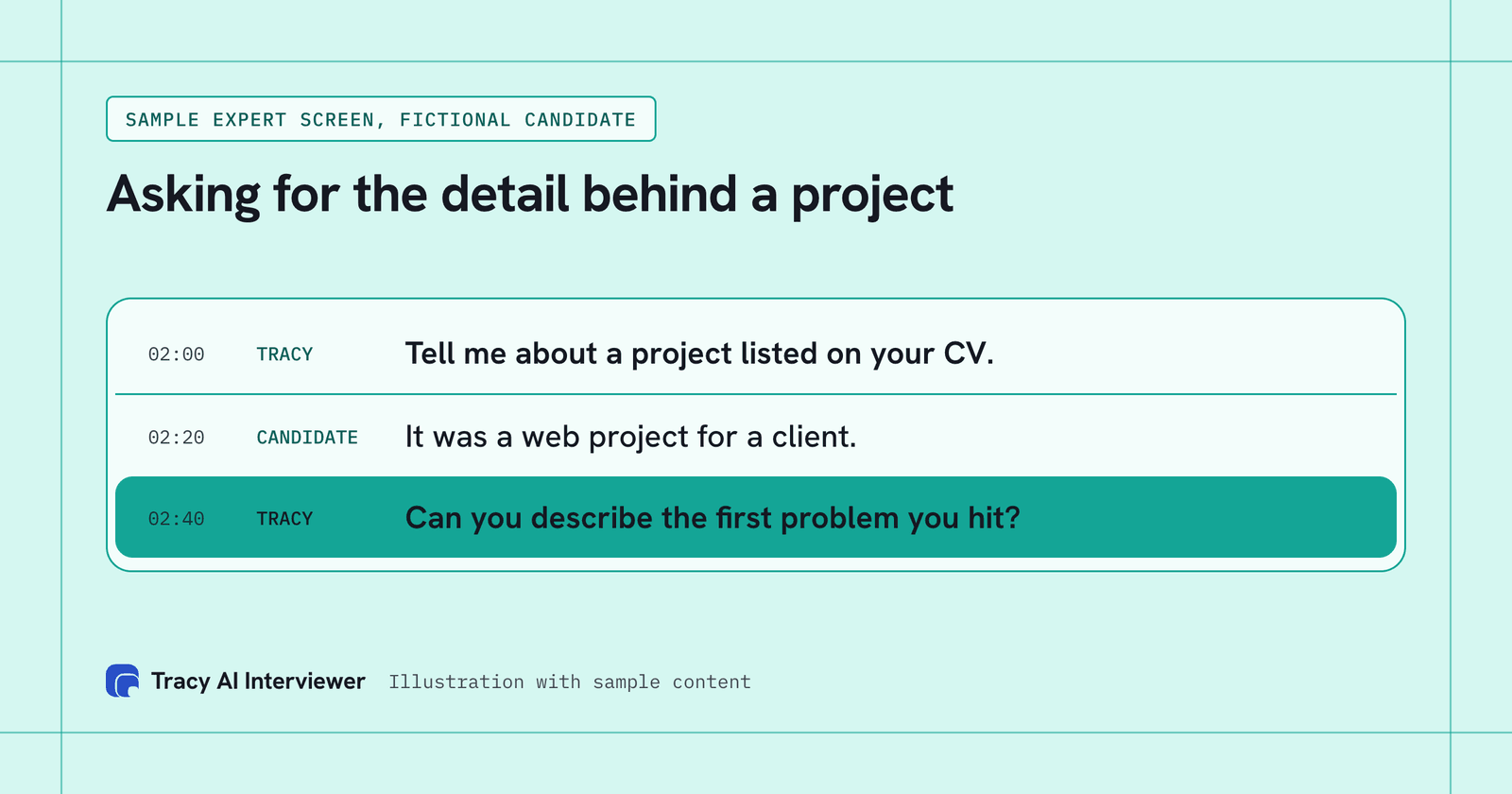
A follow-up asks for the first problem the candidate hit, so a thin answer shows how much detail sits behind it.
Which path fits you?
- Spotting the patterns: candidate fraud detection.
- Defining the problem: what interview fraud is.
- A stand-in taking the call: proxy interviews.
- Faces and voices altered by AI: what a deepfake candidate is.
- Vetting experts for a platform: AI interview tools for expert vetting.
How a platform vets experts in one interview shows the whole path.
Common questions
How many job candidates are fake?
How common is hiring fraud?
What is a proxy interview?
Do integrity signals prove a candidate cheated?
See the evidence behind every interview
Tracy shows a reviewer the integrity signals and the answers behind each interview. Your first 3 results are free.
Try it free (opens in a new tab) Book a demo (opens in a new tab)
Your first 3 results are free. No card needed.
Sources
- Checkr: The Hiring Hoax 2026, retrieved 22 Nov 2026.
- Greenhouse: 2025 AI in Hiring Report, press release of 19 November 2025, retrieved 22 Nov 2026.
- Gartner: Survey Shows Just 26% of Job Applicants Trust AI Will Fairly Evaluate Them, press release of 31 July 2025, retrieved 19 Nov 2026.
- CodeSignal: press release on assessment fraud, 25 February 2026, retrieved 22 Nov 2026.
- US Department of Justice: coordinated nationwide actions against North Korean remote IT worker schemes, 30 June 2025, retrieved 18 Nov 2026.
- FBI IC3 alerts I-012325-PSA (23 January 2025) and I-101326-PSA (13 October 2026), retrieved 18 Nov 2026.
- Tracy AI Interviewer: Pricing, retrieved 11 Nov 2026.