
In short
Remote hiring means finding, interviewing and selecting people you will never meet in an office. The benefits are a wider pool and interviews that fit any time zone. The cost is more applicants to read and more to check.
Tracy AI Interviewer gives every remote applicant a first interview on click, at any hour, with follow-ups in their own field. Your reviewer reads a recording, a transcript and what each person said to each question.
Ask counsel about employment and tax rules where each hire lives, and keep a person on every decision. Start with one remote role and read ten reports.
What is remote hiring?
Remote hiring is recruiting for roles where the person works away from a company office, and doing the recruiting itself without in-person steps. Sourcing, screening, interviewing, references and the offer all happen online. Searches for the remote hiring process and for how to hire remote employees are asking how to run those steps well.
Fully remote roles are still a small share of the market. Robert Half's analysis of US job postings found that in Q3 2026, 85% were fully on-site, 11% were hybrid and 4% were fully remote. In Robert Half's survey, 39% of those looking or planning to look for a job said more remote flexibility was a primary motivation (the sample is not stated). A remote role can draw applicants from anywhere, which is the main reason hiring for it gets harder to run.
What are the benefits of remote hiring?
- A pool that is not limited to commuting distance, so a role can reach people with the exact skills.
- Interviews that fit applicants' hours and time zones instead of your office day.
- No travel or room booking for first rounds, so more people can be seen.
- One process for everyone, which makes answers easier to compare.
A bigger pool means more first conversations, and a team that books each one by hand runs out of hours before it runs out of people. Time to hire statistics shows how long hiring takes today.
How does remote hiring differ from in-office hiring?
Five steps where remote hiring changes what the team does.
| Step | Remote hiring | In-office hiring |
|---|---|---|
| Sourcing | Any location the role allows | Commuting distance |
| First interview | Link applicants open at their own hour | Slot in office hours |
| Identity | Checked on video or by documents | Seen in person |
| Records | Recording and transcript | Interviewer notes |
| Employment law | Rules of where the hire lives | Rules of the office location |
How does the remote hiring process work?
State the time zones, tools and working hours in the post, so applicants can rule themselves out. Run the first interview asynchronously, so nobody needs to be awake at the same time as your team. Read the results side by side instead of in the order they arrived. Then invite the people you chose to a live round with the hiring manager.
The second step is the one that takes the hours. Mass hiring process and hiring process cover the steps either side of it.
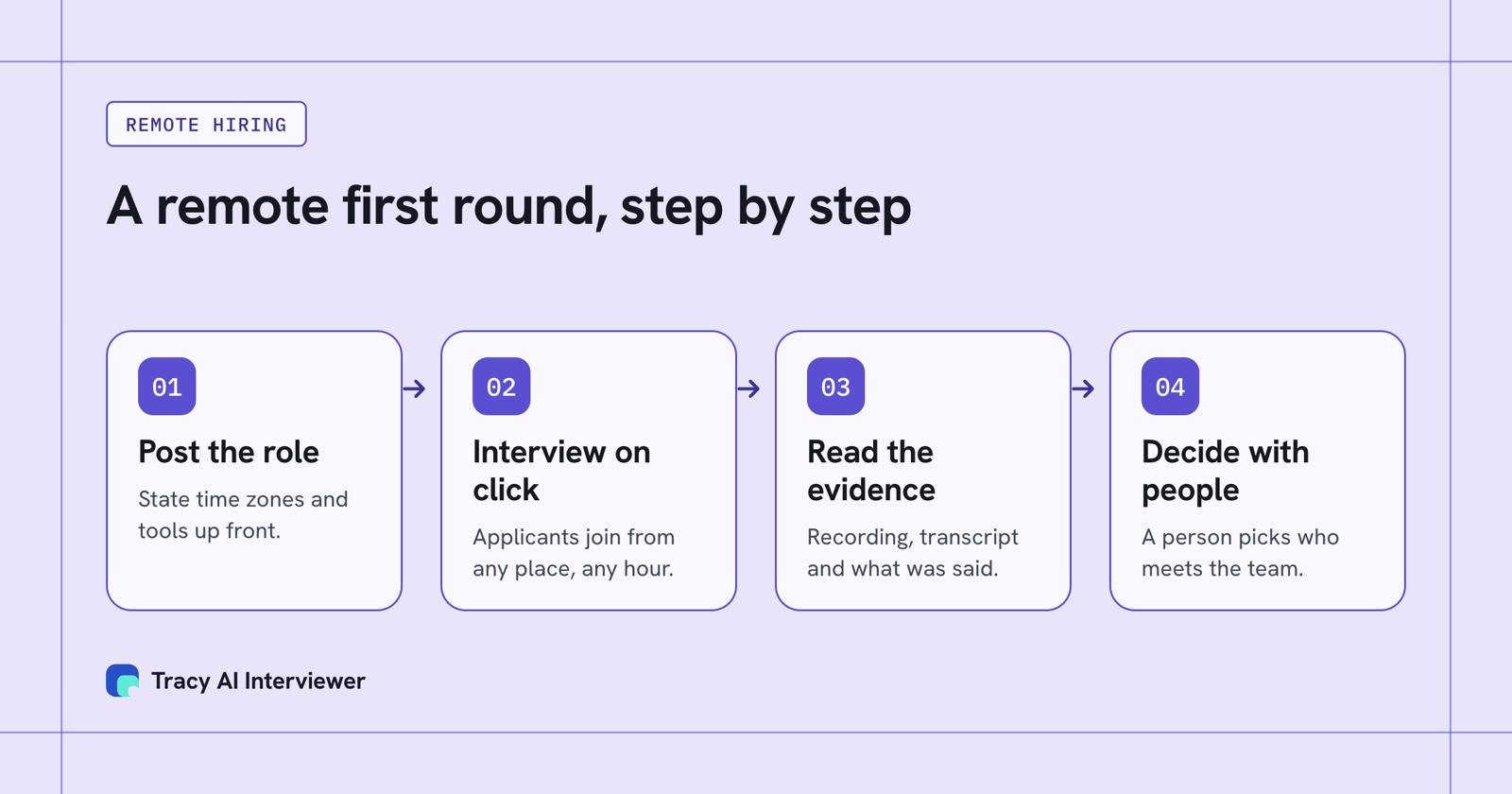
The first interview runs on the applicant's schedule, and a person reads the results before any live round.
What legal issues apply to remote hiring?
The law that applies depends on where the person lives, so ask counsel before the first offer outside your own state or country. The law firm Orrick's FAQ on hiring across borders says a company "would need to make sure that it is properly set up as an employer for that foreign jurisdiction" and that hiring abroad "may result in foreign tax and other obligations for the company". It also warns that using an independent contractor "may create misclassification risk if the worker is performing work that would otherwise be performed by an employee."
In practice, that means three questions to settle per hire: which country or state's employment rules apply, what tax and payroll registration follows, and whether the person is an employee or a contractor. Candidate notice also applies to the interview itself: tell people it is recorded and that AI runs it.
How do you check who you are interviewing?
The FBI's Internet Crime Complaint Center warned in January 2025 that North Korean IT workers had been observed using artificial intelligence and face-swapping technology during video job interviews. That is a reason to keep a person looking at the evidence.
Tracy runs integrity signals in video interviews, such as leaving the full-screen window, and shows them to the reviewer with the recording. They are for a person to weigh and never proof of anything. Candidates are told about the recording, a person reviews the result, and no decision is automated.
How does Tracy fit a remote hiring process?
An applicant in any time zone clicks the link and starts in the browser, with no account and no calendar. The link can go in a message or a careers page, WhatsApp included. Here is an excerpt for a customer success role, invented for this page:
Question 1. A customer says they might cancel. What do you do?
What they said. Asks what changed, reviews their usage, and offers a call with the person who owns the problem.
Quote at 02:20. "First I ask what changed. Then I look at their usage."
Follow-up. What if they have not logged in for a month?
Field, accounts managed. About 60 (evidence: question 2, 05:50).
Tracy writes results back to your ATS, and the API and MCP connections let your own system, Claude or ChatGPT set up interviews and read results. At one customer, average time to hire fell from 44 days to 7. Pricing is $1 per credit, one credit per started 20 minutes, and the first 3 results are free. For recruiting at volume across many roles, see hiring at volume.
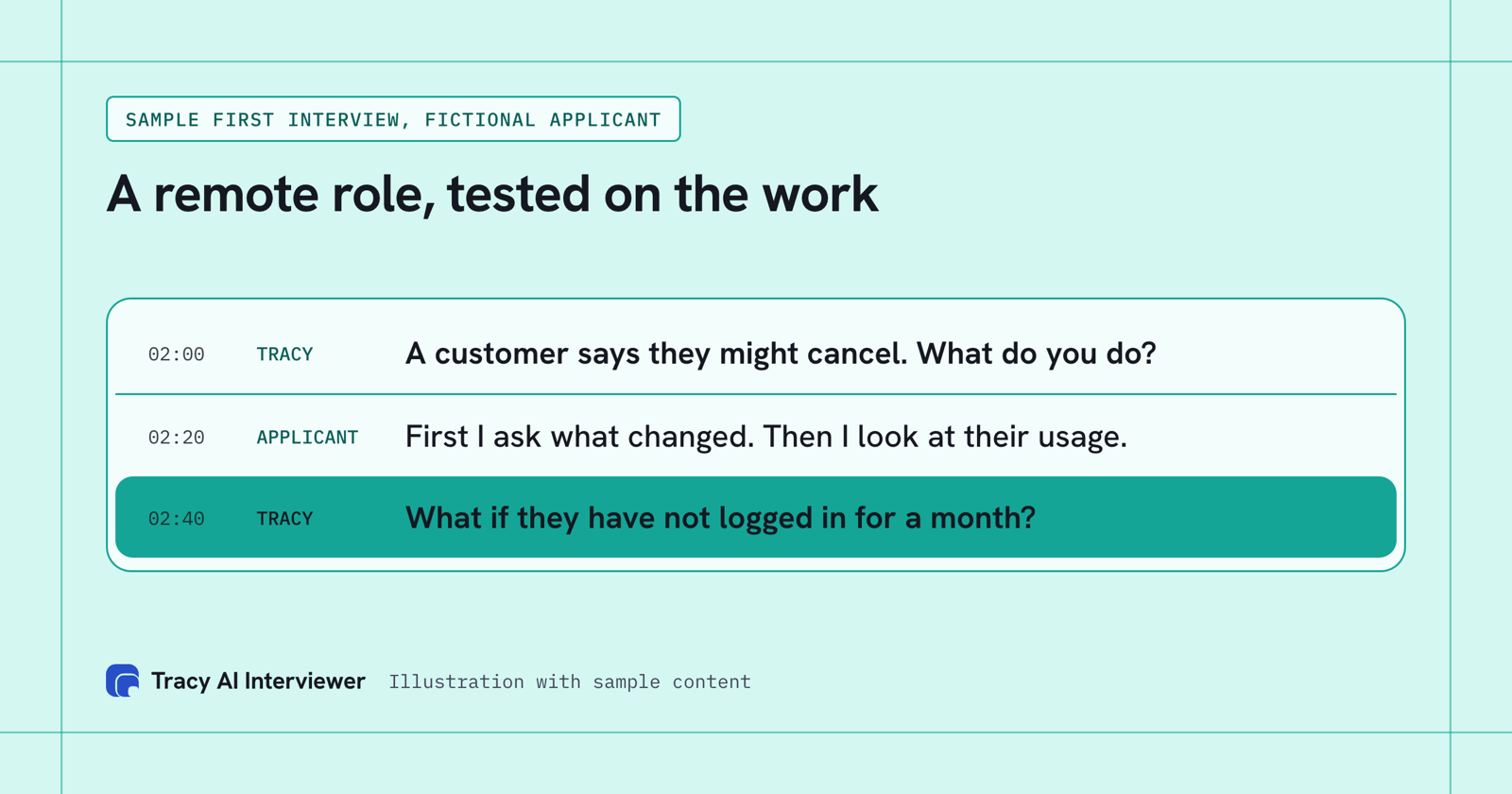
One follow-up tests a remote applicant on the work, not on how they present on camera.
Which path fits you
- Looking for market figures on remote work: remote hiring statistics.
- Checking for fake or coached candidates on video: candidate fraud statistics.
- Booking the live rounds across time zones: interview scheduling.
- Screening many applicants for one role: high-volume recruitment.
Common questions
What are the benefits of remote hiring?
How does remote hiring differ from in-office hiring?
What legal issues apply to remote hiring?
How do you hire remote employees at volume?
Does Tracy decide who to hire remotely?
Interview remote applicants at any hour
Send one link to applicants in any time zone and read what each person said. First 3 results free.
Try it free (opens in a new tab) Book a demo (opens in a new tab)
Your first 3 results are free. No card needed.
Sources
- Orrick, Can I hire people from a different country? (FAQ), retrieved 23 Nov 2026.
- Robert Half, Remote work statistics and trends (2026), retrieved 23 Nov 2026.
- FBI IC3, Public service announcement I-012325-PSA (23 Jan 2025), retrieved 23 Nov 2026.
- Tracy AI Interviewer: Pricing, retrieved 11 Nov 2026.