In short
An MCP server gives your AI access to a tool or data, and a skill teaches it how to do a task your way, so add whichever is missing. Tracy AI Interviewer is the MCP half of a hiring example: connect it to Claude and the chat can draft, invite and read results while Tracy runs the interview. You approve each create and invite, and your team decides what the answers mean.
What MCP and skills each do well
MCP vs skills is a question about what is missing. If the AI cannot reach something, you need MCP, which does that job well: one connection gives Claude access to a tool or data and actions inside it. If the AI can reach everything but does the job the wrong way, you need a skill, which does that job well: a plain-text folder that holds your steps, format and checklist. Anthropic puts it in one line: MCP connects Claude to data, and skills teach Claude what to do with that data. The two do different jobs and are usually used together.
In a hiring workflow, the skill makes sure the brief names the role and the three things the round must find out, and the connector lets Claude reach Tracy. The interview itself, with the person on the other end, is Tracy's.
What is an MCP server?
The Model Context Protocol, MCP, is an open standard created by Anthropic for AI applications to connect with tools and data sources. An MCP server is the program on the other end. It runs on a person's device or on the internet and exposes tools, resources and prompts. Tools are actions the AI can take, such as search, create and modify. Resources are data it can read, such as files and records.
In Claude, someone who adds an MCP server sees it as a connector. The difference between a connector and an MCP server is mostly vocabulary, and what an MCP server is has the longer definition.
What is a skill?
A skill is a folder of instructions, with optional scripts and reference files, that Claude loads to handle a specific task. Each skill has a SKILL.md file that says when it should be used and what Claude should follow. Claude sees only each skill's name and one-line description until a request matches one. Then it reads the full instructions, and opens extra files only if those instructions point to them.
Skills are available on Pro, Max, Ultra, Team and Enterprise plans, and they need code execution and file creation switched on. The format is the open Agent Skills specification, so a skill written for Claude can work in other tools that adopt it. A skill someone shares with you, or one you upload, has not been reviewed by Anthropic, so read its SKILL.md before you turn it on.
MCP vs skills: which do you need?
| MCP server | Skill | |
|---|---|---|
| What it gives Claude | Access to a tool or data, and actions in it | A method: steps, format, checklist |
| What it is | A server a service runs, added as a connector | A folder with a SKILL.md file |
| Reach for it when | Claude must read or change something outside the chat | Claude has access but not your process |
| Control you keep | Per-tool permissions: Always allow, Needs approval or Blocked | Read the skill before you turn it on |
| Who writes it | The service's developer | You or your team, in plain text |
A plugin is the third word you will meet. It packages skills, MCP connectors, commands and agents into one unit you install once and share. You can add a skill or a connector on its own, so a plugin only earns its place when you want several installed together.
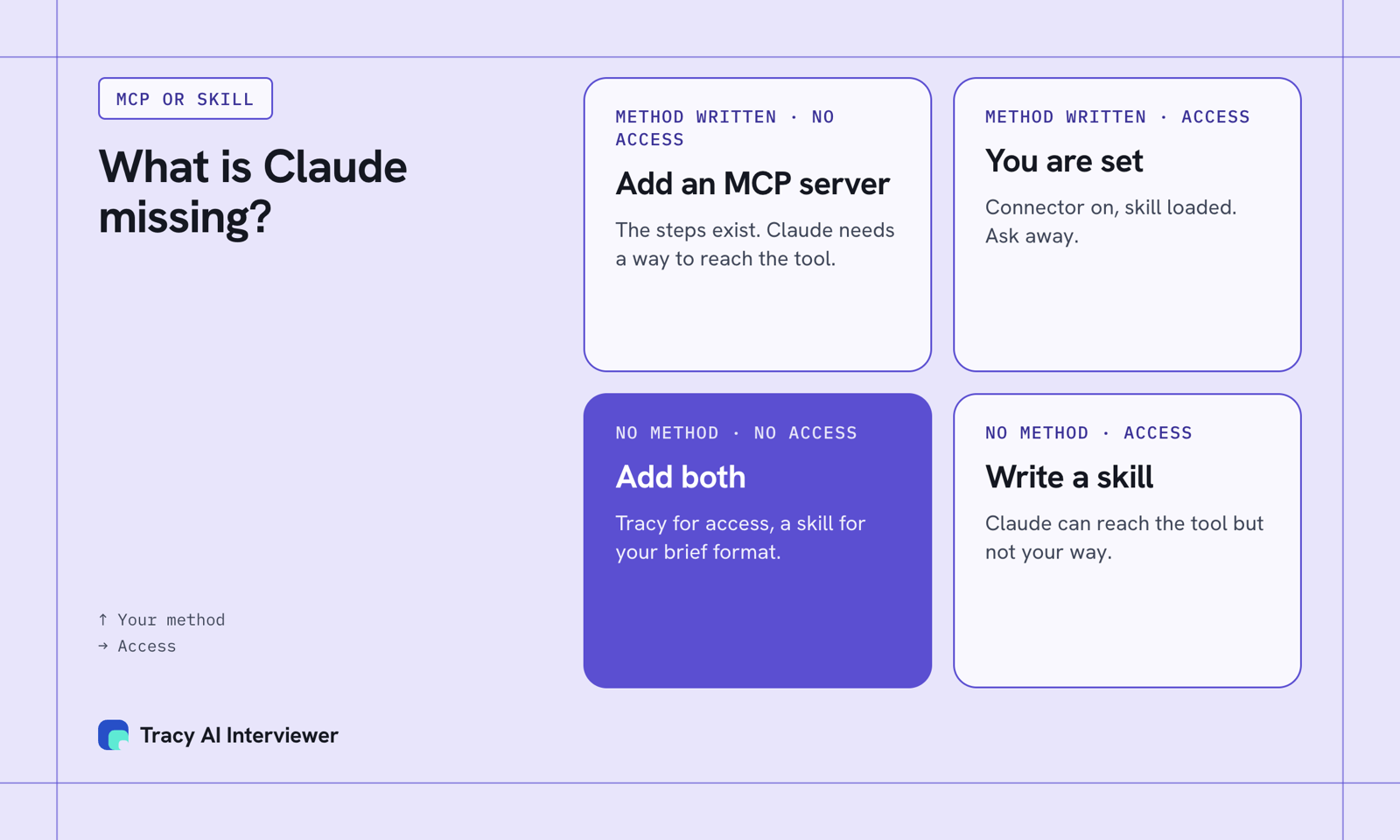
An MCP server gives Claude access; a skill gives Claude the method.
A worked example: a hiring skill and Tracy's connector
The problem to solve: Claude can reach Tracy and still write a brief that skips what your team always asks first.
Tracy AI Interviewer is the MCP side of this example. Add it to Claude as a custom connector at tracyinterview.ai/mcp and the chat can draft an interview from a short brief, create it, invite people by email, read results and check your balance. Creating and inviting wait for you to approve a preview, and Claude asks before it uses the tools. Tracy's Claude guide has the setup steps.
The skill side is yours to write. Say your team always opens an interview brief with the role, the three things the first round must find out and a time limit. A short skill can hold that rule: when someone asks for a new interview, ask for those three items first, then write the brief in your order. The skill never talks to Tracy; it shapes the request, and the connector acts on it.
Here is what that looks like for a tier 2 technical support engineer. The skill gathers the role, three must-haves (debugging logs and API errors, clear written and spoken explanations, calm under pressure) and a limit of about 15 minutes. Tracy's server returned the draft below on 14 Nov 2026 for that brief. No skill was involved, and nothing was saved or invited.
Draft returned by Tracy: Technical support engineer troubleshooting and communication interview
- Can you describe a recent technical problem a customer had and how you approached solving it?
- How do you use debugging logs and API error messages when troubleshooting issues?
- Tell me about a time you had to explain a technical problem and solution to a customer who was frustrated or upset.
- What steps do you take to stay calm and effective when dealing with high-pressure or difficult customer situations?
- Is there anything else you want to share about your experience or approach to technical support?
The result fields were Problem solving approach, Use of debugging tools, Communication skills and Handling pressure. You edit the draft before anything is created. Five questions in about 15 minutes is roughly three minutes each, and limits like that are what a skill can hold: the time limit, the number of questions, and a rule such as no catch-all last question if your team never wants one.
Used together, you ask for an interview, the skill makes sure the brief is complete, Claude calls Tracy to draft it, and you approve the preview. For more on skills in a hiring team, see Claude skills for recruiting and the hiring manager skill.
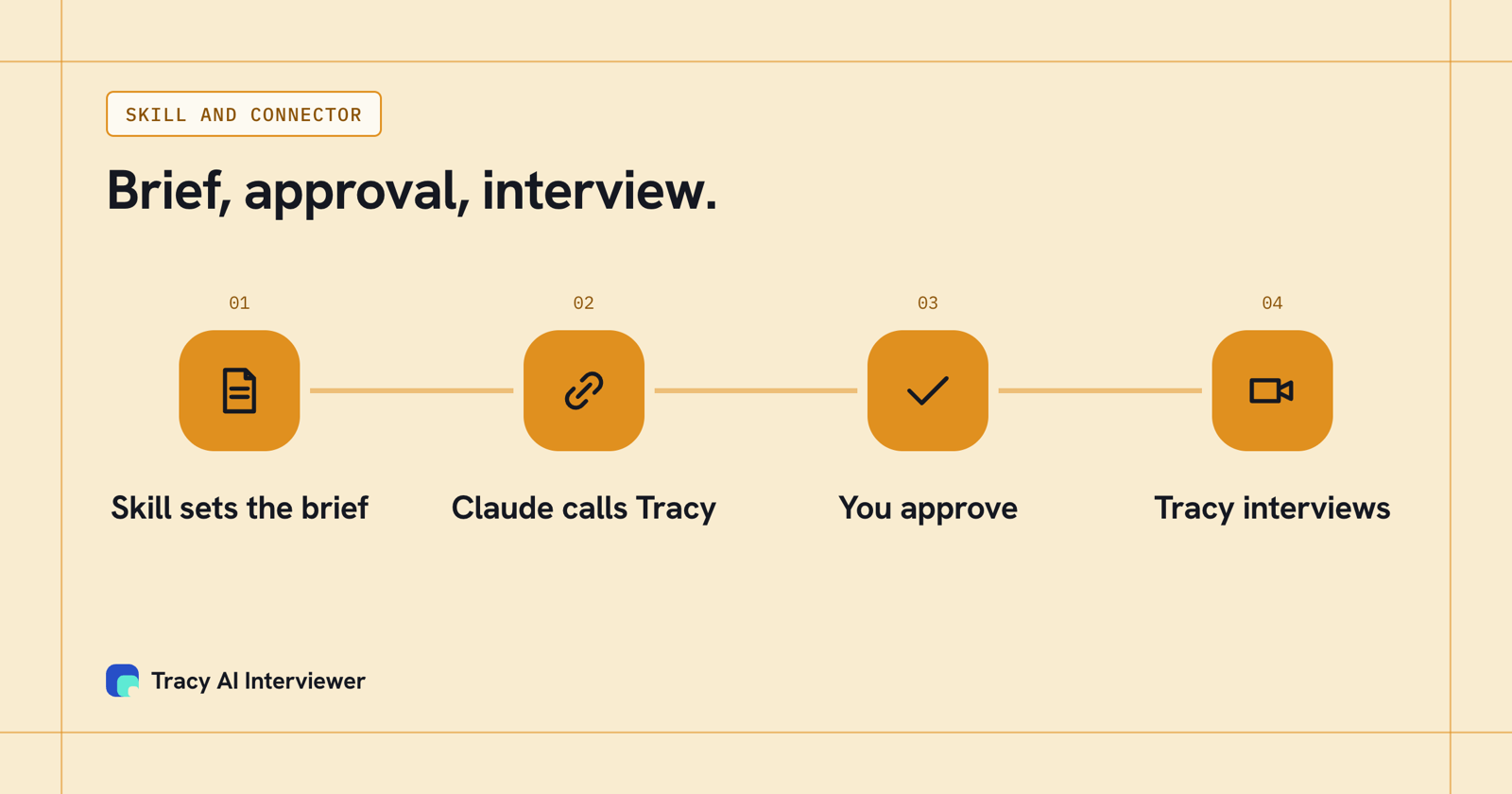
The skill shapes the request, Claude calls the connector, you approve, and Tracy runs the interview.
What Tracy adds to an MCP and skills setup
01. Reach every person
Once you approve the brief, each person you invite starts on click, at any hour, with no scheduling and no recruiter on the call. The skill sets the brief once and every invitee gets the same interview.
02. Ask the next question
Tracy follows the answer in the person's own field and waits for it. A short answer to the debugging question gets a sharper one before the interview moves on.
03. Keep the evidence
Every result holds a recording, a timestamped transcript and a written assessment per question with its reasoning. Reading results in the chat returns what each participant said to each question, the result fields and a note for an applicant tracking system. Tracy does not score, rank or reject anyone. A person reads the answers and decides.
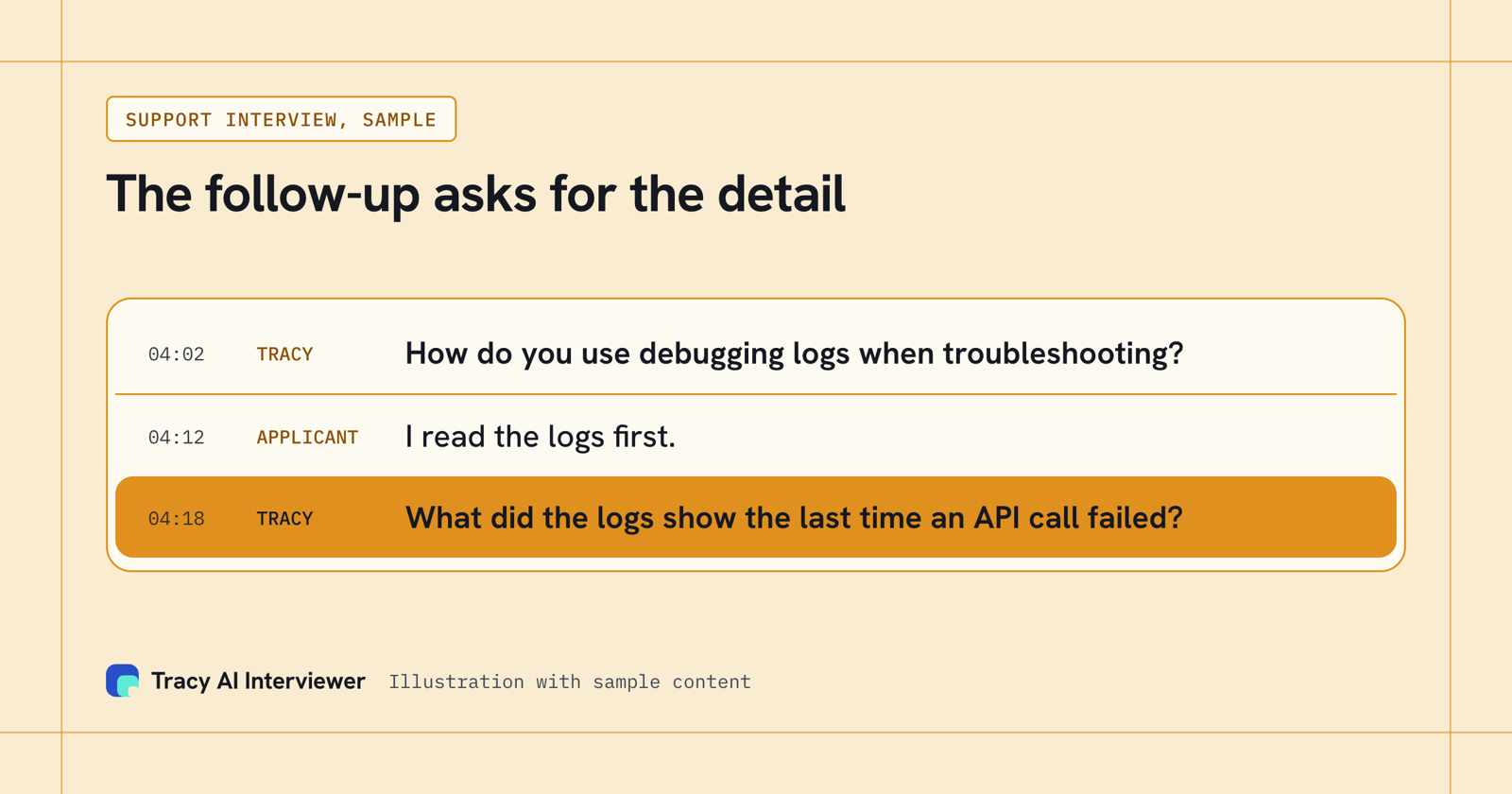
The follow-up asks for the detail the first answer left out.
Common mistakes
- Building a server for a style rule. If the only thing you need is "write it this way", a skill is lighter. A server is for reaching a system.
- Expecting a skill to log in. A skill is instructions. It can tell Claude how to use a connector, but the access has to come from the connector.
- Trusting every connector the same. A connector added by its address is custom: Anthropic has not reviewed it, and Anthropic's advice is to click Always allow only for servers you trust.
- Turning on skills without reading them. Shared and uploaded skills are not reviewed by Anthropic and can carry scripts.
Common questions
What is the difference between Claude skills and MCP?
MCP vs skills vs plugins: which is which?
Can a skill use an MCP server?
Do skills work outside Claude?
Do I need a paid plan?
Does Tracy's MCP server cost extra?
Connect Tracy, then write the skill
Add Tracy to Claude and draft one interview in chat. You approve the preview, and the first 3 results are free.
Try it free (opens in a new tab) Book a demo (opens in a new tab)
Your first 3 results are free. No card needed.
Sources
- Anthropic, Connectors, skills, and plugins, retrieved 14 Nov 2026.
- Anthropic, Skills overview, retrieved 14 Nov 2026.
- Anthropic, Skills explained (5 Mar 2026), retrieved 14 Nov 2026.
- Anthropic, Model Context Protocol (MCP), retrieved 14 Nov 2026.
- Anthropic, Add a connector that isn't in the directory, retrieved 14 Nov 2026.
- Tracy AI Interviewer, Connect, retrieved 10 Nov 2026.
- Tracy AI Interviewer, suggest_interview draft (tool call), retrieved 14 Nov 2026.