In short
Function calling is how a model asks your application to run a function you defined. MCP is an open standard for connecting AI applications to external systems, so one server can serve many chat apps. They are different things.
For a technical hiring team the difference shows in setup. Tracy AI Interviewer runs as one MCP server that ChatGPT, Claude, Gemini, Mistral and Copilot Studio use, and it drafts the interview from a job description you paste into the chat.
Use function calling inside one app you build. Use MCP when several apps need the same tool.
Is MCP the same as function calling?
They are different things at different layers. Anthropic describes tool use, which it also calls function calling, as letting Claude call functions that you define or that Anthropic provides. OpenAI's version works the same way: the model returns a tool call, and your application executes the code with the input from that call. MCP is the layer around the tool. The MCP site calls it an open-source standard for connecting AI applications to external systems, and compares it to a USB-C port for AI applications. If the term is new to you, an introduction to MCP servers covers the basics. If you run technical hiring, you will hear both terms from engineers and vendors.
What the vendors' own documentation says, read 22 November 2026.
| Question | Function calling | MCP |
|---|---|---|
| Who defines the tool | Your app, in each request: a name, a description and a JSON schema | An MCP server exposes tools, resources and prompts |
| Who runs it | Your application runs client tools; Anthropic also runs some server tools | The MCP server runs it for any connected client |
| Reuse | Defined in each app that needs it | Built once, used by any client that supports MCP |
| Where it shows up | Model APIs, inside your own code | Claude, ChatGPT, VS Code, Cursor and others |
| Approval | Your code decides whether to run each call | Set by the host, not by MCP itself; Claude asks for approval before a connector runs |
What does the same tool look like both ways?
Say you want a model to draft interview questions from a job description. With function calling, your app declares the function in each request, with a name, a description and a JSON schema for its input. This is an example we wrote to show the shape:
{
  "name": "draft_interview",
  "description": "Draft interview questions from a job description.",
  "parameters": {
    "type": "object",
    "properties": { "job_description": { "type": "string" } },
    "required": ["job_description"]
  }
}
The model replies with a tool call that names draft_interview and fills in job_description. Your application runs the code and sends the output back in a second request, the flow OpenAI's guide describes. Anthropic's tool use takes the same pieces, with the schema under input_schema.
With MCP, that declaration does not live in your app. An MCP server exposes the tool, and any connected client that supports MCP can offer it to its model and send the call to the server, which runs it. For more on how the two differ from a plain web API, see MCP vs API.
When should you use each?
Use function calling when:
- one application of yours calls a model and needs a handful of functions;
- the functions touch your own code or data and nobody else needs them;
- you want full control of what happens between the tool call and the result.
Use MCP when:
- the same capability should work in more than one chat app;
- a vendor already ships a server, so your engineers do not rebuild the functions;
- people who do not write code should use the tool by asking in a chat.
A hiring stack can use both. A custom screening script uses function calling, and the vendor tools your recruiters use from a chat arrive over MCP.
Does MCP replace function calling?
No. Anthropic lists an MCP connector among its tool-use tools, to connect to remote MCP servers from the Messages API without a separate MCP client. OpenAI's MCP page shows an mcp tool in its Responses API. MCP changes where a tool comes from and who maintains it.
What does an MCP server look like for hiring?
Tracy AI Interviewer is a remote MCP server at tracyinterview.ai/mcp. ChatGPT, Claude, Mistral, Gemini and Copilot Studio use it as a connector, and Claude Code, Codex and Gemini CLI add it with one command. Its tools cover suggesting an interview, creating and updating it, inviting participants by email, turning a public link on or off, getting results, checking your balance and creating a top-up link. Creating, inviting and enabling the link need your approval of a preview first.
With function calling you declare each function in the tools of every request your app makes. Here your team gets one server and one setup. Paste a job description into the chat and Tracy drafts the questions from it. You edit them or bring your own.
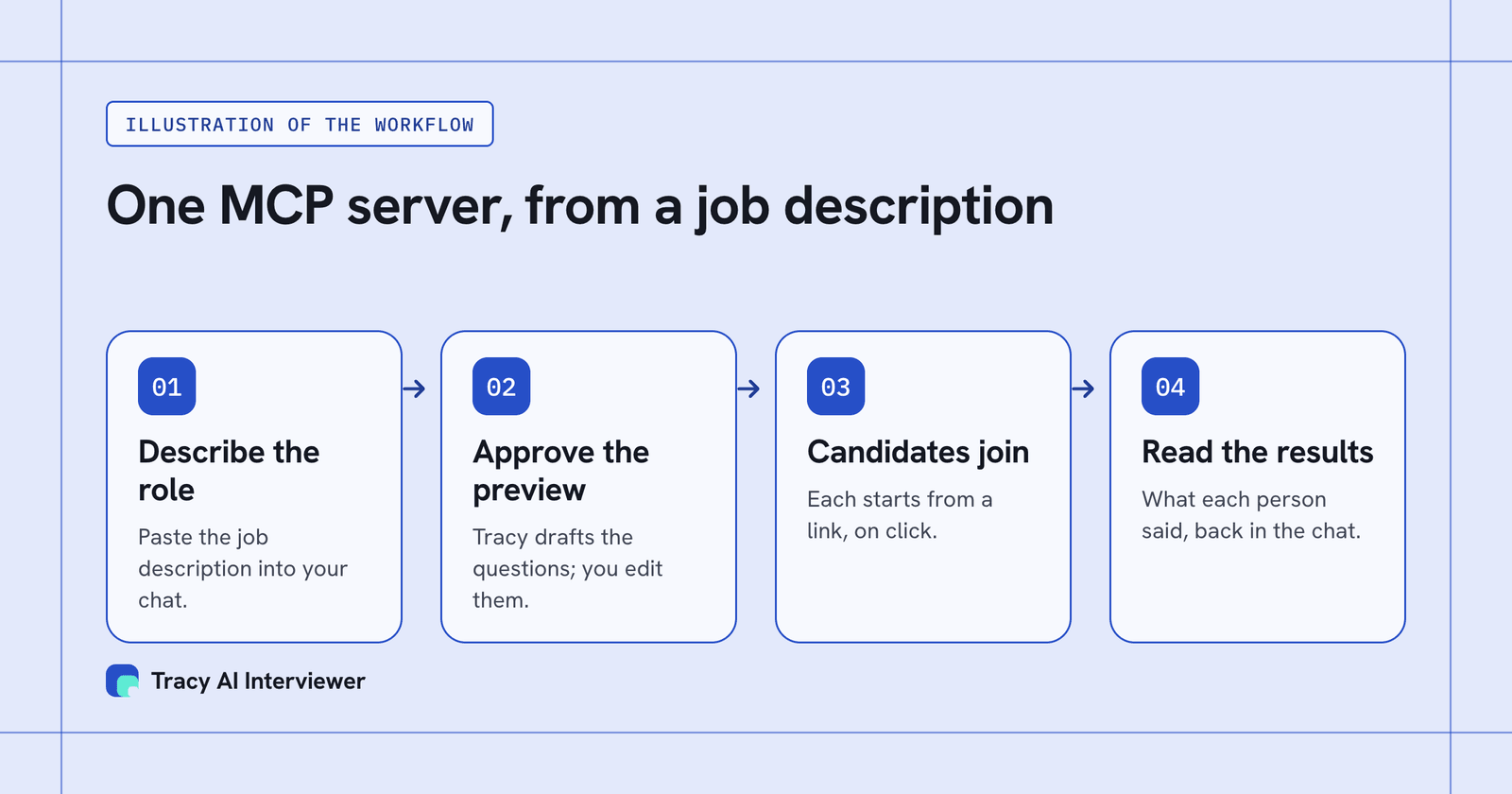
A job description becomes an interview and a set of results without leaving the chat.
What does the reviewer get back?
Here is an excerpt from a sample report, with an invented candidate. Asked to describe a feature they built on a language model, the candidate described a support reply drafter with retrieval over help articles, and said at 02:20, "A person approves every reply. The model only drafts." Tracy followed up with "How did you test it before launch?" A later question, at 06:15, produces the field "Regression set: yes, 120 cases". The reviewer sees the claim, the follow-up and the evidence for each field. For an engineering role, the reviewer reads the claim and the evidence and makes the call, because Tracy does not score or rank people.
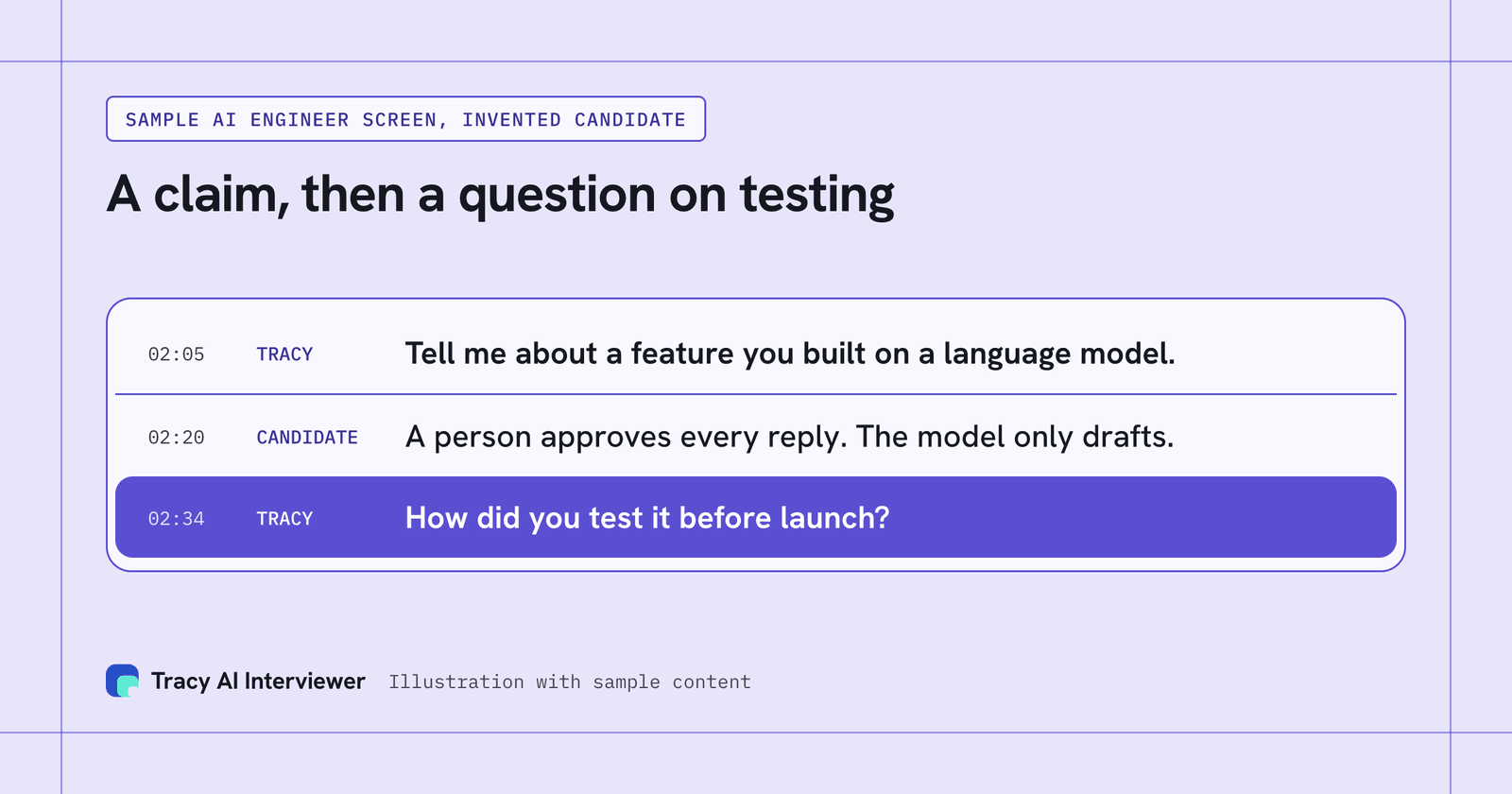
Tracy asks how the candidate tested the feature, so the reviewer sees the evidence.
What Tracy adds for technical hiring
Tracy takes the first technical conversation off your engineers' calendars. Each applicant starts on click, at any hour, and Tracy has completed 100K+ interviews. A claim such as "we tested it" gets a follow-up about how, and the recording and timestamped transcript behind each result let your team check the answer itself.
Which path fits you?
- API versus MCP: MCP vs API and MCP vs skills.
- The basics: what an MCP server is and what a remote MCP server is.
- Sign-in and approvals: MCP OAuth.
- Setup: add MCP to ChatGPT or add MCP to Claude.
- For recruiters: recruiting MCP servers.
Common questions
Is MCP the same as function calling?
When should I use each?
Does MCP replace function calling?
Do I need to write code to use Tracy's MCP server?
What does Tracy cost?
Try an MCP server on one role
Connect Tracy to your chat, paste a job description and approve the draft interview. First 3 results free.
Try it free (opens in a new tab) Book a demo (opens in a new tab)
Your first 3 results are free. No card needed.
Sources
- Anthropic, Tool use with Claude, retrieved 22 Nov 2026.
- OpenAI, Function calling guide, retrieved 22 Nov 2026.
- Model Context Protocol, What is MCP?, retrieved 22 Nov 2026.
- OpenAI, MCP documentation, retrieved 22 Nov 2026.
- Anthropic, Get started with custom connectors using remote MCP, retrieved 14 Nov 2026.
- Add Tracy AI Interviewer to Claude (public guide), retrieved 14 Nov 2026.