In short
An API gives your code a fixed set of calls, and MCP lets an AI app find a server's tools and use them while a person chats. Tracy AI Interviewer offers both, so you can ask Claude to draft and invite through its MCP server or have your own system request an interview through its API, and Tracy runs the interview either way. Your team decides which route fits the task.
What an API and MCP each do well
MCP vs API is a choice between two ways to reach the same tool. An API is a set of requests one program can make to another, and it does that job well: developers read its documentation, write the call once, and it runs the same way on every trigger with nobody watching. MCP is a standard for how an AI app finds and uses a server's tools while you chat, and it does that job well: you paste a URL, sign in, and the app asks the server what it offers. What an MCP server is has the longer definition. The two also work together: a tool on an MCP server can call an API underneath, and the MCP documentation lists API calls among the things tools do.
Neither route can sit across from the customer who cancelled. Your code can create an interview the moment the cancellation arrives, and a person in Claude can do the same by asking, but the conversation with that customer has to be held by something. That part is Tracy's.
What is the difference between MCP and an API?
An API is written for a developer, who learns the calls and builds them into code. MCP is written for an AI app, which asks the server what tools it has and then picks one to fit your request. Six differences follow from that.
Six differences between an API and an MCP server.
| Question | API | MCP |
|---|---|---|
| Who uses it | A developer's code | An AI app, for a person |
| How it is found | Read the docs, write the call | The app asks the server what it offers |
| Who decides | Your code, call by call | The AI picks a tool; you approve |
| Setup | Code and an API key | Paste a URL and sign in |
| When it fails | A status code and a stable error code in JSON | The chat shows the problem, or the connector is off |
| Best for | Work that runs on a trigger | Work done in a chat |
The discovery step is part of the protocol: a client lists a server's tools and their inputs before it uses any of them. The approval step belongs to the AI app. Claude asks before it uses a tool, and ChatGPT asks for confirmation before write actions by default.
Two squares in the grid below are mixed cases. A form you build starts with a person but calls the API through code you wrote. An agent starts from code or a schedule and finds its tools through MCP, so nobody is in the chat; with Tracy, creating, inviting and turning on a public link still wait for a person to approve a preview. In Claude, a server you add is called a connector, and connectors vs MCP covers the naming.
One task, both ways: invite five people to an interview
Take one job: set up a customer interview and invite five people. The job is the same on both routes, and each route spends its effort in a different place.
Through MCP, in Claude. With Tracy's server added, you write: "Set up a customer discovery interview for people who cancelled last month." Claude uses Tracy's tools to suggest an interview and shows you a preview. You change what you want, approve it, then ask Claude to invite five email addresses you supply, and approve the invitations. Later you ask who has finished and read the results. There is no code and no key to handle.
Through the API. A developer builds the same job into your own system, with an API key made under Integrations in your Tracy account. The key goes in the Authorization header of each call and reaches your account's interviews only. Tracy's public API guide describes three calls from a key to an invited person:
- List your interviews.
- Create one by sending who you are interviewing and what you want to find out. Tracy drafts the title, questions and result fields, and the answer carries the new interview's id. The guide's own example sends a body with two fields,
participants("Candidates for a Customer Support Lead role") andgoal("Whether they have led a small team and stay calm with upset customers"). - Invite a participant to it. Tracy emails them their personal link, and the answer holds the link too.
So when a customer cancels, your system can run those calls and the person gets the link with nobody typing in a chat. The guide adds two details a developer will want: a repeated call carrying the same idempotency key is not run twice, and the API allows 20 calls per account in any 10 minutes to generate questions or to create an interview without a setup, counted however the call is made, including from an AI app. Other calls are not limited.
Count the calls for five people: one to create the interview and five to invite, six in all. Only the create call counts toward the limit of 20 in any 10 minutes, so the sensible pattern is one interview and many invitations, not a new interview for each person. The Connect page links the API guide next to the MCP setup.
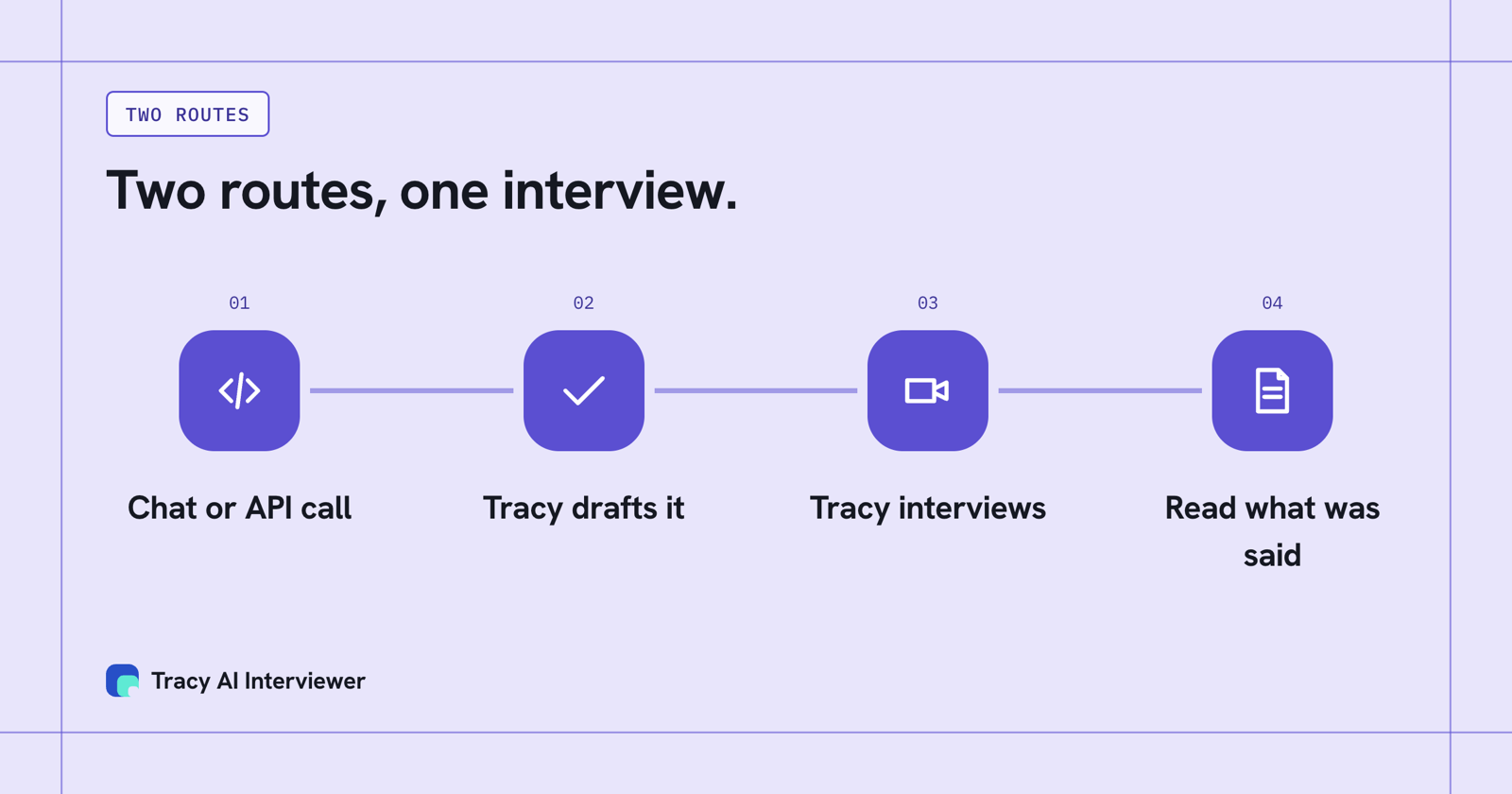
One request starts the interview, and Tracy runs it whichever route sent it.
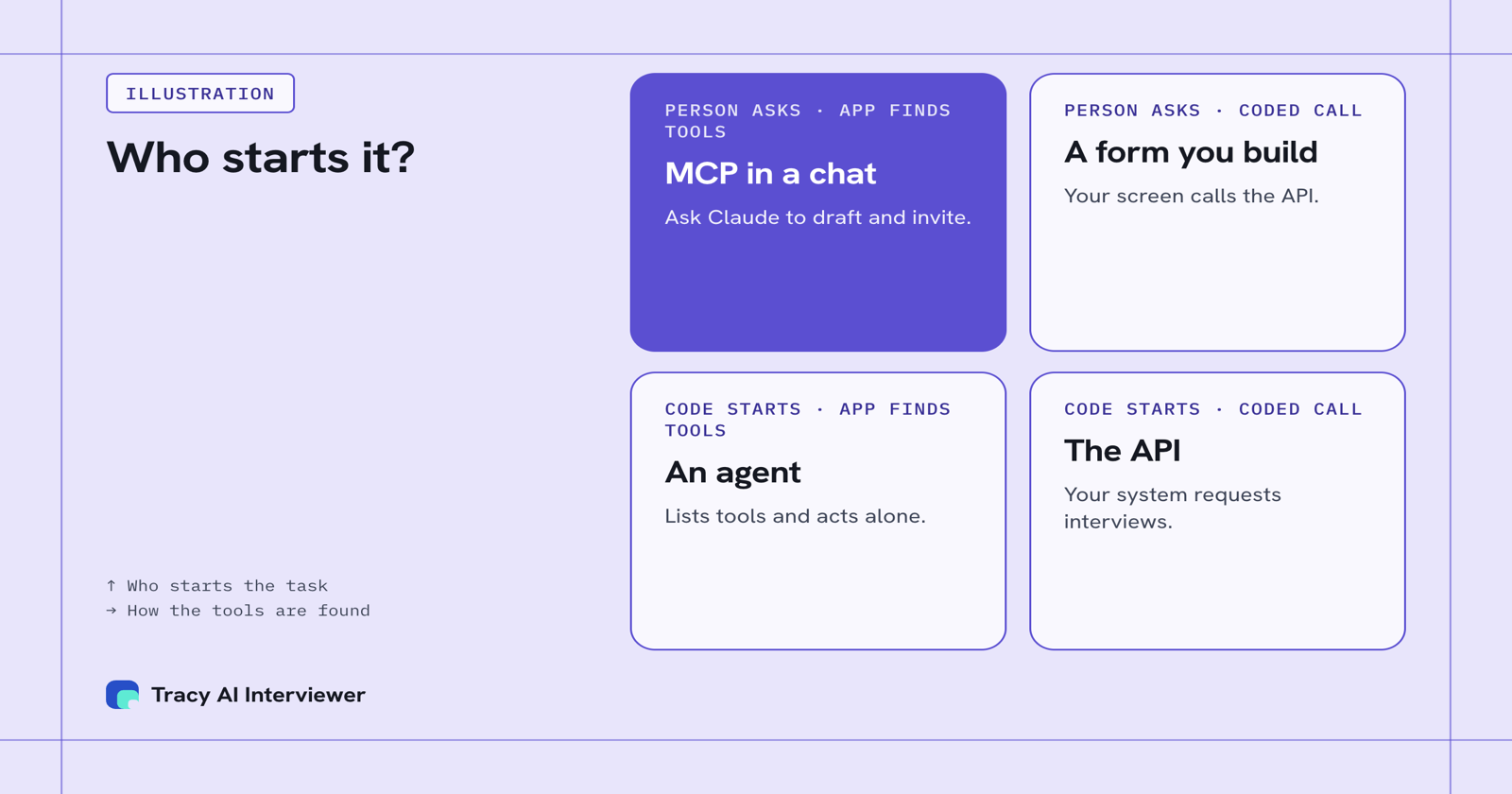
Who starts the task decides between a chat and code, and the highlighted square is the MCP route.
What Tracy adds to either route
01. Reach every person
Tracy runs the interview on video, and each person you invite starts on click, at any hour, with no scheduling and no recruiter on the call. The person being interviewed meets the same interview whichever route sent the invitation.
02. Ask the next question
Tracy follows the answer in the person's own field and waits for it. A vague reply gets a sharper question before the interview moves on.
03. Keep the evidence
Every result holds a recording, a timestamped transcript and a written assessment per question with its reasoning. Reading results returns what each person said to each question, the result fields and a note for an applicant tracking system.
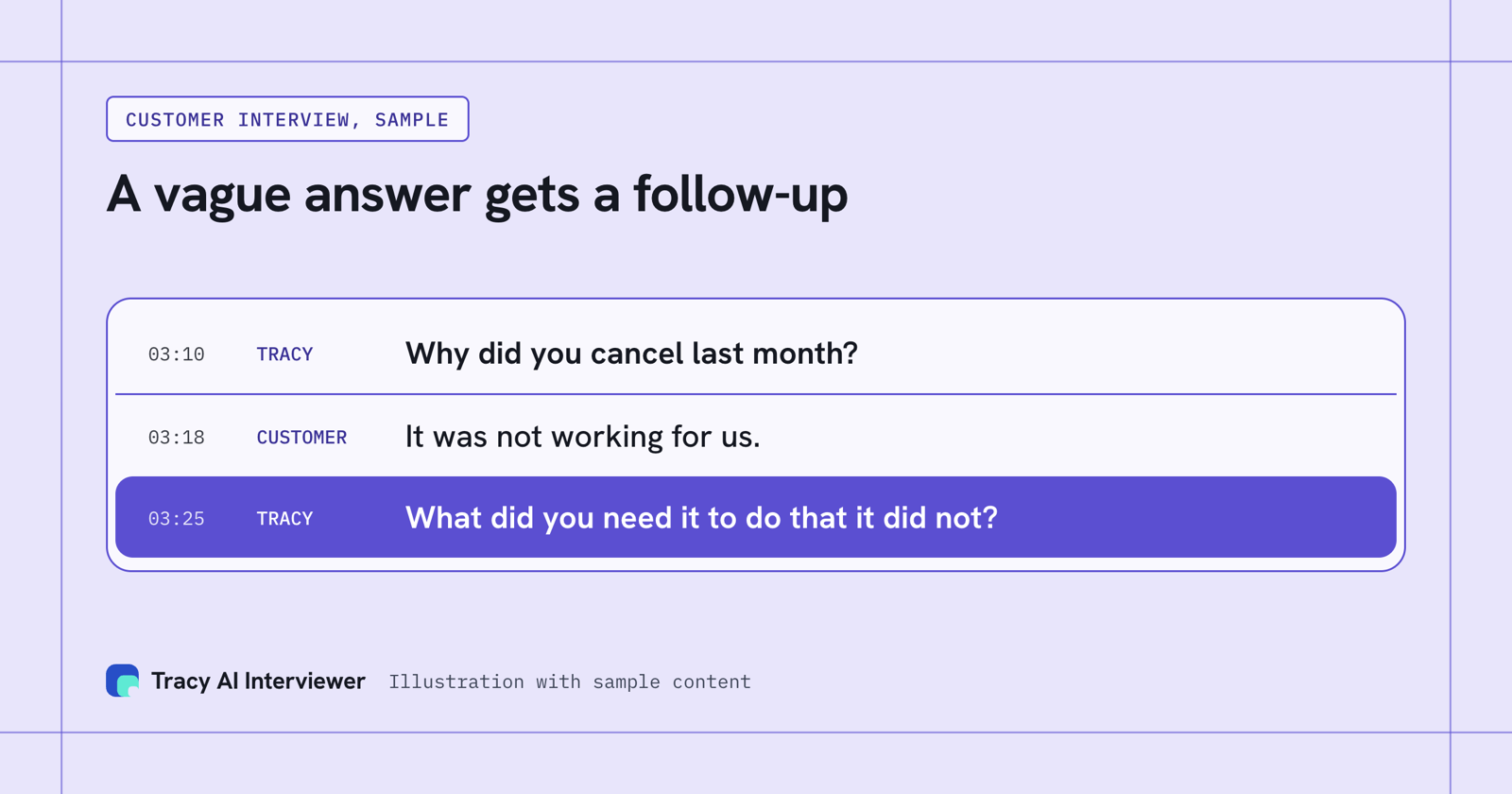
A vague answer to a customer question gets a sharper one, whichever route sent the invitation.
MCP vs API: when each route fits
Reach for MCP when:
- a person drives the work and the task changes each time;
- you want to read a preview and approve each write;
- you are setting something up once and do not want to write code.
Reach for the API when:
- a system should act on a trigger with nobody in the loop, such as a new applicant or a cancellation;
- the call is the same every time and you want exact control over it;
- many identical requests run without a person reading each one.
If you do both, set the interview up in a chat, then let the API invite people automatically. What an MCP server is covers the MCP side in more detail, and Tracy in Claude shows the chat route end to end.
One practical difference shows up when something breaks. In the API guide every failed call returns JSON with a stable error code that your code can test for, such as unauthorized for a missing or revoked key and rate_limited once an account passes 20 question-drafting calls in 10 minutes. In the chat route there is no code to test. You look at the connector instead: whether it is switched on for the conversation, and whether Claude is waiting for you to approve a call.
Common questions
What is the difference between MCP and an API?
MCP vs API for agents: which one should an agent use?
Does MCP replace APIs?
Is an MCP server an API?
Does Tracy offer MCP, an API or both?
Draft one interview in Claude
Connect Tracy to Claude and draft one interview by asking in a chat. You approve the preview, and the first 3 results are free.
Try it free (opens in a new tab) Book a demo (opens in a new tab)
Your first 3 results are free. No card needed.
Sources
- Model Context Protocol: What is MCP?, retrieved 14 Nov 2026.
- Model Context Protocol: Architecture overview, retrieved 14 Nov 2026.
- Model Context Protocol: Specification, latest, retrieved 14 Nov 2026.
- Claude Help Center: Get started with custom connectors using remote MCP, retrieved 14 Nov 2026.
- OpenAI docs: Connect your MCP server to ChatGPT, retrieved 14 Nov 2026.
- Tracy AI Interviewer: Connect, retrieved 14 Nov 2026.
- Tracy AI Interviewer: Pricing, retrieved 14 Nov 2026.
- Tracy AI Interviewer: API guide, retrieved 15 Nov 2026.