In short
A candidate evaluation template makes two reviewers write the same thing: each requirement, whether it was shown, and where the proof is. Tracy AI Interviewer interviews every applicant on the skills you set and gives your evaluator a recording, a timestamped transcript and an assessment per question to cite. Your evaluator marks each requirement and decides.
Two people read the same CV and sit through the same interview. One writes "strong fit" and the other writes "not sure". A candidate evaluation template makes both write the same thing: each requirement for the role, whether it was shown, and where the proof is. Copy it below, then see it filled in for a fictional backend developer.
What does a candidate evaluation do well?
A candidate evaluation is a written judgement on one person against the requirements of one role, with the evidence for each. Done well, it lets the next reader check every line. It sits between the interview notes that record what was said in order and the decision. A scorecard weights numbers across criteria; the evaluation says, for each thing the role needs, whether it was shown and where the proof is.
A candidate assessment template and a candidate evaluation form for an interview use mostly the same fields. What separates a useful one is the evidence column, and that is where memory runs out. Every line of this form can point to a minute in a recording once Tracy AI Interviewer has interviewed the applicant.
The candidate evaluation template
Copy the tables into a document or a sheet. Fill in Table 2 from the CV, the interview and any work sample, and write the source beside every line.
Table 1: setup
| Field | Entry |
|---|---|
| Candidate | |
| Role | |
| Stage | |
| Evaluator | |
| Sources used | CV, interview recording, work sample, reference |
Table 2: requirements and evidence
| Requirement | Type | Shown? | Evidence and source |
|---|---|---|---|
| Requirement 1 | Must-have | ||
| Requirement 2 | Must-have | ||
| Requirement 3 | Must-have | ||
| Requirement 4 | Nice-to-have | ||
| Requirement 5 | Nice-to-have |
Scroll the table sideways to see all 4 columns.
Shown? takes one of four values. Shown means you saw or heard it directly. Partly means some evidence, with a gap. Not shown means it was asked and not shown. Not assessed means it has not been covered yet.
Table 3: risks and gaps
| Concern | Evidence | What would settle it |
|---|---|---|
Table 4: decision
| Field | Entry |
|---|---|
| Recommendation | Advance, hold or stop |
| Reason, in two sentences | |
| Plan for the risk you accept | |
| Next step, owner and date |
Use four to six requirements, taken from the job's must-haves and not from the whole job description.
Rules for a fair evaluation
- Check the must-haves first. A must-have marked Not shown stops an Advance until someone assesses it.
- Direct evidence outranks reported evidence. Something you heard in the interview counts for more than a CV line or a referee's opinion, so write which kind it is.
- Put the source beside every line. "Interview 12:40", "CV page 2" or "Reference call" lets the next reader check it.
- Keep Not assessed apart from Not shown. The first means nobody asked. The second means they were asked and it did not appear.
- Use the same requirements for every candidate for the role. To set finalists side by side afterwards, use the candidate comparison template.
- Judge against the role, not the last candidate you saw.
- Decide in writing: give the reason in two sentences and name the risk you accept.
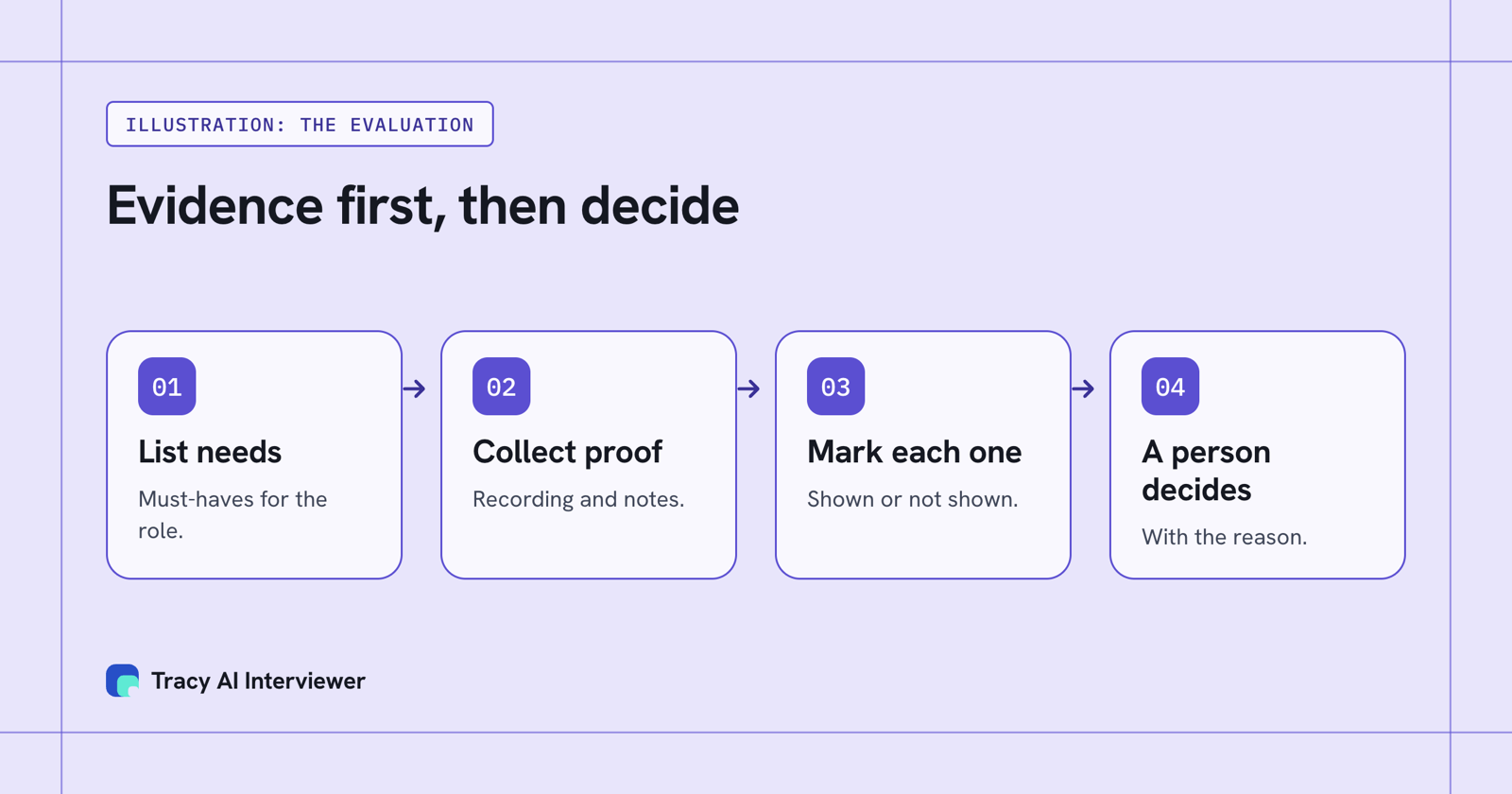
The evaluation follows the evidence: list requirements, collect proof, mark each one, decide.
A filled example: backend developer
A fictional finalist for a backend developer role. The evidence is written for this page.
Table 5: filled example, requirements and evidence
| Requirement | Type | Shown? | Evidence and source |
|---|---|---|---|
| Designs a service API | Must-have | Shown | Walked through versioning an endpoint so older clients kept working. Interview 12:40. |
| Debugs a production issue | Must-have | Partly | Found a slow query from the logs. Did not say how the fix was checked. Interview 19:05. |
| Writes tests that catch regressions | Must-have | Shown | Described a contract test added after an outage. Interview 24:30. |
| Explains trade-offs to non-engineers | Nice-to-have | Shown | Put a caching choice in terms of cost and stale data. Interview 31:15. |
| On-call experience | Nice-to-have | Not assessed | Two years on the CV. Not asked. |
Scroll the table sideways to see all 4 columns.
Table 6: filled example, risks and gaps
| Concern | Evidence | What would settle it |
|---|---|---|
| How a fix is verified | Interview 19:05, no check described. | Ask for the last incident and how they confirmed recovery. |
Recommendation: advance. Reason: two of three must-haves were shown directly and the third partly, with a gap one question can settle. Plan: ask the verification question in the second round and ask about on-call work. Owner: the hiring manager, by Friday.
What does the filled example show that blank fields do not?
It shows where the next question comes from. A blank template invites "strong fit". The filled backend developer example marks one must-have Partly: the candidate found a slow query from the logs and did not say how the fix was checked (Interview 19:05). That gap becomes the one question for the second round.
Count the five lines: three Shown, one Partly, one Not assessed. Nobody has to argue about the Partly line, because the time points to the proof. Table 6 then says what would settle it.
Interviewing every applicant on the same must-haves gives each line a time to cite, so the filled example can be the shape of the evaluation for every applicant.
What Tracy adds to a candidate evaluation
Tracy AI Interviewer interviews each applicant on the skills you set for the role, so the requirements in Table 2 are what gets asked. The must-haves are the natural place to start.
01
Reach every applicant
Each applicant starts on click, at any hour, with no scheduling and no recruiter on the call. The fortieth applicant gets the same questions as the first, so every evaluation has evidence of the same shape.
02
Ask the next question
Tracy follows the answer in the applicant's own field and waits. A Partly line like the one in Table 5 can get its missing detail inside the interview.
03
Keep the evidence
Each result holds a recording, a timestamped transcript and a written assessment per question with its reasoning. The Evidence and source column can point to a time instead of a memory.
Shown, Partly and Not shown stay with your evaluator. Tracy reports what was said and does not weigh, rate or rank anyone. The reviewer applies any weights, and a person decides.
For what a finished result contains, read what a Tracy result holds, question by question. If you also want numbers beside the evidence, the interview rating scale covers that. To try it, run one role with three real interviews and fill in the template from the results.
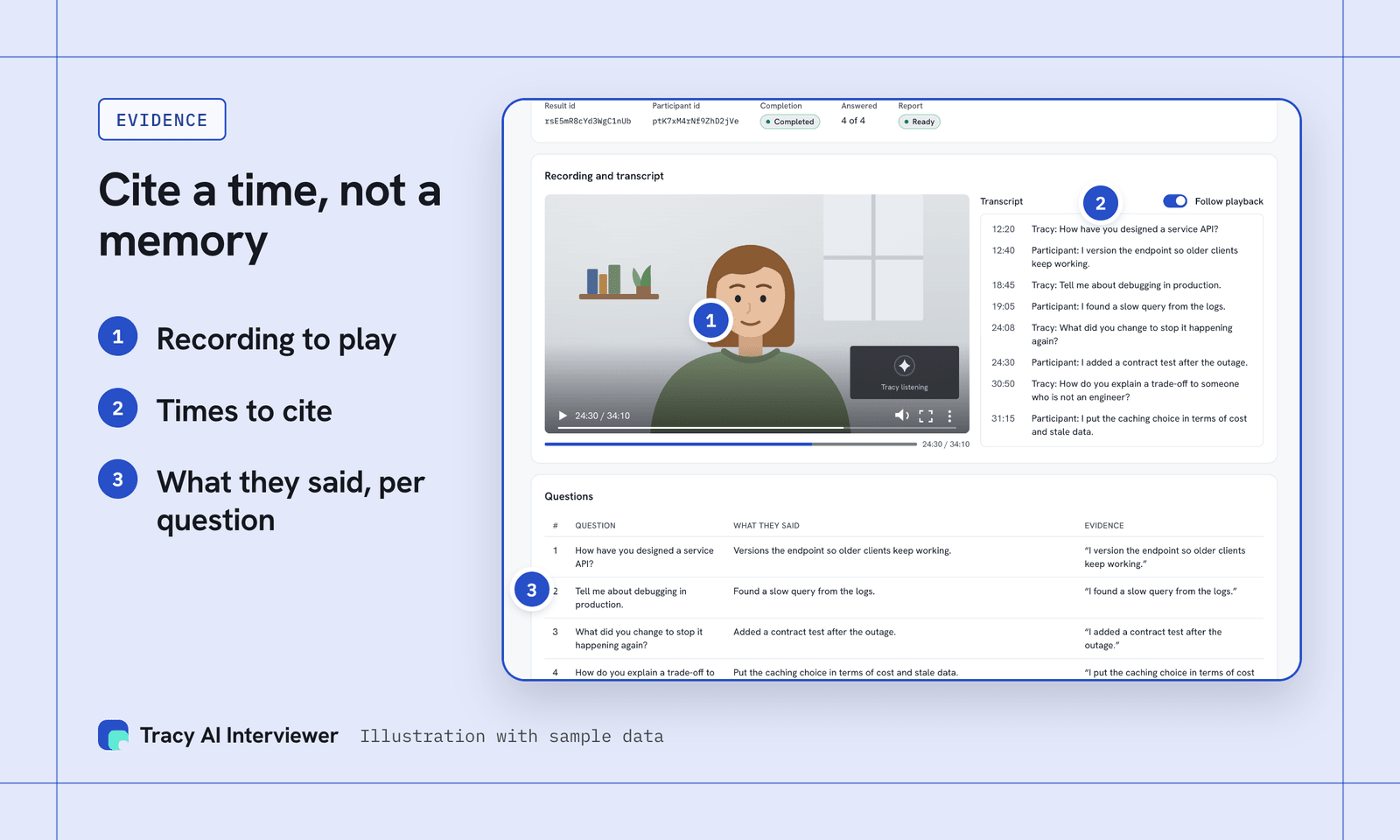
Each requirement can cite a quote and a time from the result.
Which path fits you
- Screening a large applicant pool for one role: one interview per applicant.
- Interviewing engineers: interviews for engineering hires.
- Deciding who to interview before you evaluate: screening interviews run by AI.
Common questions
What should a candidate evaluation form include?
What is the difference between a candidate evaluation and a scorecard?
How do you write a candidate evaluation?
Is a candidate assessment template the same thing?
Can AI evaluate candidates?
Fill the template from a real interview
Run one role as a Tracy interview, then fill each evidence line with a time from the result. The first 3 results are free.
Try it free (opens in a new tab) Book a demo (opens in a new tab)
Your first 3 results are free. No card needed.
Sources
- Tracy AI Interviewer Connect page, retrieved 11 Nov 2026.