
TLDR Tracy AI Interviewer runs this first round for every applicant: questions from your job description, follow-ups in the candidate's own field, and a recording and assessment per question.
Below: sixteen questions in four groups with follow-ups and what to listen for, and a six-question 20-minute template.
Next step: send us one role and we build the interview plan.
We make Tracy AI Interviewer.
The first round has a short job: decide who deserves more of your team's time. Most first rounds do it badly. They ask "tell me about yourself", hear a rehearsed answer and move on, and the follow-up that would have shown whether the person did the work never gets asked. The first round interview questions below are built around the follow-up. Each one comes with the question to ask after the first answer and a note on what a good answer contains.
Use them for any role by swapping the role-specific questions in the first group. Further down, we show how Tracy AI Interviewer runs the same first round for every applicant and hands your team a recording and a written assessment to read.
What a first round must settle
Four things, in this order. Everything else can wait for the second round.
- Can they do the work? Skills for this role, in their own field.
- How do they think? Reasoning they can explain, not answers they recited.
- How do they work? Ownership, feedback and working with other people.
- Can they start? Hours, time zone and start date.
Ask every candidate for the role the same core questions. A 2022 re-analysis by Sackett and colleagues in the Journal of Applied Psychology, covering earlier published meta-analyses, put the mean validity of structured interviews at .42 and of unstructured interviews at .19. That is a correlation between the interview rating and later job performance ratings, based on 105 and 32 studies (7,864 and 3,125 people) (source). Same questions give you answers you can compare. Follow-ups let you check them.
Sixteen first round interview questions, grouped by what they settle
Pick one or two from each group and keep the follow-up beside the question. Ask it only after you have heard the first answer.
Group 1: can they do the work
| Ask | Follow up with | Listen for |
|---|---|---|
| 1. Walk me through a piece of work you finished recently and are proud of. What was your part? | What would you do differently now? | Their own decisions, separate from the team's. A result with a number or a consequence. Owns a miss. |
| 2. Which tools or methods do you use every day for this job, and which one limits you? | Why did you choose it over the alternative? | Reasons from experience. A list lifted from the job advert sounds the same for every candidate. |
| 3. What is the hardest problem you solved in the last year? | What did you try first that did not work? | Detail about the dead end. Honest account of the time it took. |
| 4. A role-specific question you could only answer if you do the job. For support: a customer reports an error you have not seen. What do you ask first? | What do you do if they cannot send you logs? | A sensible first question, then a second path when the first closes. |
Group 2: how they think
| Ask | Follow up with | Listen for |
|---|---|---|
| 5. You have two ways to do a task and little time. How do you choose? | What did that choice cost you? | Names the criteria and the risk, and admits the cost. |
| 6. Tell me about a time you were wrong about something at work. | What did you check afterwards? | Ownership without blaming someone else. A habit they changed. |
| 7. How do you decide that a piece of work is done? | Tell me about a time it was not done when you thought it was. | A standard they apply, such as checks, tests or a review by someone else. |
| 8. Explain something from your field to someone who does not work in it. | What did they ask that you did not expect? | Plain words. Checks that the other person understood. |
Group 3: how they work
| Ask | Follow up with | Listen for |
|---|---|---|
| 9. Tell me about feedback that changed how you work. | What did you stop doing? | A specific change, not "I take feedback well". |
| 10. Describe a time you disagreed with a colleague about how to do something. | What happened afterwards? | Listened first, used evidence, and the relationship held. |
| 11. Tell me about a task you finished later than planned. | When did you tell the person waiting, and what did you change next time? | Early warning. A concrete change in how they plan. |
| 12. What do you do when you are blocked and nobody is around? | How long do you try before you ask for help? | Initiative with a limit. |
Group 4: can they start
| Ask | Follow up with | Listen for |
|---|---|---|
| 13. Which hours and time zone can you work, and from when? | Is anything likely to change that in the next three months? | Clear, consistent answers. |
| 14. What made you apply for this role? | What do you want to be doing in a year? | Interest in the work itself and some preparation. |
| 15. What would you need in your first month to do good work? | Which of those can you arrange yourself? | Realistic needs, and some independence. |
| 16. What would you like to ask us about the role? | What would make you say no to an offer? | Questions about the work. A clear idea of what matters to them. |
Skip questions about age, family plans, health, religion or where someone is from. They do not predict the work and can create legal exposure in many places. If you are unsure about a question, ask your counsel before you use it.
A first round template: six questions in 20 minutes
Copy this into your own document and swap in questions from the groups above. The minutes are a guide.
| Block | Minutes | Question |
|---|---|---|
| Opening | 1 | Say how the interview works and that every candidate gets the same questions. |
| Can they do the work | 5 | Question 1 and the role-specific question 4, each with its follow-up. |
| How they think | 4 | Question 5 with its follow-up. |
| How they work | 5 | Question 11 with its follow-up. |
| Can they start | 3 | Question 13, then question 14. |
| Close | 2 | Question 16, then what happens next and when. |
Write what a strong answer contains for each question before the first candidate joins. For a technical role, see our software engineer interview questions. Our guide to AI behavioral interviews covers the situation-and-result questions in groups 2 and 3.
Run the first round with Tracy
Writing good questions takes an afternoon. Asking them of two hundred applicants takes a team, and this is where Tracy takes over.
- Set up from the job description. Tracy generates the questions from the role. Edit them, or use the sixteen above as your own. Choose a style from quick to deep, technical to behavioural.
- Follow-ups on what the candidate said. She asks in the candidate's own field, follows up on what the candidate said, using the follow-up column above as a guide, and waits for the answer. Roy Junyoung Jang, Director, Residency & Investment at Antler Korea, said: "Tracy sometimes brings up exactly those questions I might have forgotten to ask, which has been a pleasant surprise."
- The CV, when you want it. With the CV check on, Tracy reads the CV.
- Same first round, any hour. Each applicant starts on a click with no scheduling and no recruiter present. The person interviewed needs only a browser link and no account, and is told on the join screen that the conversation is recorded and transcribed. See the participant experience.
- Evidence per result. Your team reads a recording of both sides, a timestamped transcript and a written assessment per question with its reasoning. Group 4 answers, such as hours and start date, appear in the written assessment. The strongest candidates are ranked above the rest and flagged to the recruiter.
A person decides who goes forward. Read more on how AI interview reports work and AI screening interviews.
A 20-minute first round is one credit, which is $1. One hundred of them cost $100. The first 3 results are free with no card, there are no seats and no upfront cost. See pricing. To try it, create an interview for this exact role and run it with three real applicants.
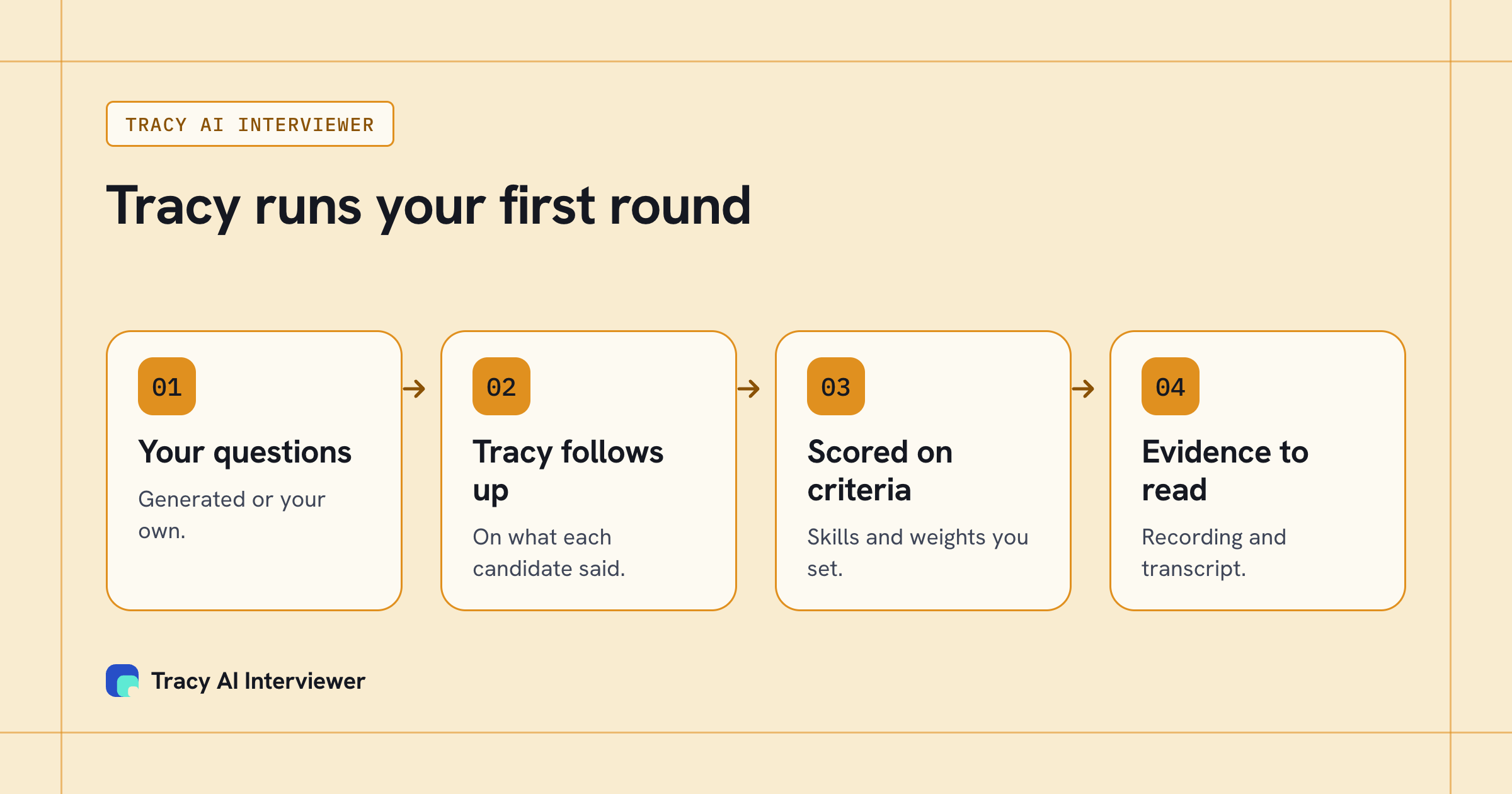
Tracy asks your questions, follows up, scores on your criteria and leaves the evidence to read.
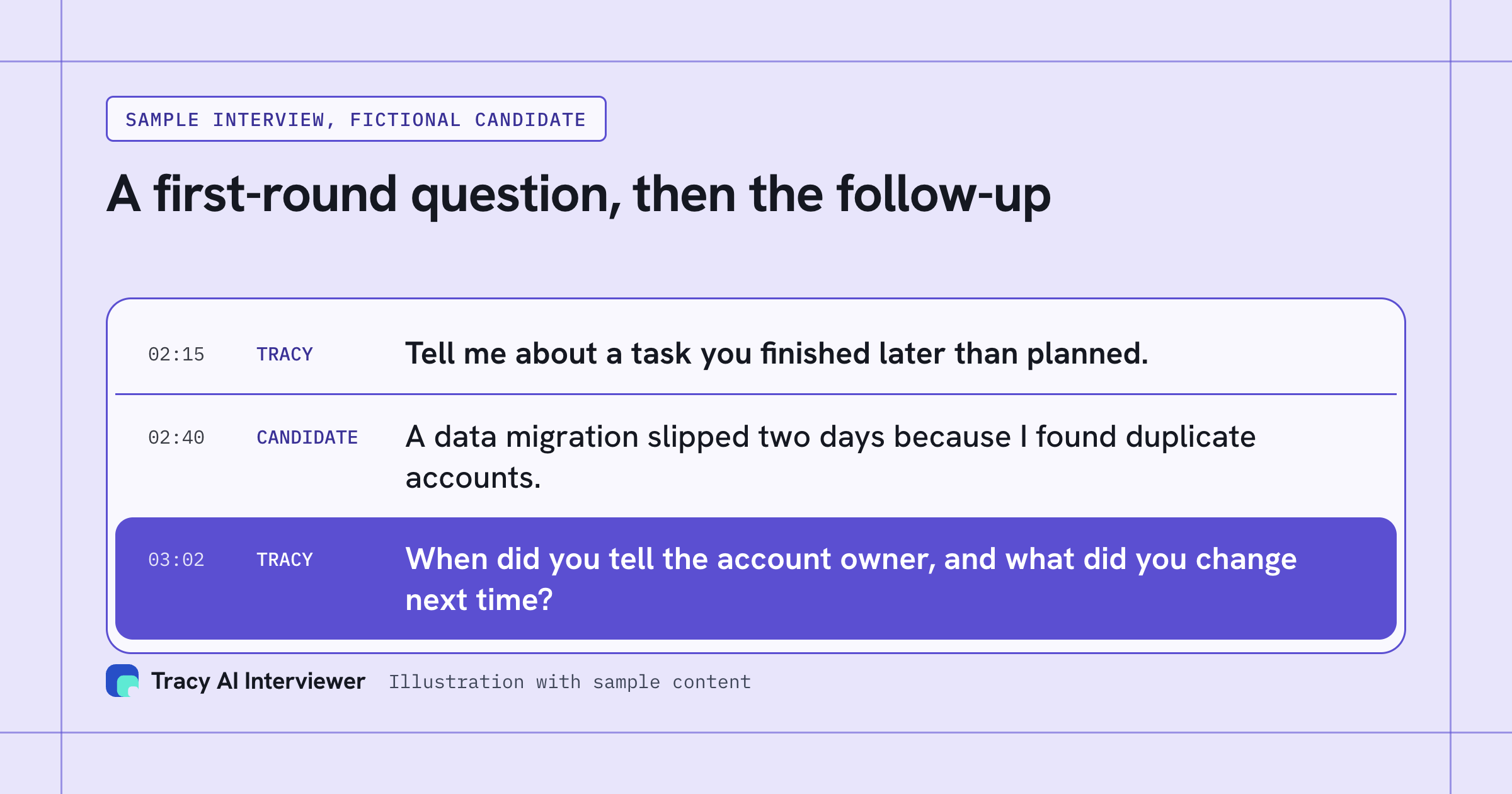
The follow-up asks for the detail a rehearsed answer leaves out.
Which path fits you
- Screening applicants for open roles: applications.
- Many applicants for the same role: volume hiring.
- Wondering how to screen before you interview: how to screen candidates.
Questions
What are good first round interview questions to ask candidates?
How long should a first round interview be?
What are the best first interview questions for employers to avoid?
Should every candidate get the same first round questions?
Can an AI interviewer run the first round?
How do I score the answers?
Copy the template, then run it as a Tracy interview. Send us one role and we will build the interview plan from it in days, with a recording and report you can check. Try it free · Book a demo
Sources
- Sackett, Zhang, Berry and Lievens (2022), Revisiting meta-analytic estimates of validity in personnel selection, Journal of Applied Psychology 107(11), retrieved 9 Nov 2026.
- Tracy AI Interviewer home page, customer quotes, retrieved 9 Nov 2026.
- Tracy AI Interviewer pricing, retrieved 5 Nov 2026.
- Tracy AI Interviewer Connect page, retrieved 5 Nov 2026.