In short
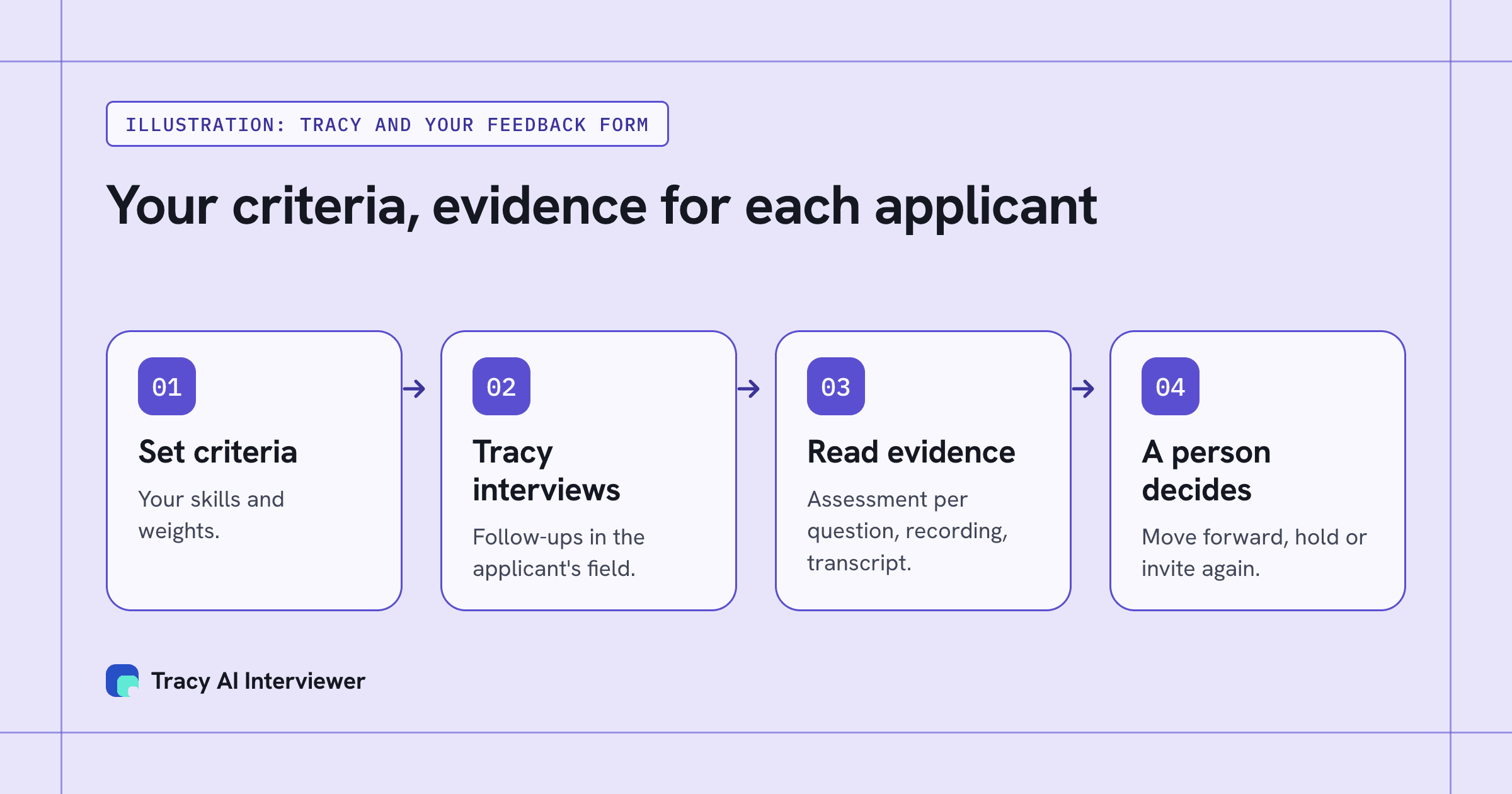
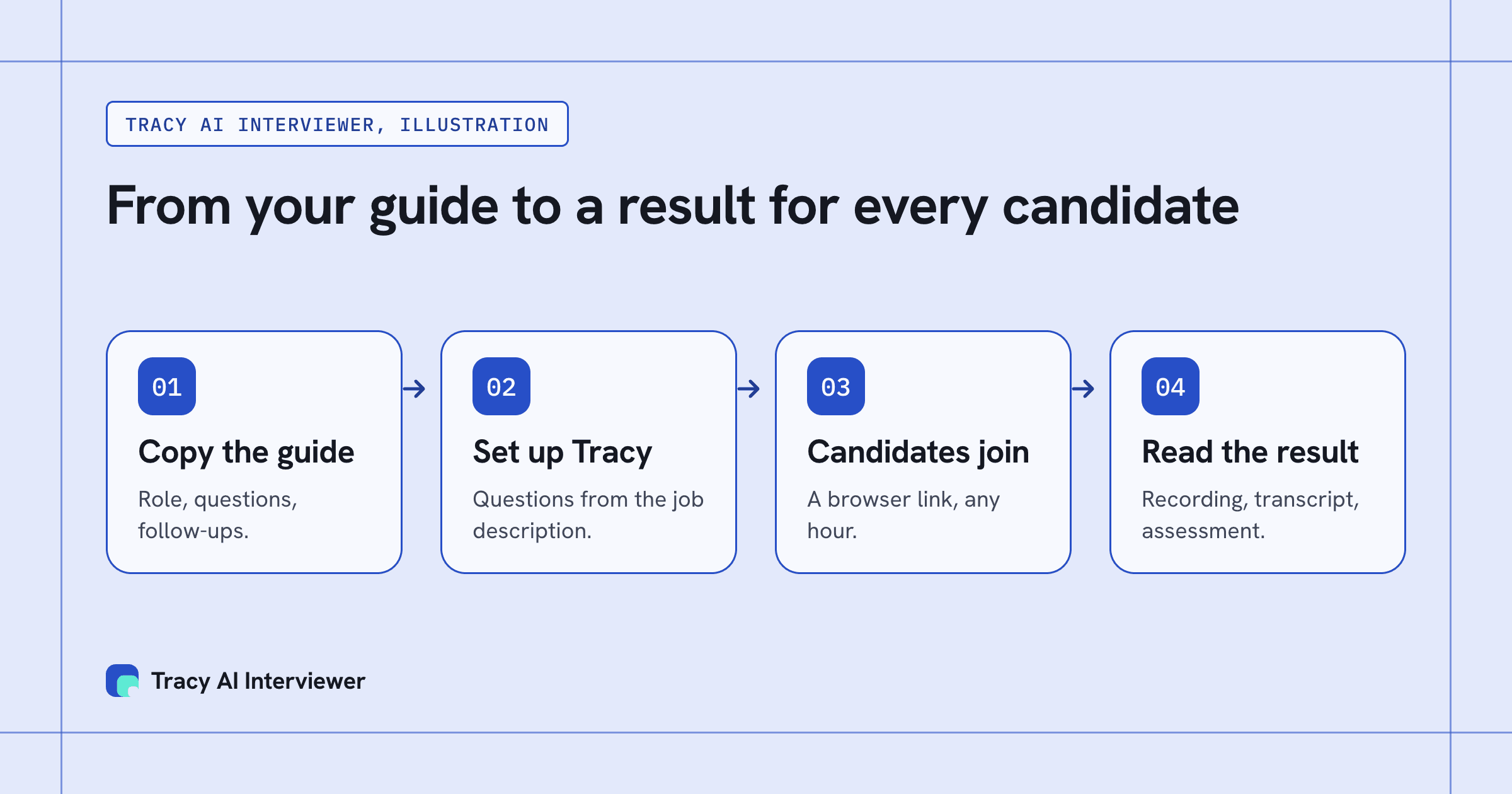
Tracy AI Interviewer interviews each applicant on the skills and weights you set, so finalists are compared on the same criteria and the same kind of evidence: a recording, a timestamped transcript and a written assessment per question.
Below: a candidate comparison template with a close-call rule, and a filled three-finalist example.
Candidates are ranked against the others who took the interview. A person chooses.
Next step: copy the template, then run one role as a Tracy interview.
We make Tracy AI Interviewer.
Three finalists, three interviewers, three sets of notes. One finalist was interviewed last and is the one everyone remembers. One answered different questions on a Monday morning. The third has two pages of notes because the interviewer likes writing. A candidate comparison template makes the finalists comparable: the same criteria, the same scale, one line of evidence for each score and a rule for close calls, agreed before anyone is rated. Copy it below, see it filled in for three fictional finalists, then see how Tracy AI Interviewer scores every finalist on the same criteria.
Why finalists get compared unfairly
Finalists get compared unfairly for four reasons. They answered different questions, so the scores measure the questions. They have different evidence: one has a recording, another a paragraph written from memory. The last interview is the freshest, so the last finalist gains. And in an open discussion the first strong opinion anchors everyone else.
The template answers each one: shared criteria, evidence beside every score, one criterion compared at a time, and scores written before the discussion.
The candidate comparison template
Copy the tables into a sheet. Put the weights in column B and the finalists' scores in columns C to E, rows 2 to 6. For the finalist in column C the weighted score is =SUMPRODUCT($B$2:$B$6,C2:C6)/SUM($B$2:$B$6). Fill it right for the others.
Table 1: setup
| Field | Entry |
|---|---|
| Role | |
| Decision owner | |
| Decision date | |
| Finalists | A, B, C |
| Must-haves (pass or fail, checked before scoring) |
Table 2: weighted scores sheet
| Criterion | Weight (adds to 100) | Finalist A | Finalist B | Finalist C |
|---|---|---|---|---|
| Criterion 1 | 30 | |||
| Criterion 2 | 20 | |||
| Criterion 3 | 20 | |||
| Criterion 4 | 20 | |||
| Criterion 5 | 10 | |||
| Weighted score |
Scroll the table sideways to see all 5 columns.
Table 3: evidence per criterion
| Criterion | Finalist A | Finalist B | Finalist C |
|---|---|---|---|
| Criterion 1 | Quote or moment | ||
| Criterion 2 | |||
| Criterion 3 | |||
| Criterion 4 | |||
| Criterion 5 |
Scroll the table sideways to see all 4 columns.
Scale: 1 is no evidence, 3 meets what the role needs, 5 is exceptional. Write what 2 and 4 mean for your role before the first interview.
Table 4: decision record
| Field | Entry |
|---|---|
| Weighted scores | |
| Gap between first and second | |
| Close-call rule | If the top two are within 0.3, choose on the heaviest criterion; if still level, on the smaller risk. |
| Biggest risk for each finalist | |
| Reference checks | Done, pending or not needed |
| Decision | |
| Why, in two sentences | |
| Plan for the risk you accept |
Use four or five criteria. Set the weights, the must-haves and the close-call rule before the first finalist is interviewed.
How to compare finalists fairly
- Treat must-haves as pass or fail. A finalist who fails one is not rescued by a high score elsewhere.
- Compare one criterion at a time. Read all three finalists on criterion 1, then criterion 2. The evidence for the same question sits side by side.
- Score alone first. Write scores and evidence before the group meets.
- Compare like with like. Same round, same criteria, same kind of evidence. If one finalist had a different interview, say so on the sheet.
- Use the rule, and overrule it only in writing. If the group chooses against the numbers, record why.
- Write the decision in two sentences and name the risk you accept.
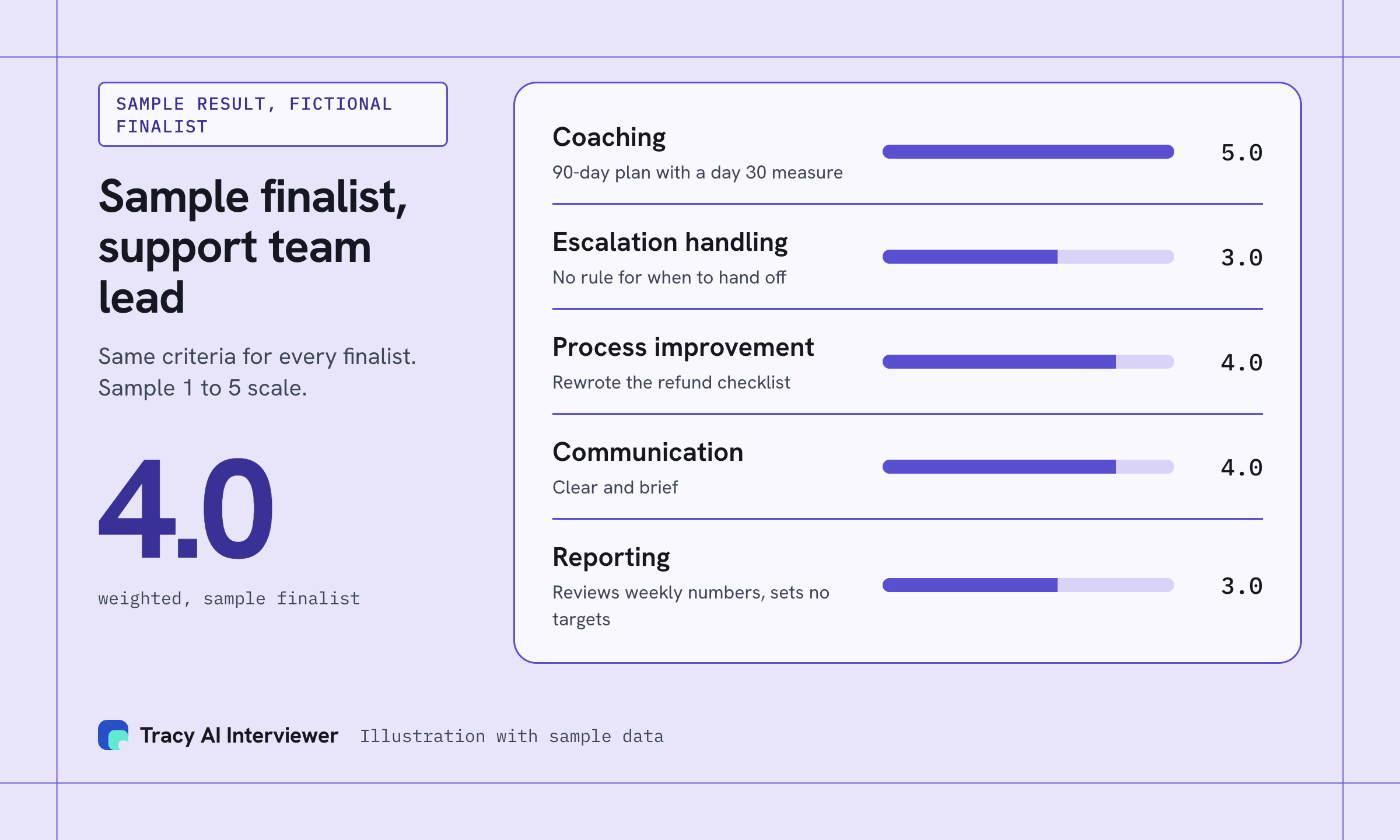
Each finalist gets the same criteria, a score and a line of evidence per criterion.
A filled example: three finalists for a support team lead
Fictional finalists. The evidence is written for this page, and the scale is the one in the template.
Table 5: filled example, scores (fictional finalists)
| Criterion | Weight | Finalist A | Finalist B | Finalist C |
|---|---|---|---|---|
| Coaching | 30 | 4 | 5 | 3 |
| Escalation handling | 20 | 5 | 3 | 4 |
| Process improvement | 20 | 3 | 4 | 3 |
| Communication | 20 | 4 | 4 | 5 |
| Schedule fit | 10 | 5 | 3 | 4 |
| Weighted score | 100 | 4.1 | 4.0 | 3.7 |
Scroll the table sideways to see all 5 columns.
Table 6: filled example, evidence (fictional finalists)
| Criterion | Finalist A | Finalist B | Finalist C |
|---|---|---|---|
| Coaching | Weekly one to ones for two new hires; changed the plan after one missed targets. | 90-day plan for a struggling agent, with a measure at day 30. | Talked about morale, no plan described. |
| Escalation handling | Walked through a P1 outage and who was told when. | Handed escalations to a manager without a rule for when. | Named a clear trigger, less detail on follow-through. |
| Process improvement | One macro change, no result given. | Rewrote the refund checklist and cut repeat tickets. | General ideas, no example. |
| Communication | Clear, a little long. | Clear and brief. | Checked understanding after each point. |
| Schedule fit | Any shift. | Mornings only. | Can cover most evenings. |
Scroll the table sideways to see all 4 columns.
Finalist A leads by 0.1, inside the 0.3 close-call band, so the rule applies. The heaviest criterion is coaching, where B scored 5 against A's 4. Decision: B. B's risk is escalation handling at 3, so the plan is to pair B with an escalation lead for the first 60 days and to ask B's referee about escalations. The record says why the number alone did not decide it.
Compare finalists on the same criteria
A comparison is fair when every finalist is scored on the same criteria and the evidence has the same shape. Tracy AI Interviewer interviews each applicant for the role on the interview you set up, so the criteria match.
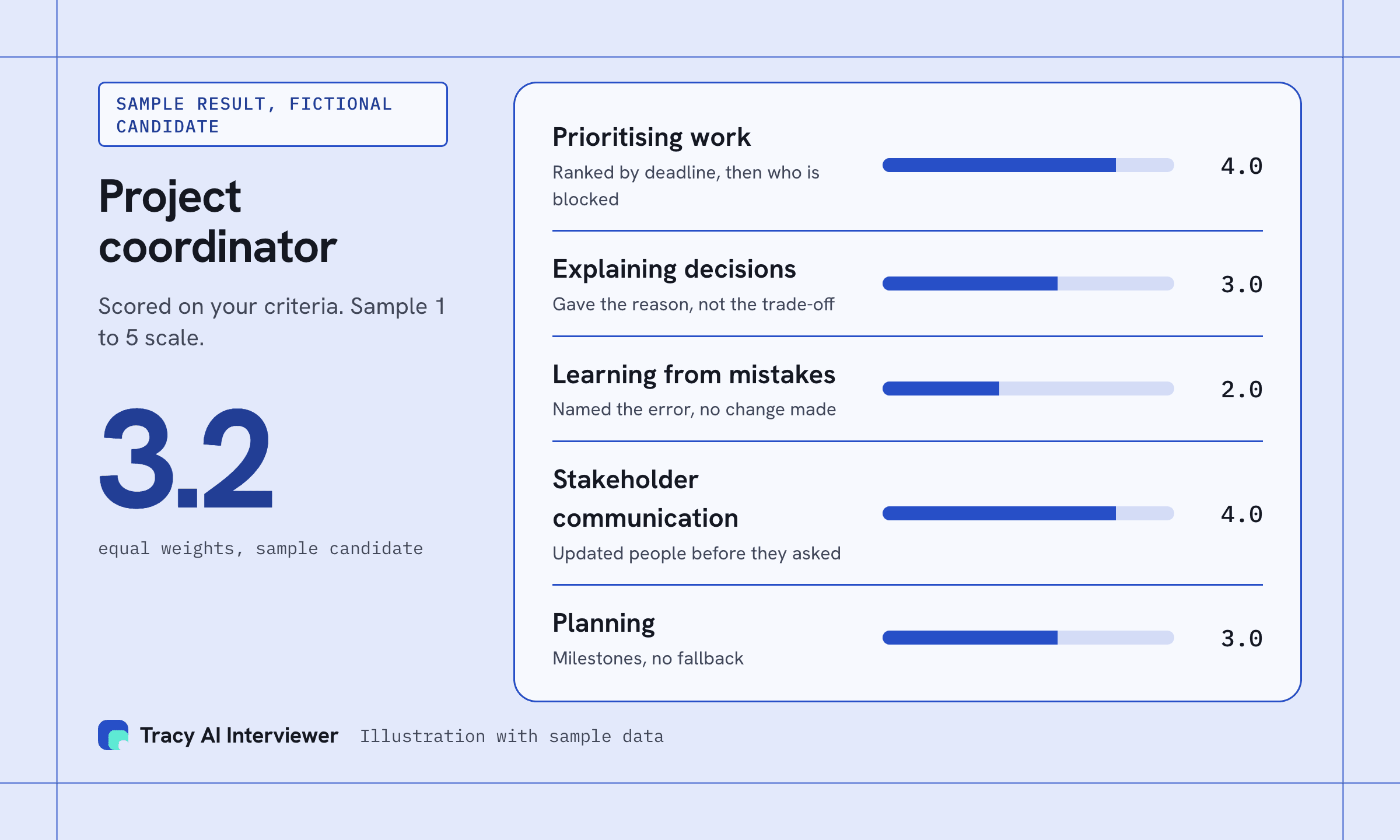
- Same criteria. You set the skills and their weights for each role or role family, and each result is scored on them.
- Same evidence. A recording of both sides, a timestamped transcript and a written assessment per question with its reasoning, for every finalist and not only those whose interviewer took good notes.
- Ranked. Each candidate is ranked against the others who took the interview, and strong ones are flagged to the recruiter automatically, so the finalist list starts from the top of the pile.
- Shareable. Resume match, interview score, strengths and gaps and the recording sit in one record, shareable by link or PDF. A Director at a top-tier early-stage VC: "For borderline candidates who are difficult to evaluate based on quantitative scores alone, Tracy makes it much easier to share their responses and assessment results with other team members for further discussion."
- A person decides. A recruiter can move a candidate forward, override a rejection or invite someone to interview again, and the full history stays on the record. See how an AI interview report reads.
The first 3 results are free with no card. After that it costs $1 per credit, one credit per started 20 minutes of an interview that produced a result, with no seats and no upfront cost. See pricing. To try it, run one role with three real interviews and put the results in the template.
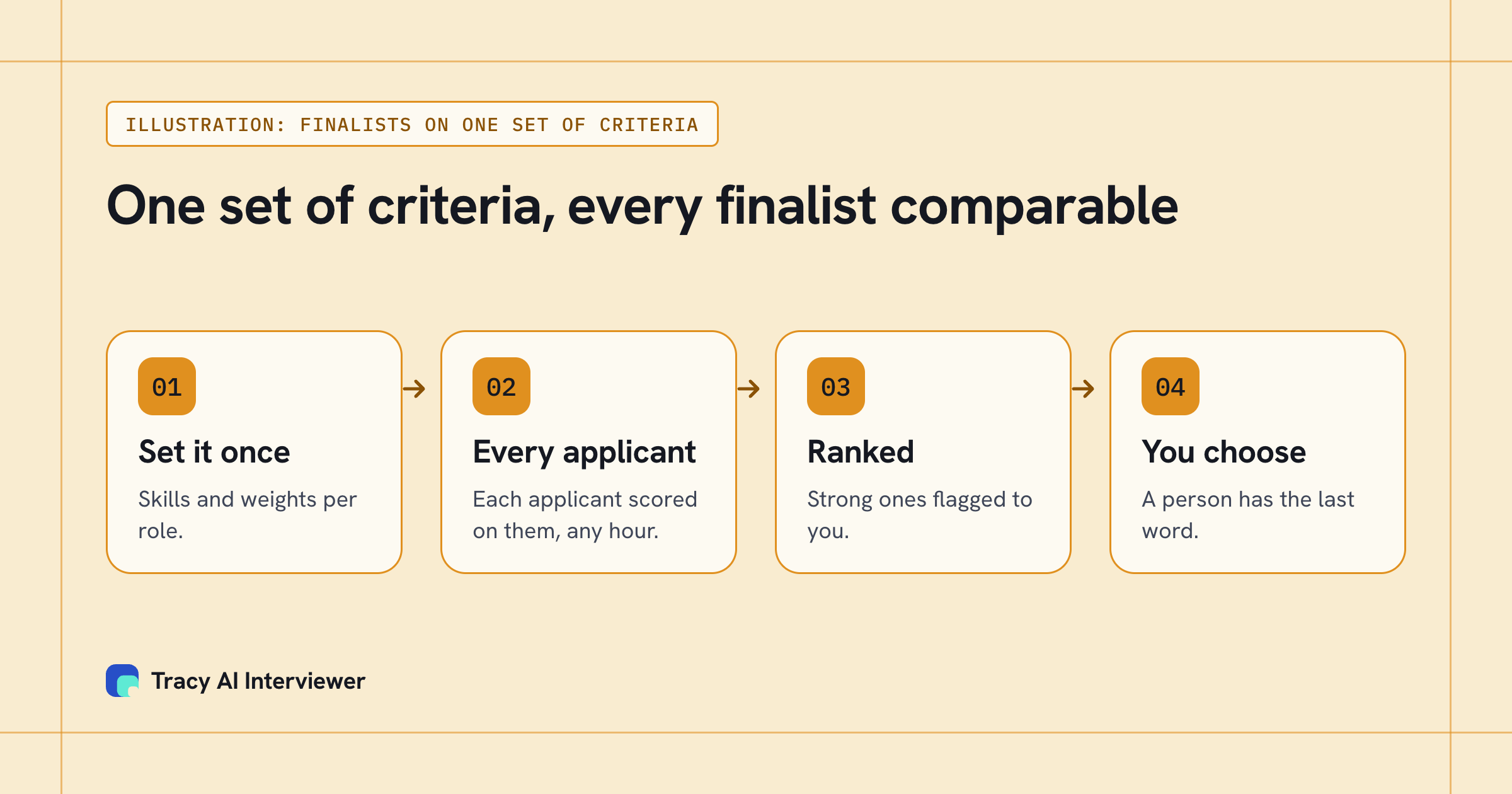
The same criteria and the same kind of evidence make the finalists comparable.
Which path fits you
- Many applicants for one role, and a shortlist to build: volume hiring.
- Engineering finalists: technical interviews.
- Choosing how many to interview before you compare: AI screening interviews.
Common questions
How do you compare candidates fairly?
What should a candidate comparison template include?
How do you compare candidates in Excel?
What if two finalists score almost the same?
Should the numbers decide, or the group?
Try Tracy on your next role
Tracy interviews every applicant, asks follow-up questions and sends you a ranked shortlist.
Try it free (opens in a new tab) Book a demo (opens in a new tab)
Your first 3 results are free. No card needed.
Sources
- Tracy AI Interviewer home page, customer quotes, retrieved 9 Nov 2026.
- Tracy AI Interviewer pricing, retrieved 9 Nov 2026.
- Tracy AI Interviewer Connect page, retrieved 9 Nov 2026.