
In short
SHRM's 2025 median is 1.98 HR professionals per 100 employees, up from 1.58 in 2017. Pave's data on 3,471 companies gives 1 per 38 employees at private companies under 1,000, counting talent acquisition inside HR. The US had about 939,700 HR specialists in 2025, per the BLS.
With a team that size, listening to every leaver and new hire takes help. Tracy AI Interviewer runs exit interviews and check-ins with a follow-up when an answer is vague, and your team reads each person's words.
Next step: run one exit interview and read it.
HR statistics are easy to quote and hard to compare, because each source defines the HR team, the employee base and the year its own way. The numbers below come with their definitions. Counts of AI use in HR sit on AI in HR statistics, and employee engagement statistics covers the engagement side.
What is the HR to employee ratio?
SHRM's 2025 CHRO benchmarking gives a median of 1.98, nearly two HR professionals for every 100 employees, up from 1.58 before the pandemic in 2017. Pave, analysing 3,471 companies with 50 or more employees and at least one HR team member, reports 1:38 (2.6%) at private companies under 1,000 employees, 1:32 at private companies of 1,000 or more and 1:33 at public ones. Pave counts talent acquisition inside HR. As an example, a 500-person company has about 10 HR professionals at SHRM's median and about 13 at Pave's 1:38, so the choice of benchmark moves the answer by a few people. The table sets the figures side by side.
Which HR ratio counts what?
SHRM and Pave define HR headcount differently, so the rows are not interchangeable. Sources: SHRM, 2025 CHRO Benchmarking; Pave, HR to employee ratio benchmark (2026).
| Measure | Number | Who counted, how, when |
|---|---|---|
| HR staff per 100 employees, median | 1.98 | SHRM, 2025 CHRO benchmarking; sample not stated |
| Same measure, 2017 | 1.58 | SHRM, the pre-pandemic figure |
| Private companies under 1,000 employees | 1:38 (2.6%) | Pave, 3,471 companies with 50+ employees, includes talent acquisition |
| Private companies of 1,000+ | 1:32 | Pave, same dataset |
| Public companies | 1:33 | Pave, same dataset |
| HR expense, share of operating expense | 2.4% | SHRM, 2025, about double the 2017 level |
| Median HR budget growth | 9.1% | SHRM, 2025 over 2024 |
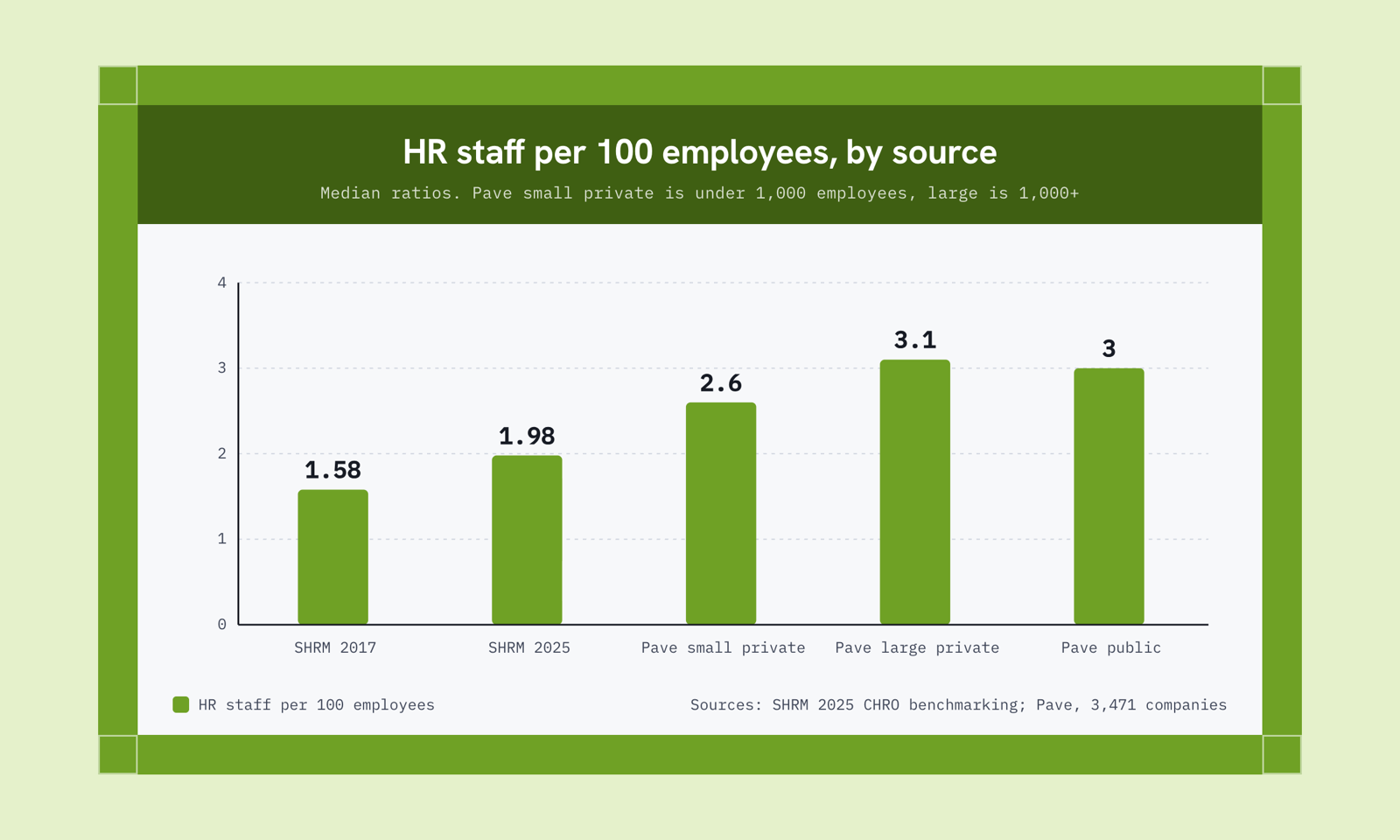
Median HR staffing is between about 1.6 and 3.1 per 100 employees depending on the source and the company.
How many HR professionals are there?
The US Bureau of Labor Statistics counted about 939,700 jobs for human resources specialists in 2025, with a median annual wage of $75,940 in May 2025. It projects 6% growth from 2025 to 2035 and about 73,700 openings a year on average. The page lists human resources managers only in a table of similar occupations, with a 2025 median pay of $149,280, and gives no job count for them, so 939,700 is specialists alone.
What are the key HR metrics?
HR teams usually track the size and cost of the function, hiring speed, turnover and the quality of hires. For size and cost there is the ratio above, HR expense as a share of operating expense (2.4% in SHRM's 2025 data) and revenue per full-time employee, which SHRM puts at almost $173,000, the highest in its research since 2017. Hiring speed is covered in time to hire statistics, which explains why two sources can differ by weeks. For turnover, the US Job Openings and Labor Turnover Survey reported monthly rates for September 2026 of 3.3% total separations, 2.1% quits and 1.0% layoffs and discharges, with 3.4% hires and 7.5 million job openings. Those are monthly rates for all US nonfarm employers, so they are not annual turnover. The cost of a bad hire covers what a wrong match costs, and engagement has its own page of figures in employee engagement statistics.
How is AI changing HR teams?
SHRM's 2026 research, from 1,908 HR professionals, reports that 39% of organizations use AI across HR, with talent acquisition ahead of other areas at 27%. AI in HR statistics sets that beside HireVue's and LinkedIn's figures and what each counts.
Where does a small HR team find time to listen?
At SHRM's median of about two HR professionals per 100 employees, a team has to choose which conversations to have. Exit interviews and 30-day check-ins are two candidates. Tracy AI Interviewer takes them on. Start from a brief, adjust the questions and send one link to leavers or new hires. Each person joins on video in their own time and is told it is recorded. A thin answer prompts a gentle follow-up. HR receives each person's words per question with the recording behind them, and a person decides what to do next.
In an invented exit interview, the employee blames the longer commute after an office move, Tracy asks whether anything else played a part, and a later answer names the weekly planning meeting as the thing they valued most. Every point is timestamped.
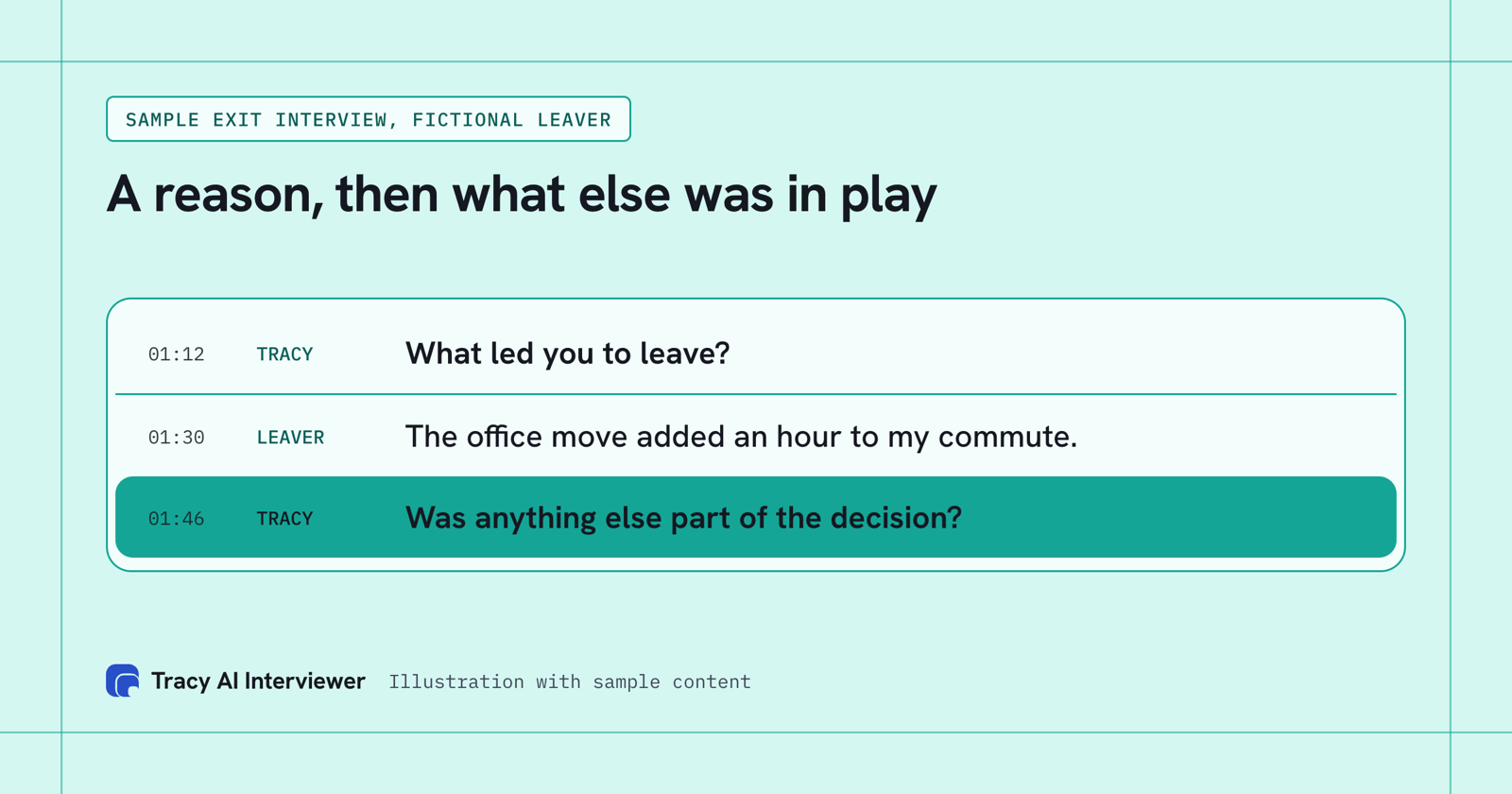
A leaver's first reason gets a follow-up asking what else was in play, so HR hears more than one cause.
Which path fits you?
- Asking leavers well: exit interview questions.
- Running the conversation: running an exit interview step by step.
- Hearing from people at scale: interviews that scale across a people team.
- Picking tools: tools for HR teams.
- Reading what leavers say: exit interview analysis.
Exit interviews and check-ins with Tracy show the route from link to report.
Common questions
What is the HR to employee ratio?
How many HR professionals are there?
What are the key HR metrics?
Is the HR to employee ratio rising?
How many companies are behind Pave's ratio?
What does an HR specialist earn?
Run your next exit interview with Tracy
Create an exit interview, share the link and read what each leaver says, with the recording behind it. The first 3 results are free.
Try it free (opens in a new tab) Book a demo (opens in a new tab)
Your first 3 results are free. No card needed.
Sources
- SHRM: More support for HR, talent and CHRO benchmarking survey insights (2025), retrieved 23 Nov 2026.
- Pave: HR to employee ratio benchmark, retrieved 23 Nov 2026.
- BLS: Occupational Outlook Handbook, human resources specialists, retrieved 23 Nov 2026.
- BLS: Job Openings and Labor Turnover, September 2026, retrieved 23 Nov 2026.
- SHRM: AI in HR 2026, From Hype to Measured, Human-Centered Impact, retrieved 23 Nov 2026.