
In short
No single figure for the cost of a bad hire holds up. Gallup puts replacing an employee at one-half to two times annual salary, and the widely repeated 30 percent of first-year earnings comes only from secondary articles.
One cause to check is a CV claim nobody tested. Tracy AI Interviewer opens an interview for every applicant from a link, asks about what the CV says, and hands the reviewer the recording, the transcript and each answer, question by question. A person decides.
A worked example below, on invented inputs, totals $25,002 for a $60,000 role.
Next: work out your own number, then run one role through Tracy.
Search the topic and the numbers vary widely, most of them without a stated method. If you already track quality of hire, you have one input for the calculation below.
This guide sorts the figures that can be checked from the ones that cannot, shows how to calculate your own cost, and covers the causes you can act on before the offer. Tracy AI Interviewer helps at the first of those: it interviews every applicant and follows up on the claims on their CV, so a reviewer hears the detail before anyone is hired.
How much does a bad hire cost, and is it 30 percent of salary?
There is no single verified number. Gallup estimates that replacing an individual employee can cost one-half to two times the employee's annual salary (2019), which covers any departure and not only a bad hire. The 30 percent of first-year earnings figure is credited to the US Department of Labor by secondary articles; use it only as a label for a guess and calculate your own number. Hiring cost figures are more concrete but cover only the cost of filling a role.
Which number counts what
Each figure counts something different, so do not add them together.
| Figure | What it counts | Source and scope |
|---|---|---|
| One-half to two times annual salary | Replacing an employee who leaves, for any reason; Gallup's authors call it conservative | Gallup, March 2019, US businesses |
| 30% of first-year earnings | A bad hire, credited to the US Department of Labor by secondary articles | Secondary articles; no study cited there |
| $851 | Average job ad spend per hire | Appcast, 2024 data, over 1,300 US employers |
| £2,000 and £3,500 | Median cost per hire: non senior employees and senior managers | CIPD with Omni RMS, April to May 2026, 1,014 UK HR professionals |
How do you calculate the cost of a bad hire?
Add six lines and use your own inputs: the cost of the first hire, onboarding and training, pay during the months of low output, manager and team time spent covering, the cost of hiring again, and any customer or revenue loss you can trace. The example below uses a $60,000 role. Only the $851 for job ads comes from a source (Appcast's average ad spend per hire). Every other input is invented for illustration.
Worked example with invented inputs
An example for a $60,000 role. Inputs other than the $851 ad spend are invented. Replace them with yours.
| Cost line | How it is counted | Example |
|---|---|---|
| First hire | $851 ads plus 25 hours at $50 | $2,101 |
| Onboarding | Training and setup | $3,000 |
| Low-output pay | 3 months at $5,000 | $15,000 |
| Team time | 40 hours at $70 | $2,800 |
| Hiring again | Same as the first hire | $2,101 |
| Total | Sum of the five lines | $25,002 |
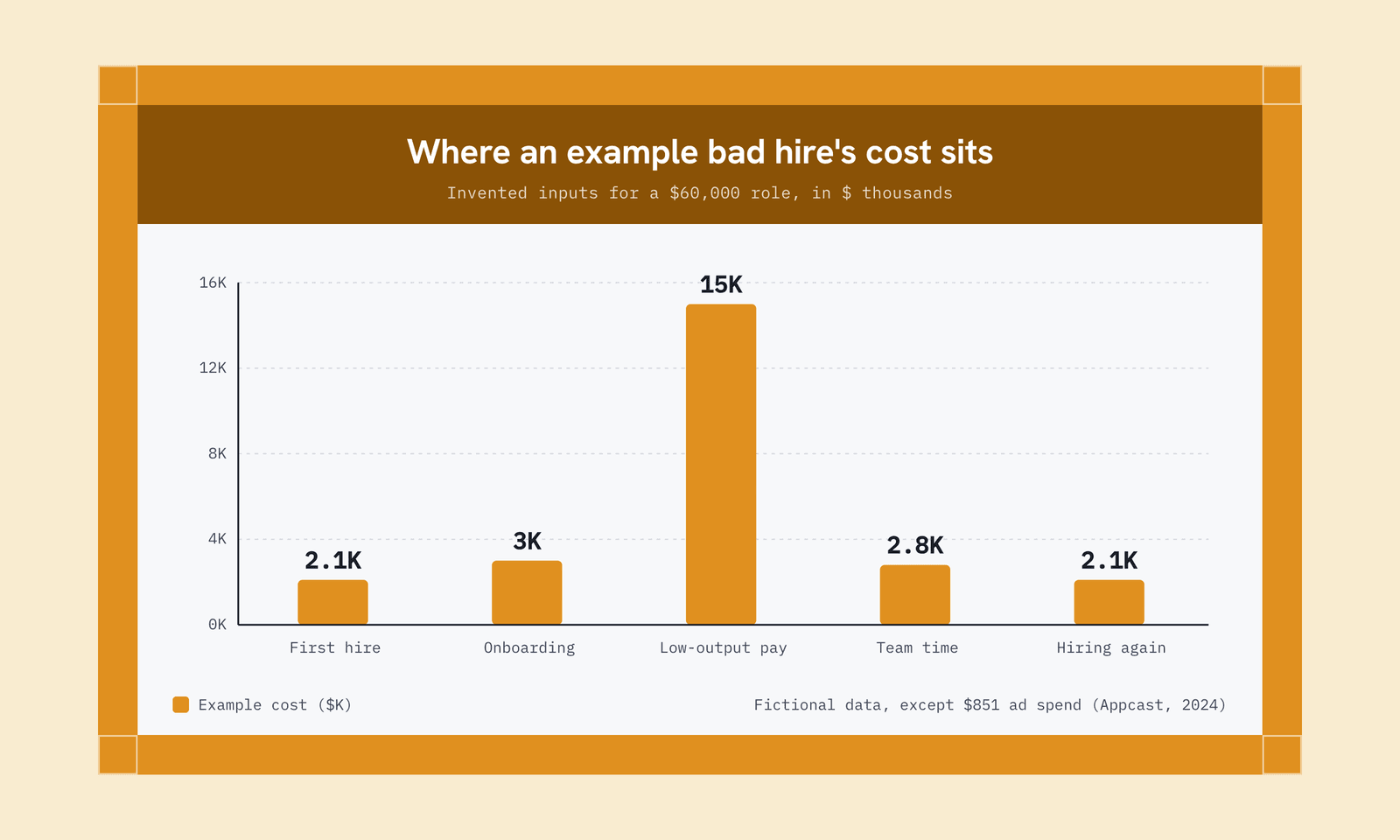
In the example, pay for months of low output is the largest line, at $15,000 of $25,002.
The total of $25,002 is about 42 percent of the $60,000 salary and leaves out lost customers and morale. Your total will differ because it comes from your inputs, and you can check each one.
What causes a bad hire, and what fixes it?
Here are five causes to check, each with a fix you control.
- A CV claim nobody tested. Ask for the detail behind each claim before the offer.
- Different questions for different applicants, so answers cannot be compared. See what a structured interview is.
- A shortlist drawn from the CVs that look familiar. Gem's customer data (June 2021 to May 2025) shows 8 percent of applicants getting past initial screening, so most were turned away at that first screen.
- A rushed decision when a role has been open for weeks. Time to hire statistics shows how long roles stay open.
- No written view of what a strong answer sounds like, so the interview rewards whoever talks best.
How does Tracy AI Interviewer test a CV claim?
Tracy covers the first cause. You describe the role or bring your own questions, share one link, and applicants open it whenever they like, with no calendar. With the CV check on, Tracy reads the CV, asks about its claims and follows up on the replies. The reviewer receives both sides on video, a timestamped transcript, and a short written summary of each person's answers to each question. The join screen tells applicants the interview is recorded and transcribed.
A sample of one claim being tested:
Tracy: Your CV says you led a team of 10. Tell me about that team.
Applicant (sample): It was four of us. I led one project.
Tracy: Was the group of ten a wider department?
In the sample report, the CV claim and the spoken answer sit side by side with the quote and its time, and a person decides what the difference means. This is an illustration with sample content.
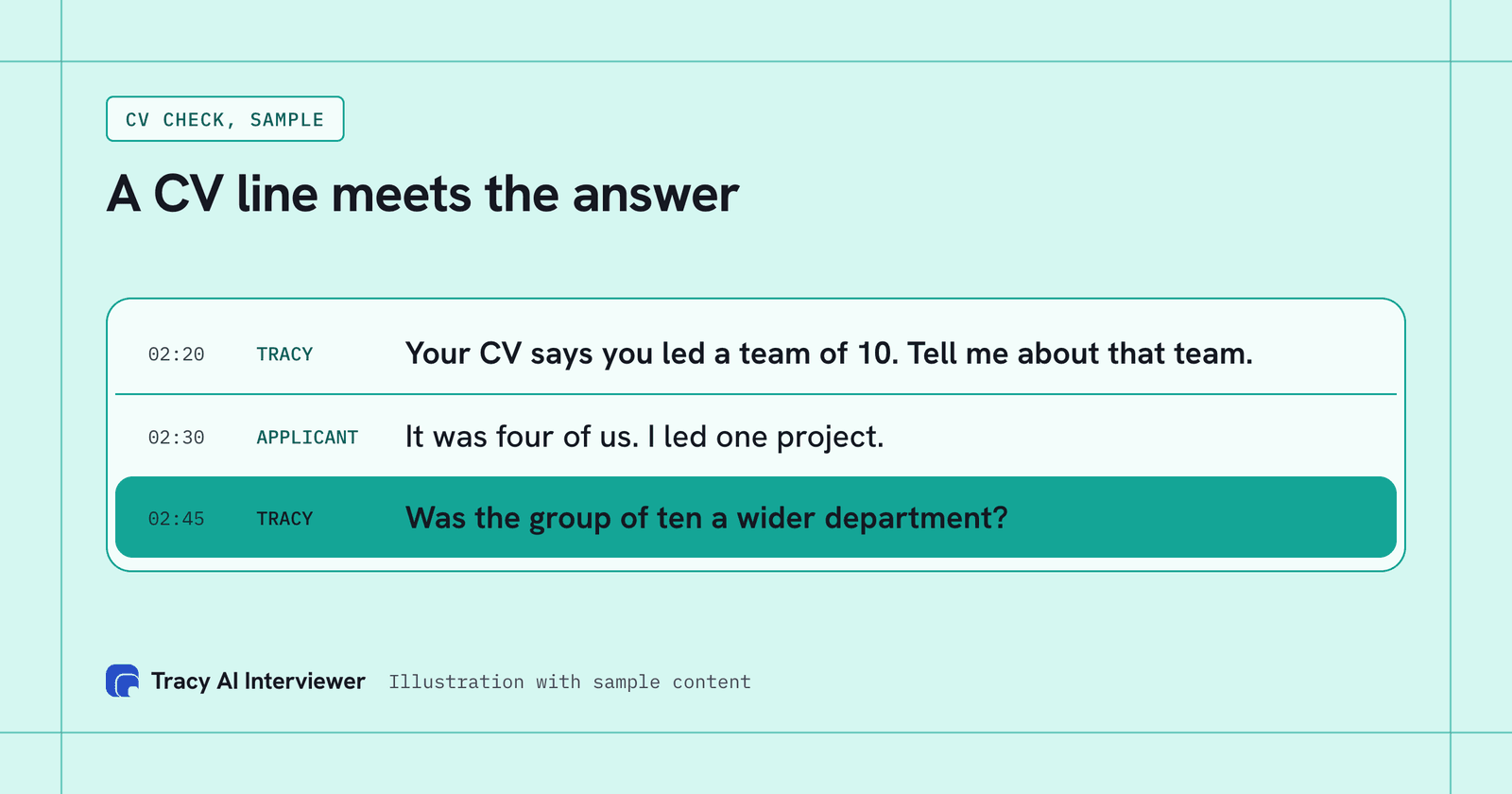
A CV line and the spoken answer sit side by side, so the reviewer hears the difference before the offer.
What Tracy leaves to your team
Tracy reports what each person said, with evidence, and a person decides. It does not predict who will perform, and scoring, ranking and rejecting are not things it does. Culture, references and fit with the manager stay with your team. If you only hire a few people a year, your own team can run a structured conversation and that will do.
Test the fix on one role
Pick the role where a miss hurt most last year and run it for four weeks.
- Calculate the cost of that miss with the table above, using your own inputs.
- Build the interview from the job description, add the questions that would have exposed the miss and put the link in the job post.
- Ask the owner to read the reports of people the CV screen would have filtered out.
- After four weeks, ask whether any of them would have changed who got the offer. If none would, drop the pilot.
Which path fits you:
- Measuring the outcome: the formulas for quality of hire.
- Many people into one role: recruiting at volume for a single job.
- Setting the funnel size: estimating applicants per job.
- Checking skills, not titles: skills-based hiring.
- The volume workflow with Tracy: volume hiring.
Common questions
How much does a bad hire cost?
Is the cost of a bad hire 30 percent of salary?
How do you calculate the cost of a bad hire?
How can you reduce the cost of a bad hire?
Hear every applicant before the offer
Build an interview from one job description and Tracy will ask about every CV claim, whatever the hour. First 3 results free.
Try it free (opens in a new tab) Book a demo (opens in a new tab)
Your first 3 results are free. No card needed.
Sources
- Gallup, This Fixable Problem Costs U.S. Businesses $1 Trillion (13 March 2019), retrieved 22 Nov 2026.
- Appcast, average cost per hire (2024 job ad data), retrieved 18 Nov 2026.
- CIPD with Omni RMS, Resourcing and Talent Planning 2026, retrieved 18 Nov 2026.
- Gem, key takeaways from the 2026 Recruiting Benchmarks Report, retrieved 18 Nov 2026.
- Tracy AI Interviewer home page, retrieved 22 Nov 2026.