In short
Open questions with a follow-up reach the cause behind a polite answer. This page has 15 exit interview questions, each with its follow-up and what to listen for. Tracy AI Interviewer asks them as an interview, follows up on one-word answers and returns a recording, a timestamped transcript and what the leaver said to each question. Your team reads it and decides what to change.
Good exit interview questions are open, specific and followed by a second question. The first question gets the reason people give, and a one-word first answer is common. If the leaver says "a better opportunity" and the note-taker writes it down, the conversation has stopped before the useful part.
This page has 15 exit interview questions with the follow-up to ask and what to listen for, a short list for interns, a way to handle one-word answers and a template to copy. It works with a form, a call or a doc.
The cause of a resignation usually sits one question after the answer people give first. Tracy AI Interviewer takes that second question off the note-taker: it runs your questions as an interview, asks a sharper one when an answer is vague and leaves a recording, a transcript and a report. See how Tracy runs exit interviews, part of our guide to AI interviews for people teams.
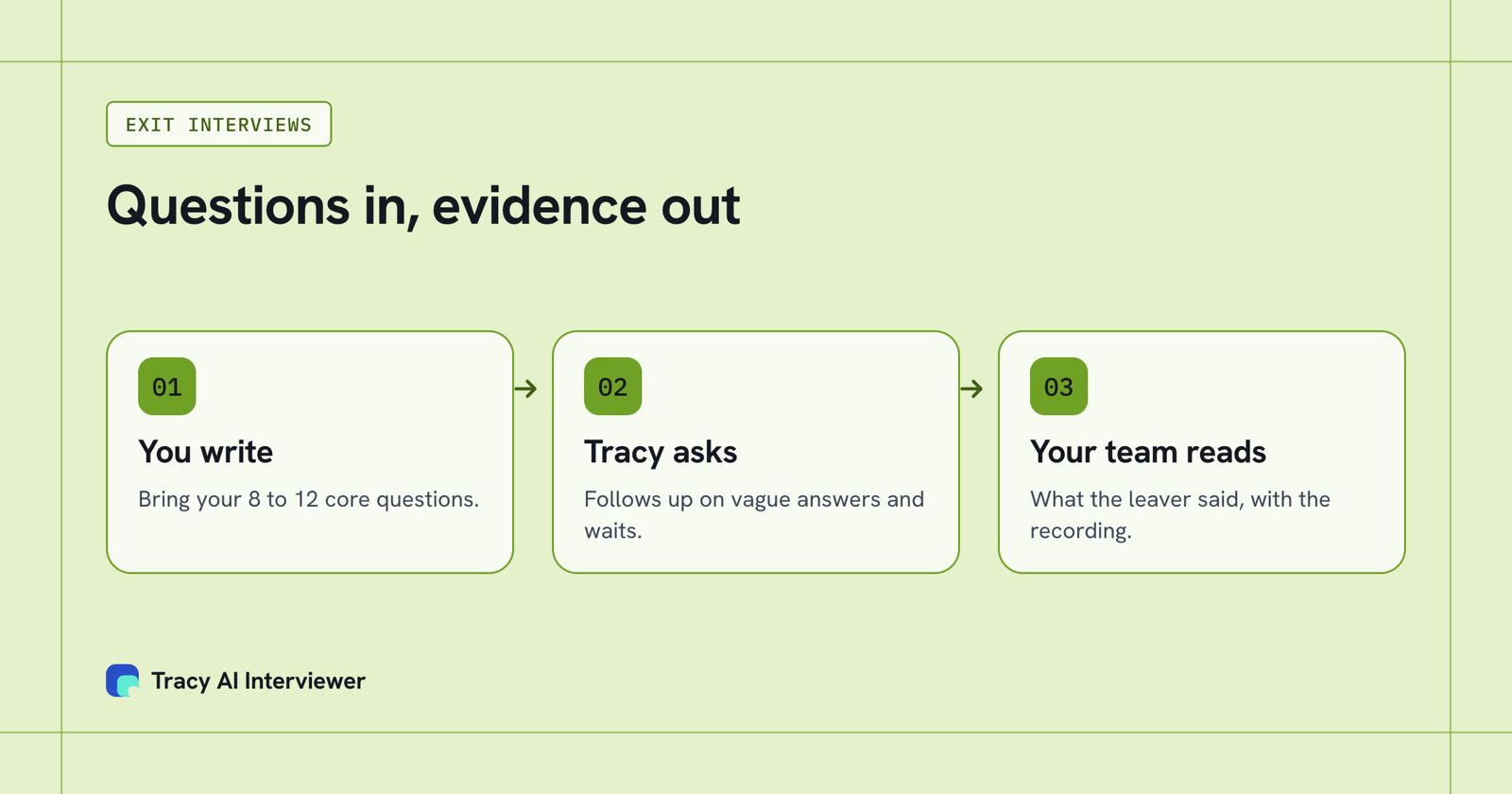
Your questions go in, and a recording and what the leaver said come out.
What a well-run exit interview gets right
ApplicantStack's exit interview guide (7 Oct 2026) says the most effective exit interviews are run by someone other than the employee's manager, are scheduled in the final week rather than on the last day, and fit 8 to 12 core questions into 30 to 45 minutes. It also says to tell the leaver how the feedback will be used and that it will not affect references or final records.
The questions below follow the same order. Start with why they are leaving, move to the work, the manager and the team, then growth and pay, and finish on what to change. The same structure is behind a structured interview: the same questions in the same order, so answers can be compared across people.
Those practices set up a good conversation. They do not supply the second question for every leaver, which is the part the next sections build in.
15 exit interview questions with follow-ups
Pick 8 to 12 for one conversation. Ask the follow-up only after you have heard the first answer, and ask every leaver the same core questions so the answers can be compared.
Why they are leaving
1. What made you decide to leave?
Follow up with: What did that have that this job did not?
Listen for: A named cause, such as a role, a date or a person, not a mood.
2. When did you first start thinking about leaving?
Follow up with: What was happening that week?
Listen for: A moment or an event, and how long it ran before anyone noticed.
3. What would have made you stay?
Follow up with: Who could have changed that, and when?
Listen for: A fix that was possible, and the point where it stopped being possible.
The work
4. How well did the job match what you were told when you joined?
Follow up with: Which part was most different?
Listen for: A specific gap between the description and the days.
5. What did you enjoy most, and least?
Follow up with: How often did the least enjoyable part come up?
Listen for: How often, and whether it was fixable.
6. Did you have what you needed to do the job well?
Follow up with: What was missing, and who did you ask?
Listen for: Tools, information or time, and whether asking worked.
Manager and team
7. How would you describe the support you got from your manager?
Follow up with: Can you give an example from the last month?
Listen for: Concrete behaviour, good and bad, with a date.
8. How did the team work together?
Follow up with: What happened the last time two people disagreed?
Listen for: How conflict was settled, and by whom.
9. Did you feel your work was recognised?
Follow up with: When did you last feel it was?
Listen for: A date, or "I can't remember".
Growth and pay
10. What did you think of the chances to learn and grow here?
Follow up with: What did you ask for that you did not get?
Listen for: A specific request and the reply it got.
11. How did your pay and benefits compare with what you expected?
Follow up with: What would have felt fair?
Listen for: Whether pay is one reason among several or the main one.
What to change
12. What is one thing we should change?
Follow up with: What would you change first if you ran the team?
Listen for: Something small enough to do this quarter.
13. What should we keep?
Follow up with: Why does that matter to you?
Listen for: Strengths worth protecting.
14. Would you recommend working here, and to whom?
Follow up with: What would you tell them first?
Listen for: A conditional answer, which often names the real gap.
15. Would you come back?
Follow up with: What would have to be different?
Listen for: Whether the door is open, and why.
Exit interview questions for interns
Interns leave because the internship ended, so the useful questions are about what it was like and what would bring them back.
- What did you expect the internship to be, and what was it? Follow up with: what surprised you most?
- Who taught you the most? Follow up with: what did they do that helped?
- Did you get work that mattered? Follow up with: which project, and why?
- Would you consider a full-time role here? Follow up with: what would decide it?
What do you ask when someone gives a one-word answer?
Ask for an example, then ask what would have changed it. If the person would rather not say, accept that and move on. The leaver chooses what to share.
| They say | Ask next |
|---|---|
| "A better opportunity." | What did that role have that this one did not? |
| "Nothing, it was fine." | What was the least fine part of an ordinary week? |
| "The manager." | Can you give an example from the last month? |
| "Pay." | What would have felt fair, and did you raise it? |
| "Burnout." | When did the workload start to feel too much, and what was behind it? |
| "Personal reasons." | Is there anything about work you would like us to hear? |
Six one-word answers and the follow-up to ask next.
Why the second question decides what you learn
The problem is the one-word answer that nobody follows up. ApplicantStack puts 8 to 12 core questions in 30 to 45 minutes, which is about four minutes a question. A leaver says "a better opportunity". In those four minutes the person running the call has to notice that this is a label, not a cause, and ask what that role had that this one did not.
A note-taker who is also listening for the next question can miss that moment. Tracy asks the follow-up each time and waits for the end of the thought, and the recording lets a second person hear what was said before anything changes.
Exit interview template to copy
Copy the five column names into a doc or sheet and fill one row per question. The example rows are fictional.
| # | Question | Answer, in their words | Follow-up asked | Theme |
|---|---|---|---|---|
| 1 | What made you decide to leave? | "A better opportunity came up." | What did that role have that this one did not? | Path to promotion |
| 3 | What would have made you stay? | "A date for the promotion conversation." | Who could have given you that? | Path to promotion |
| 13 | What should we keep? | "The team." | What about the team? | Team |
Scroll the table sideways to see all 5 columns.
Template with three example rows. The answers are fictional.
When the same theme shows up in several rows, you have a finding. Quote the leaver's words next to it so nobody has to take your summary on trust.
What Tracy adds to exit interviews
01
Reach every leaver
Each leaver can start on click, at any hour, with no scheduling and no one from HR on the call. ApplicantStack suggests the final week, and the interview fits around whatever that week looks like.
02
Ask the next question
Tracy asks in the leaver's own field, follows what they said and waits for the end of the thought. A one-word answer gets the follow-up from the table above.
03
Keep the evidence
Each result holds a recording, a timestamped transcript and what the leaver said to each question. A second person can hear the moment a point was made before anything changes.
How do you run these questions as a Tracy interview?
Tracy runs these questions as an interview. You choose the exit conversation, bring your own questions and send an invite. The person joins in the browser when it suits them, with no account to create. Tracy says who she is and what happens next, and the join screen says the conversation is recorded and transcribed before it starts. She asks your questions, follows up on vague answers and waits for the end of a thought.
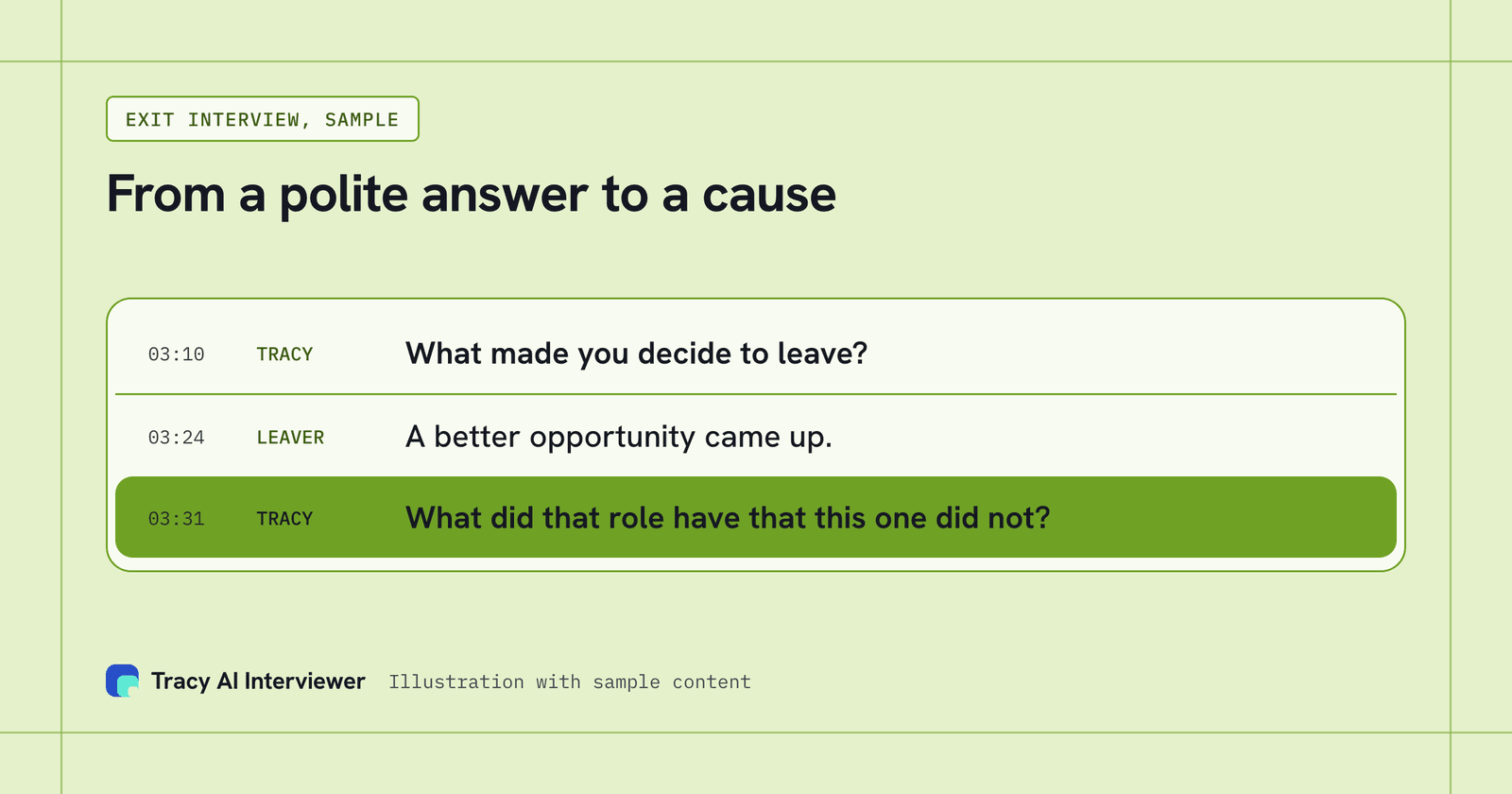
The follow-up from the one-word answers table, asked in the interview.
What do you read afterwards?
Afterwards you read what the leaver said to each question and open the recording at the moment a point was made. Tracy reports what was said and gives no score. Grouping answers into themes is done by Claude, ChatGPT or the reviewer, and a person decides what to change.
The result below is a recreation with fictional data. Each question shows what the person said and the quotes behind it, beside the recording and a transcript timed to it.
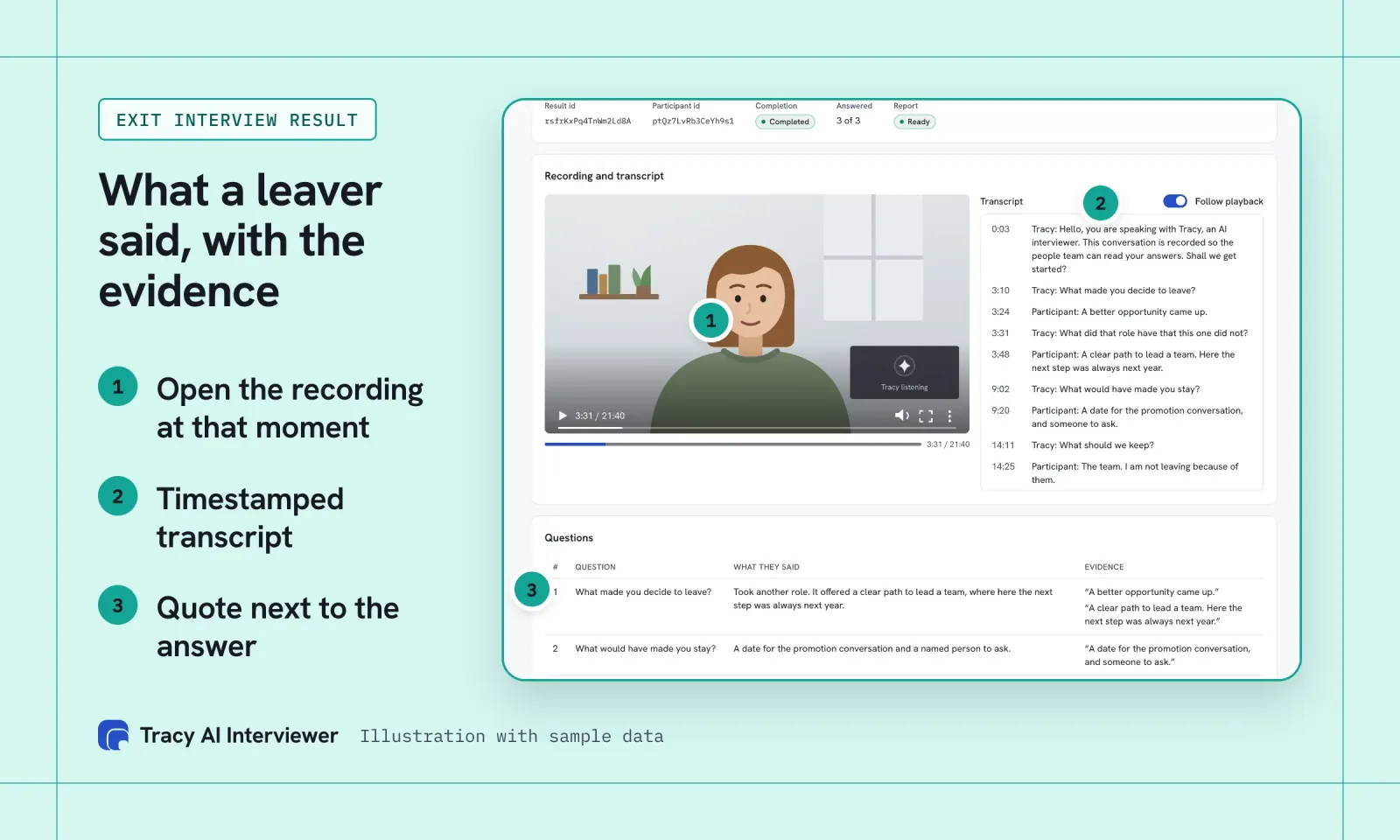
Each answer sits next to the quote and the moment it came from.
Where should you start?
Start with one exit interview. Use the 8 to 12 questions you picked above, run it, and compare what you read with what your survey said about the same person. Tracy costs $1 per credit, one credit per started 20 minutes, and the first 3 results are free. For a check-in at the other end of the employee's time with you, see 30-60-90 day check-in questions.
Which path fits you
- Cost before you start: pricing.
- What the person sees on the join screen: participant experience.
- A question guide for any interview: interview guide template.
Common questions
What exit interview questions should you ask an employee?
What exit interview questions work for interns?
Are there exit interview questions and answers you can copy?
How many exit interview questions should you ask?
Who should run an exit interview?
Run your exit questions in Tracy
Bring your 8 to 12 questions and send one invite. The first 3 results are free.
Try it free (opens in a new tab) Book a demo (opens in a new tab)
Your first 3 results are free. No card needed.
Sources
- Tracy AI Interviewer people teams use case, retrieved 14 Nov 2026.
- Tracy AI Interviewer product page, retrieved 14 Nov 2026.
- Tracy AI Interviewer pricing, retrieved 11 Nov 2026.
- ApplicantStack, Exit Interview Questions That Get Honest Answers (7 October 2026), retrieved 14 Nov 2026.