In short
As of November 2026, ChatGPT drafts the paperwork of onboarding: a first-week plan, a 30-60-90 plan and answers to the questions every new starter asks.
It cannot tell you how a new hire is doing. Tracy AI Interviewer, connected to ChatGPT, runs a short check-in at day 30 and asks a sharper question when an answer is vague.
You read what each person said, with the words behind each point. The first 3 results are free.
ChatGPT for onboarding is a drafting job. Give it your handbook and a role description and it will write the first-week plan, the welcome note and the answers to the repeated questions. This guide covers the setup, the prompts and the one part of onboarding that a document cannot cover, which is hearing how the new hire feels once the plan is running. For the wider set of people-team uses, see ChatGPT for HR professionals.
How can ChatGPT help onboard employees?
It helps with three jobs: drafting plans from your own documents, answering the questions new starters repeat, and preparing the manager for each conversation. The setup that keeps this tidy is a ChatGPT Project. OpenAI's help page, read on 23 Nov 2026, says a project groups chats, files and instructions, and that instructions apply only inside that project. A project holds 5 files on Free, 25 on Go and Plus, and 40 on Edu, Pro, Business and Enterprise.
Put the handbook, the role description and your standard first-week schedule in one project called Onboarding. Then every prompt below starts from your material and not from ChatGPT's general idea of a first week.
Which prompts work for onboarding?
Run each on a role you have already onboarded and see whether the output matches what happened.
- For the first week: "Using the role description and handbook in this project, draft a first-week plan for a customer support agent: one line per day with the activity, who they meet and what they should be able to do by Friday. Mark anything you had to assume."
- For the 30-60-90 plan: "Turn the role description into goals for days 30, 60 and 90. Keep each goal observable by the manager, and list the first question the manager should ask at each stage."
- For new-starter questions: "From the handbook, answer the ten questions people ask in week one. Quote the handbook section behind each answer and write 'not covered' where it is silent."
- For the buddy: "Write a one page checklist for a buddy in the first two weeks. Plain words, no jargon."
The 'not covered' instruction matters because ChatGPT otherwise fills gaps with what an average company would do, and a new hire then gets a policy you do not have.
What data should stay out of ChatGPT?
Keep new-hire personal details out unless the task needs them, and check the plan's data terms before you upload anything. OpenAI says it does not train on business data by default for ChatGPT Business and Enterprise. Leave out health, visa and pay details from drafting prompts, because a first-week plan does not need them.
What ChatGPT cannot tell you about a new hire
A plan cannot say whether it worked. A manager with eight new starters rarely has time for eight 30-day conversations, and a one-word reply in a survey, such as "fine", hides the thing you most want to know.
Tracy AI Interviewer covers that gap. It connects to ChatGPT through its MCP server (the steps are in how to add MCP to ChatGPT). In ChatGPT you say you want a 30-day check-in for new hires, bring your own questions or let Tracy draft them from your description, and approve the preview ChatGPT shows. Each person gets a link, opens it in a browser with no account and talks when it suits them. Tracy says who she is and what happens next, and the person is told about the recording before it starts. When an answer is vague she asks a kinder, sharper question about it. The same link can go to a whole cohort of starters, so the manager with eight new hires does not need eight diary slots, and each person answers at a time that suits them.
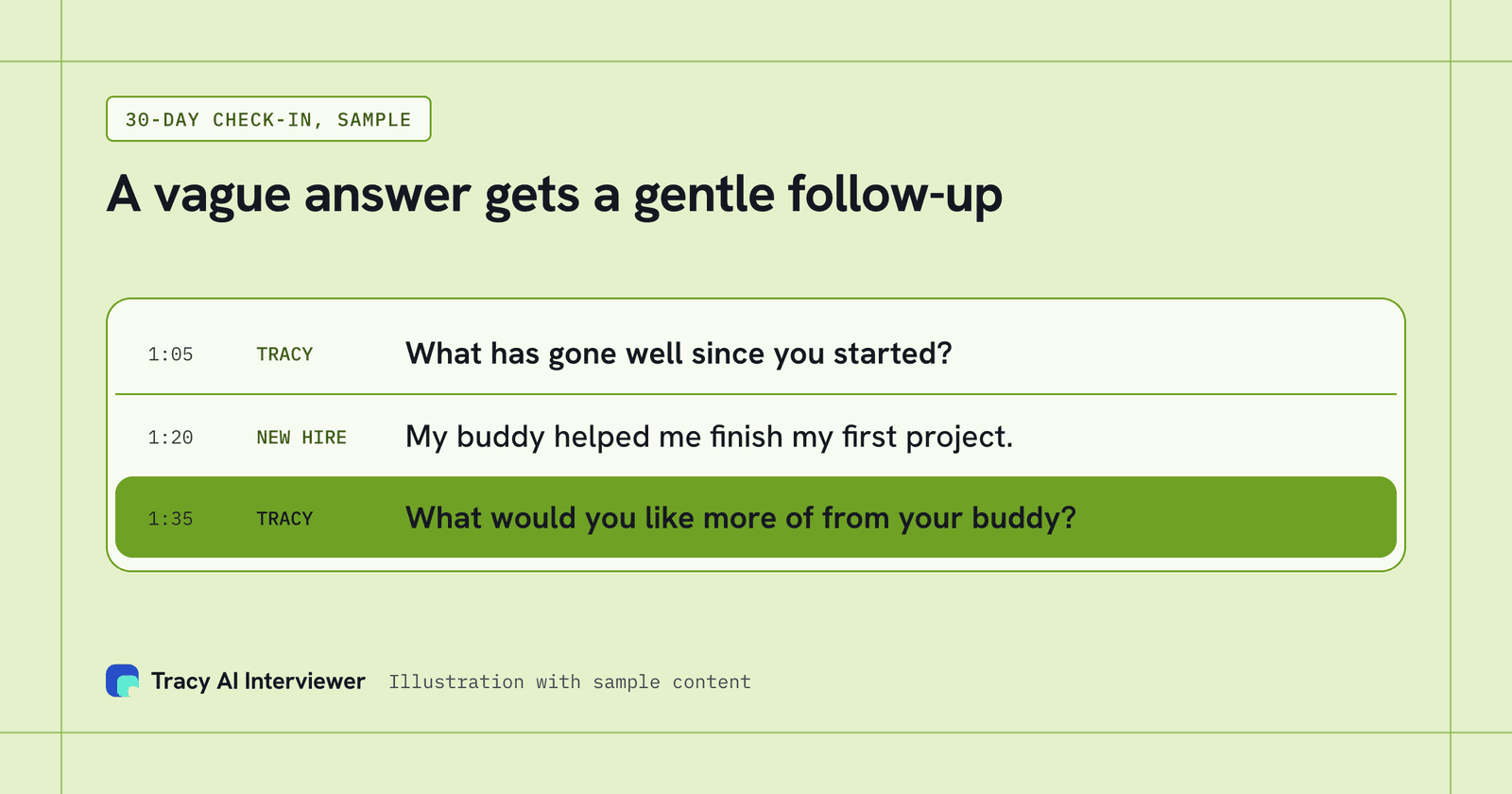
A vague answer gets a gentle follow-up.
What the manager reads after day 30
Ask ChatGPT for the results and it returns what each person said to each question, the result fields and a note for your applicant tracking system. By default it gives the latest completed session, and the report appears shortly after a session ends. Here is how two fields read for the new hire in the sample above:
| Result field | What the person said | Evidence |
|---|---|---|
| Support received | A buddy helped with the first project | 1:20, "My buddy helped me finish my first project." |
| Open question | Unsure who approves purchase requests | 3:00, "I am not sure who approves purchase requests." |
Invented sample data.
The manager now has one thing to fix, the purchase approval route, and one thing to keep, the buddy. Tracy has completed 100K+ interviews, and it does not score or rank anyone: the manager reads what was said and decides what to do.
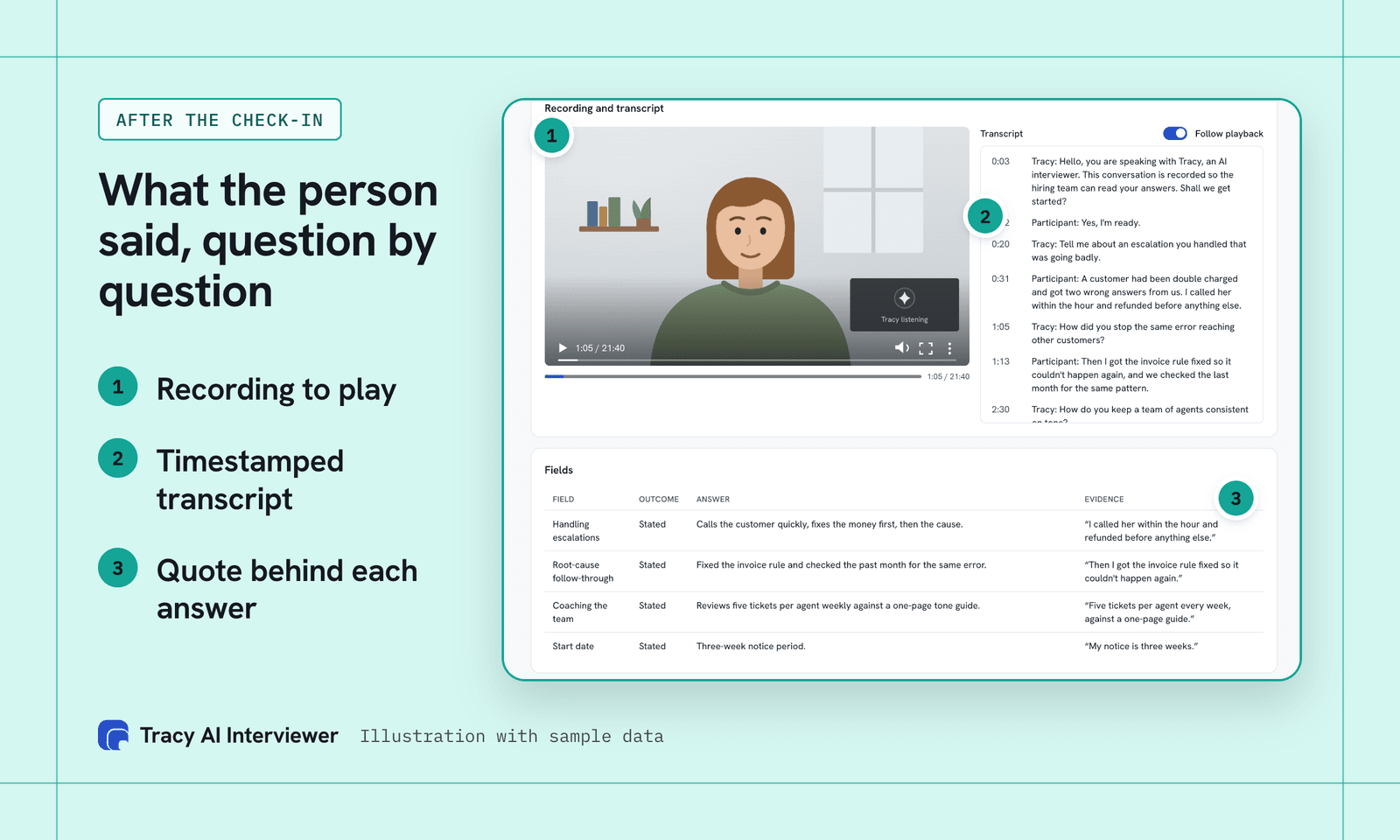
Each point keeps the words and the moment behind it.
Which path fits you?
- Writing the questions for each stage: 30-60-90 day check-in questions.
- Numbers on why the first months matter: onboarding statistics.
- Other people-team prompts: ChatGPT for performance reviews.
- Exit conversations: ChatGPT exit interview questions.
- Connecting Tracy to a chat tool: Tracy and ChatGPT, step by step.
Common questions
How can ChatGPT help onboard employees?
Which prompts work for onboarding?
Can ChatGPT run a new-hire check-in?
Is it safe to put new-hire details in ChatGPT?
Check in with every new hire from ChatGPT
Connect Tracy to ChatGPT, pick the 30-day check-in and approve the preview. First 3 results free.
Try it free (opens in a new tab) Book a demo (opens in a new tab)
Your first 3 results are free. No card needed.
Sources
- OpenAI Help Center, Using projects in ChatGPT, retrieved 23 Nov 2026.
- OpenAI, ChatGPT Business pricing, retrieved 23 Nov 2026.
- Tracy AI Interviewer, Connect, retrieved 23 Nov 2026.