In short
HR teams use AI for four jobs: running payroll and benefits, listening by survey, talking with people one to one, and drafting documents. Most tools do one of them well.
Tracy AI Interviewer handles the one-to-one conversation: check-ins and exit interviews where a thin answer gets a gentle follow-up, with each theme tied to the moment it was said.
Viva Glint, Culture Amp, Lattice and Leapsome fit survey programmes. HiBob and Paycor fit teams that want AI inside the system that holds payroll and records.
Run one onboarding check-in first: your first 3 results are free.
What AI tools do HR teams use?
HR teams use AI tools for four jobs. HR suites such as HiBob and Paycor put AI into payroll, benefits, scheduling and reporting. Survey platforms such as Viva Glint, Culture Amp, Lattice and Leapsome add AI summaries to engagement surveys. General assistants such as ChatGPT and Claude help with drafting. Tracy AI Interviewer covers the conversation: she holds a check-in or exit interview with each person and reports what they said.
The jobs differ, so most HR teams end up with two or three of these, not one.
How is AI used in HR?
AI use in HR is still partial. SHRM's State of AI in HR 2026, a survey of 1,908 HR professionals covering 138 HR tasks, found that 39% of organizations use AI in their HR functions and another 23% use it elsewhere in the business.
Where teams do use it, the work is mostly summarising and answering. Paycor lists resume processing, answers to new-hire questions at any hour and benefits support. Viva Glint's page says it can summarise thousands of employee comments. Neither a survey nor an AI summary of its comments goes back to ask what a one-word answer meant; an interview does.
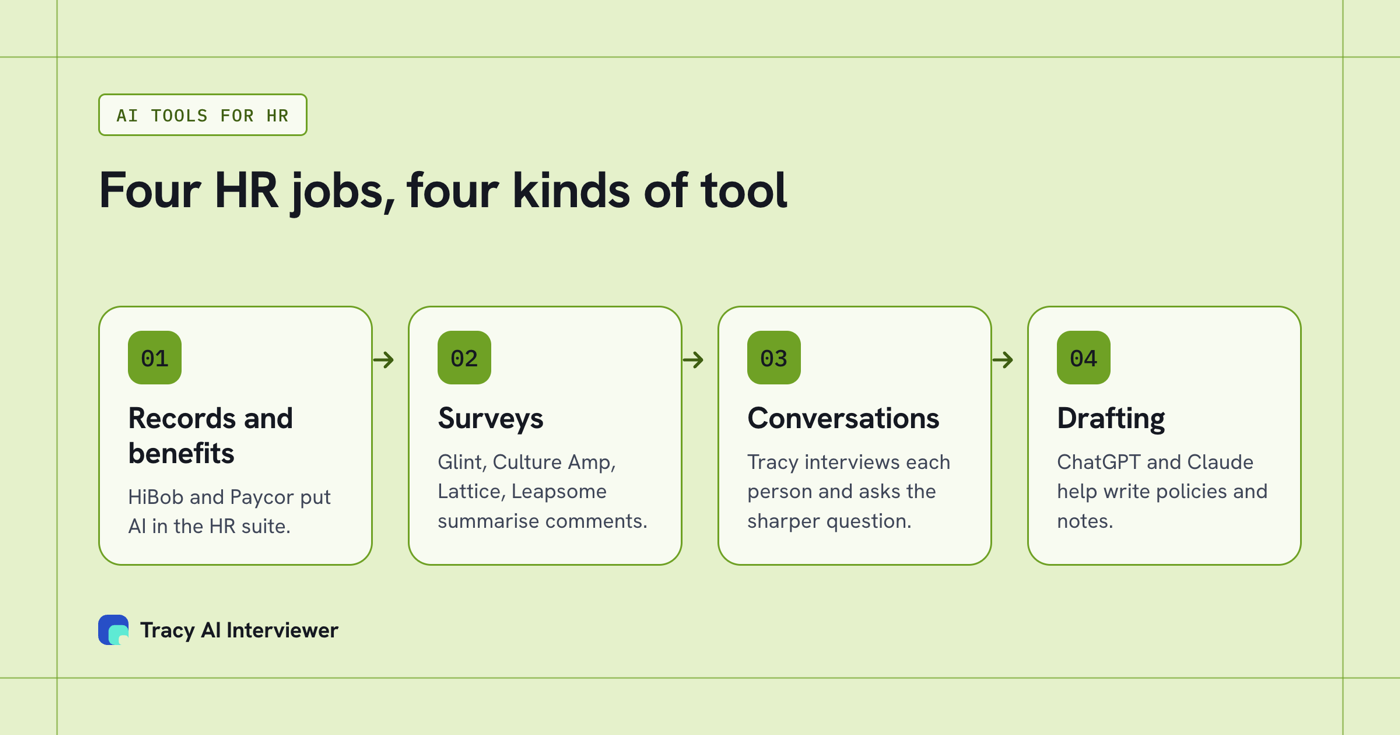
Each HR job has a different tool: records, surveys, conversations and drafting.
How are the tools ranked?
The order follows how close each tool gets to what people actually think, because that is the part of HR work where AI changes the most for a people team. The reason is given beside each place.
- Tracy is first: she talks with each employee, presses gently when an answer is thin, and links every theme to the words and moment behind it.
- Viva Glint is second: it summarises thousands of survey comments with AI, and it publishes a price.
- Culture Amp is third: it lists pulse surveys, AI comment summaries and an onboarding and offboarding survey, with no published price.
- Lattice is fourth: its engagement product has surveys, pulse, onboarding and exit surveys and AI analysis of trends.
- Leapsome is fifth: a question library, action plans and offboarding surveys at a list price per employee.
- HiBob is sixth: a people platform with Bob AI, built around records, not conversations.
- Paycor is seventh for this job: its AI work is in recruiting, scheduling, benefits and analytics.
For payroll, benefits or scheduling the order flips, and Paycor and HiBob are the better picks.
Survey prices are for each vendor's engagement product only, read on 22 November 2026.
| Tool | Takes this job | Price |
|---|---|---|
| Tracy AI Interviewer | Check-in, stay and exit interviews | First 3 results free, then $1 per credit |
| Viva Glint | Surveys with AI comment summaries | $2.00 per user a month, 50-seat minimum |
| Culture Amp | Pulse surveys and AI summaries | Not published |
| Lattice | Surveys, pulse, exit, AI trends | $4 per seat a month, $4,000 minimum |
| Leapsome | Question library and action plans | EUR 4 per employee a month |
| HiBob | People platform with Bob AI | See its pricing page |
| Paycor | Recruiting, benefits, scheduling, analytics | See its pricing page |
What Tracy adds for a people team
Tracy holds the check-in or exit conversation with each person, so a manager does not need to find the time for all of them.
- You pick the type of conversation, whether an onboarding check-in, an engagement conversation or an exit interview, and use your own questions or edit the ones she drafts from your aim.
- People join from a browser at a time that suits them, so nobody needs a calendar slot. Tracy introduces herself and explains what happens next, and the recording is announced before it starts.
- A vague answer gets a kind, sharper one. Say someone leaves because of the schedule. Tracy asks how the hours were set, then what would have made them stay.
You read themes with the words behind each one, and the recording and transcript sit behind every point. ApplicantStack's exit interview guide advises that someone other than the manager runs the exit interview, in the final week rather than the last day, with 8 to 12 core questions that fit 30 to 45 minutes. Tracy is not the manager, and she keeps to the questions you set. She does not decide anything about a person: your team does. Tracy is SOC 2 Type II attested; ask hello@tracyinterview.ai for the report.
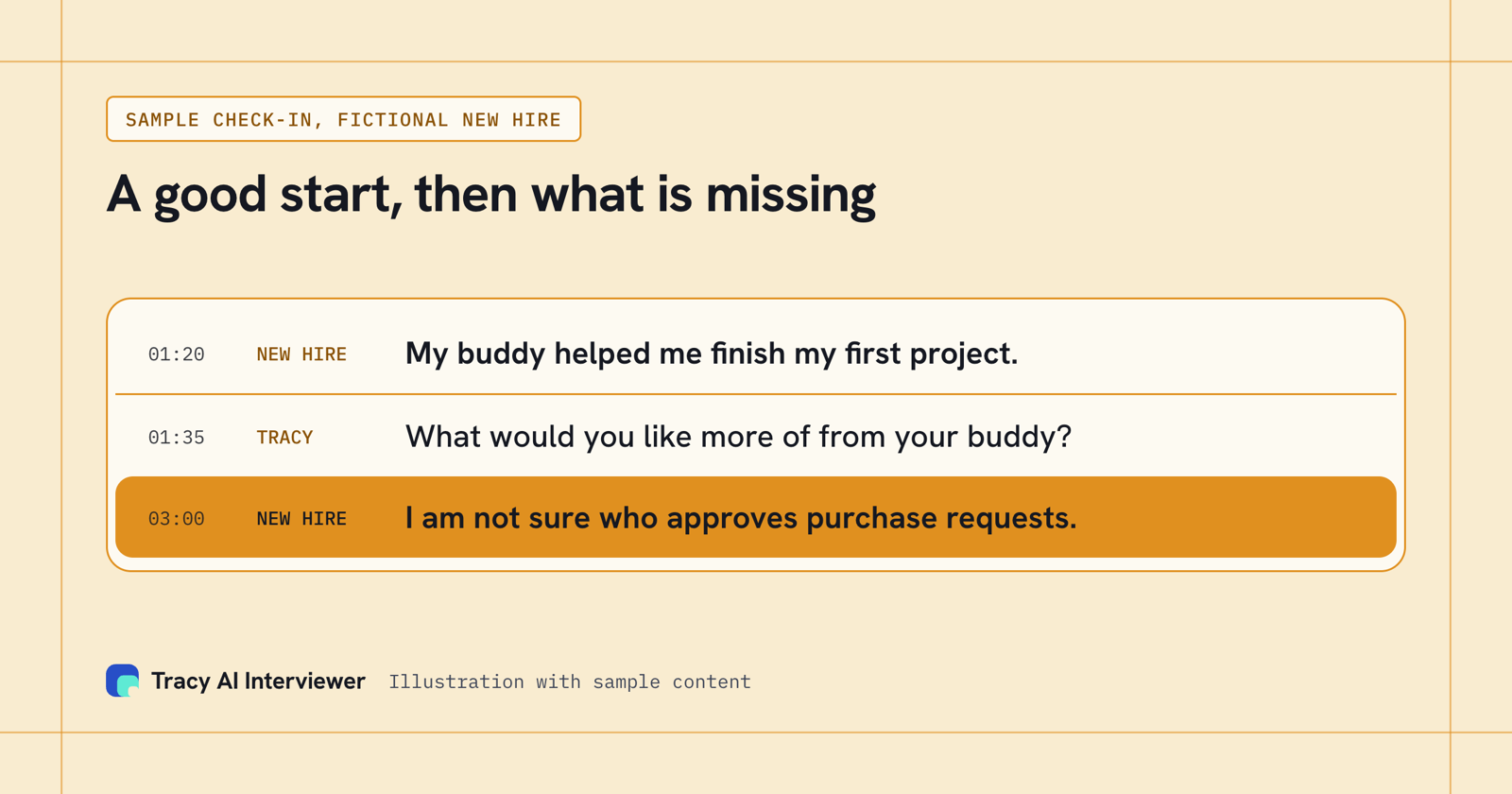
A thin answer at a 30-day check-in gets a follow-up, and each line carries a time.
Which tool fits which HR team?
Vendor pages were read on 22 and 23 November 2026.
- Viva Glint suits teams already in Microsoft that run an annual or pulse survey and want comments summarised.
- Culture Amp suits teams that want pulse surveys and an onboarding and offboarding survey in one place; ask for a quote.
- Lattice suits teams that want engagement surveys beside performance work and can meet a $4,000 annual minimum.
- Leapsome suits teams that want a question library and action plans, priced per employee.
- HiBob suits teams that want AI inside the people platform that holds their records.
- Paycor suits teams that want AI across payroll, scheduling and benefits answers.
Choose Tracy when you want to hear why: a 30-day check-in for every new hire, or an exit interview that goes past one-word answers. See the 30-60-90 day check-in questions for what to ask and exit interview questions for leavers.
Which path fits you?
- Running an engagement programme: best employee engagement survey tools compares survey platforms.
- Handling leavers: best exit interview software compares exit tools.
- Hiring for your own team: AI recruiting software compares ATS tools and point tools.
- Asking why people stay: stay interview questions gives a ready list.
Common questions
What AI tools do HR teams use?
What are the best AI tools for HR?
How is AI used in HR?
Can AI replace an HR conversation?
Hear what people actually think
Tracy holds check-ins and exit interviews and asks a kind, sharper question when an answer is vague. First 3 results free.
Try it free (opens in a new tab) Book a demo (opens in a new tab)
Your first 3 results are free. No card needed.
Sources
- Tracy AI Interviewer: Pricing, retrieved 23 Nov 2026.
- Tracy AI Interviewer: Connect, retrieved 23 Nov 2026.
- Microsoft Viva Glint, retrieved 23 Nov 2026.