
In short
Exit interview analysis turns free-text answers into a few coded themes, counted by team and tenure, each with a quote someone can check. This page gives a four-step method, a coding sheet and a report template.
Tracy AI Interviewer improves what goes in: she follows up on one-word answers and returns what each leaver said to each question, with the recording and a timestamped transcript.
Start with your next ten leavers: ask the same core questions and code them against one tag list you fix before reading the first answer.
Exit interview analysis starts with a pile of interviews, and it becomes useful when you can say how many people left for the same reason and show the words behind the number. That takes four moves: code each answer with a fixed tag, count by group, keep one quote per theme and give each theme an owner. Most of the work happens before the analysis, in what the leaver was asked and whether the first answer was followed up. This page covers both, with a coding sheet and a report template you can copy. The questions themselves are in exit interview questions with follow-ups.
What is exit interview analysis?
SHRM describes it as reviewing and interpreting systematically gathered data to spot trends that inform organizational decisions. It says the exit interview should use standardized questions and responses so that they can be coded, and that analysis needs substantial data from a large number of exit interviews over months and years. As a rule of thumb of our own, treat a theme that fewer than five leavers raised as a lead to check, not a finding.
How do you turn exit interview answers into themes?
Code each answer with one tag from a fixed list, count the tags by group and write each theme with a quote, an owner and a date. AIHR's seven-step process says the same in more steps: define the problem, decide the data, collect it, clean it, analyze it, share the insights and decide actions.
- Name the question. AIHR's first step is to know what you are trying to accomplish. A good one is "Why do engineers leave in their first 18 months?".
- Code every answer. Give each leaver one primary tag and keep the quote next to it. Fix the tag list before you read the first answer, so the last answer is coded the same way as the first.
- Count by group. Split by team, tenure band and manager, and show the count out of the total. Do not report a group of fewer than five people as a finding; flag it as a lead.
- Write the theme. One sentence, the count, one quote with its time, a named owner and a date.
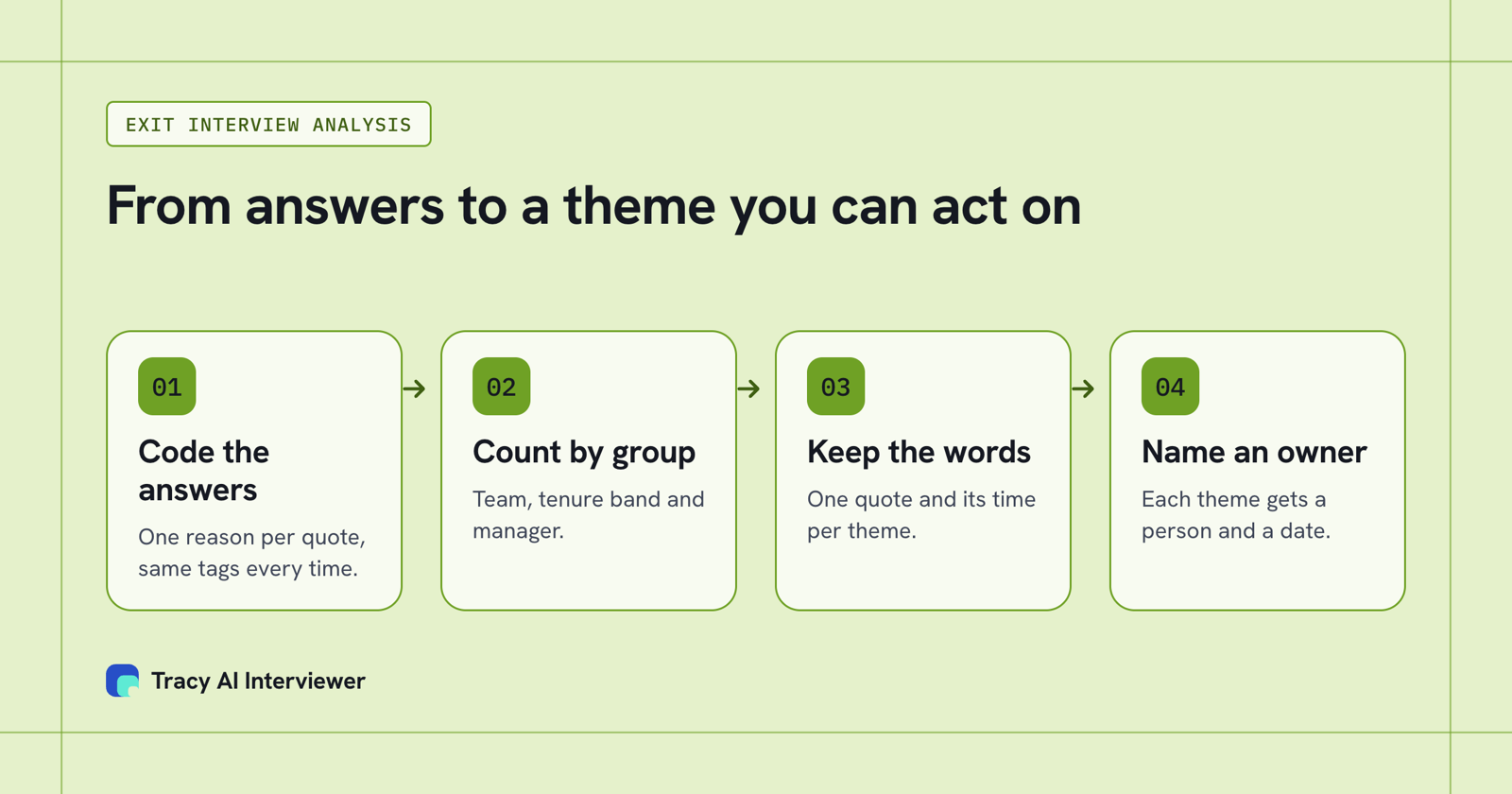
Four moves take a pile of answers to a theme with an owner.
Exit interview analysis template
Two sheets cover it. The first is a coding sheet with one row per leaver. Write the stated reason and the reason after the follow-up in separate columns, because the gap between them is the finding.
| Leaver | Team | Tenure band | Stated reason | Reason after follow-up | Tag | Quote and time |
|---|---|---|---|---|---|---|
| L-01 | Support | 1 to 2 years | "A better opportunity." | A lead role was open elsewhere and none was open here | Growth path | "Here the next step was always next year." 3:48 |
| L-02 | Logistics | Under 1 year | "The commute." | The office move added an hour each way | Commute | "The office move added an hour to my commute." 1:30 |
Scroll the table sideways to see all 7 columns.
Fictional rows. Keep the tag list fixed before you start: manager, growth path, pay, workload, role fit, team, company direction, commute or location, personal.
The second is the report. Put the question at the top, then the sample (how many leavers, which months, which teams), then a row per theme.
| Theme | Leavers | By team | Quote | Owner | Date |
|---|---|---|---|---|---|
| Growth path | 9 of 24 | Support 5, Sales 3, Ops 1 | "Here the next step was always next year." | Head of support | 15 Jan |
| Workload | 6 of 24 | Support 4, Ops 2 | "Two people left and nobody took their work." | Support lead | 15 Jan |
Scroll the table sideways to see all 6 columns.
Fictional numbers, to show the format. Put the count out of the total on every row.
Where does exit data go wrong before you analyze it?
It goes wrong in the interview itself. Qualtrics lists as a drawback that leavers may be tempted to sugarcoat things to leave a good last impression, and a one-word answer that nobody follows up gets coded as it was said. "A better opportunity" becomes a tag, then a top theme, and the theme tells leadership nothing about what to change.
Gallup's survey of 717 US voluntary leavers (8 to 20 November 2023) points at where to look first. Of the leavers who said their exit was preventable, 70% named actions more directly related to how they are managed daily. Code manager behavior separately from role, pay and workload, and ask for an example whenever someone says "the manager".
How does Tracy help with exit interview analysis?
Tracy AI Interviewer runs the exit interview itself. You choose the exit conversation, bring your own questions or describe the role and edit Tracy's draft, and send a link. Leavers join in the browser at a time that suits them and are told before it starts that the conversation is recorded and transcribed. When the first answer is "a better opportunity", Tracy asks what was behind it, so the reason after the follow-up is on the record next to the stated one.
For each question you get what the leaver said, with a timestamped transcript and the recording of both sides. Tracy gives no score. The reviewer groups the answers into themes, or Claude or ChatGPT does it from the results through Tracy's connector, and a person checks each theme against the quotes.
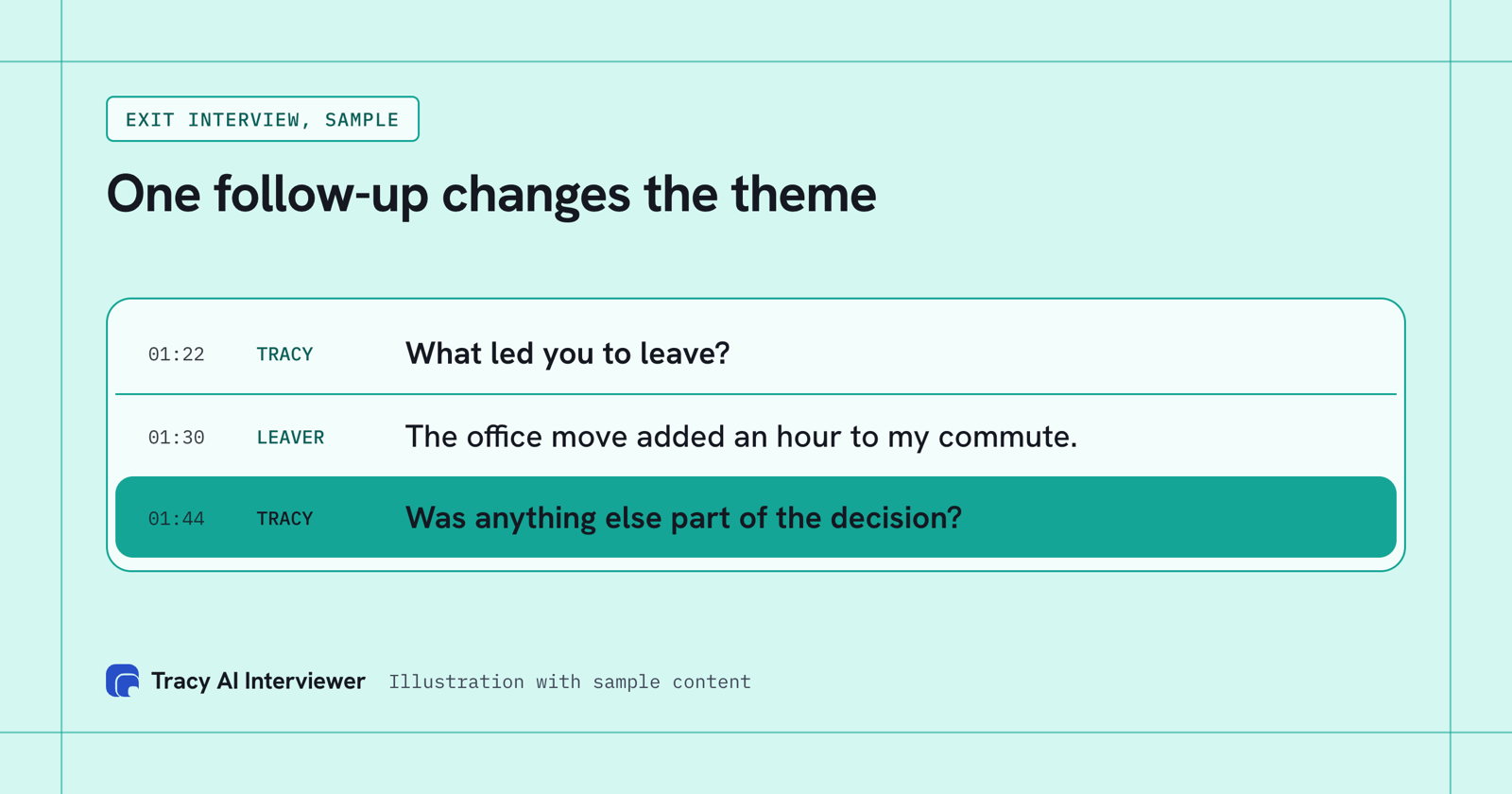
One follow-up can add a reason the first answer left out.
Where should you start?
Take your next ten leavers, ask the same core questions and code them with the tag list above. In Tracy a 15-minute exit interview is one credit, $1: $1 per credit, one credit per started 20 minutes. Use how to conduct an exit interview for who should run it. To catch people before they leave, see stay interview questions.
Which path fits you
- You still need the question list: exit interview questions with follow-ups.
- You want software that runs exit interviews: best exit interview software.
- You want to see what a written summary can look like: AI interview summaries.
- You want a read on the team between exits: employee pulse survey questions.
- You want the price first: pricing.
Common questions
What goes in an exit interview analysis report template?
What does an exit interview analysis report show?
Do you need an exit interview analysis dashboard?
How many exit interviews do you need before you analyze them?
Collect answers worth coding
Run your next exit interviews in Tracy and read what each leaver said, with the follow-up behind it. Your first 3 results are free.
Try it free (opens in a new tab) Book a demo (opens in a new tab)
Your first 3 results are free. No card needed.
Sources
- SHRM, How Do You Analyze Exit Interview Data Effectively? (25 April 2025), retrieved 22 Nov 2026.
- AIHR, Exit Interview Data Analysis: A 7-Step Process (Andrea Boatman, undated), retrieved 22 Nov 2026.
- Gallup, Employee Turnover Is Preventable, Yet Often Ignored (9 July 2024, updated 16 February 2026), retrieved 22 Nov 2026.
- Qualtrics, Employee exit interviews: question themes and best practices, retrieved 23 Nov 2026.
- Tracy AI Interviewer people teams use case, retrieved 14 Nov 2026.
- Tracy AI Interviewer pricing, retrieved 22 Nov 2026.