
In short
Tracy AI Interviewer runs exit interviews and check-ins in the browser, with no calendar, and asks a sharper question when an answer is vague. Each result keeps a recording, a transcript timed to it and what each person said to every question. A person reads the result and decides what to change.
Exit surveys collect one-word answers, and a survey cannot ask what the word meant. An AI exit interview is a conversation, run by an AI interviewer, that asks your questions and then asks the next one when an answer is vague.
Tracy AI Interviewer runs exit interviews, onboarding check-ins and engagement conversations this way. She asks your questions, follows up on what the person says, waits for them to finish and leaves a recording, a transcript and a report of what each person said to each question. This page covers what that gives a people team, what it leaves to you and where to start. The people teams use case shows the same flow on the product site.
What is an AI exit interview?
An AI exit interview is a conversation with someone who is leaving, run by an AI interviewer instead of a form or a busy HR partner. It asks everyone the same questions, as a structured interview does. It follows up on vague answers and leaves a record you can read afterwards. Unlike an exit survey, it can ask a second question.
Tracy's follow-ups depend on the answer before them. A vague answer gets a sharper question, and she waits for the end of a thought before she speaks.
Why do exit surveys and check-ins fall short?
The people teams page names three problems. Exit surveys collect one-word answers. Managers do not have time for every 30-day check-in. People say more to a patient listener than to a form.
- One-word answers. A survey cannot ask what the word meant.
- No time. A manager with several new hires cannot sit through a check-in each at 30, 60 and 90 days and still do the work.
- The wrong format. A form gives people a box to fill. A conversation gives them room to explain.
To write the questions, adapt the run order and follow-ups in the interview guide template, which is written for hiring but works as a layout for any set conversation.
How does an AI interviewer handle a vague answer?
The people teams page shows this exchange. An exit interview opens with "What made you decide to leave?" and the first answer is "Mostly the schedule." Tracy asks whether the problem is the hours or how they were set. The person says shifts were posted two days ahead, so they could never plan anything. A third question asks what would have made them stay.
A survey would have stored the word "schedule". The conversation gave a cause the team can act on: shifts were posted two days ahead.
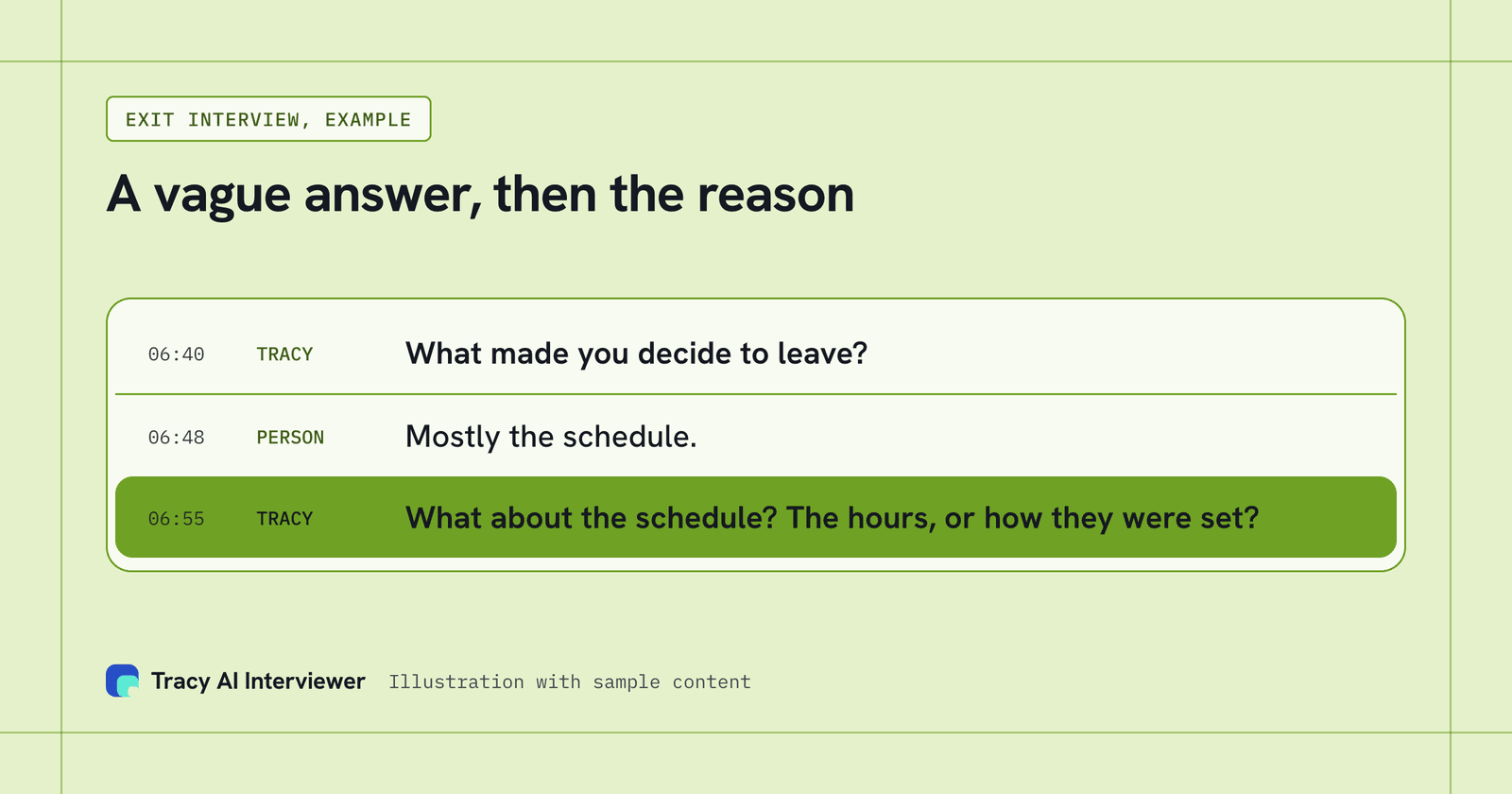
One follow-up turns "the schedule" into a cause the team can fix.
How does Tracy run an exit interview or a check-in?
There are three steps and no calendar to manage.
- Choose the conversation. Onboarding check-in, engagement or exit. Bring your own questions.
- Send the invite. People join in the browser when it suits them, with no account to create and no time slot to book.
- Read what each person said. Each answer comes with the words behind it, and the recording and transcript sit underneath. Claude, ChatGPT or you can group the answers into themes.
Tracy says who she is and what happens next. The join screen tells people the conversation is recorded and transcribed before it starts.
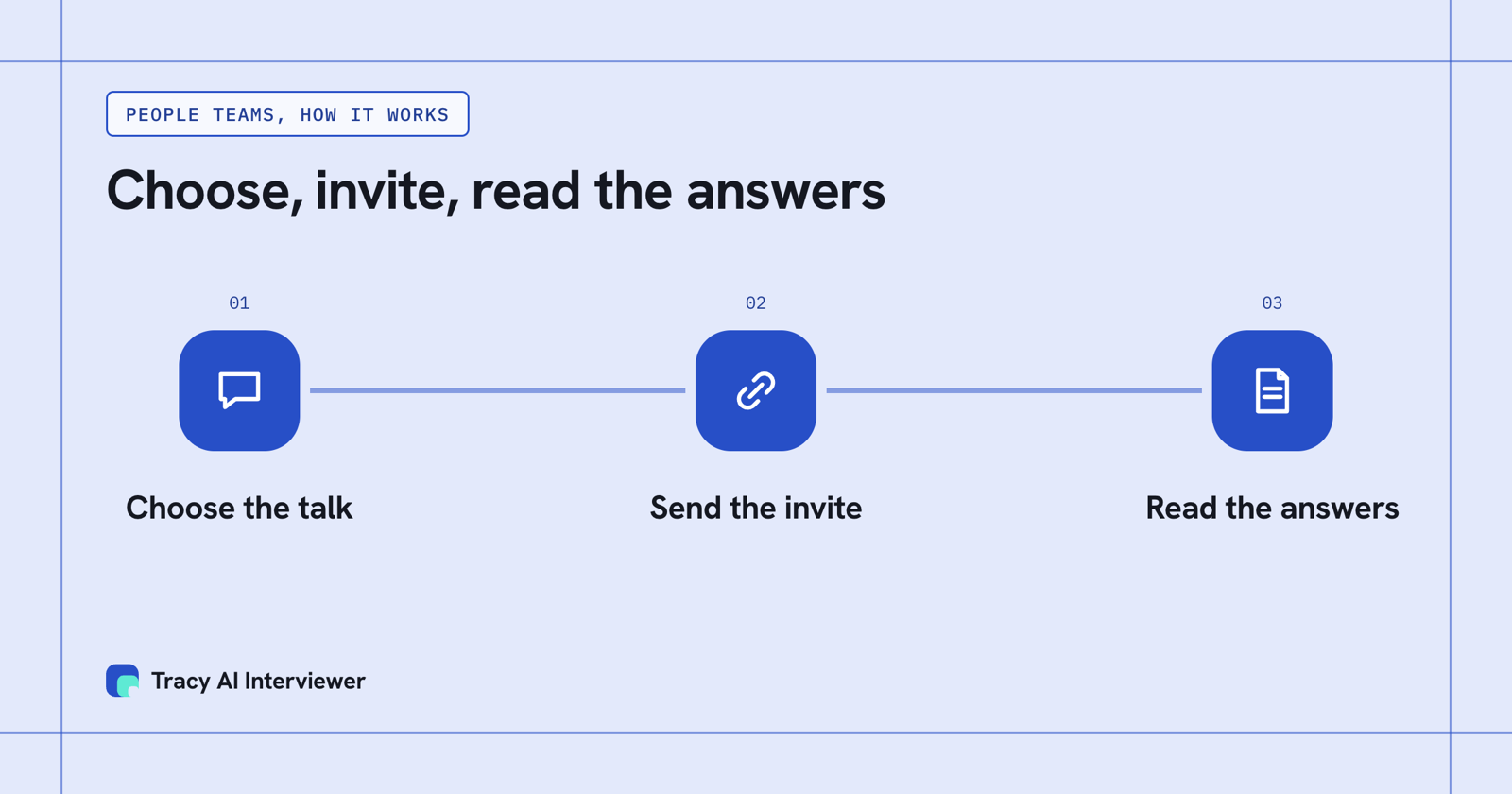
Three steps take you from a question list to what each person said.
Which conversations can you run?
| Conversation | What you want to hear |
|---|---|
| New hire check-in at 30, 60 and 90 days | What differs from what they were told |
| Engagement or stay conversation | Why people who could leave stay |
| Exit interview | The cause behind the reason given |
Three conversations a people team can run with Tracy, and what each one is for.
Once the interviews are in, interview transcript analysis shows how to turn answers into themes while keeping the quote and timestamp behind each one.
What stays with a person?
- Reading and deciding. Tracy reports what was said, with evidence; this checklist for reading a report shows what to look for. A person decides what it means and what to change. She does not score, rank or judge anyone.
- Serious concerns. If someone describes harassment, discrimination or a safety problem, a person takes it from there under your policy. Agree the route before the first interview.
- Who sees what. Decide who can watch recordings and read reports, and say so in the invitation.
- The 1:1. A check-in with an AI interviewer does not replace a manager's conversation. The manager can read what was said before the 1:1.
Where should a people team start?
Pick one conversation. The smallest first run is one exit interview or one 30-day check-in, using ten questions you already ask. Read the result next to what your survey told you. If the interview shows causes the survey missed, run the next ten.
Tracy costs $1 per credit, one credit per started 20 minutes, and the first 3 results are free. Each person starts when it suits them, at any hour, so a leaver can answer outside office hours. The interview is recorded on both sides, with a transcript timed to the recording, so you can open the moment behind any point in the result. A conversation of 20 minutes or less is one credit, and each further started 20 minutes is another. To try it, create one exit interview with your own questions and read the first result.
Which path fits you
- Customer discovery instead of people topics: customer research.
- What the person sees on the join screen: participant experience.
- Cost before you start: pricing.
Common questions
Are exit interviews normal?
Are exit interviews worth it?
Are exit interviews mandatory?
Can an AI interviewer run an exit interview?
Do people know the interview is recorded?
Create an interview for your people team
Choose an exit or check-in, add your own questions and read the first result. The first 3 results are free.
Try it free (opens in a new tab) Book a demo (opens in a new tab)
Your first 3 results are free. No card needed.
Sources
- Tracy AI Interviewer people teams use case, retrieved 14 Nov 2026.
- Tracy AI Interviewer product page, retrieved 14 Nov 2026.
- Tracy AI Interviewer pricing, retrieved 11 Nov 2026.