In short
The graduate recruitment process usually runs from application form to online tests, a first-round interview, an assessment centre and an offer. Graduate vacancies drew an average of 140 applications each in 2024 to 2025, so most applicants are filtered out before anyone speaks to them.
Tracy AI Interviewer lets you interview every applicant instead: each starts on click, at any hour, and Tracy follows up on what they said. Your reviewer reads a recording, a transcript and what each person said to each question.
Candidates rate Tracy 92 on NPS. Run it on one intake, then invite the people you pick to the assessment centre.
What is the graduate recruitment process?
It is the yearly cycle in which an employer attracts, assesses and hires students and recent graduates, usually for a structured scheme. Employers differ, but the stages targetjobs describes are common:
- Application: "Typically, the first part of the recruitment process for a graduate job or scheme is filling out an application form."
- Online tests: applicants who pass the form are "likely" to be asked to complete psychometric tests.
- First-round interview: it "could be pre-recorded."
- Assessment centre: "essentially group interviews, in which employers bring together a number of candidates."
- Final interview: for some employers, though targetjobs calls it "rare."
- Offer.
The order and the number of stages change from one employer to the next, and so does the timing. Searches for the graduate application process or a named firm's graduate recruitment process are mostly asking this question from the applicant's side.
Why do graduate schemes struggle with volume?
Applicants per vacancy have climbed. The Institute of Student Employers' Student Recruitment Survey 2025, covering 155 UK employers and more than 1.8 million applications, found graduate vacancies drew an average of 140 applications each in 2024 to 2025, up from 38 in 2002 to 2003 and 86 in 2022 to 2023. Retail, FMCG and tourism roles drew 290 each. In the same survey, graduate hiring fell 8% and apprentice hiring rose 8%.
The US shows the same direction. Handshake's platform data put applications per job from the Class of 2024 about 64% above the Class of 2023, while US employers told NACE in spring 2026 that they expect to raise Class of 2026 graduate hiring by 5.6%. In our view, the form and the tests exist to cut that pile down, and graduates have little work history for a CV to show.
Where does a first interview fit in the graduate application process?
Put it right after the application, ahead of the online tests. A pre-recorded interview cannot respond to what the applicant says. Tracy AI Interviewer is a two-way interview: the next question is built from the answer just given, so a thin answer gets probed and a strong one gets room.
Graduates have project, team and motivation stories rather than job histories, and a follow-up is how a reviewer finds out what the applicant did in that story. Each person starts when ready, in the browser, with no account and no calendar, so exam periods and time zones do not decide who gets seen. The first-round interview guide covers the stage in general.
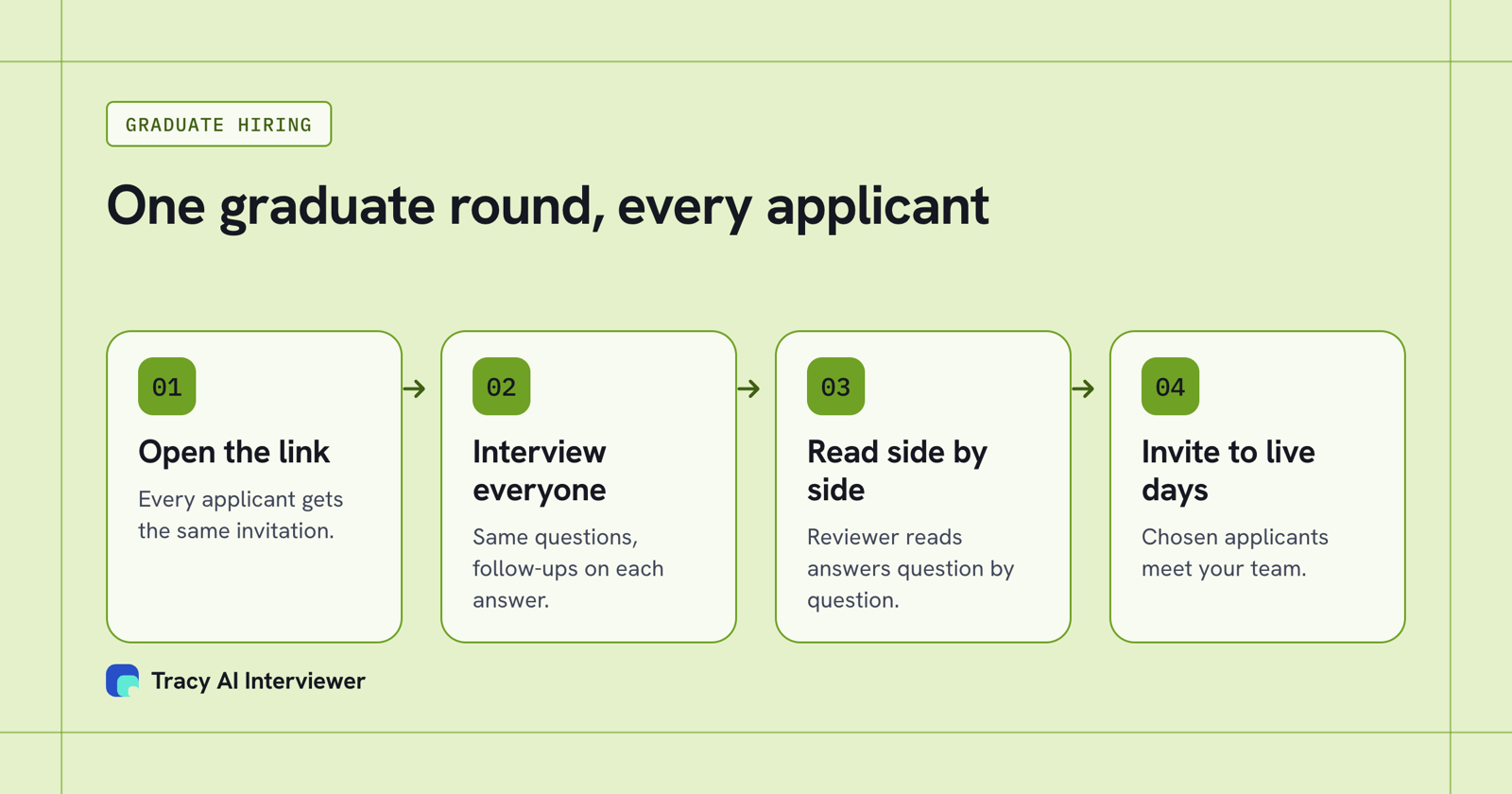
Every applicant gets the same invitation and first interview, and people choose who moves on to the live days.
What should the first graduate interview ask?
Ask about things a student has done. Four questions that work for most schemes:
- Tell me about a team project at university. Follow up on what they would change.
- Why this programme? Follow up on which part of the work they have already tried.
- Describe something you learned quickly. Follow up on how they knew it had worked.
- What did you do when a plan fell apart? Follow up on who else was involved.
Bring your own questions, or describe the programme and Tracy drafts them for you to edit. First-round interview questions and candidate screening questions give longer lists.
What does the reviewer receive?
The reviewer gets a recording of both sides, a timestamped transcript and what each person said to each question. Here is an excerpt for a graduate programme, invented for this page:
Question 1. Tell me about a team project at university.
What they said. Led a four-person software project, split the work by strengths and solved a clash by agreeing a weekly check-in.
Quote at 02:20. "We agreed a weekly check in after two people clashed."
Follow-up. What would you do differently now?
Field, led a team project. Yes, 4 people (evidence: question 1, 02:20).
The reviewer reads the same fields for every applicant and chooses who goes forward.
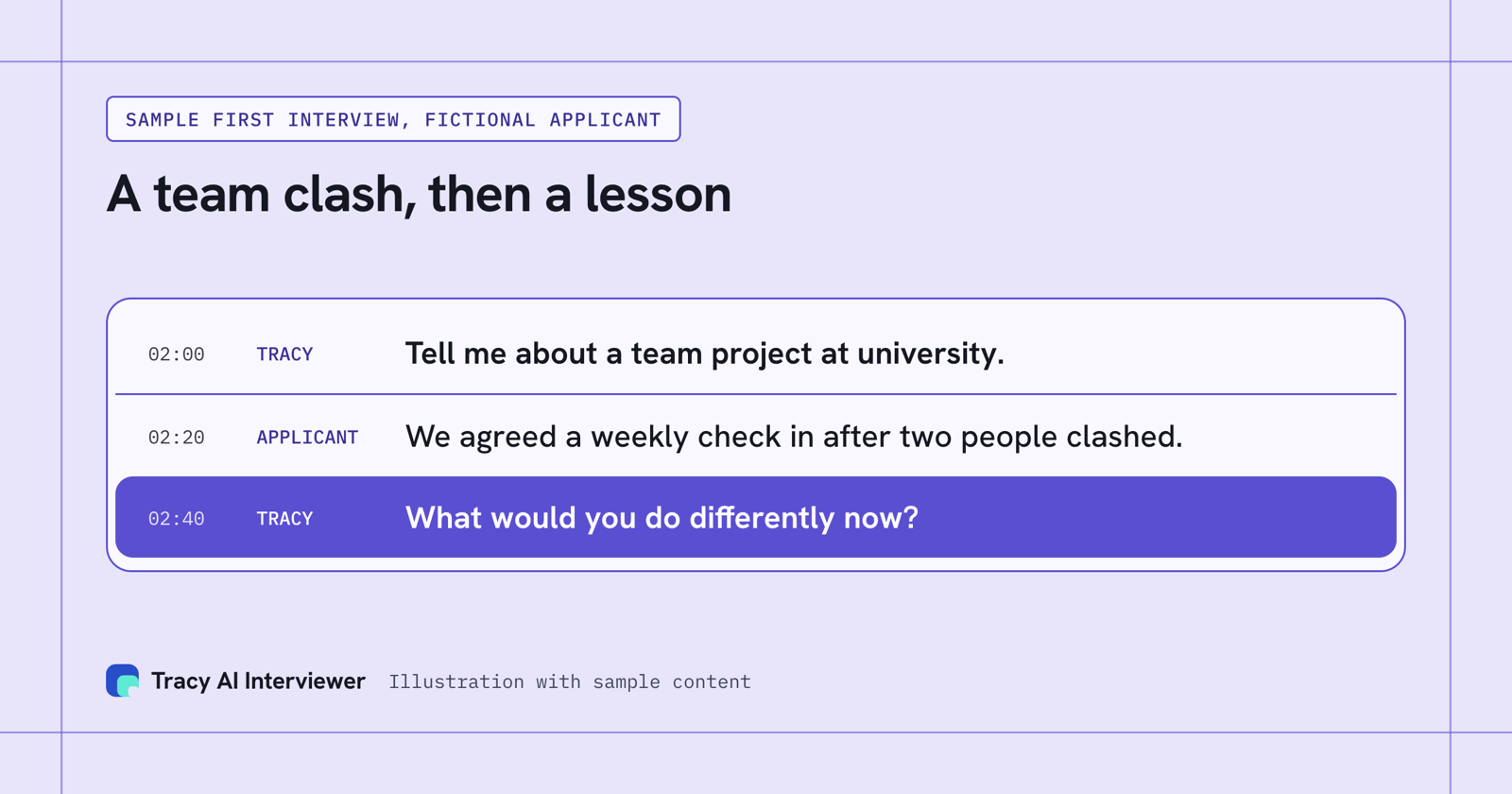
One follow-up asks the graduate to reflect, which a form or a recorded answer cannot do.
How does the graduate scheme process work for engineers?
For technical schemes the first interview can include a coding task, followed by questions on the approach and the trade-offs. A reviewer from the engineering team reads the recording and transcript before choosing who attends the assessment centre.
Tell applicants before they start that the interview is run by AI and is recorded. Tracy's join screen says the conversation is recorded and transcribed.
How does Tracy fit a graduate programme?
The interview link can go in a university portal, an email or a WhatsApp message. Tracy writes results back to your ATS, and the API lets your own system request interviews. Pricing follows results: $1 per credit, one credit per started 20 minutes, with the first 3 results free. For a campaign with thousands of applicants, mass hiring process and high-volume recruitment cover the planning, and hiring at volume shows how teams use it.
Which path fits you
- Planning a whole early-careers intake: early talent hiring.
- Writing the first-round questions: first-round interview questions.
- Wondering how applicants feel about an AI interviewer: AI interview candidate experience.
- Screening thousands for a seasonal or frontline intake: mass hiring process.
Common questions
What is the graduate application process?
How long does a graduate recruitment process take?
What is the graduate scheme process for engineers?
How can a graduate programme interview every applicant?
Does Tracy pick which graduates to hire?
Interview every graduate applicant
Send one link to every applicant and read what each person said to each question. First 3 results free.
Try it free (opens in a new tab) Book a demo (opens in a new tab)
Your first 3 results are free. No card needed.
Sources
- targetjobs, What is the recruitment process for a graduate job or scheme? (12 Aug 2026), retrieved 23 Nov 2026.
- Institute of Student Employers, Student Recruitment Survey 2025 (15 Oct 2025), retrieved 19 Nov 2026.
- Handshake, Class of 2025 career outlook report (Aug 2024), retrieved 19 Nov 2026.
- NACE, Job Outlook 2026 Spring Update (27 Apr 2026), retrieved 19 Nov 2026.
- Tracy AI Interviewer: Pricing, retrieved 11 Nov 2026.