In short
Early talent hiring is recruiting people at the start of their careers: graduates, interns, apprentices and school leavers. Their CVs are thin and applications pile up, so the first screen has to find potential, not experience.
Tracy AI Interviewer gives every applicant a video interview on click, at any hour, and follows up on what they say. Your reviewer reads what each person said per question and decides who moves on.
UK employers in one survey averaged 140 applications per graduate vacancy. Try one programme free.
What is early talent hiring?
Early talent hiring means recruiting people who are at the start of their working lives, and building the programmes that bring them in: graduate schemes, internships, apprenticeships and school leaver roles. The exact cutoff varies by employer, but the shared feature is that candidates have little work history to judge, so you are choosing on potential.
The volume is large. The UK's Institute of Student Employers surveyed 155 employer members who recruited over 31,000 student hires from more than 1.8 million applications. Employers received an average of 140 applications per graduate vacancy over the last two years, up from 86 in 2022/3 and 38 in 2002/3, and 89 per school or college leaver vacancy. Graduate hiring fell 8% year on year while apprentice hiring rose 8%.
In the US, iCIMS platform data shows entry level openings averaged 36 applicants each in May 2025, up 22% on a year earlier. NACE's spring 2026 update found employers expect to raise new college graduate hiring for the Class of 2026 by 5.6%, from 185 employer respondents surveyed 12 February to 17 March 2026.
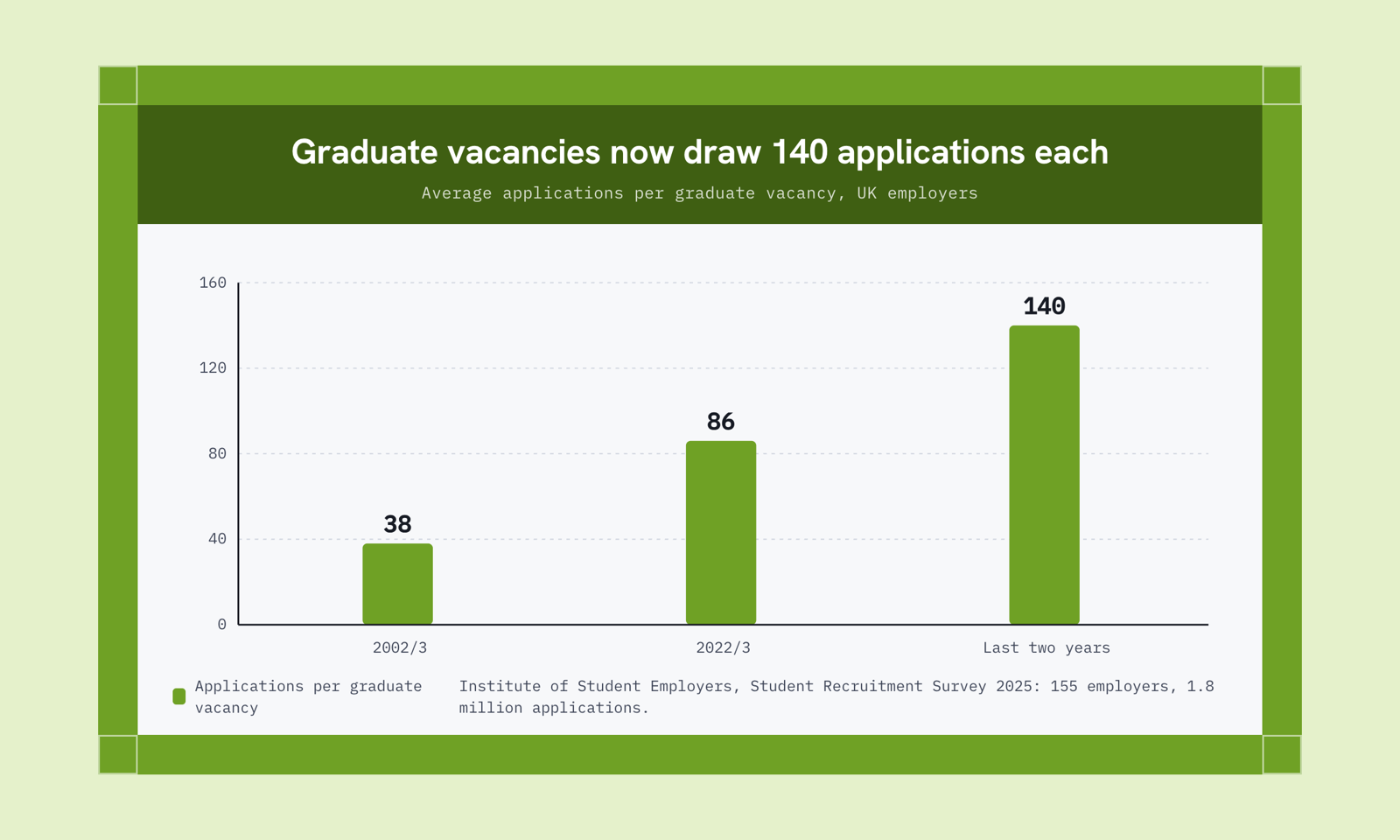
Applications per graduate vacancy have almost quadrupled in two decades.
Why early talent is a screening problem
With 140 applications for one place, a recruiter cannot hold a conversation with everyone, so most teams filter on CVs, forms or tests and talk to a shortlist. For people with little experience that filter is weak. Test Partnership, an assessment vendor, says early careers hiring "works best when you stop focusing on experience and start measuring potential", and that AI-written CVs and answers make written materials "even more unreliable indicators of ability or interest".
Its remedy is a test for everyone. An interview can do the same job: one structured conversation with each applicant, asking the same questions and following what they say. The practical blocker has always been time. The method for running a structured interview is well known; the question here is how to hold one with hundreds of graduates. See also how many applicants a typical job gets for the wider picture.
How to attract early-career talent
Four things help without a bigger budget:
- Say what the process is. List the stages, how long each takes and when they will hear back. Applicants often hear nothing back; see the candidate ghosting statistics.
- Let them apply when it suits them. A student with lectures and part-time shifts will not hold a weekday slot. An interview that starts when they click, in a browser, at any hour, removes the scheduling step.
- Ask about what they have done, not what they have been paid for. A team project, a club budget or a part-time job is real material for a first interview.
- Reply fast. A first interview that is already done by the time you review applications shortens every later stage.
How a first interview works at graduate volume
Tracy AI Interviewer is built for this stage. You share one link for the programme. Each applicant starts on click, at any hour, in the browser with no account, and is told on the join screen that the conversation is recorded and transcribed. Tracy drafts questions from the role description, you edit them, and she asks them in the same way to everyone, then follows up on the answer in front of her. Your reviewer gets a recording, a timestamped transcript and what each person said to each question, and decides who moves on. Tracy does not score, rank or reject anyone.
A customer cut its average time to hire from 44 days to 7, with Tracy doing the work of 53 full-time recruiters in one month. The example below shows a follow-up on a graduate answer.
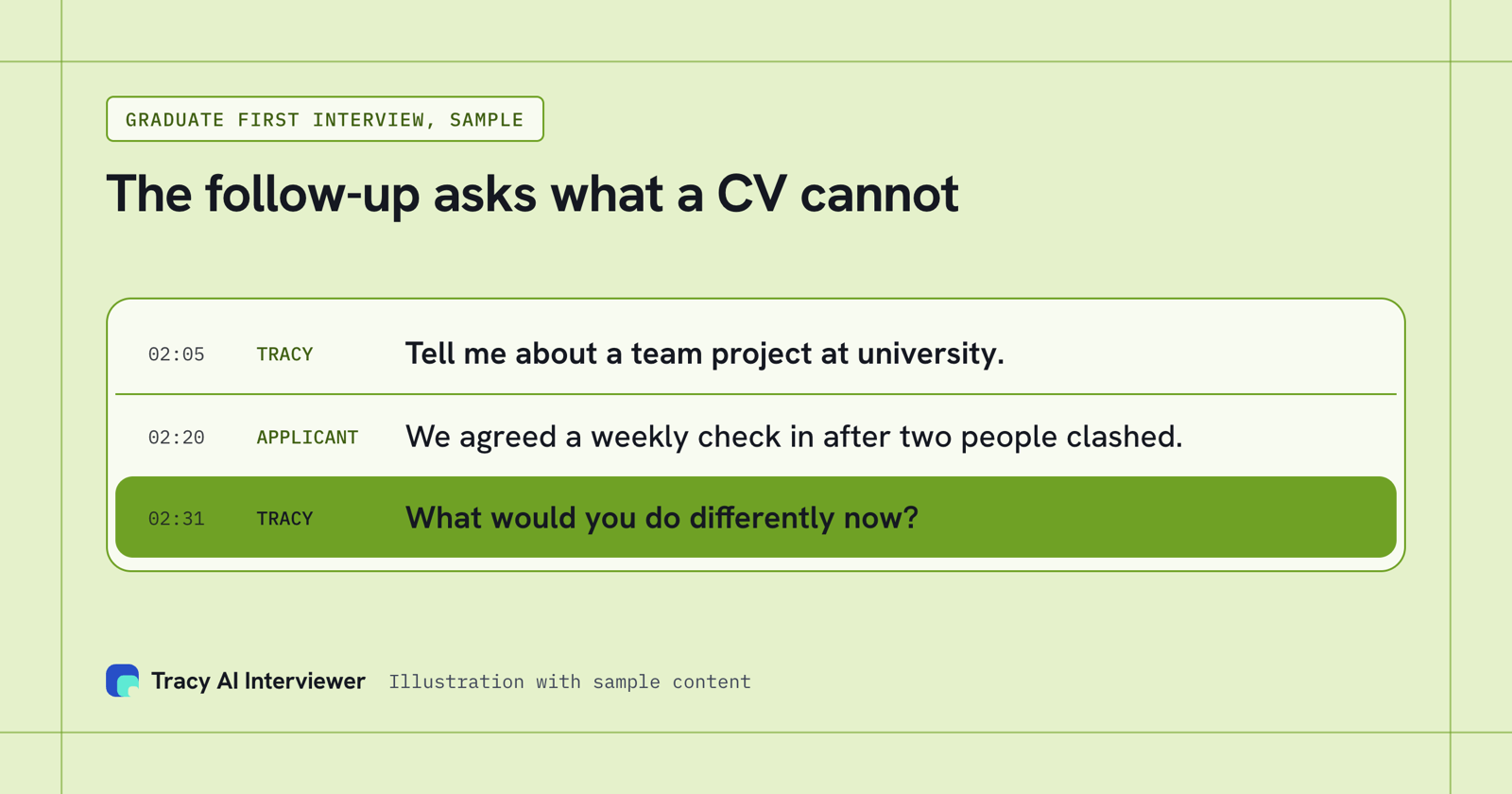
A follow-up turns a stock answer into a specific one.
What are the common pitfalls?
- Judging on school name or a short internship. Test Partnership calls these weak signals of how someone will perform.
- Interviewing only a shortlist, so everyone cut at the CV stage never gets to explain themselves.
- Asking different questions of different people, which makes answers impossible to compare.
- Treating written answers as proof of ability once applicants can have an AI write them.
- Making early-career applicants book a slot in office hours.
- Leaving people without news after the interview.
A structured first interview open to everyone, with the evidence kept for the reviewer, covers most of these.
How to tell whether the programme worked
Measure a programme by what happens after the offer. Pick a few post-hire indicators, such as performance, time to productivity and retention, and read each intake the same way a few months in. The quality of hire metrics guide shows how to put them on one scale. Keep each hire's first-interview record beside those results. When an intake underperforms, you can open what people said at the start and see whether the interview asked the right things, instead of guessing.
Which path fits you
- Running a graduate scheme end to end: the graduate recruitment process.
- Choosing a tool for a university or programme: AI interview tools for universities.
- Screening large pools of any kind: high-volume recruitment.
Common questions
What is early talent hiring?
How to attract early-career talent?
What are the common pitfalls?
How many applications does a graduate vacancy get?
Can an AI interview work for graduates?
Give every graduate a first interview
Share one link and Tracy interviews each applicant on click, with follow-ups on their answers. The first 3 results are free.
Try it free (opens in a new tab) Book a demo (opens in a new tab)
Your first 3 results are free. No card needed.
Sources
- Institute of Student Employers, Apprenticeships rise as graduate vacancies drop 8% (Student Recruitment Survey 2025), retrieved 23 Nov 2026.
- Test Partnership, Early careers: unique hiring strategies (updated 27 Mar 2026), retrieved 23 Nov 2026.
- iCIMS, Insights June Workforce Report: Class of 2025, retrieved 18 Nov 2026.
- NACE, Job Outlook 2026 Spring Update (27 Apr 2026), retrieved 18 Nov 2026.
- Tracy AI Interviewer pricing, retrieved 11 Nov 2026.