In short
Claude for consultants speeds up the drafting: proposals, research notes, slides and spreadsheets, kept in one Project per client. You review each output before a client sees it.
The evidence for a finding still has to come from the client's people. Tracy AI Interviewer, connected to Claude, interviews the stakeholders you invite on video and puts the follow-up question that a vague answer calls for.
Each result comes with a recording and a transcript stamped by time, which lets a slide point to a quote. Start with one stakeholder group and read the first interviews before you invite more.
How can consultants use Claude?
For the writing and structuring around an engagement. Anthropic's help pages list what Claude can produce as files: Excel spreadsheets, PowerPoint presentations, Word documents and PDFs, on every plan, up to 30 MB per file. Claude Projects hold a client's files and instructions in one workspace with its own chat history, so the engagement context does not have to be pasted again each time. And Research builds a cited report from the web and connected tools when you need a market or company read.
Those strengths cover the desk side of consulting. Findings that rest on what a client's own people say need interviews, and Claude cannot hold them (the same goes for customer discovery work). This page follows one engagement: a process review at a logistics client.
Which Claude prompts work for proposals and client deliverables?
Give Claude the client's context, the audience for the document and what the reader must decide. Six prompts to start from:
- Proposal outline: "Draft a one-page proposal outline for [client] on [problem]. Sections: situation, approach, deliverables, timeline, team. Mark every assumption." Check each assumption with the client.
- Research brief: "Using Research, summarize [client]'s market and name three trends that affect [decision]. Cite every source." Open the sources.
- Interview plan: "List the stakeholder groups I should hear from on [problem] and the three things each could tell me that the others cannot."
- Synthesis: "From these notes, draft five findings. Give each one a supporting quote and say how many people raised it." Check the counts.
- Slide draft: "Turn the findings into a ten-slide .pptx: one finding per slide, quote at the bottom." Review every slide.
- Red team: "Which of these findings would the client's CFO challenge, and with what question?"
Put the client's brief, your house style and the glossary in the Project's instructions so every chat in that engagement starts from them.
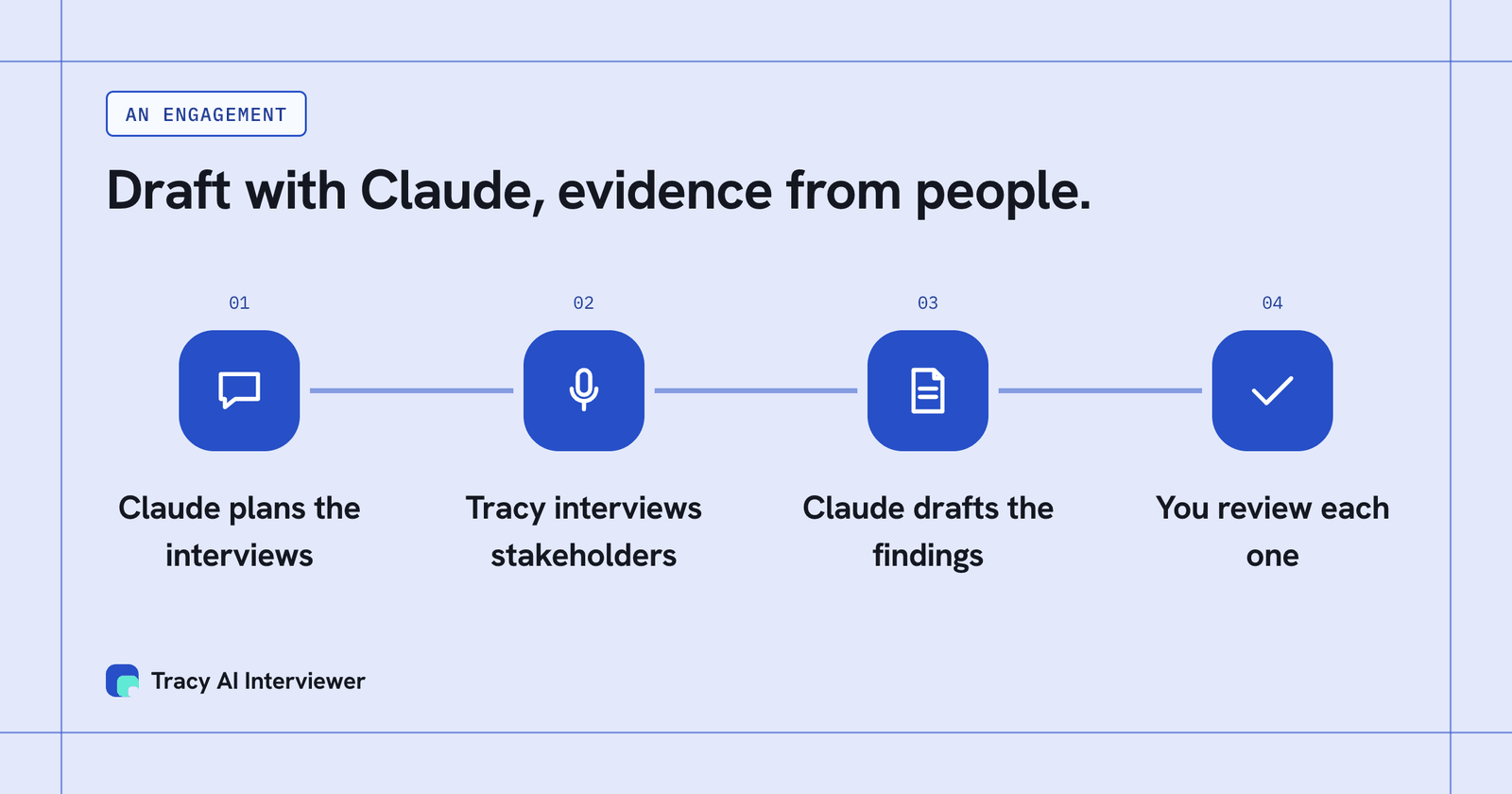
Claude drafts, Tracy gathers what the client's people say, you decide what the findings are.
Can you use Claude with client material?
Settle it before the first upload. Check the client's contract, your firm's policy and the data terms of your plan, and strip names where you can. Anthropic also notes that Claude's outputs may need review and warns that instructions can be hidden in external files or websites, so read what Claude produced from outside material before it goes into a deliverable.
Skills can package your firm's templates so Claude follows them each time. Anthropic's guidance is to use skills only from sources you trust, such as ones you wrote yourself.
Where does Claude stop and the client's people start?
A finding like "the dispatch team retypes orders every Friday" cannot come from a model. It comes from a person describing the last time they did it, and the useful part is the second question: what does that cost you?
In the invented sample below, a dispatch coordinator at the logistics client says that when a late order is flagged she calls the warehouse and waits for a callback. The follow-up asks how long the wait usually takes, and the transcript now holds the delay in her own words.
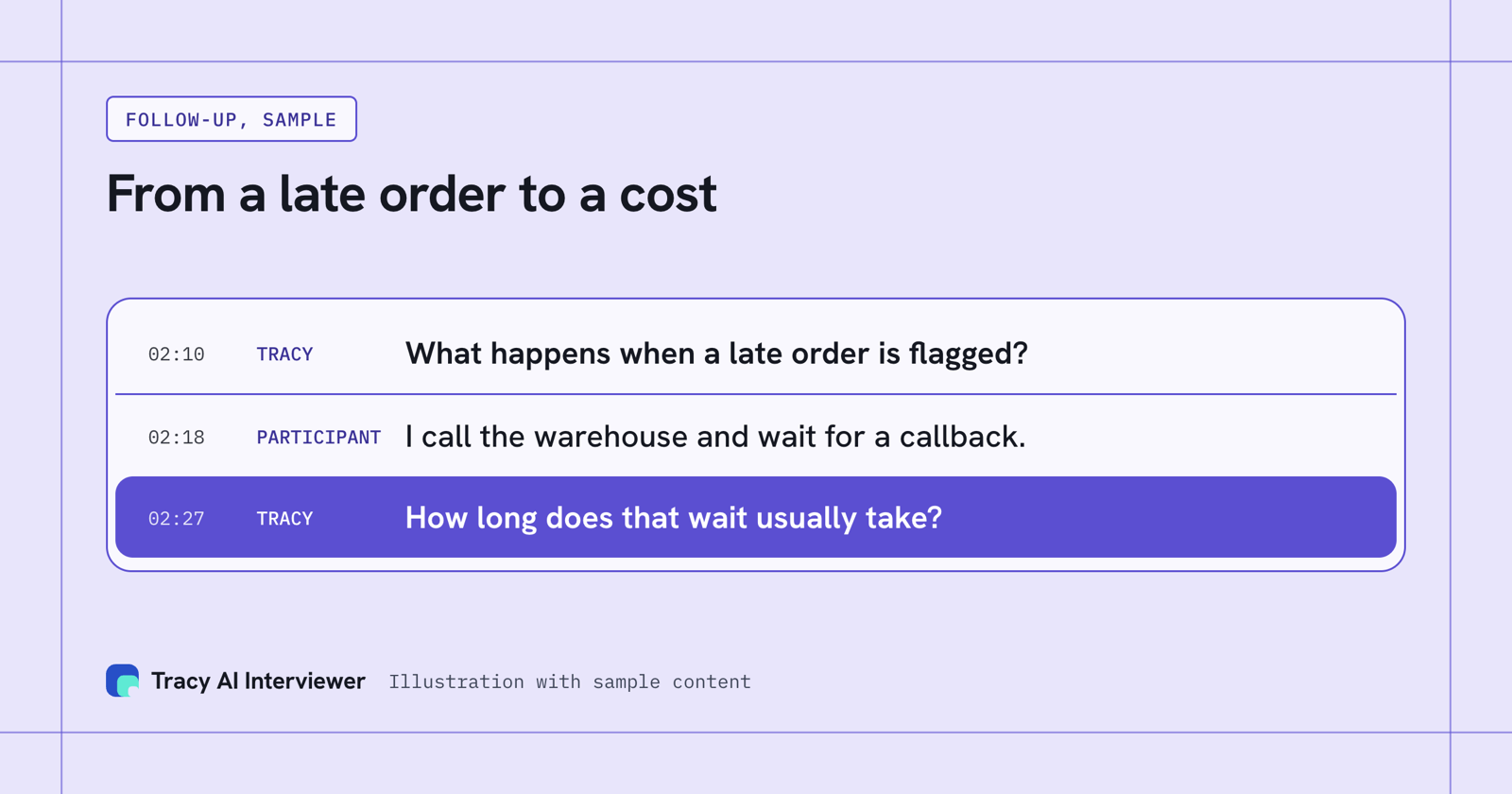
The second question turns a routine into a delay the client can measure.
How do you interview a client's stakeholders from Claude?
Connect Tracy AI Interviewer in Claude as a custom connector: Customize, Connectors, Add, Add custom connector, then paste https://tracyinterview.ai/mcp. Team and Enterprise workspaces need an owner to add it first. Each step is in the Claude setup guide. Then type a request like this:
Set up a 15-minute interview in Tracy AI Interviewer for dispatch coordinators at a logistics client. I want to learn how they handle a late order today and what they do when the system and the warehouse disagree. Show me the draft first, and create nothing until I have read it.
Claude asks you to approve the interview before it is created, and again before any invitation goes out. Send it to the stakeholders the client agrees to put forward. Each stakeholder opens the link in a browser, needs no account, and sees a join screen stating that the conversation is recorded and transcribed. A new interview starts with a public link already on: anyone who has it can join, up to 20 people for 14 days. No one is invited at that point; you can switch the link off. Every interview runs from the same guide, so answers sit side by side, and Claude can group them into shared themes and outliers. Open the transcript behind a quote before it goes into a deliverable.
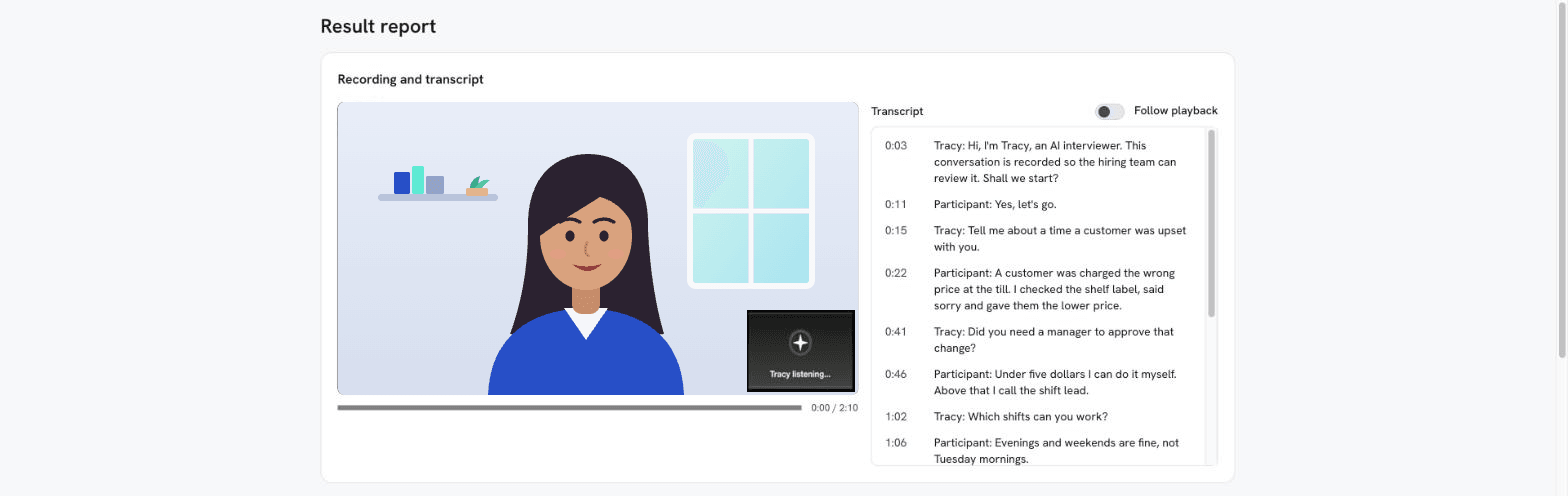
Every finding traces to a recording and its timed transcript.
What does Tracy add to Claude for consultants?
- Reach every stakeholder you invite, at any hour and with no calendar. A review that needs forty voices stops depending on forty diaries.
- Ask the next question. Tracy follows each answer in the person's own field and waits for it.
- Keep the evidence. Each result has its recording and a time-coded transcript, which lets anyone check a finding in your report at the source. Tracy is SOC 2 Type II attested, with the report available on request at hello@tracyinterview.ai.
The report is a link, so you can send a stakeholder's result to the client sponsor.
What stays with the consultant?
- The scope and the questions. A draft from Tracy or your own guide decides what every person is asked.
- The invitation list. Agree it with the client before anything is sent.
- The judgement. Claude drafts the slide and you decide whether the finding holds. A handful of interviews shows reasons; it does not size a problem.
Ten 15-minute stakeholder interviews come to $10, since each started 20 minutes uses one $1 credit, and 3 results are free.
More for your engagement
- Discovery interviews with customers: Claude for customer research.
- Setting up the connector: Claude user interviews.
- Lost-deal and market questions: Claude for competitive analysis.
- Coding interview notes into themes: Claude for qualitative research.
- Cost first: the pricing page.
Common questions
How can consultants use Claude?
Can Claude write proposals and client deliverables?
Can consultants use Claude with consulting firm data?
Are there Claude skills for consultants?
Can the client sponsor see a stakeholder's result?
Interview the client's people
Link Tracy to Claude, ChatGPT or Gemini, or to Copilot Studio, then interview stakeholders by sending one message. Your first 3 results cost nothing.
Try it free (opens in a new tab) Book a demo (opens in a new tab)
Your first 3 results are free. No card needed.
Sources
- Add Tracy AI Interviewer to Claude (public guide), retrieved 9 Nov 2026.
- Tracy AI Interviewer customer research use case, retrieved 9 Nov 2026.
- Anthropic: Create and edit files with Claude, retrieved 22 Nov 2026.
- Anthropic: What are projects?, retrieved 14 Nov 2026.
- Anthropic: Using Research on Claude, retrieved 22 Nov 2026.
- Anthropic: Agent Skills overview, retrieved 14 Nov 2026.
- Anthropic: What are skills?, retrieved 14 Nov 2026.
- Anthropic: Get started with custom connectors using remote MCP, retrieved 14 Nov 2026.