In short
ChatGPT is good at preparing an interview: it drafts questions, a follow-up for each and a mock round. It cannot hold the interview with your applicants.
Tracy AI Interviewer connects to the same chat and runs each interview on video. It follows up in the person's own field and leaves a recording and transcript behind every result.
Tracy starts from the job description you already paste, so one chat takes a role from brief to first interviews.
Try one role: the first 3 results are free.
Can ChatGPT run a mock interview?
Yes. ChatGPT will play the interviewer or the candidate, in text or out loud, and it holds to whatever script you give it. What it cannot do is invite your applicants, listen to them or hand you a result for each one.
OpenAI's voice page describes ChatGPT Voice as a spoken conversation inside a chat, with hours by plan (3 hours on Plus, for example) and no video or screen sharing in Live mode. That is enough to rehearse with, and too little to interview a shortlist. Candidates already rehearse this way: HireVue's 2026 Global AI in Hiring Report, a survey of more than 3,100 hiring managers, puts candidate AI use at 46% for practising interviews, as reported by those managers.
This page is written for the person running the process. If you are the candidate, the prompts below work with the roles swapped, and how to prepare for an AI interview covers the other side.
Which ChatGPT prompts prepare an interview?
A prompt that names the role, the stage and the format gets a usable set; a prompt that says "interview questions for engineers" gets a list you have seen before. Six to start from. Replace the brackets and run the check under each.
- Start from outcomes. "Here is the job description for [role]. List the five things this person must be able to do in their first 90 days, and for each one write a question that asks for a past example." Check: delete any outcome you cannot test in a 20-minute call.
- Add the follow-up. "For each question, write the follow-up you would ask if the answer stays general." Check: the follow-up should ask for a detail, such as who, how long or what happened next.
- Describe good and thin answers. "For each question, describe in two lines what a strong answer includes and what a thin one sounds like." Check: keep it in words; the reviewer decides what the words are worth.
- Keep it the same for everyone. "Turn this into a first-round script of eight questions, the same for every candidate, in this order." Check: a structured interview is the point of this step.
- Rehearse the follow-ups. "Act as a candidate for [role] with [years] of experience. Answer two of my questions in general terms, on purpose, so I can practise asking for the detail." Check: if you accept the vague answer in the rehearsal, you will accept it in the call.
- Debrief from your notes. "Here are my notes from the call. Separate what the candidate said from what I concluded, and list what I did not ask." Check: read the second list first.
For engineering roles, add the stack and the level to prompt 1. Software engineer interview questions shows what a finished set looks like.
Why structure matters when you prepare with ChatGPT
ChatGPT will write a different set of questions every time you ask, and the research favours the opposite. Sackett and colleagues' 2022 re-estimate in the Journal of Applied Psychology ranks structured interviews first among selection methods, with an operational validity of .42 for job performance against .19 for unstructured ones. Pick one script, keep it, and ask every candidate the same questions.
The manual route runs out here. A hundred 20-minute first rounds is about 33 hours of live calls, before anyone books a slot. ChatGPT gives you the script in two minutes and cannot take a single one of those calls.
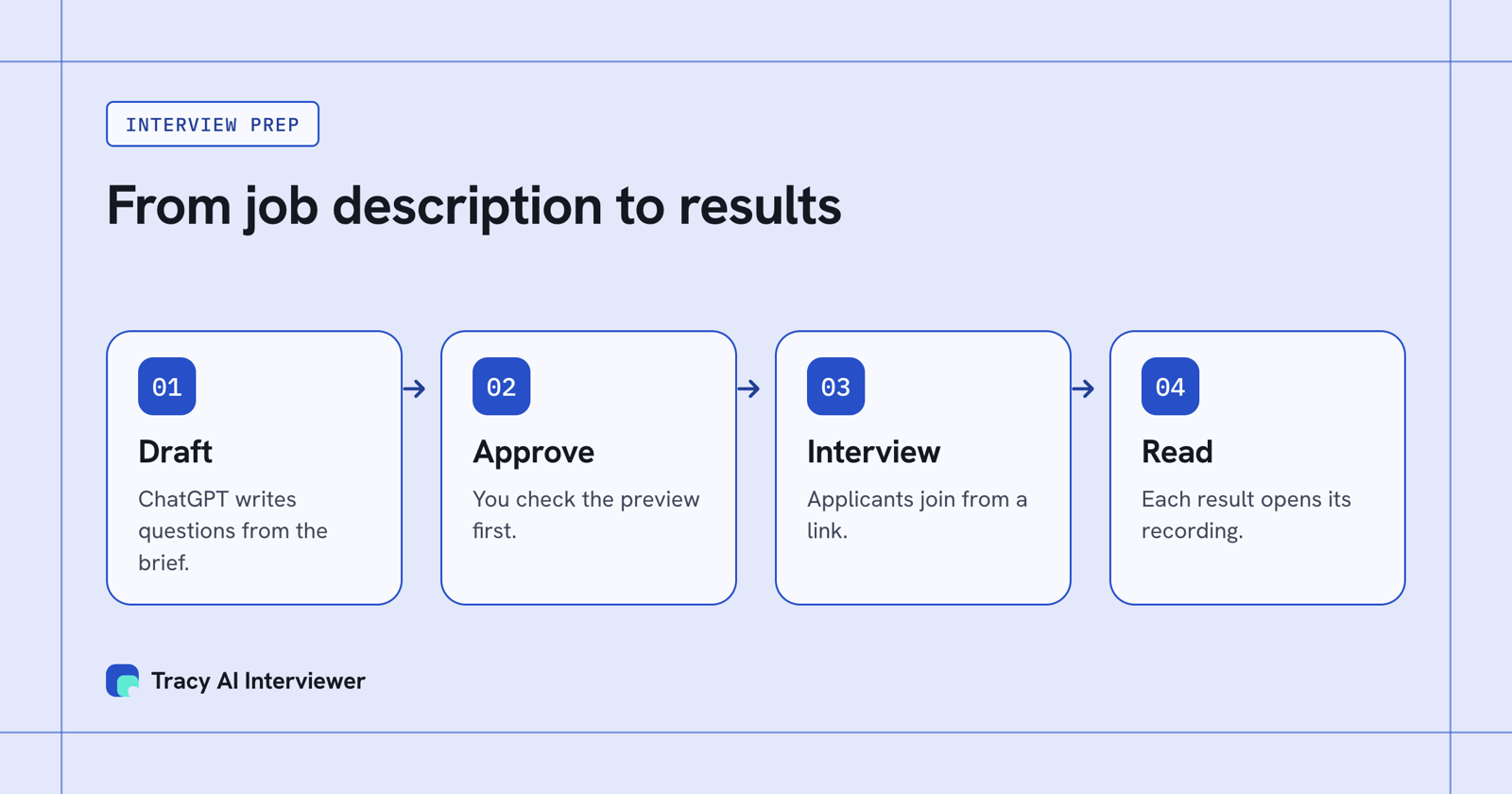
Prepare the interview in ChatGPT, approve it, and let applicants interview on their own time.
How do you start the interviews from ChatGPT?
Add Tracy to ChatGPT once. Open it under Plugins, choose Install plugin, sign in to Tracy and click Allow. On a work or school workspace an admin may have to allow custom plugins first, and if the option to add a custom MCP server is missing, check Developer mode in your settings. The ChatGPT setup guide has each step.
Then start a new chat, type @, pick Tracy AI Interviewer and paste the script from prompt 4 together with the job description.
- Tracy drafts the interview and ChatGPT shows it as a preview: the opening, each question and the report field it fills. Nothing exists yet.
- You approve the preview and the interview is created. Nobody is invited until you approve an invitation preview as well.
- You choose how people get it. Invite applicants by email from your own list, or share the public link. A new interview has the link on, for up to 20 people for 14 days, and you can switch it off from the chat.
- Each applicant opens the link in a browser, at any hour, with no account. The join screen tells them the conversation is recorded and transcribed.
- Ask "who has finished?" and the answers come back into the chat: what each person said to each question, plus the result fields.
What does a follow-up from Tracy look like?
Tracy lets the person finish, then asks for the detail that was left out, in their own field. In the sample below, a data engineer describes a fix and Tracy asks who was told when it broke.
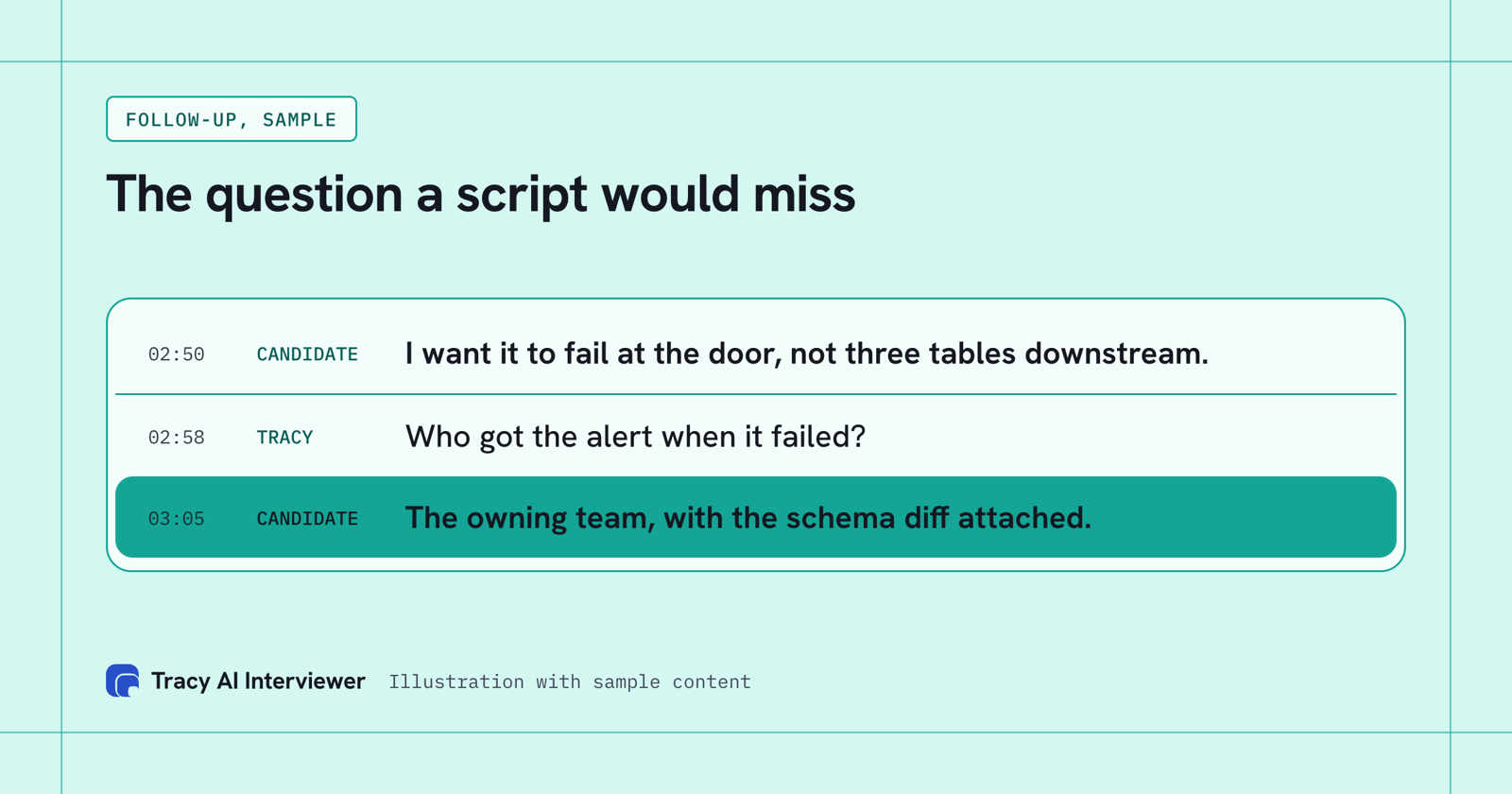
A good answer gets one more question that shows who owned the problem.
What the reviewer gets afterwards
For that answer the report has a field, "Schema change handling: checks at ingestion with alerts", with its evidence pointing to question 1 at 02:50. Behind it sit the recording of both sides and a timestamped transcript, so a hiring manager can open the moment instead of trusting a summary. Tracy reports what was said; it does not score, rank or reject anyone, and the person reading decides who moves on.
One Tracy customer cut its average time to hire from 44 days to 7, and Tracy did the work of 53 full-time recruiters in one month. For engineering roles you can also set a coding task inside the interview, with follow-ups on approach and trade-offs. Interview questions for AI interviews covers how to write questions for a call nobody sits in on.
Which path fits you?
- Writing the first set of questions: an interview guide template and the prompts above.
- Feedback after each call: ChatGPT for candidate feedback.
- Wondering what candidates do with ChatGPT in your own calls: AI-assisted coding interviews.
- Comparing assistants first: Claude and ChatGPT for business.
Common questions
How do I prepare for an interview with ChatGPT?
Can ChatGPT run a mock interview?
Can ChatGPT interview my applicants?
Does Tracy score or reject candidates?
What does it cost to try?
Run your first interview from a chat
Paste a job description, approve the preview and send applicants a link. You read what each one said.
Try it free (opens in a new tab) Book a demo (opens in a new tab)
Your first 3 results are free. No card needed.
Sources
- OpenAI: ChatGPT Voice FAQ, retrieved 23 Nov 2026.
- HireVue: 2026 Global AI in Hiring Report, retrieved 19 Nov 2026.
- Sackett et al. (2022), Journal of Applied Psychology 107(11): Revisiting meta-analytic estimates of validity in personnel selection, retrieved 19 Nov 2026.
- Tracy AI Interviewer: ChatGPT guide, retrieved 14 Nov 2026.
- Tracy AI Interviewer: Pricing, retrieved 11 Nov 2026.