25 Software Engineer Interview Questions With Follow-Ups
 The best software engineer interview questions do not end at the first correct sentence. They give the candidate something specific to reason about, then use a follow-up to test ownership, trade-offs or edge cases.
Use this list as a question bank, not a script to finish in one sitting. A 30-minute first round usually fits three or four core questions with follow-ups. Pick the sections that match the job and write down what a strong answer should contain before the first candidate joins.
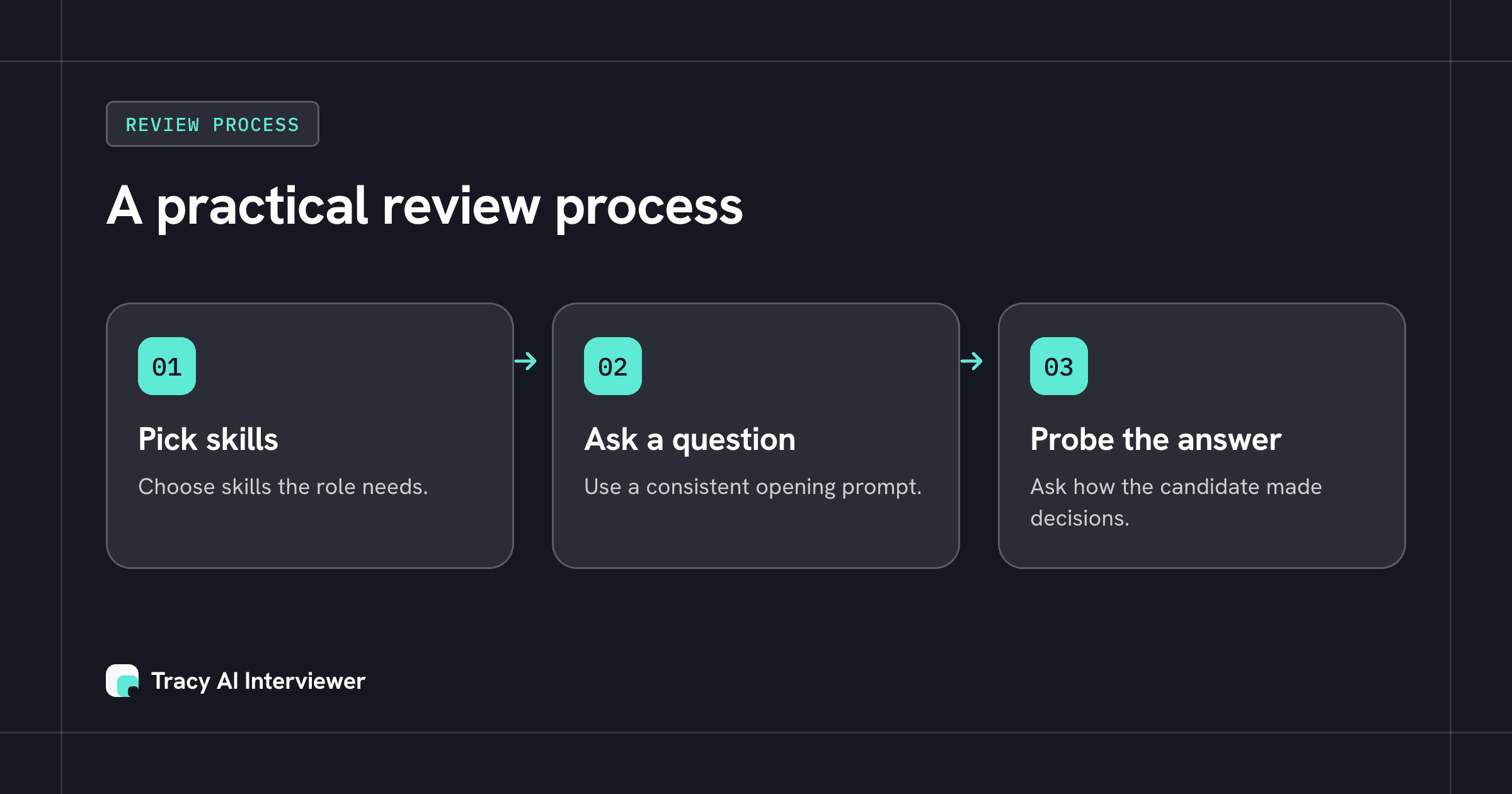
How to use these questions
- Pick four competencies the role needs, such as debugging, API design, reliability and collaboration.
- Choose one opening question for each.
- Keep the follow-up beside it. Ask it only after hearing the first answer.
- Write observable signals, not personality labels.
- Score the evidence after the interview, with the transcript or notes open.
For a junior role, look for a sound approach and the ability to learn. For a staff role, expect clearer trade-offs, wider system effects and examples of influencing other teams. Do not use seniority to turn trivia into a harder interview.
Project and ownership questions
| # | Opening question | Follow-up | Strong-answer signals |
|---|---|---|---|
| 1 | Tell me about a system you shipped that you are proud of. | Which decision was yours, and what changed because of it? | Separates personal work from team work, names a constraint and gives a measurable result. |
| 2 | Describe a technical decision you would make differently now. | What information did you have then, and what did you learn later? | Judges the decision in its original context, then names the new evidence. |
| 3 | Tell me about the hardest production incident you handled. | What was the first signal, and what did you change to prevent a repeat? | Gives a timeline, distinguishes mitigation from root cause and names the follow-up work. |
| 4 | Walk me through a feature from request to release. | Where did the original requirement change, and how did you respond? | Covers discovery, design, implementation, testing and rollout without pretending the plan stayed fixed. |
| 5 | What piece of code have you removed or simplified? | How did you prove it was safe to remove? | Values less code, checks callers and telemetry, and explains the rollback plan. |
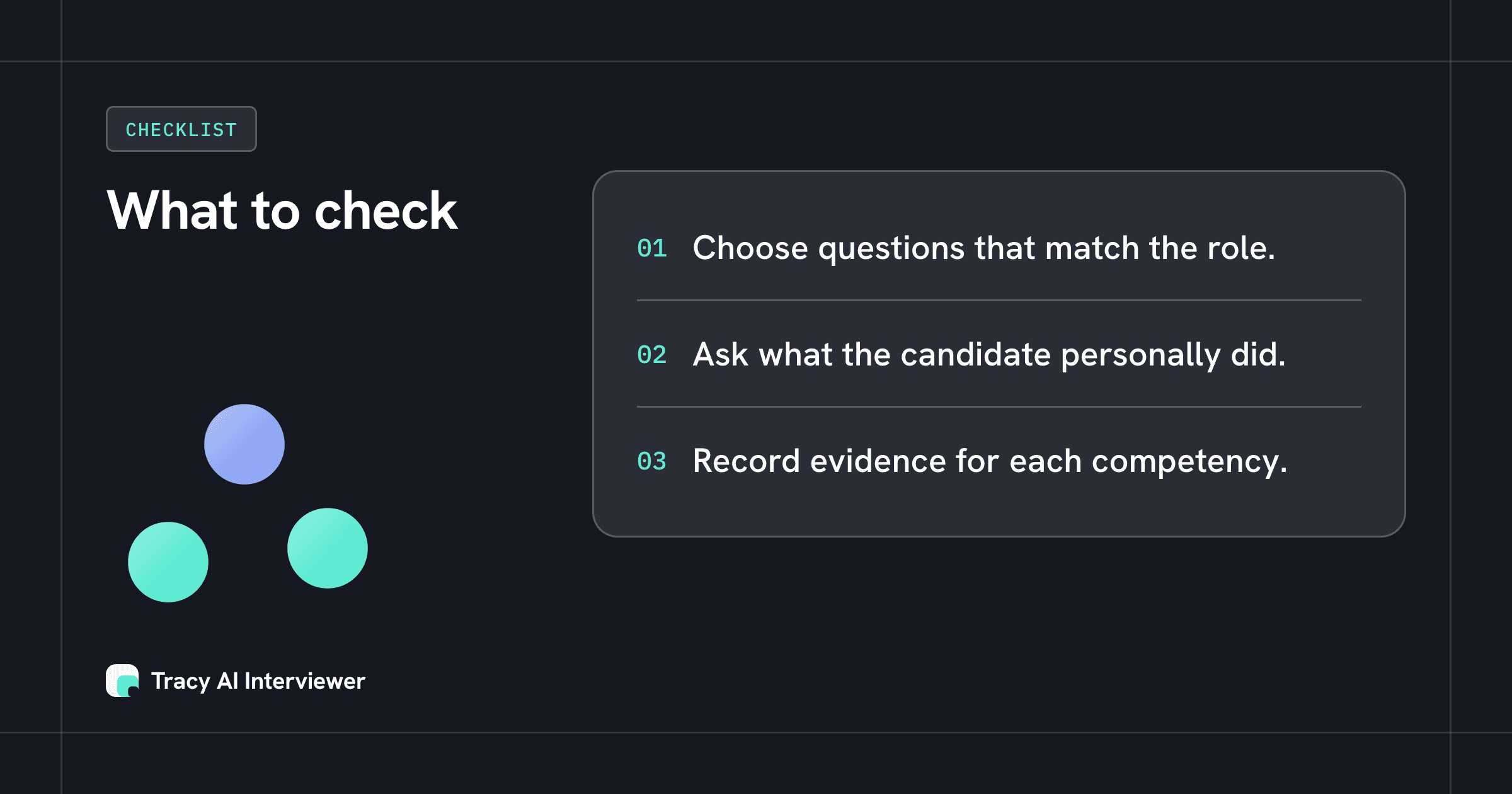
Weak answers stay at team level: "we improved performance" or "we migrated to microservices." Ask what the person changed, why that option won and how the result was measured. A candidate can be collaborative and still state their own contribution clearly.
Coding and data-structure questions
These can be discussed at a whiteboard, in a shared editor or through a small live task. Let the candidate choose a familiar language unless the job genuinely depends on one.
| # | Opening question | Follow-up | Strong-answer signals |
|---|---|---|---|
| 6 | Given a stream of events, return the ten most frequent values in the last hour. | What changes at 50,000 events per second? | Starts with a correct structure, then bounds memory with buckets or another window strategy. |
| 7 | Merge overlapping time intervals. | How do you handle intervals that touch at the boundary? | States whether endpoints are inclusive, sorts deliberately and tests empty and single-item inputs. |
| 8 | Design a least-recently-used cache. | What happens when two requests update the same key? | Combines a map with ordered access, then discusses locking, atomic operations or ownership. |
| 9 | Find whether a directed graph contains a cycle. | How would your answer change for a graph too large for one machine? | Explains visited and active states, complexity and the limit of the local algorithm. |
| 10 | Process a file that does not fit in memory and return duplicate records. | What if exact answers are required? | Distinguishes hashing, sorting and approximate methods, and accounts for disk or partitioning. |
A strong coding answer goes past naming a familiar algorithm. Look for assumptions, test cases, complexity and a response when the constraint moves. If the candidate writes code, ask them to run or reason through at least one edge case before you do.
Debugging and testing questions
| # | Opening question | Follow-up | Strong-answer signals |
|---|---|---|---|
| 11 | An API's 99th-percentile latency doubled after a release. What do you do first? | The median did not move. What does that suggest? | Checks the change, narrows by endpoint and dependency, and reasons about a tail affecting a subset. |
| 12 | A test passes locally and fails in CI once every twenty runs. How do you investigate? | How would you make the failure reproducible? | Considers shared state, order, timing and environment, then controls seeds, clocks or concurrency. |
| 13 | Users report duplicate payments, but logs show one request. Where do you look? | How would you prevent another charge while investigating? | Checks retries and downstream processing, then adds idempotency or a temporary guard. |
| 14 | Memory grows slowly for several days before a service restarts. How do you isolate the leak? | Which measurement would distinguish a leak from a larger working set? | Uses heap profiles or allocation data over time and compares retained objects after steady load. |
| 15 | A daylight-saving change broke scheduled jobs. How would you test the fix? | What should be stored as local time, and what should be stored as an instant? | Separates business-local schedules from UTC instants and tests ambiguous and missing local times. |
The useful signal is the order of investigation. Strong debuggers protect users, establish what changed, gather evidence and narrow the system. They do not jump straight to rewriting the suspected component.
System-design questions
Change the scale and reliability target to fit the level. The candidate should be free to ask questions before drawing boxes.
| # | Opening question | Follow-up | Strong-answer signals |
|---|---|---|---|
| 16 | Design a notification service for email, SMS and push. | How do you prevent a retry from sending the same message twice? | Separates channel workers, persistence and delivery state, and uses idempotency at the right boundary. |
| 17 | Design a rate limiter for a public API. | Where does state live across regions? | Chooses an algorithm for the requirement, then discusses consistency, latency and failure behaviour. |
| 18 | Design file upload for large videos. | How does an interrupted upload resume safely? | Uses multipart upload, content validation and durable upload state, with security checks. |
| 19 | Design search for a product catalogue. | How quickly must price and stock changes appear? | Clarifies ranking and freshness, separates the search index from the source of truth and plans reindexing. |
| 20 | Design an audit log for sensitive account changes. | Who can alter or delete the log? | Makes events append-only, protects access, records actors and plans retention and verification. |
Do not grade a diagram by how many fashionable components it contains. Grade whether the design meets the stated traffic, consistency, privacy and failure requirements, and whether the candidate can explain what they would build first.
Collaboration and judgement questions
| # | Opening question | Follow-up | Strong-answer signals |
|---|---|---|---|
| 21 | Tell me about a technical disagreement with another engineer. | What evidence changed the discussion? | Represents the other view fairly, uses a test or constraint and explains the eventual decision. |
| 22 | A product manager wants a deadline you think is unsafe. What do you do? | What smaller version could you offer? | Makes risk concrete, proposes scope choices and shares ownership of the outcome. |
| 23 | A junior engineer submits code that works but is hard to maintain. How do you review it? | What feedback belongs in the pull request and what belongs in a conversation? | Prioritises correctness and learning, gives actionable examples and avoids turning preference into law. |
| 24 | You inherit a service nobody understands. What is your first month? | Which change would you deliberately postpone? | Maps users, owners, alerts and failure modes before a rewrite, then creates a safe improvement sequence. |
| 25 | When should an engineer accept technical debt? | Name debt you accepted and how it was tracked. | Connects the shortcut to a real deadline or experiment and states the repayment trigger. |
A simple scoring guide
Score each competency from 1 to 4 with a written reason.
| Score | Evidence |
|---|---|
| 1 | No relevant example or the approach would not work. |
| 2 | Partly workable answer, but important assumptions or risks are missing. |
| 3 | Sound answer with explicit trade-offs and a relevant example. |
| 4 | Sound answer that also anticipates failure modes, measures the result and adapts when the constraint changes. |
Avoid one overall "technical strength" number until reviewers have scored the separate competencies. A candidate can be strong at debugging and weaker at distributed design. That profile is more useful than an average stripped of context.
For every score, keep one sentence of evidence. "3 because they proposed idempotency keys at the payment boundary and explained retry behaviour" is reviewable. "Good systems thinker" is not.
Running these questions with an AI interviewer
A two-way AI interviewer can ask the same opening questions and branch into the follow-ups when the candidate's answer creates a useful path. Tracy AI Interviewer's product page says it can introduce coding tasks, system design, debugging and code walk-through work, then probe the trade-offs behind an answer.
That does not remove engineering review. A reviewer should inspect the candidate's words, code, transcript or recording behind a strong or weak score. The interviewer collects evidence; the hiring team decides.
CodeSignal and HackerRank also offer technical assessments, and both describe AI interview products. A standard assessment is useful when you need a validated task at high volume. An interview is useful when you need to hear why the candidate chose an approach and how it changes under a follow-up. Some teams use both in sequence.
See AI technical interviews for a complete task and follow-up chain, and AI interview reports for the reviewer checklist.
Questions
What should I ask in a software engineer interview? Ask for one real project, one coding or debugging task, one design problem and one collaboration example. Follow up on the candidate's own trade-offs and contribution.
How many questions fit in a 30-minute engineering screen? Usually three or four core questions with follow-ups. Depth is more useful than rushing through a long list.
What makes a strong technical interview answer? A strong answer makes assumptions explicit, compares options, tests edge cases, admits uncertainty and ties claims to work the candidate personally did.
Should every engineer get the same questions? Use the same core competencies and opening questions for comparable candidates, then allow follow-ups based on each answer.
Can an AI interviewer ask software engineering questions? Yes. A two-way AI interviewer can present a coding, debugging or system-design task and ask about the candidate's solution. A person should review the evidence and decide.
See how Tracy works with coding, debugging and system-design interviews that include follow-up questions.
Sources
All sources retrieved 2 Nov 2026.
- Tracy AI Interviewer, product page: coding tasks, system design, debugging, code walk-through, adaptive follow-ups and report evidence.
- CodeSignal, technical assessments: assessment format and validation positioning.
- HackerRank, Screen: technical screening and question-library scope.
- HackerRank, Chakra: AI interview follow-ups on candidate work and score explanations.