In short
Tracy AI Interviewer runs your screening script as an interview every applicant starts on a click, with no call to book, and leaves a recording and a written assessment for each question.
Below: a word-for-word phone screening script with knock-out checks, core questions and a call record, plus a filled example.
One Tracy customer cut its average time to hire from 44 days to 7.
Run the script by hand while volume is low. Move it into Tracy when calls pile up.
We make Tracy AI Interviewer.
A recruiter's phone screen is short, and the same ten minutes get repeated for every applicant. Skip the script and each call asks different things, the notes are hard to compare, and the hiring manager asks what the candidate actually said. A phone screening script fixes the order, the words for the knock-out questions and the shape of the notes.
Below is a phone screening script for recruiters you can copy, a filled example, and how Tracy AI Interviewer runs your screening script when each applicant starts from a link and there are too many to call.
What a phone screen has to settle
Three things, in this order. Anything else can wait for the interview with the hiring manager.
- Can they take the job? Location, right to work, pay, notice. These are yes or no, so ask them in the same words every time.
- Do they have the core skill? One recent example, with a result.
- Do they want this role? A reason that fits what the job really is.
For the wider funnel around the call, see how to screen candidates.
The phone screening script
Copy the script into a document and keep it open during the call. Say the quoted lines as written; the rest is yours. A first call of 15 to 20 minutes fits this layout.
1. Opening (about 2 minutes)
"Hi [name], this is [your name] from [company]. Is now still a good time? I would like about 15 minutes to ask a few questions about your background and the [role] position, then tell you what happens next. I will take notes as we talk. Is that fine?"
2. Knock-out checks (about 3 minutes)
Five checks, each with the question to ask and the answer you need.
| Check | Ask | Needed answer | Pass? |
|---|---|---|---|
| Location or work arrangement | Where are you based, and does [on-site, hybrid or remote] work for you? | ||
| Right to work | Do you have the right to work in [country] without sponsorship? | ||
| Pay | What range are you looking for? | ||
| Notice and start | What is your notice period, and when could you start? | ||
| Other processes | Are you talking to other companies right now? |
Scroll the table sideways to see all 4 columns.
Ask the knock-outs of every candidate in the same words. Write what they said, not only pass or fail.
3. Core questions (about 8 minutes)
Four questions, each with a follow-up and what to listen for.
What are you doing in your current role, day to day?
- Follow up with
- What part is yours alone?
- Listen for
- Ownership, a real scope
Why are you looking, and why this role?
- Follow up with
- What would make you say no?
- Listen for
- A reason that fits the role
[Skill from the job description]: describe a recent time you used it.
- Follow up with
- What was the result?
- Listen for
- A specific example with an outcome
[Second skill]: how would you handle [a situation from the job]?
- Follow up with
- What did you do the last time?
- Listen for
- Steps, not a slogan
4. Their questions and close (about 2 minutes)
"What questions do you have for me? ... Here is what happens next: [step], and you will hear from me by [date]."
5. Call record
Fill this in straight after the call.
| Field | Entry |
|---|---|
| Knock-outs | All passed, or which one failed |
| Best quote | |
| Concern | |
| Recommendation | Submit, hold or decline |
| Next step and date |
How to use the script
- Say the knock-outs the same way to everyone. It keeps the call fair and the notes comparable.
- Follow up once, then move on. One good follow-up beats three questions on the same point.
- Write quotes. The hiring manager reads what the candidate said, not your summary.
- Stop when a knock-out fails. Thank them, say what happens next and end the call kindly.
- Send the record the same day. The hiring manager then reads it while the call is fresh.
A filled example: IT support specialist
A fictional call for an IT support specialist role at a client company. The candidate and answers are invented for this page.
| Check or question | What the candidate said | Note |
|---|---|---|
| Work arrangement | Hybrid, two days on-site in Columbus | Pass |
| Notice and start | Two weeks, free from the first of next month | Pass |
| Pay | 62 to 68 thousand dollars a year | Within the client's band |
| Day to day | Tier 2 desk for about 400 users, owns the onboarding checklist | Real scope |
| Why looking | The team is shrinking and nobody mentors new hires | Fits a mentoring role |
| Skill: Active Directory | Rebuilt the group structure after a merger, cut access tickets by about a third | Specific, ask for the method |
| Situation: a VPN outage | Checked the gateway, then the certificate, told the floor lead in ten minutes | Clear order |
Recommendation: submit. Best quote: "I told the floor lead before I knew the cause, so nobody was guessing." Next step: send the profile to the client the same day.
When calls pile up: run the script in Tracy
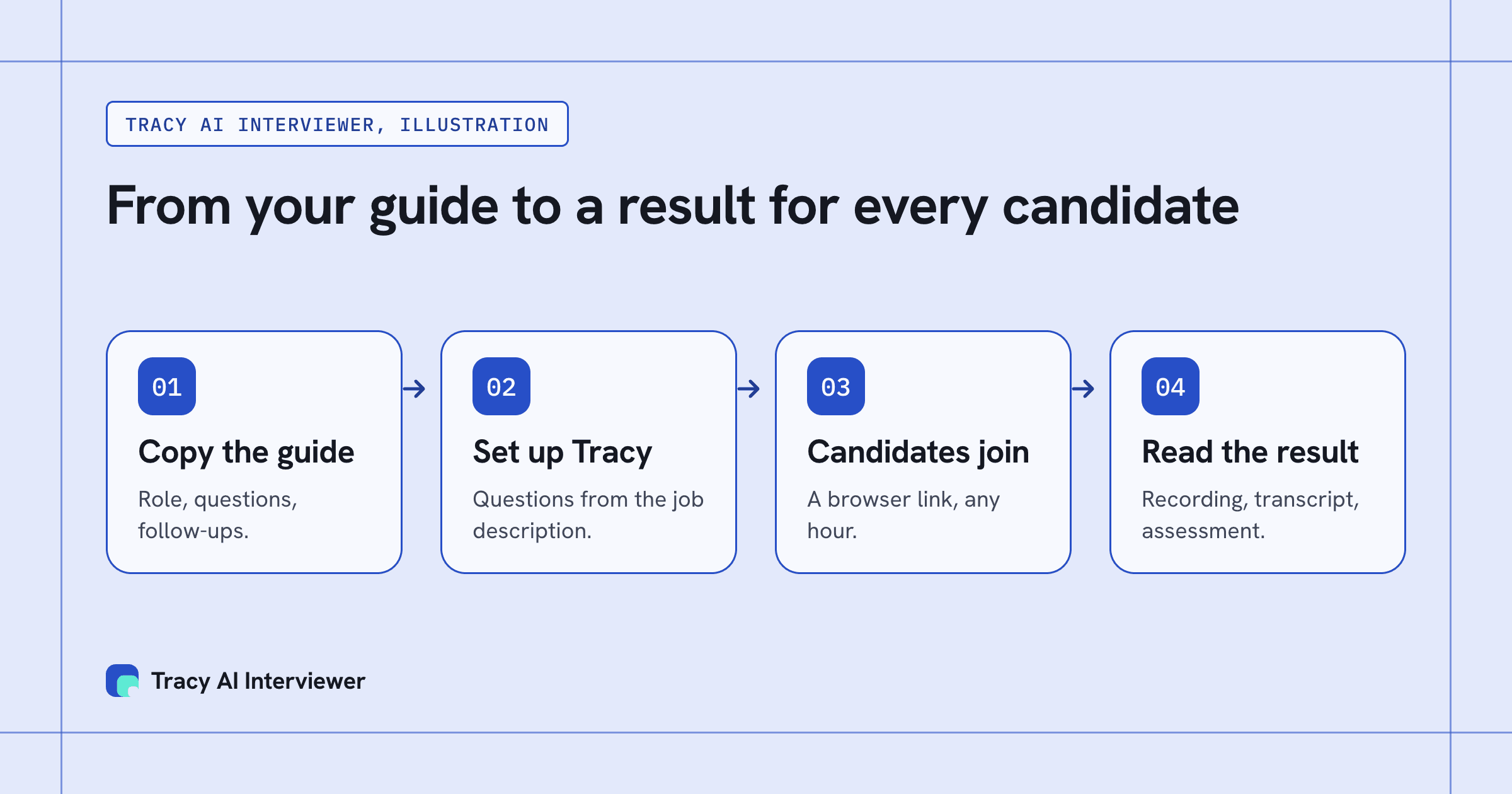
When one role draws more applicants than you can call in a day, calling everyone is the bottleneck. That is the point to move the first screen into Tracy and keep your own calls for the shortlist.
- Your script becomes the interview. Paste in the knock-outs and core questions, or let Tracy generate questions from the job description and edit them.
- Every applicant, any hour. Each applicant starts on a click, with no scheduling and no recruiter present. A reminder goes out after a day, and failed interviews are chased automatically.
- Follow-ups on what was said. She asks in the applicant's own field, follows up and waits for the answer.
- Candidates enjoy it. Steven Perry, Account Executive at IT Resources, an IT staffing firm in Tampa, US, says: "By the time they finish with this platform, they're even laughing and joking."
- Strongest on top. Each candidate is ranked against the others who took the interview, and strong ones are flagged to you.
- A package you can send on. Resume match, interview score, strengths and gaps, recording and fit rationale in one record, shareable by link or PDF.
A person decides: you can move a candidate forward, override a rejection or invite someone to interview again. See staffing agencies and how an AI interview report reads.
To try it, paste your knock-outs and core questions into one role and run it.
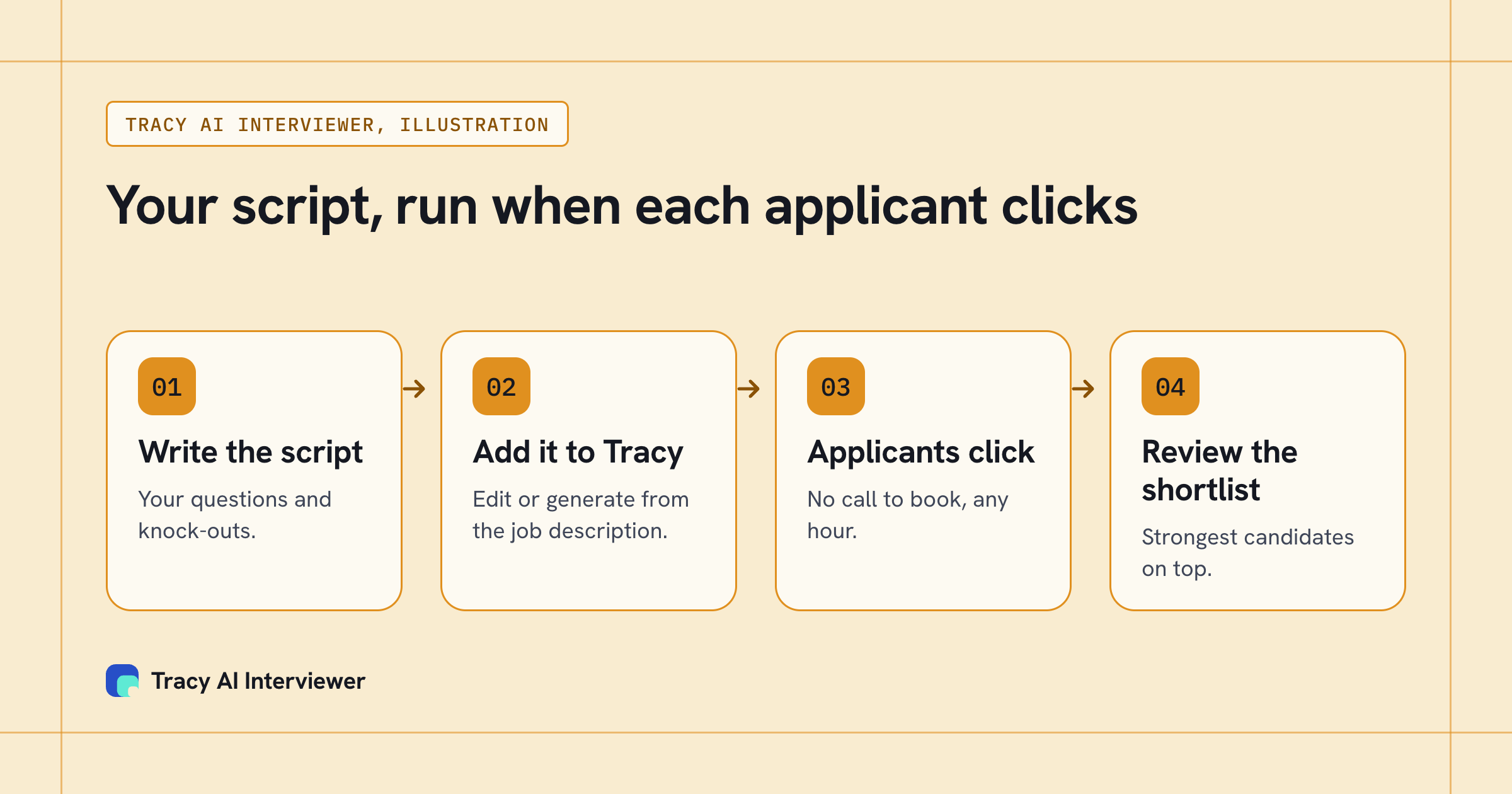
You write the script once; Tracy runs it from a link and ranks the results.
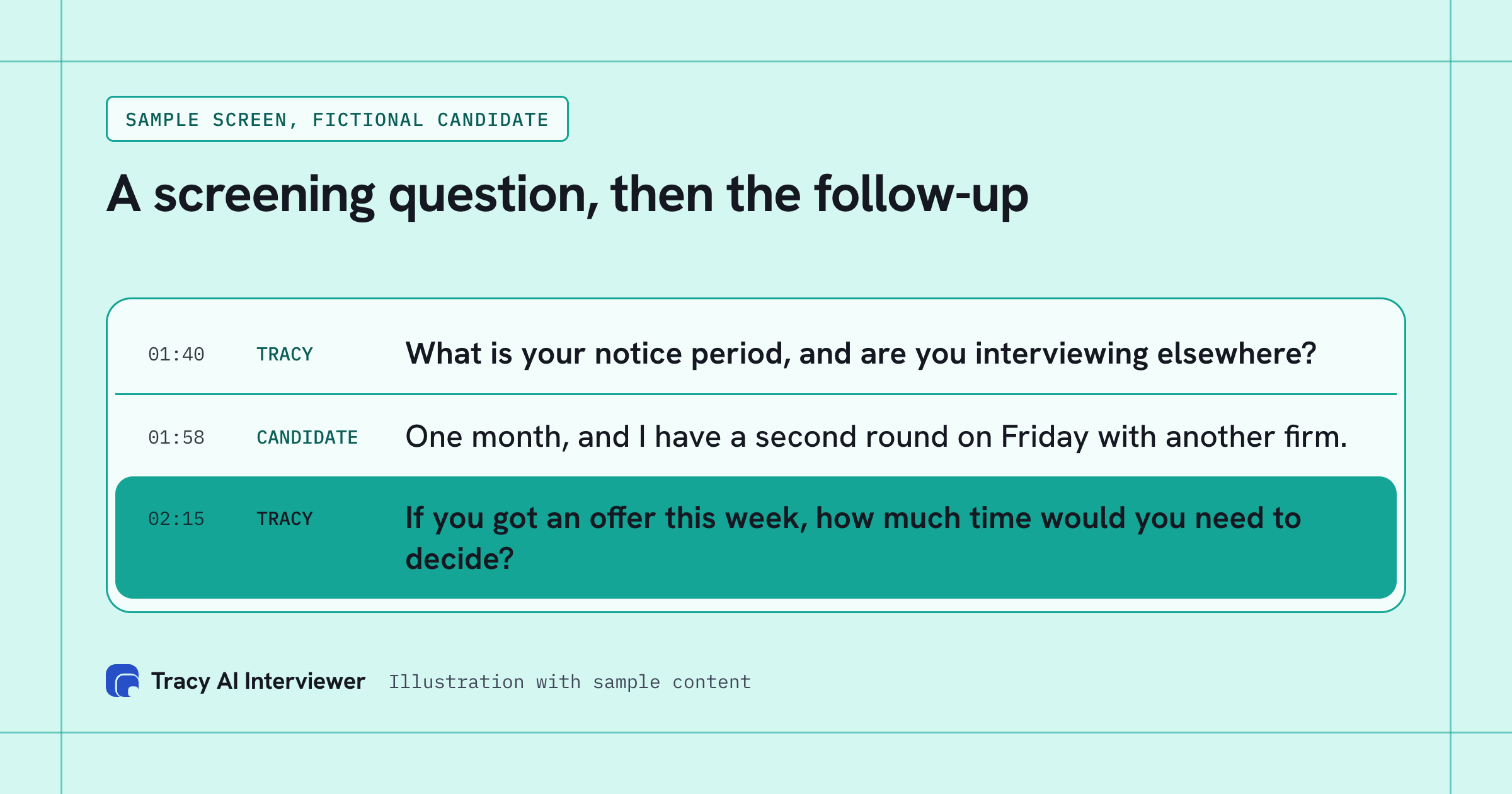
The follow-up asks what a recruiter would ask next, on every screen.
Which path fits you
- Agencies and RPO teams sending candidates to clients: volume hiring.
- Screening applicants who arrive through an apply page: applications.
- What candidates see on their side: participant experience.
Common questions
What do recruiters ask in a phone screen?
How long should a recruiter phone screen be?
What is a recruiter screening call script?
What should you write down on a phone screen?
Can Tracy replace the phone screen?
Try Tracy on your next role
Tracy interviews every applicant, asks follow-up questions and sends you a ranked shortlist.
Try it free (opens in a new tab) Book a demo (opens in a new tab)
Your first 3 results are free. No card needed.
Sources
- Tracy AI Interviewer home page, customer quotes, retrieved 9 Nov 2026.
- Tracy AI Interviewer Connect page, retrieved 9 Nov 2026.