
TLDR Tracy AI Interviewer runs the technical screen for every applicant: a coding task inside the interview, then follow-ups on approach and trade-offs, with a recording and written assessment per question.
A technical screen is the early interview that tests whether a candidate has the skills a technical role needs, before a longer loop.
The first 3 results are free, then $1 per credit, with no seats and no upfront cost.
Next step: send us one role and we build the interview plan.
We make Tracy AI Interviewer.
What is a technical screen?
A technical screen is an early interview that tests whether a candidate has the technical skills a role needs, before the team schedules a longer technical loop. It is also called a technical screening round, a technical phone screen or a technical screen interview. It sits after the résumé review and before the on-site or final interviews.
The output is a decision with notes: pass the candidate to the full loop, hold, or stop. Many technical screens combine three things: fundamentals questions, a short coding or problem-solving task, and a conversation about past work.
Who runs a technical screen?
Four setups are common.
Four ways to run a technical screen, what each looks like and where it strains.
| Who runs it | What it looks like | Where it strains |
|---|---|---|
| An engineer from the team | A call, a shared editor and a problem to solve together. | Engineer hours. Each screen takes the time of someone who is also building the product. |
| A recruiter with a script | Fixed fundamentals questions and a pass mark. | Limited depth. A script covers the questions it lists, so an unexpected approach goes unexplored. |
| An online assessment | Timed tasks the candidate completes alone. | It scores the submitted answer. Nobody asks why unless a reviewer adds a call. |
| An AI interviewer | A live conversation with a coding task and follow-ups. | Needs a clear set of skills to test and a human to decide. |
Teams often mix them: an assessment to filter, then a screen to understand how the candidate thinks.
A technical screen tests the skills a technical role needs, early, and ends in a decision.
A technical screen example
A backend engineer screen might run in this order.
Sample backend engineer screen: four parts, an example prompt and what a strong answer includes (fictional example).
| Part | Example prompt | A strong answer includes |
|---|---|---|
| Fundamentals | What is the difference between a process and a thread? | A correct distinction and when each is the right tool. |
| Coding task | Write a function that removes duplicates from a list. | Working code, a stated approach and an edge case. |
| Follow-up on the task | What is its time complexity? What changes if the list does not fit in memory? | A cost for the approach and a different design under the new limit. |
| Past work | Tell me about a performance problem you fixed. | What they measured, what they changed and the result. |
The follow-ups are where the screen earns its time. A correct function shows the candidate can solve the problem; the follow-up on memory shows whether they can reason past it. Our software engineer interview questions page has more prompts of this kind.
Technical screen vs the full technical loop
The screen is the first filter and the loop is the full evaluation. A screen is shorter and narrower: it asks whether the candidate has the core skills at all. The loop comes after and goes deeper, with several rounds that may include system design, a longer coding problem and a conversation with the hiring manager.
A good screen saves the loop for the people most likely to pass it. A weak screen lets too many through, and engineers spend loop time on candidates who should have stopped earlier. It can also stop strong candidates, if the questions test trivia instead of the work.
What makes a technical screen work
- Test the skills the job uses. Pick the three or four skills the role needs this year and write a question for each. Skip trivia the team would look up.
- Ask each candidate about the same skills. It lets you compare people on the same ground.
- Follow up on the approach. Ask why, what it costs and what breaks. This separates a memorised answer from understanding.
- Write down evidence. One line or quote per skill, so a second person can check the decision.
A screen that skips the follow-ups becomes a quiz. A screen that skips the evidence becomes an opinion.
Running the technical screen with Tracy
Tracy runs the technical screen as a conversation the candidate starts from a link, so no engineer has to be on the call.
- Coding task inside the interview. Live coding, SQL, debugging or multiple choice, in the same interview as the questions.
- Follow-ups on approach and trade-offs. She asks in the candidate's own field and follows up on what they said.
- Questions from the job description. Edit them or use your own, and set the skills and weights for the role.
- Evidence per result. A recording of both sides, a timestamped transcript and a written assessment per question with its reasoning.
A person decides from the evidence. Tracy runs the interview and writes the report. See AI technical interviews for the full workflow and technical interviews for the use case.
The first 3 results are free with no card. After that it is $1 per credit, no seats, no upfront cost. See pricing. To see the method applied, set up one engineering role and read the first results.
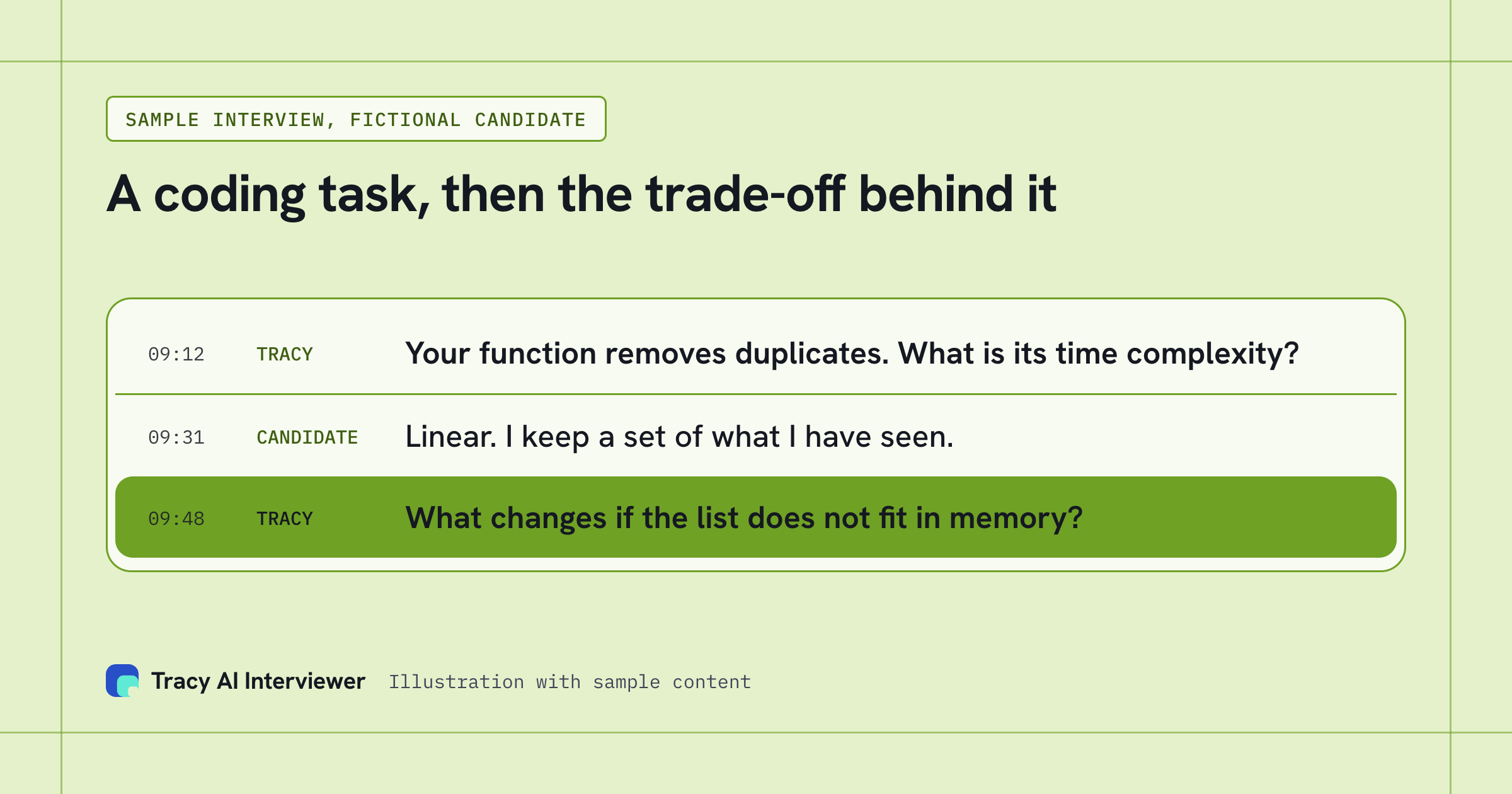
Tracy follows a coding answer with a question about its cost, so the screen tests reasoning as well as output.
Related terms
- Technical interview. The wider term for any interview that tests technical skill. A screen is the first one.
- Coding interview. An interview where the candidate writes code to solve a problem.
- Take-home test. A task completed alone and submitted later.
- System design interview. A longer round on how to build a large system, usually later in the loop.
- Pre-screening interview. A shorter first conversation on the basics, before the technical screen.
Which path fits you:
- Technical roles: see technical interviews.
- Many applicants: see hiring at volume.
- Reading the output: see AI interview reports.
Questions
What is a technical screen?
What happens in a technical screening round?
What is a technical phone screen?
Who runs a technical screen interview?
Can an AI interviewer run a technical screen?
See the method applied in one real interview. Send us one role and we will build the interview plan in days, with a recording and report you can check. Try it free · Book a demo
Sources
- Tracy AI Interviewer home page, customer quotes, retrieved 9 Nov 2026.
- Tracy AI Interviewer pricing, retrieved 9 Nov 2026.
- Tracy AI Interviewer Connect page, retrieved 9 Nov 2026.