In short
Talent acquisition teams are carrying more applications for fewer hires: Gem found recruiters handling 93% more applications than in 2021 (data to May 2025), and Greenhouse found that only 32 of every 1,000 U.S. applications reach a first interview (January to August 2026).
Tracy AI Interviewer gives every applicant a first-round interview from a link at any hour, follows up on each answer, and hands the recruiter a written summary of what each person said.
For one Tracy customer, average time to hire went from 44 days to 7, and over a single month its interviews took on the workload of 53 full-time recruiters.
Next step: run one open role through Tracy and compare it with your phone screens.
Talent acquisition statistics come from three kinds of source: platform data from applicant tracking systems, surveys of recruiters and surveys of candidates. They answer different questions, so this page lists each figure with its publisher, period and group. For the same numbers cut by recruiting cost and market size, see recruiting statistics; for the definition of the function itself, see what talent acquisition is.
What are the key talent acquisition metrics?
Recruiting teams usually track speed (days to fill), funnel conversion (how many applications reach an interview and an offer), recruiter capacity (hires and open requisitions per recruiter), source quality, cost per hire and what candidates experience. The table gives the latest figure for each from a named publisher.
Which metric counts what?
Each row comes from a different dataset and period, so rows are not comparable with each other. Sources: Greenhouse (2026), Gem (2025), Ashby (2026), Appcast (2025).
| Metric | Figure | Who counted, when |
|---|---|---|
| Days to fill | 62 days | Greenhouse, U.S. customers, January to August 2026 |
| To first interview | 32 of 1,000 | Greenhouse, applications at 9,473 U.S. companies, January to August 2026 |
| Openings with no hire | One in three | Greenhouse, U.S. openings, January to August 2026 |
| Past screening, to offer | 8% and 0.5% | Gem customers, applicants, June 2021 to May 2025 |
| Referral screen pass | 52% vs 35% | Ashby, referred candidates vs all, January 2021 to March 2026 |
| Hires per recruiter | 7.3 a quarter | Ashby, Q1 2026 (4.5 in early 2023) |
| Open reqs per recruiter | 14 | Gem, 2024 daily average, 56% more than in 2021 |
| Ad cost per hire | $851 | Appcast, U.S. employers, job ad spend per hire, end of 2024 |
Where do applications drop out?
The funnel is steep at the front. Greenhouse found that only 32 of every 1,000 applications reach a first interview, and Gem found that 8% of applicants advance past initial screening and 0.5% receive an offer. Ashby reports that recruiter screens pass about 35% of candidates overall and that referred candidates pass 52% of the time, so most unreferred volume is filtered out at the first screen.
Workload sits on the same stage. Ashby's customer data shows the average recruiter reaching 7.3 hires per quarter by Q1 2026, up from 4.5 in early 2023, while Gem recorded 14 open requisitions per recruiter in 2024, 56% more than in 2021. Gem also reports overall hiring volumes roughly 30% below pre-downturn levels, so more applications are chasing fewer openings.
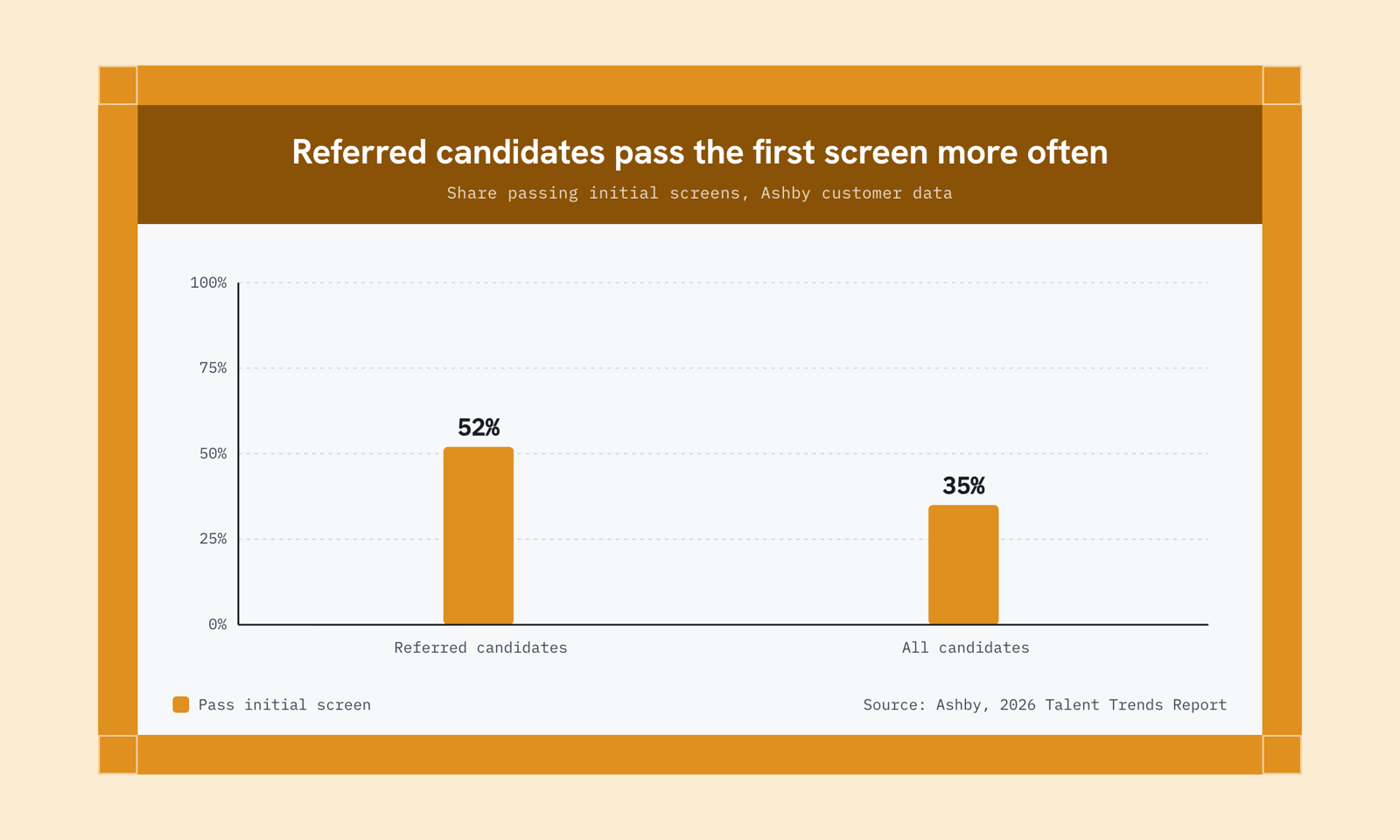
Referred candidates pass the first screen more often than the average candidate, so unreferred volume is filtered out there.
Is there a skills gap in applicants?
Recruiters say there is a gap between profiles and people. In TestGorilla's 2026 survey of 1,428 U.S. and 483 U.K. talent professionals, 90% of U.S. recruiters and 87% of U.K. recruiters said claimed AI skills were weaker than the profile suggested at least sometimes, and 73% of U.S. and 75% of U.K. recruiters believed half or more of the resumes and profiles they see are AI-written. TestGorilla is a skills-testing vendor.
An applicant who describes a project in their own field has to say what they did, which a profile line does not require. Tracy asks the next question from the answer just given, so a claim on a profile gets a follow-up about how the applicant did the work.
What is the state of talent acquisition in 2026?
Volume is up while hiring is down: recruiters handle 93% more applications than in 2021 (Gem), and one in three Greenhouse openings closes with no one hired. Tools are spreading: LinkedIn's Future of Recruiting 2025, a September 2024 survey of 1,271 recruiting professionals in management roles or higher across 23 countries, found 37% of organizations actively integrating or experimenting with generative AI in hiring, up from 27% a year earlier, and those using it reported saving about 20% of the work week.
Candidates wait in that queue. CandE's 2025 benchmark, built on more than 66,000 candidate surveys, found 31% of North American candidates had not heard back one to two or more months after applying, and 56% of candidates got no feedback after being rejected in screening and interviewing. See candidate ghosting statistics for more on what waiting does to applicants.
What does a first round look like when every applicant gets one?
Tracy AI Interviewer moves the first round off the recruiter's calendar. You write the role brief or bring your own questions, share one link, and each applicant starts when ready, at any hour, in the browser. Tracy follows up in the applicant's own field and waits for the end of the thought. The recruiter reads a written summary of what each person said to each question, with the words and timestamps behind it, and decides who goes forward. Tracy reports what was said and does not rank anyone. Results can be written back to your ATS, and the API and MCP connections let your own tools start an interview.
A sample note with invented data shows the shape of a high-volume screen: an applicant says they want regular hours near home, Tracy asks which hours suit them, and the early-shift answer is logged with its time. Candidates rate Tracy 92 on NPS. To compare it with your phone screens, run one open role through it and read the summaries beside your own notes.
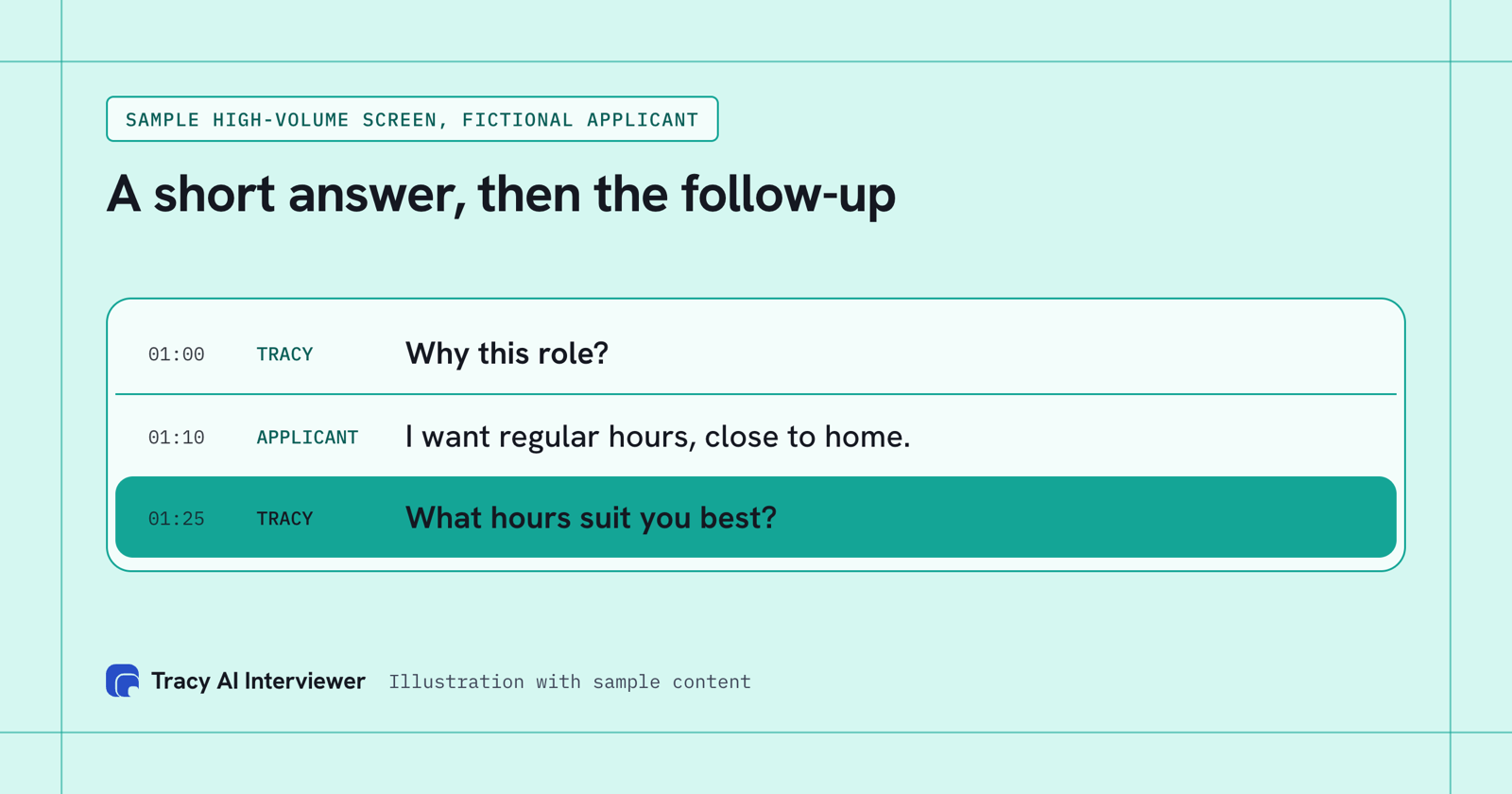
A short screening answer gets a follow-up that turns it into a usable note.
Which path fits you?
- Setting the plan: a talent acquisition strategy.
- Choosing software: talent acquisition software compared.
- Measuring speed: time to hire statistics.
- Handling the queue: high-volume recruitment.
- Setting up the first interview: what a first-round interview covers.
Volume hiring with Tracy follows a role from the first link to the report.
Common questions
What are key talent acquisition metrics?
Is there a skills gap in applicants?
What is the state of TA in 2026?
How many applications reach a first interview?
What do candidate experience statistics show?
Give every applicant a first interview
Tracy runs each applicant's first round and follows up on every answer, so recruiters read summaries instead of booking calls. First 3 results free.
Try it free (opens in a new tab) Book a demo (opens in a new tab)
Your first 3 results are free. No card needed.
Sources
- Greenhouse: The Hire Standard, fall 2026 US benchmark report, retrieved 18 Nov 2026.
- Gem: Key takeaways from the 2026 Recruiting Benchmarks Report, retrieved 18 Nov 2026.
- Ashby: Recruiter Productivity, 2026 Talent Trends Report, retrieved 18 Nov 2026.
- Appcast: 2025 Recruitment Marketing Benchmark Report, retrieved 18 Nov 2026.
- LinkedIn: The Future of Recruiting 2025, retrieved 18 Nov 2026.
- TestGorilla: Recruiting in the AI era (2026), retrieved 18 Nov 2026.
- Survale: 2025 CandE Benchmark Research key statistics, retrieved 18 Nov 2026.