In short
Talent acquisition software covers attracting, tracking, interviewing and hiring people. A suite holds the record of every applicant; a point tool does one step inside it.
Tracy AI Interviewer is the point tool for the first conversation: each applicant starts from a link, Tracy follows up in their own field, and your reviewer reads the recording, the transcript and what the person said to each question. Results can be written back to your ATS.
Choose the suite on record-keeping and price, then add Tracy when applicants wait for a first call: 100K+ interviews completed, 99% interview completion.
Run one open role through Tracy and read the follow-ups.
What is talent acquisition software?
Talent acquisition software is the set of tools a team uses to attract, track, interview and hire people. It splits into suites, which keep every applicant, stage and offer in one record, and point tools, which do one job inside that process. Most teams run a suite and add a point tool where the suite is thin.
Ashby's 2026 Talent Trends Report puts the median time from application to hire at 30 days for business roles and 40 days for technical roles, from Ashby customer data for Q2 and Q3 2025 covering over 109 million applications. The first conversation with each applicant sits early in that stretch. Tracy AI Interviewer runs it: the applicant opens a link, Tracy asks questions in their field, and the team reads the result.
Do you need a suite, a point tool, or both?
Both, for most teams. The suite is the system of record: it posts the job, collects applications, moves people through stages and holds the offer. A point tool earns its place when one stage backs up. If applicants wait days for a first conversation, pipeline reports do not shorten the wait; a tool that holds the conversation does.
Tracy writes results back to your ATS, so the suite stays your single record. The volume hiring page shows the flow for a team with many applicants per role.
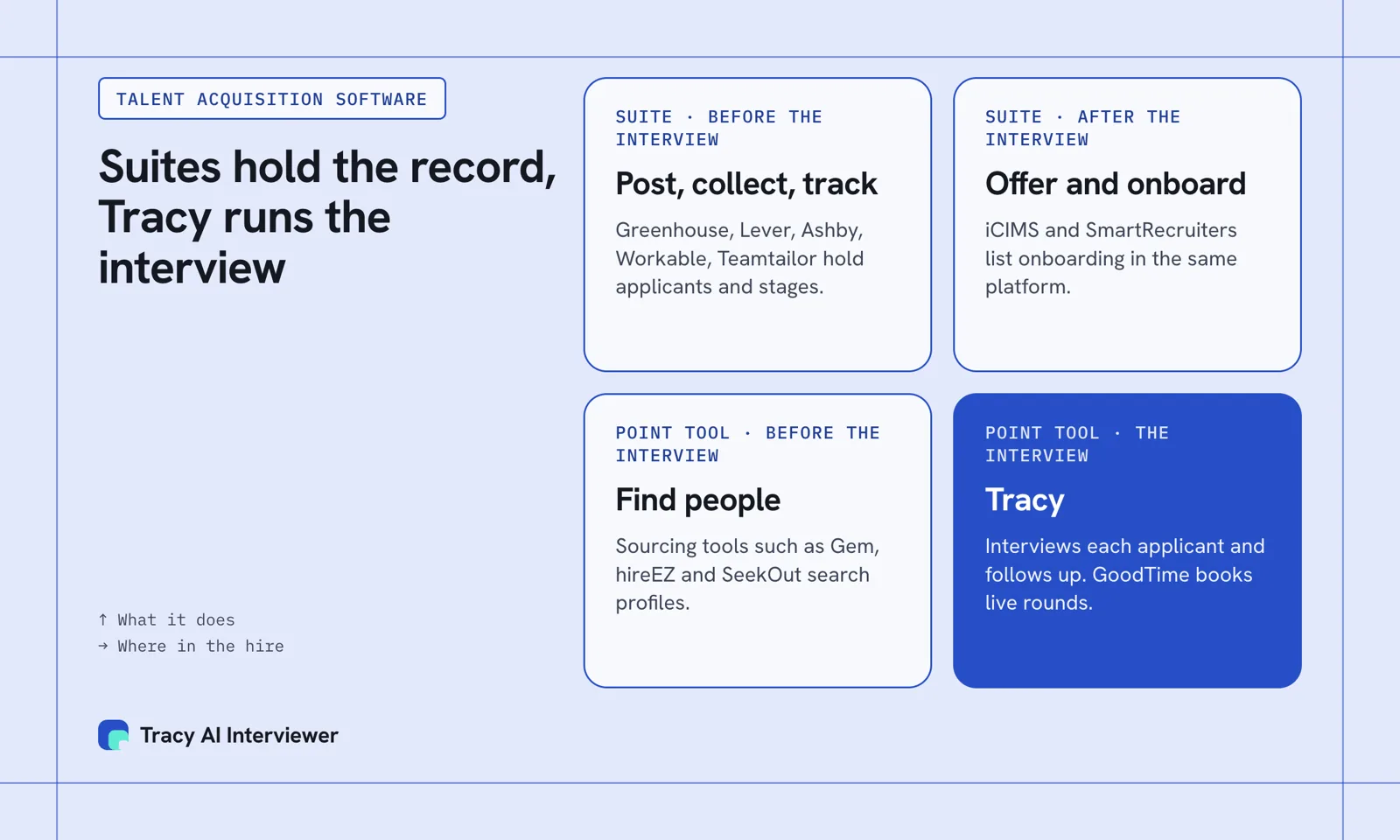
Suites hold the record before and after the interview; Tracy is the tool for the interview itself.
What is the best talent acquisition software in 2026?
There is no single best. For the record, pick a suite: Workable or Ashby if you want a price on the page, Greenhouse, Lever, iCIMS or SmartRecruiters if you buy by quote. For the first-round interview, Tracy.
One rule sets the order below. Tools that talk with the applicant come before tools that store the applicant. Among the suites, those with an entry price on the page come first, lowest to highest as listed, and the quote-only suites follow in alphabetical order. Units differ (a per-user price, a plan price), so the table names them. Prices and features are the vendors' own, read on 23 Nov 2026, and Teamtailor's on 14 Nov.
Talent acquisition software side by side
What each vendor's pages state. Entry prices read 23 Nov 2026 (Workable 22 Nov, Teamtailor 14 Nov).
| Tool | What it covers | Entry price |
|---|---|---|
| Tracy | Interviews every applicant and follows up | $1 per credit after 3 free results |
| Loxo | ATS, CRM, sourcing and AI agents in one product | Core from $149 per user a month |
| Workable | ATS with 200+ job boards and a talent CRM | Standard $299 a month |
| Ashby | ATS with AI search, review and an MCP server | Foundations $400 a month |
| Greenhouse | ATS with an AI Notetaker on every plan | Quote, demo |
| iCIMS | Enterprise ATS with CRM and onboarding | Quote, demo |
| Lever | ATS with admin automation and fit-score sorting | Customised, demo |
| SmartRecruiters | Job posting to onboarding in one platform | Not on its home page |
| Teamtailor | ATS; its AI summarises CVs and video interviews | Quote request |
Each tool: verdict, fit, trade-off and price
Tracy AI Interviewer
Verdict: Interviews each applicant from a link and returns the recording, a transcript and what the person said to each question.
Best for: Teams hiring at volume, or for roles where a CV says little.
Trade-off: It covers the interview step, so keep your suite for the pipeline.
Price: Listed in the table above.
Loxo
Verdict: Describes itself as a Talent Intelligence Platform that replaces the ATS, with CRM, sourcing, outreach and AI agents.
Best for: Teams that want sourcing and CRM in the same product as the ATS.
Trade-off: Core leaves out Loxo Source, outreach and the agent workforce; Professional adds them and shows no price.
Price: Core is $149 per user a month, with annual billing.
Workable
Verdict: An ATS with distribution to 200+ job boards, a talent CRM, scorecards and self-scheduled interviews.
Best for: Small teams that want a published plan price.
Trade-off: There is no free plan, and AI screening draws on the 3,000 AI credits in each plan, one per candidate screened.
Price: Standard at $299 a month; Premier and Enterprise cost more.
Ashby
Verdict: An ATS with AI candidate search, application review and interview summaries, plus an MCP server and custom AI agents.
Best for: Growth teams that want one system with AI built in.
Trade-off: Its AI Notetaker and AI Interviewer are paid add-ons, and Plus, Enterprise and Analytics are priced by contact.
Price: Foundations, for up to 100 employees, is $400 a month, with 10% off for annual commitments.
Greenhouse
Verdict: An ATS with an AI Notetaker on every plan and suggestions for interview questions and scorecards.
Best for: Teams that want an AI Notetaker included on every plan.
Trade-off: Core, Plus and Pro carry no prices on the pricing page.
Price: Customised to your hiring needs; book a demo.
iCIMS
Verdict: An enterprise-grade applicant tracking system with candidate relationship management, employer branding and onboarding.
Best for: Larger teams that want onboarding in the same system.
Trade-off: The site offers a demo request and no price.
Price: Quote.
Lever
Verdict: An ATS where admin, scheduling and follow-ups run on automation, with applicants sorted by fit score and fraud signals flagged.
Best for: Teams that want ranking and automation inside the pipeline.
Trade-off: Pricing is set by company size, hiring volume and implementation, and starts with a demo.
Price: Customised.
SmartRecruiters
Verdict: A recruiting platform from job posting to onboarding, now part of SAP SuccessFactors.
Best for: Teams that want sourcing, tracking and onboarding in one core platform.
Trade-off: Its home page shows no price.
Price: Ask the vendor.
Teamtailor
Verdict: An ATS whose AI summarises CVs and video interviews in one click, with structured interviews and smart scheduling marked included.
Best for: Teams that want AI summaries and interview kits inside the ATS.
Trade-off: The pricing page is a quote request.
Price: By quote. See Teamtailor pricing.
What Tracy adds beside a suite
The suites above list interviewing as a stage. Tracy runs the conversation itself.
- Each applicant starts on click, at any hour, in a browser, with no calendar and no recruiter on the call. If an applicant drops off, they can come back within 10 minutes.
- Tracy asks in the person's own field and follows the answer, so a thin reply gets the next question. You can bring your own questions or describe the role and edit the draft.
- Your reviewer opens a report link with the recording, a timestamped transcript and what the person said to each question, and decides. The report can go back into the ATS record.
Tracy connects to Workable and Breezy HR through chat connectors and to the ATS you already use, and it has an API and an MCP server. Teams that already run Workable can start from the Tracy and Workable guide.
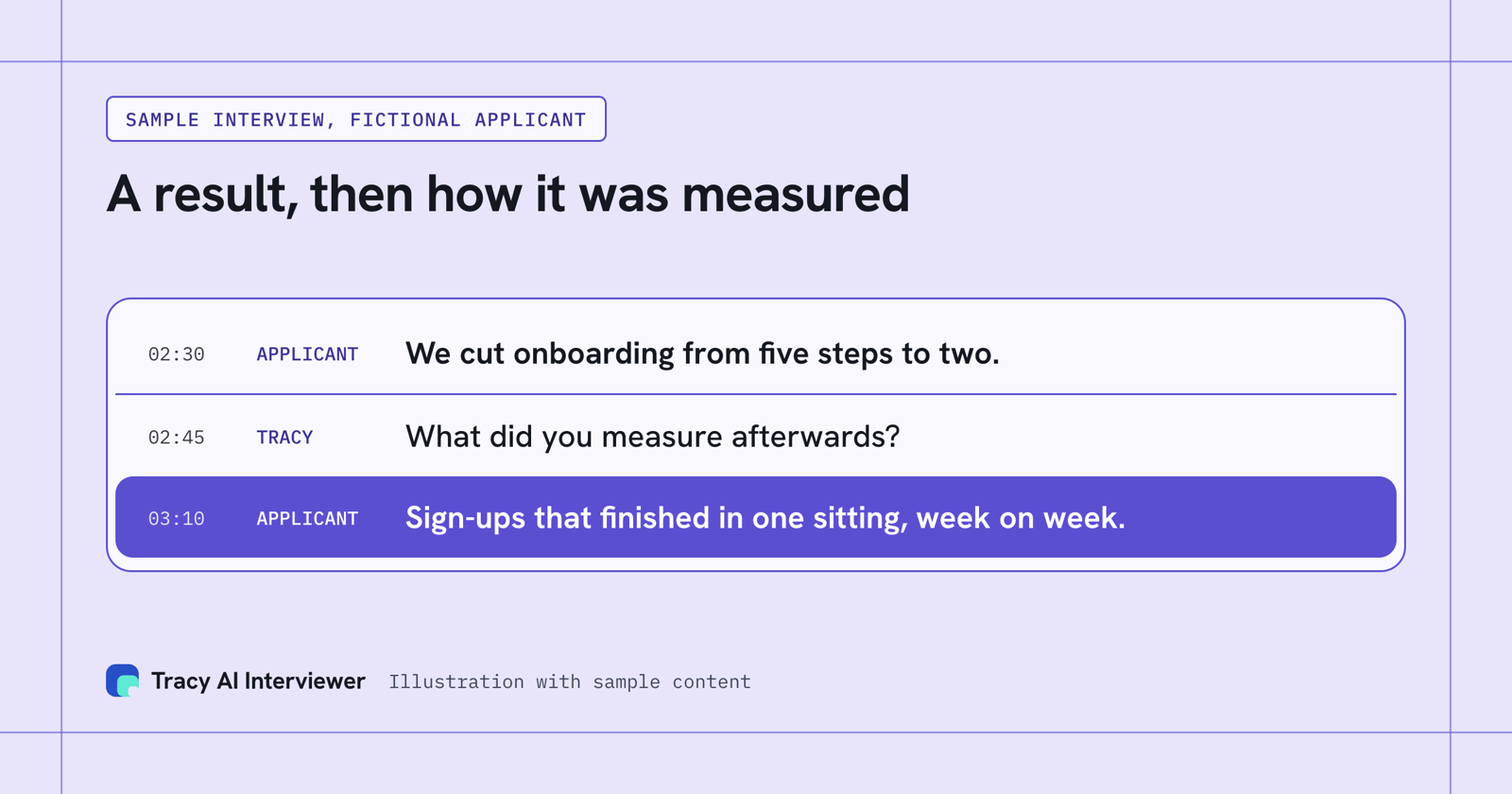
Tracy asks what was measured after a stated result, and each line carries a time.
What to ask on a demo call
Ask four things on a demo call. How long does migration take, and is it free? Loxo says migration is free for teams of three or more seats. Which fields does an AI add-on write back to your record? What is the contract unit: annual up front, as Loxo bills, or monthly? And how does cost move with volume? A suite priced per seat or plan stays flat as applicants grow, while Tracy's cost follows the interviews you run.
Which path fits you?
- Weighing suites that add AI: AI recruiting software shows which AI sits inside each ATS.
- Starting from the process rather than the tool: talent acquisition strategy.
- Working to a small budget: recruiting software for small business.
- Interviewing hundreds at once: high-volume recruitment.
- Already on Teamtailor: Tracy next to Teamtailor.
- New to the field: what talent acquisition is.
Common questions
What is talent acquisition software?
Suites vs point tools: which should you buy first?
Which talent acquisition software shows its price?
Does talent acquisition software include interviewing?
Interview every applicant, not just a few
Tracy interviews each applicant from one link and follows up on every answer. Your first 3 results are free.
Book a demo (opens in a new tab) Try it free (opens in a new tab)
Your first 3 results are free. No card needed.
Sources
- Tracy AI Interviewer: Pricing, retrieved 23 Nov 2026.
- Tracy AI Interviewer: Connect, retrieved 23 Nov 2026.
- Ashby: Recruiter Productivity, 2026 Talent Trends Report, retrieved 18 Nov 2026.