In short
A system design question separates candidates only when its follow-up makes them name a trade-off, and each of the 15 below carries one. Tracy AI Interviewer asks them of every engineering applicant, follows the answer, and keeps the recording and transcript. Your senior engineers read what each candidate said and decide who gets the live design round.
Two candidates draw the same boxes for the same system. One says what breaks first and how they would find out. The other says "add a cache". System design interview questions only separate those two when each has a follow-up, so every question below comes with one.
The page is for hiring managers and engineers who interview senior and mid-level backend candidates. It gives questions and follow-ups; for the scoring grid, use the system design interview rubric. Candidates preparing for a design round can use the follow-ups as practice.
Your senior engineers have time for the follow-up with a few candidates, not with all of them. Tracy AI Interviewer asks it of every applicant in the spoken part of the round, while the drawn diagram and a long design exercise stay with the live round. For the wider process, see AI technical interviews and technical interviews.
Fifteen system design interview questions, grouped by what they test
A good design question leaves the candidate room to choose what to clarify, what to build first and what to give up, and the follow-up shows how well they know the choice. Start with one or two from each group. Vary the opening question only if you can compare answers; otherwise give everyone the same one. Ask the follow-up after the first answer, and note what a strong answer must contain before anyone joins.
Group 1: scoping the problem
1. Design a system that sends reminders to a million users. What do you ask before drawing anything?
- Follow up with
- Which answer would change the design most?
- Listen for
- Reminder types, delivery guarantees, time zones, the peak, what a late reminder costs. Ranks the questions by impact.
2. Design a ticket booking system for events. Where is the hard part?
- Follow up with
- What happens when two people click the last seat?
- Listen for
- Contention on one seat, a hold with an expiry, strong consistency where it matters. Says what can be a little stale.
3. How do you size a system when nobody gives you numbers?
- Follow up with
- Which assumption would you check first?
- Listen for
- Users, actions per user, size per action. States assumptions, tests the biggest one and checks the order of magnitude.
Group 2: data and storage
4. Design the data model for a chat app with group chats.
- Follow up with
- How would you load the last 50 messages of a busy group?
- Listen for
- Messages keyed by conversation and time, a store chosen for the read pattern, pagination.
5. When would you choose a relational database, and when not?
- Follow up with
- What would make you move off the one you chose?
- Listen for
- Transactions, joins and structure against key access and scale. Names a signal such as write rate or hot rows, not a brand.
6. How do you handle a table that grows without limit?
- Follow up with
- What do you do about the oldest data?
- Listen for
- Partitioning, retention, archive, the cost of queries over history, and what the product actually needs.
Group 3: scale and performance
7. Your design works at 100 requests a second. What breaks first at 10,000?
- Follow up with
- How would you know before customers do?
- Listen for
- Finds the likely bottleneck, such as database writes or a single queue. Load tests and alerts on saturation.
8. Where would you add a cache, and where would you not?
- Follow up with
- What happens when the cache is empty after a restart?
- Listen for
- Repeated reads, tolerance for stale data, invalidation, cold starts and stampedes.
9. A queue backs up every evening. What do you check?
- Follow up with
- What changes if the cause is one slow consumer?
- Listen for
- Arrival rate against processing rate, retries, poison messages, more consumers, back-pressure.
Group 4: failure and reliability
10. A service you call goes down. What do your users see?
- Follow up with
- What would you show them?
- Listen for
- Timeouts, retries with limits, fallbacks, a degraded mode. Avoids retry storms.
11. How do you make a payment-style request safe to retry?
- Follow up with
- What if the retry arrives an hour later?
- Listen for
- Idempotency keys and stored results. Knows exactly-once is rare and says what a duplicate costs.
12. Tell me about an outage you were part of.
- Follow up with
- What changed in the design afterwards?
- Listen for
- A real incident, their role, the cause, and a concrete change such as an alert, a limit or a runbook.
Group 5: trade-offs and communication
13. You can have lower latency or stronger consistency here. Which do you pick?
- Follow up with
- Which user would complain?
- Listen for
- Chooses with a reason from the product and names who pays for it. Not a slogan about a theorem.
14. The team has two weeks. What do you build first?
- Follow up with
- What do you leave out on purpose?
- Listen for
- The simplest design that meets today's need, a note on the next order of magnitude, and what is deferred.
15. Explain this design to someone who missed the discussion.
- Follow up with
- What did you leave out of the explanation?
- Listen for
- An order: the problem, the main parts, one request path, the main risk.
These follow-ups help only when someone asks them, in the same way, of every applicant.
Where a design answer gets specific
We wrote the pairs below for questions 2, 7 and 11. None of them is a quote from a real candidate.
Table 6: Weak and strong answers to design questions 2, 7 and 11.
| Weak answer | Strong answer | |
|---|---|---|
| Question 2, the last seat | "Whoever clicks first wins." | "I would hold the seat for a few minutes with an expiry. Claiming the seat is one atomic step, so two people cannot both hold it, and the hold expires if the sale does not complete. Browsing can be a little stale." |
| Question 7, the 10,000 requests | "Add more servers." | "Probably the database writes, because reads can be cached. I would load test to find where latency bends and alert on that before customers see it." |
| Question 11, the safe retry | "Retry until it works." | "The client sends a unique key. The server stores the result under it and returns the same result on a retry. A duplicate charge costs more than a slow retry." |
The follow-up a question list cannot ask
A list hands every candidate the same first question. It cannot ask the second and third, which depend on what the candidate just said. The lines below are made up, and so is the candidate. The chain opens on question 11, and each follow-up builds on the last answer.
Tracy: How do you make a payment-style request safe to retry?
Candidate (fictional): The client sends a unique key with each request, and the server remembers it.
Tracy: What if the retry arrives an hour later?
Candidate: The server still has the key and returns the stored result, as long as we keep keys that long.
Tracy: How long would you keep them, and what does it cost?
Candidate: Longer than the longest retry window, maybe a day. It is one small row per payment.
The last question asks the candidate to price their own design, which the first answer never does.
Asked live, 100 design conversations of 20 minutes take about 33 hours of engineer time, and 1,000 take about 333. At that size the first round shrinks to the few applicants your engineers have hours for. Asked by Tracy, every applicant gets the follow-up, and your engineers spend their hours reading the results.
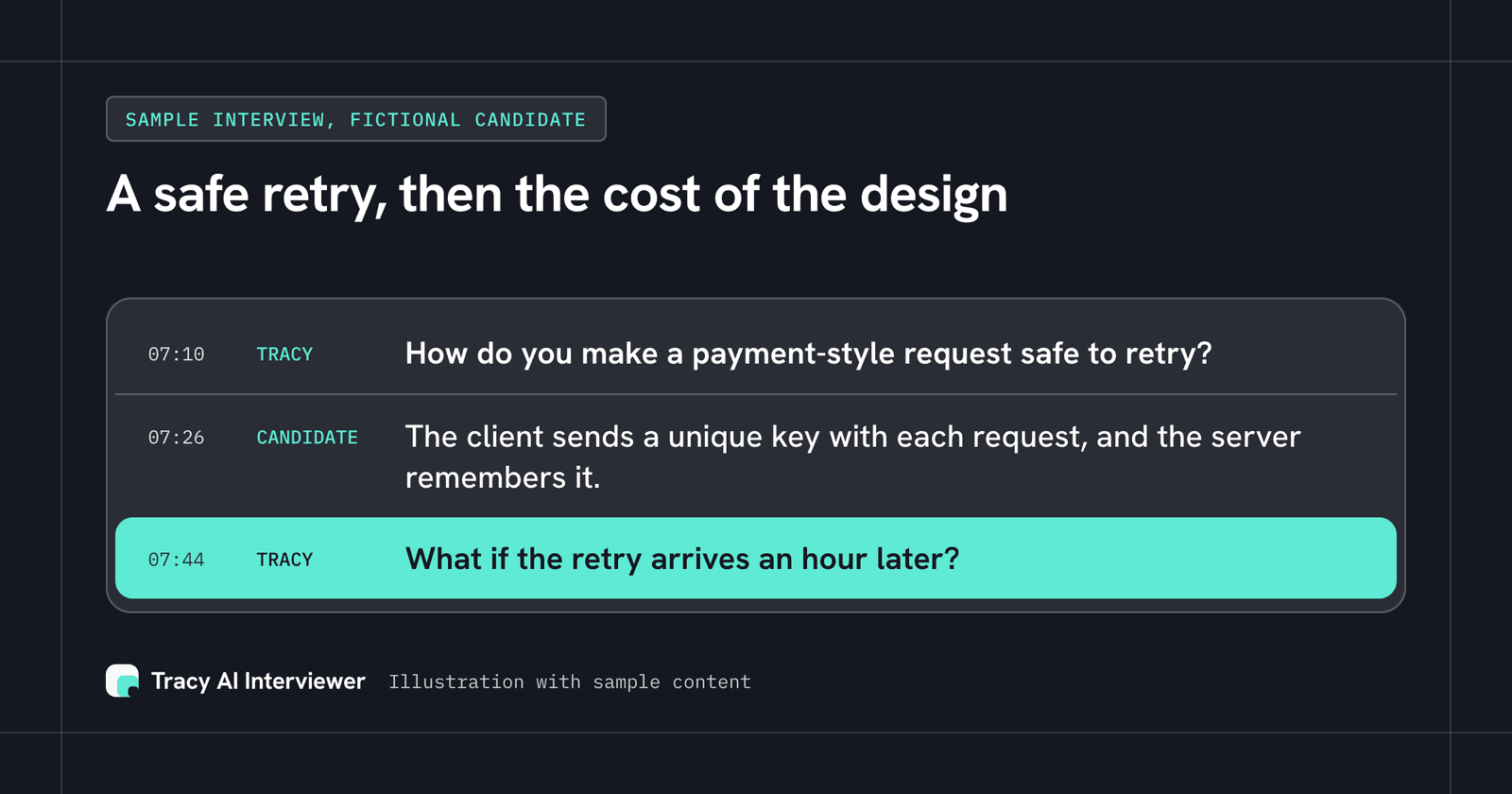
Asked next, the retry question tests the trade-off the candidate chose.
What Tracy adds to system design interviews
The questions above need an interviewer for every applicant. Tracy is that interviewer.
- Reach every applicant. Each candidate starts on click, at any hour, with no scheduling and no engineer on the call. Every one of them gets the same design question.
- Ask the next question. Tracy follows the answer in the candidate's own field and waits. "Add a cache" meets "What happens when the cache is empty after a restart?"
- Keep the evidence. Every result has a recording, a timestamped transcript and a written assessment per question with its reasoning. An engineer can check what was said before the live round.
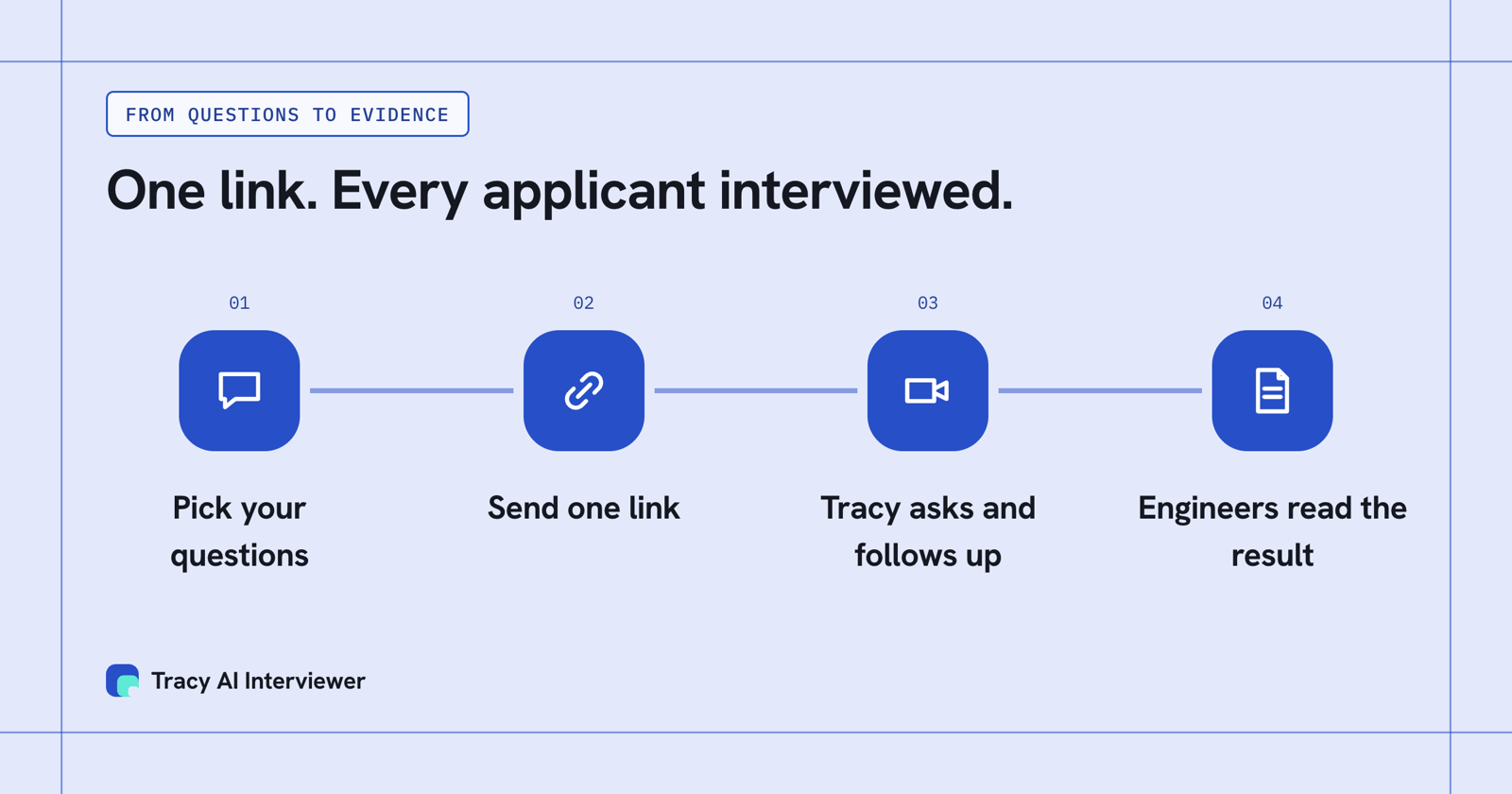
One link reaches every applicant, and your engineers read the result.
How the first design conversation runs
- Tracy asks the design question, follows up on trade-offs and waits for the candidate to finish. A coding task can sit in the same interview; Tracy then asks about the approach.
- Tracy drafts the questions from your job description for you to edit; the product page shows how.
- A browser and a link are all a candidate needs: no account, no calendar, any hour. The join screen notes that the session is recorded and transcribed; what candidates see is on one page.
- Each result carries the recording and transcript, so a senior engineer reads the trade-off the candidate named, plus a note for your ATS. See the report layout.
- In a video interview, gaze, face detection, tab changes, delay before answers, external screens and fullscreen exits are each captured as integrity signals, unless you turn them off. Each goes to a person with its evidence and none is proof; see how reviewers read them.
A design conversation often runs past 20 minutes, and each started 20 minutes costs one $1 credit, so a 35-minute interview uses two. Your engineers need no seats, and the first three results are free, no card needed. See pricing.
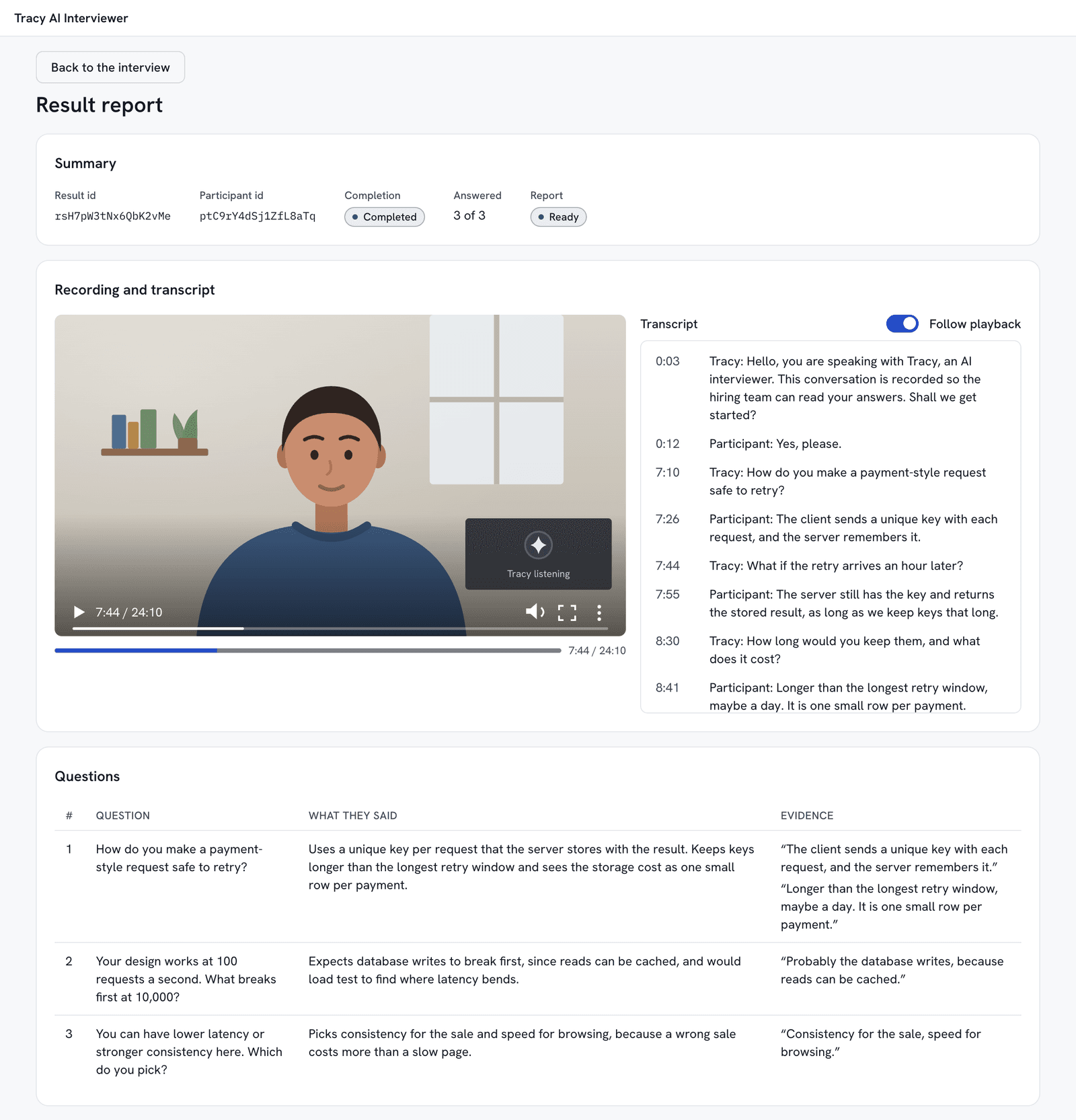
A senior engineer reads each design answer next to its recording and transcript.
What stays with your engineers
- A senior engineer reads each report and decides who gets a design round.
- Calibrate: one engineer reads five transcripts cold and is told which level the round is for. Questions where that read differs from the report are reworked before the next hundred invitations.
- The design round: the whiteboard or diagram session, and the final call on level, stay with your engineers. They score it with the system design interview rubric.
For a handful of senior hires, an hour with a staff engineer works fine; AI interview vs human interview explains when it stops working. When every applicant needs a design conversation, your engineers' calendars are the limit. For questions beside this round, see backend developer interview questions, coding interview follow-up questions and React interview questions.
Common questions
What are good system design interview questions?
What are good system design interview questions for senior engineers?
What follow-up questions test trade-offs in a system design interview?
How do you answer system design interview questions as a candidate?
Can Tracy run a system design interview?
Does Tracy decide who gets a design round?
Run the design questions you chose
Load your questions, send one link, and read each recording and result before the live round. The first 3 results are free.
Try it free (opens in a new tab) Book a demo (opens in a new tab)
Your first 3 results are free. No card needed.
Sources
- Tracy AI Interviewer home page, retrieved 14 Nov 2026.
- Tracy AI Interviewer pricing, retrieved 14 Nov 2026.
- Tracy AI Interviewer Connect page, retrieved 14 Nov 2026.