In short
These machine learning engineer interview questions test whether a candidate can frame a problem, trust an evaluation and keep a model working after launch, with a follow-up for each of the 15. Tracy AI Interviewer asks them of every applicant, coding task included, follows the answer into the reasoning, and returns the recording and transcript. Your ML lead reads the evidence and decides.
What good machine learning engineer interview questions do
Say a machine learning engineer role draws 400 applications. Every CV lists PyTorch, scikit-learn and a Kaggle result. The CV cannot tell you who has found out why a model that scored well offline did badly in production, and who has only tuned a notebook. Good machine learning engineer interview questions ask what they did when the live numbers disagreed with the test set, and each question below has a follow-up that goes after the cause.
ML leads, hiring managers and recruiters can run these 15 machine learning engineer interview questions in a first technical conversation of 20 to 30 minutes. A take-home or a deep modelling review is better kept for your own team to do later.
Tracy AI Interviewer asks that second question of every applicant, coding task included. If a candidate would retrain, the next question is how they would know the data was the cause. For the wider process, see technical interviews with Tracy. For the neighbouring role, see AI engineer interview questions.
What should a machine learning engineer interview test?
It should test whether the candidate can frame a problem, trust an evaluation and keep a model working after launch. Algorithm names come second.
Fifteen machine learning engineer interview questions, grouped by what they test
From each group, select one or two. Ask the follow-up when the first answer ends. Fix what a strong answer contains ahead of the first interview.
Group 1: Framing the problem
1. A product team asks for "a model to predict churn". What do you ask before you build anything?
- Follow up with
- What would make you say a model is not needed?
- Listen for
- The decision it supports, how churn is defined, the time window, a simple rule as baseline, the cost of each error.
2. How do you choose a metric when one class is rare?
- Follow up with
- A model has 98% accuracy and is useless. How?
- Listen for
- Precision and recall, the cost of each error, a threshold set with the business. Accuracy hides the rare class.
3. How do you set a baseline?
- Follow up with
- How do you know a gain over it is real?
- Listen for
- A simple baseline on the same split. Variation across seeds or folds, not one run.
Group 2: Data and evaluation
4. Offline results are strong and production results are poor. Where do you look?
- Follow up with
- How do you tell which cause it is?
- Listen for
- Leakage, training and serving differences, drift, label delay. Compares feature distributions.
5. How do you split data for a model that predicts the future?
- Follow up with
- What goes wrong with a random split?
- Listen for
- A split by time. Future information leaking into training. The same user on both sides.
6. One feature is extremely predictive and you are suspicious. Why?
- Follow up with
- How do you check?
- Listen for
- It may only exist after the outcome. Checks when the value becomes available, runs without it.
Group 3: Modelling
7. A model overfits. What do you do?
- Follow up with
- What if you cannot get more data?
- Listen for
- Looks at validation curves. Regularisation, a simpler model, early stopping, augmentation.
8. When would you choose gradient-boosted trees over a neural network?
- Follow up with
- When would you change your mind?
- Listen for
- Tabular and smaller data, speed, explainability. Neural networks for images and text.
9. Write code that computes precision and recall from predicted and true labels.
- Follow up with
- What do you return when there are no positive predictions?
- Listen for
- Counts true and false positives and false negatives. Handles a zero denominator and says the convention.
Group 4: Production
10. How do you deploy a model so you can roll it back?
- Follow up with
- How do you know the new one is better in production?
- Listen for
- Versioned artefacts, a shadow or canary release, a live metric, a rollback path.
11. How do you monitor a model after launch?
- Follow up with
- Inputs drift but accuracy looks fine. What do you do?
- Listen for
- Input and prediction distributions, delayed labels, alert thresholds, retraining triggers.
12. Latency doubled after a model change. What do you check?
- Follow up with
- What would you trade away?
- Listen for
- Model size, batching, feature fetching, hardware, caching. Trades accuracy for speed with the owner.
Group 5: Judgement
13. Tell me about a model you shipped that did not work as expected.
- Follow up with
- What did it teach you about the data?
- Listen for
- A real case, what they measured, what they changed.
14. How do you explain a prediction to someone who is not technical?
- Follow up with
- What do you refuse to claim?
- Listen for
- Plain words, uncertainty stated. No causal claim from a correlated feature.
15. How do you decide a model is good enough to ship?
- Follow up with
- Who signs off?
- Listen for
- Tied to a decision and the cost of errors. Guardrails, review of risky cases, a monitoring plan.
Weak and strong answers to the same questions
Each row answers one question two ways.
Table 6: Weak and strong answers to the same questions, written as examples.
| Weak answer | Strong answer | |
|---|---|---|
| Question 4, the offline gap | "The production data is noisier." | "I would first check for leakage, then compare feature distributions between training and live traffic, and check whether labels arrive late." |
| Question 6, the suspicious feature | "It is a strong feature, so keep it." | "I would ask when that value is known. If it is only filled in after the outcome, it is leakage, and I would retrain without it." |
| Question 13, the model that failed | "We retrained it and it improved." | "Live accuracy fell because a partner changed a field. We added an input check and an alert before retraining, so we would catch it earlier." |
A follow-up chain on the model that fails live
This chain is an illustration. The data and the candidate are fictional, and no real interview sits behind it. It starts from question 4.
Tracy: Offline results are strong and production results are poor. Where do you look?
Candidate (fictional): I would retrain on more recent data and see if it helps.
Tracy: How would you find out whether the data is the cause?
Candidate: Compare each feature's distribution in training with live traffic, and check it is computed the same way in both.
Tracy: Everything matches. What next?
Candidate: Check for leakage, a feature only known after the outcome.
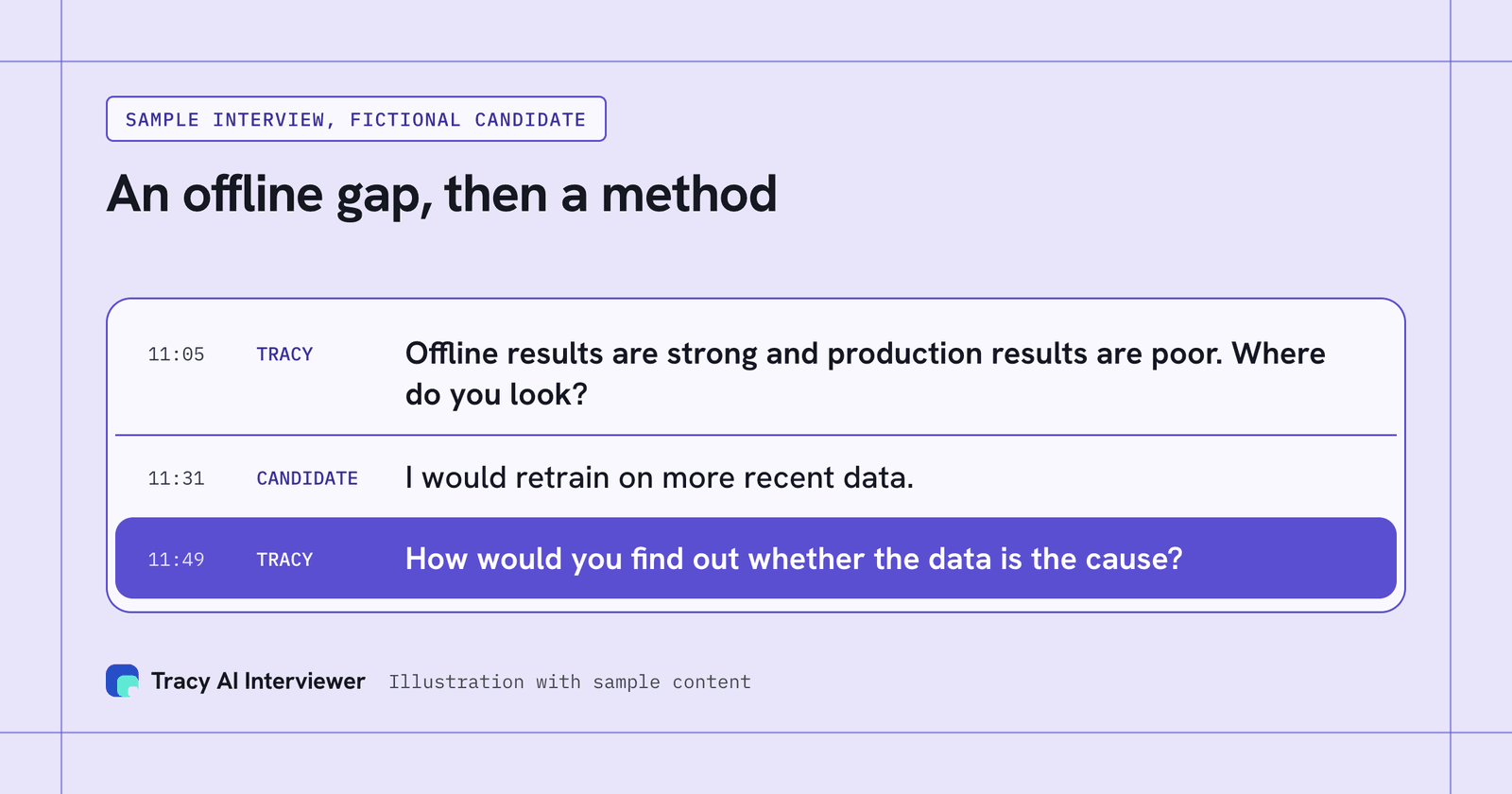
A second question built on the candidate's own answer shows whether they have a method for finding the cause.
What a list of questions cannot do alone
The chain above shows the gap. A list can contain "How would you find out whether the data is the cause?", but that question only exists once the candidate has said they would retrain. It is asked in response to an answer, so it cannot go out as a form. For 400 applicants, a 30-minute call each is 200 hours, which is five working weeks for one person. Tracy asks the second question as each applicant answers the first, and your ML lead reads the chains instead of holding the calls.
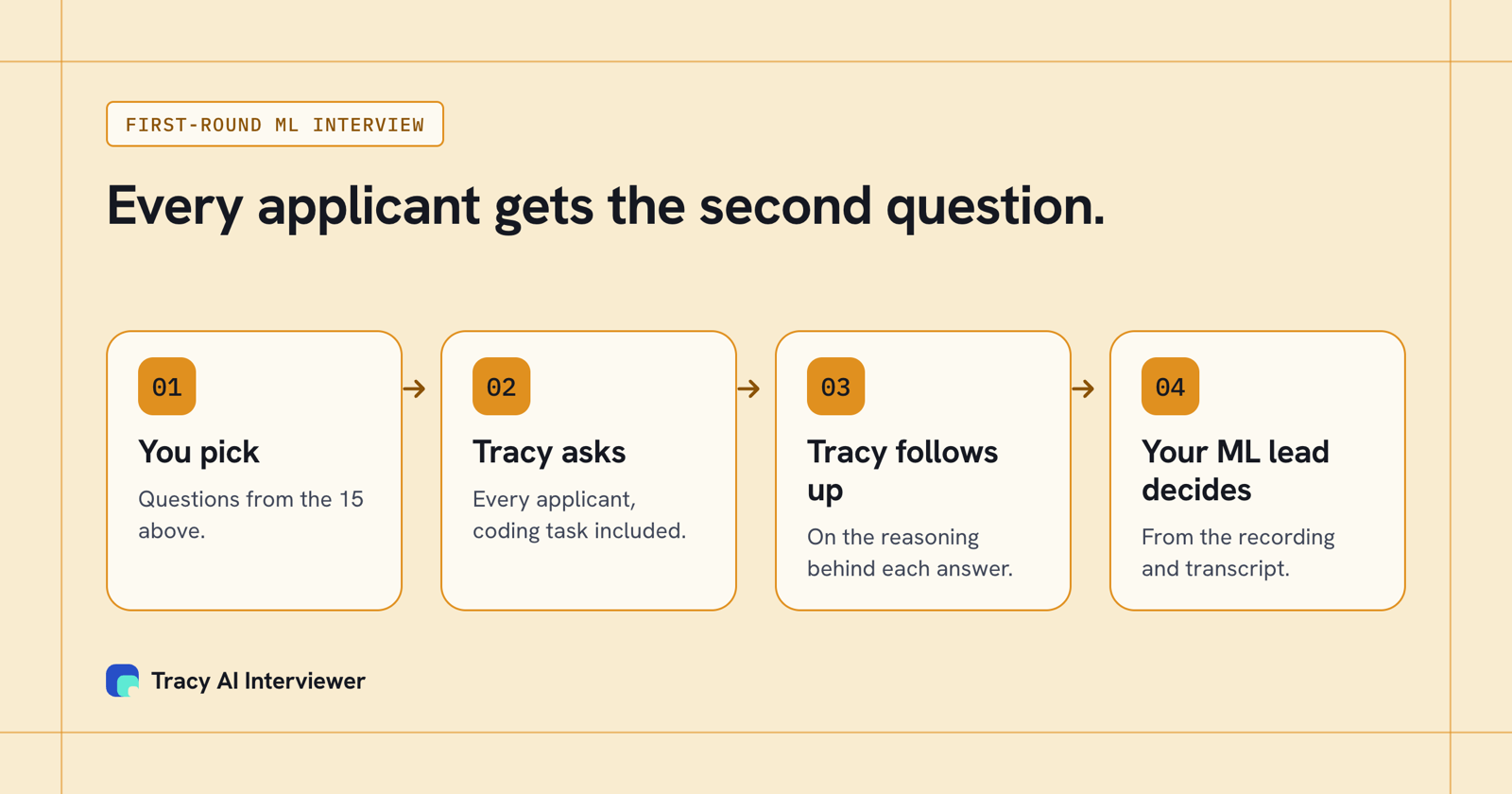
Every applicant gets the same opening question and a follow-up built on their own answer.
What Tracy adds to machine learning engineer interviews
01
Reach every applicant
Each applicant can start on click, at any hour, with no scheduling and no recruiter on the call. A browser link is all they need, with no account or calendar. The join screen states that the conversation is recorded and transcribed; see what the candidate goes through.
02
Ask the next question
Tracy asks in the candidate's own field, follows what they said and waits for the answer. A coding task can be part of the interview, and the follow-ups cover approach and trade-offs. Question 9 works as a short task.
03
Keep the evidence
Each result includes a recording, a timestamped transcript and a written assessment per question with its reasoning, plus what the candidate said to each question and the result fields. See the answers and fields a report holds.
One customer cut its average time to hire from 44 days to 7, and Tracy did the work of 53 full-time recruiters in one month.
Tracy drafts the questions from the role you describe, and you edit them or bring your own; see where the drafts come from. CV check is a setting. The interview also captures integrity signals: tab changes, gaze, face detection, delay before answers, fullscreen exits and external screens. Your ML lead sees the evidence behind each, and a signal is not proof.
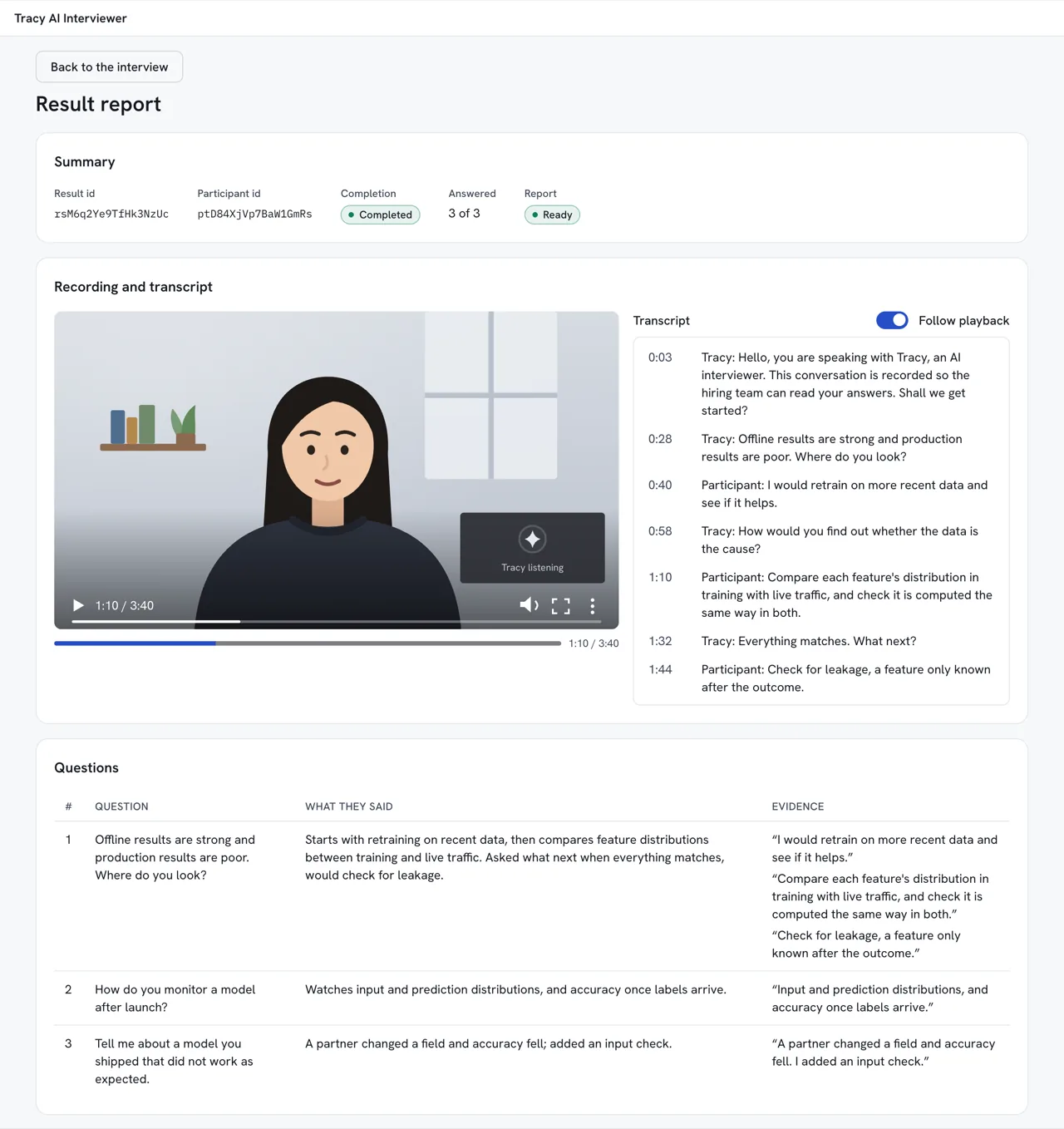
Your ML lead can open the recording and the transcript behind each answer before they decide.
Keep three decisions with your ML lead
- Who moves forward: a senior ML engineer reads the report and decides, working from the candidate's quoted answers.
- Calibration: a second ML engineer reads five transcripts without your lead's notes. If the two reads diverge, revise the questions before the next hundred invitations.
- The modelling round: a real dataset, a take-home or a paper discussion stays with your team.
For two hires a year, a call with your own ML lead is simpler; see when your own lead's call is enough. With hundreds of applicants, volume hiring is where Tracy fits. To try it, put three of these questions into one open ML role and have your ML lead read the first batch of reports. For the data side of the same team, see data engineer interview questions, and for the coding language, Python interview questions.
Common questions
What are good machine learning engineer interview questions and answers?
Can Tracy run a coding task in a machine learning interview?
Does Tracy decide who to hire?
Run these questions on your open ML role
Paste three questions into a Tracy interview and read the first report. The first 3 results are free.
Try it free (opens in a new tab) Book a demo (opens in a new tab)
Your first 3 results are free. No card needed.
Sources
- Tracy AI Interviewer home page, retrieved 14 Nov 2026.
- Tracy AI Interviewer pricing, retrieved 14 Nov 2026.
- Tracy AI Interviewer Connect page, retrieved 14 Nov 2026.