In short
Fifteen React questions, each with a follow-up and what a strong answer sounds like, test rendering, effects, performance, structure and judgment in a first conversation. Tracy AI Interviewer asks them of every applicant, can add a coding task to the same interview and follows up on the approach and its costs. Your engineers read the recordings and decide who gets the hands-on round.
Every React CV lists hooks, state management and performance. A CV says hooks. The follow-up shows whether the developer has ever opened the profiler before reaching for memoisation, or wraps everything in it. Under each question sits a follow-up that asks for the reasoning behind the habit.
The questions are for engineering managers and recruiters hiring mid-level and senior React developers, and fit a first conversation lasting 20 to 30 minutes. Pairing or live coding belongs later, with your own engineers. Candidates can use the follow-ups as practice; a developer with ten years of experience should answer each with a case from real work.
Tracy AI Interviewer takes that first conversation with every applicant. For neighbouring roles, see frontend developer interview questions and system design interview questions, and for the wider process, technical interviews.
What makes a good React interview question?
A good React question asks for a case from real work and has a follow-up beside it. A written list does that well: every applicant gets the same questions, and the Listen for column says what a strong answer sounds like before anyone joins.
The list cannot ask what to do next. That depends on what the developer just said, and it is the part Tracy takes over.
Fifteen React interview questions, grouped by what they test
One question from each group will do for a first pass; open with the same ones for everyone. Save each follow-up for after the first answer, and write down what a strong answer sounds like first.
Group 1: rendering and state
1. A component re-renders more often than you expect. How do you find out why?
- Follow up with
- What would you check before reaching for memoisation?
- Listen for
- Uses the profiler, finds what changed (props, state, context or the parent) and fixes the cause. Memoisation comes late.
2. Where should a piece of state live: in the component, lifted up, in context or in a store?
- Follow up with
- Pick a case from your last project.
- Listen for
- As close to its use as possible, lifted when siblings need it, context for rarely changing values. Asks how often it changes.
3. What is derived state, and why do people get it wrong?
- Follow up with
- How do you fix a component that copies props into state?
- Listen for
- Computes from props and state during render because a copy goes stale. Uses a key to reset when identity changes.
Group 2: effects and data
4. When do you use an effect, and when not?
- Follow up with
- What bug does a missing dependency cause?
- Listen for
- Effects sync with something outside React. Not for values computed during render or for responding to a click. Knows stale closures and cleanup.
5. A search list shows stale results when the user types fast. What is going on?
- Follow up with
- How would you fix it?
- Listen for
- Requests return out of order. Cancels the old request or ignores any response that is not the latest.
6. How do you load and cache server data?
- Follow up with
- When would you not use a data library?
- Listen for
- Server state differs from interface state: caching, retries, invalidation. A small app may not need a library.
Group 3: performance
7. A page gets slow after a long list is added. Where do you start?
- Follow up with
- What would you do for ten thousand rows?
- Listen for
- Measures first. Virtualises long lists, uses stable keys, avoids creating work in render, and checks network and bundle too.
8. When do useMemo and useCallback help, and when are they noise?
- Follow up with
- How do you tell in a real app?
- Listen for
- Helps when a memoised child depends on the value or the computation is costly. Otherwise adds cost. Measures.
9. How do you keep a bundle small as the app grows?
- Follow up with
- What do you split first?
- Listen for
- Route-level splitting and lazy loading, a dependency audit, a bundle analyser. Does not split before measuring.
Group 4: structure and testing
10. How do you structure a large React app so a new person can find things?
- Follow up with
- What breaks first as the team grows?
- Listen for
- Folders by feature, clear lines between interface, data and logic, shared components with owners, conventions written in the repo.
11. What do you test in a component, and what do you leave out?
- Follow up with
- Show me a test you would delete.
- Listen for
- Behaviour as the user sees it after an action, mocks at the network edge. Avoids tests of implementation details and snapshot-only tests.
12. How do you handle errors in a React app?
- Follow up with
- What does the user see when one widget fails?
- Listen for
- Error boundaries, loading and empty states, reporting. One failing widget does not blank the page.
Group 5: judgment and experience
13. Tell me about a hard bug you fixed in a React app.
- Follow up with
- How did you know it was fixed for good?
- Listen for
- A real bug, how they reproduced it, the root cause, and a test or guard they added.
14. What have you changed your mind about in React over the years?
- Follow up with
- What do you still do the old way, and why?
- Listen for
- A specific shift, such as classes to hooks or global stores to server-state libraries, with reasons from their own work.
15. How do you build a custom dropdown so it is accessible?
- Follow up with
- What would a keyboard user hit first?
- Listen for
- Prefers a native element or an established headless library. Focus handling, roles, arrow keys. Tests with a keyboard and a screen reader.
What a developer who has debugged this says
The pairs below are written for questions 1, 4 and 13. They are not quotes from real candidates.
Table 6: Weak and strong React answers to questions 1, 4 and 13.
| Weak answer | Strong answer | |
|---|---|---|
| Question 1, the extra renders | "I would wrap it in React.memo." | "I would open the profiler and see why it rendered: the parent, state, props or context. Often the parent creates a new object on every render. Memo comes last." |
| Question 4, effects | "useEffect runs when the component loads, so I use it for anything that needs to run." | "For syncing with something outside React, such as a subscription, a timer or a fetch with cleanup. Not for values I can compute during render." |
| Question 13, the hard bug | "I cannot think of a specific one." | "A form lost input after the parent re-rendered with a changed key. I logged mounts to find it, fixed the key and added a test that types, re-renders and checks the value." |
A stale search list, followed up until the fix is proven
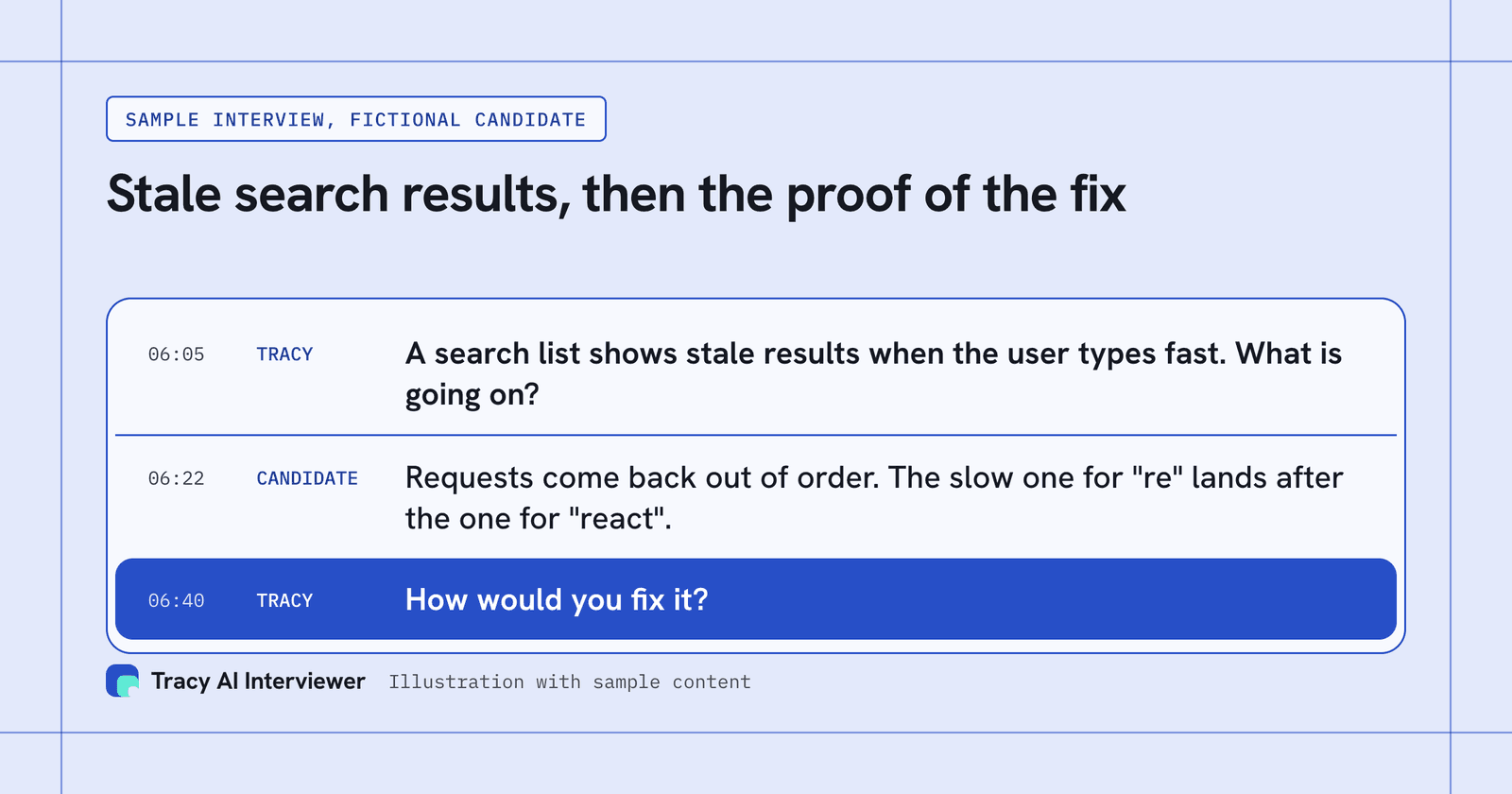
The candidate here is made up, as is every line. The chain starts at question 5 and each follow-up picks up from the previous answer.
Tracy: A search list shows stale results when the user types fast. What is going on?
Candidate (fictional): Requests come back out of order. The slow one for "re" lands after the one for "react".
Tracy: How would you fix it?
Candidate: Cancel the old request when a new one starts, or ignore any response that is not the latest.
Tracy: How would you prove the fix works?
Candidate: A test with two requests where the first resolves last, and check the screen shows the second.
The last question separates a candidate who proves a fix from one who trusts it.
The follow-up shows whether the candidate proves a fix.
What Tracy adds to React screening
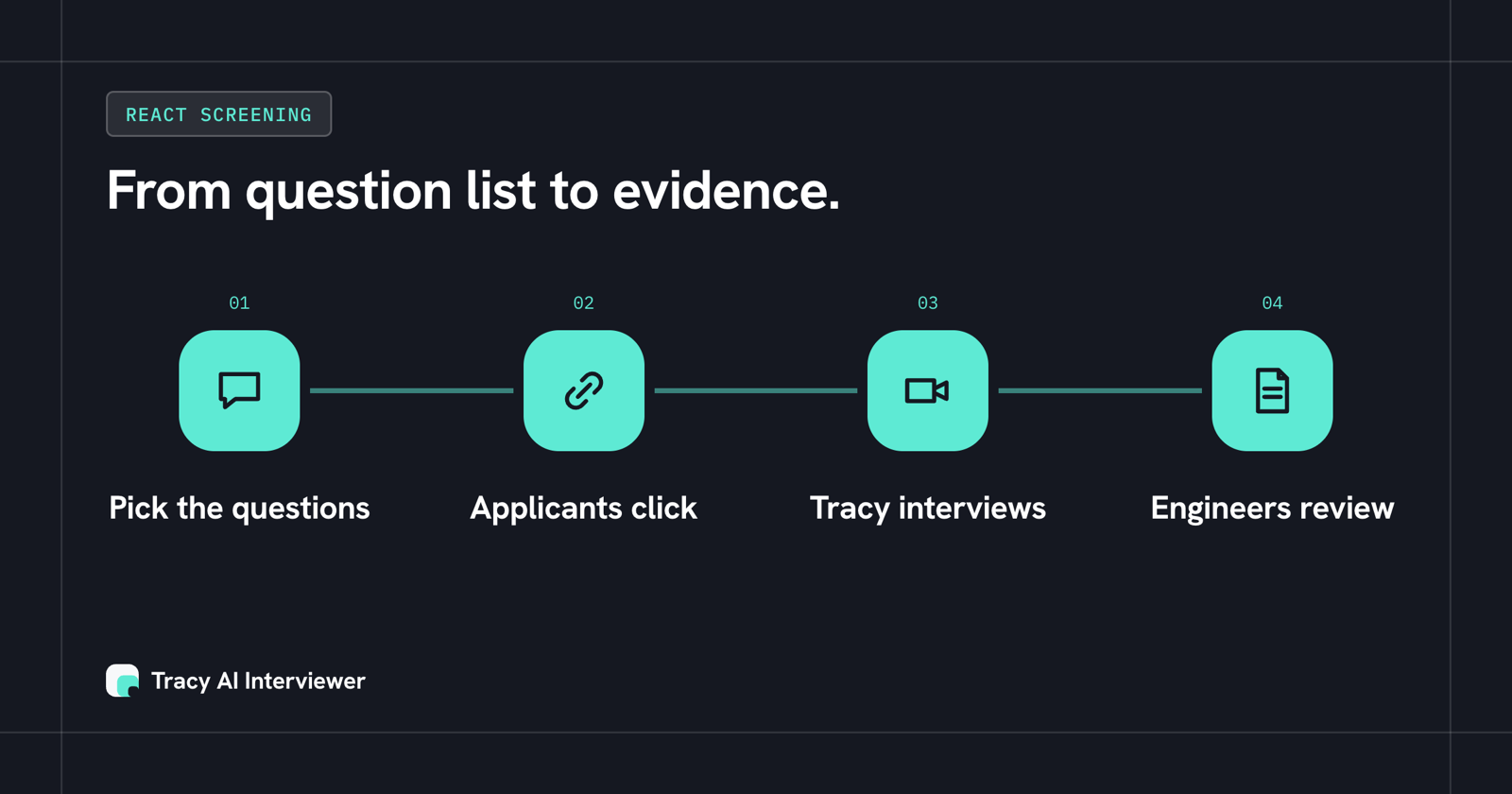
01
Reach every applicant
Each applicant can start on click, at any hour, with no scheduling and no recruiter on the call. Developers join when it suits them, and nobody waits for a calendar slot.
02
Ask the next question
Tracy asks in the person's own field, follows what they said, and waits for the answer. "Requests come back out of order" is followed by how the fix would be proved.
03
Keep the evidence
Every result includes a recording, a timestamped transcript, and a written assessment per question with its reasoning. An engineer can check the profiler answer and the fix before the live round.
From question list to evidence.
What a hundred first calls cost your team
At 20 to 30 minutes a conversation, a hundred React applicants is 33 to 50 hours of live calls.
- Want a coding task beside the spoken questions? Tracy's follow-ups cover the approach and the trade-offs, and your engineers read the answers.
- Tracy turns your job description into draft questions, and you edit them. See the product page.
- Applicants need a browser and a link, not an account or a calendar slot. The join screen says up front that it is recorded and transcribed; see the applicant view.
- Each result carries the recording, the transcript and an ATS note, so a manager can check the profiler answer and the fix. Sample report.
- In a video interview your reviewer sees face detection, tab changes, gaze, external screens, delay before answers and fullscreen exits, with the evidence for each. Read how those signals are reviewed before treating one as meaningful.
Candidates rate the Tracy interview experience 92 on NPS. A credit is $1 and pays for 20 minutes of interview, counted per started block once a result exists, so a 25-minute interview uses two. Your first three results are free and need no card, and engineers who read reports need no seats. See pricing.
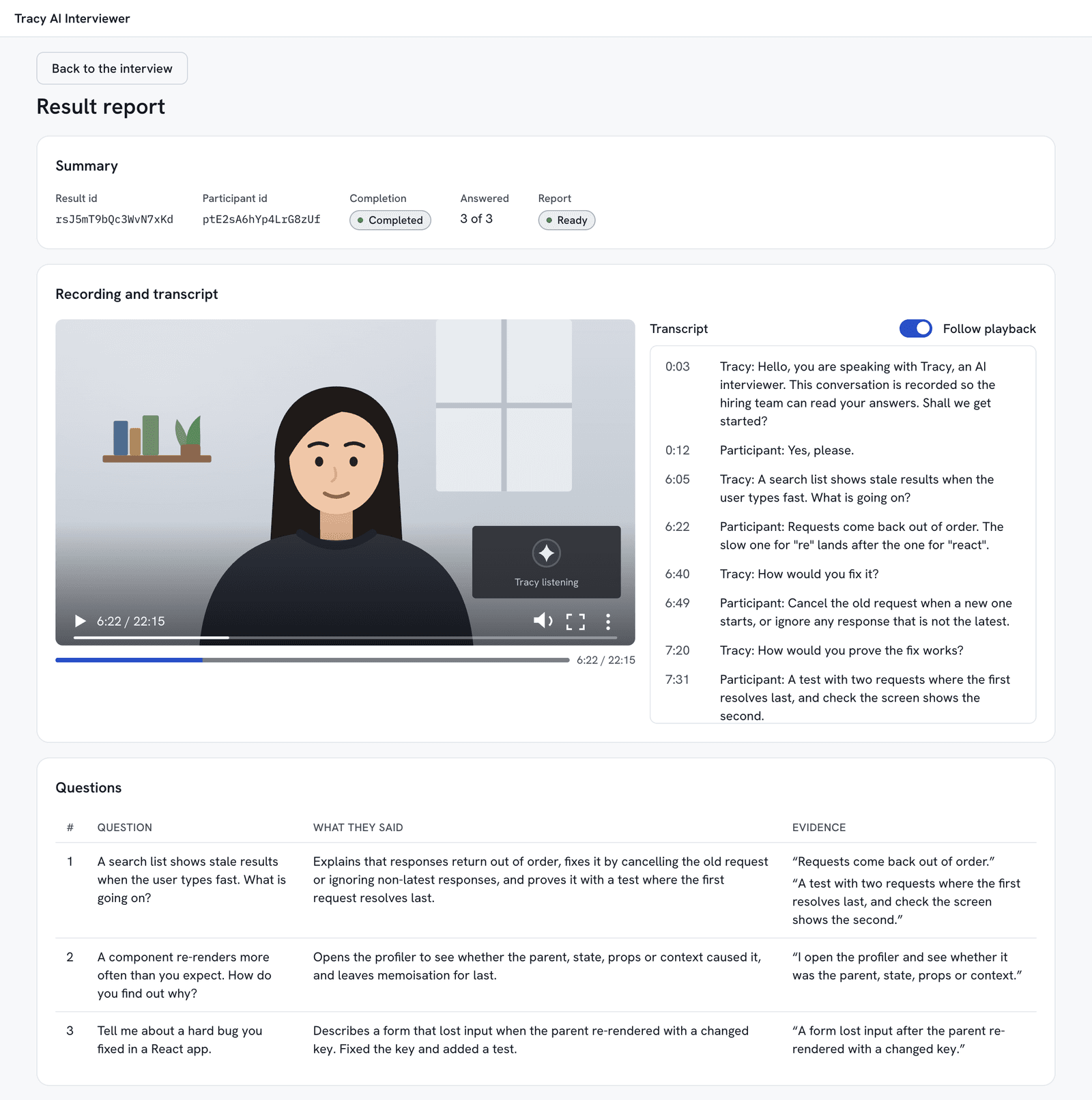
Your engineer reads each React answer and opens the recording and transcript behind it.
Three decisions your engineers keep
- The engineering manager reads each report and decides who gets the hands-on round.
- Calibrate: ask one senior developer to read five transcripts cold. If the transcripts tell a different story from the report, reword those questions before the next hundred applicants.
- The hands-on round: pairing, a take-home or a code review stays with your team. See coding interview follow-up questions for what to ask there.
For three hires, a quick call with your lead developer is the simple route (compare AI interview vs human interview first). A hundred applicants need AI technical interviews instead. For the backend side of a full-stack opening, see system design interview questions.
Common questions
What are good React interview questions?
What React interview questions suit experienced developers?
What React interview questions suit a developer with 10 years of experience?
How should I prepare for React interview questions?
Can Tracy run a coding task for React candidates?
Does Tracy pick the React developers who move forward?
Send one link to every React applicant
Add the React questions you picked, send one link and read the recordings and reports as they arrive. The first 3 results are free.
Try it free (opens in a new tab) Book a demo (opens in a new tab)
Your first 3 results are free. No card needed.
Sources
- Tracy AI Interviewer home page, retrieved 14 Nov 2026.
- Tracy AI Interviewer pricing, retrieved 14 Nov 2026.
- Tracy AI Interviewer Connect page, retrieved 14 Nov 2026.