
TLDR Tracy AI Interviewer runs a first-round design conversation scored on these criteria: she asks the design questions, follows up on each answer and scores on the skills and weights you set.
Every result keeps a recording, a timestamped transcript and a written assessment per question, and a person decides.
Below: five weighted criteria with 1, 3 and 5 anchors, a follow-up per row and a filled example.
Next step: send us one role and we build the interview plan.
We make Tracy AI Interviewer.
Two interviewers watch the same recorded design session and score it a 2 and a 4. One liked the diagram. The other noticed the candidate never asked how many users the system would have. A system design interview rubric stops that argument before it starts, because it writes down what each score means before anyone is interviewed. This one has five criteria, weights you can change, and anchors for a weak, solid and strong answer.
Use it as it is for a mid-level or senior backend role, or change the wording to fit your stack. It works for a live round with an engineer and as the scoring sheet behind a recorded interview. Further down, we show how Tracy AI Interviewer runs the first round from the same rubric, so your engineers spend their time on the candidates who clear it.
The system design interview rubric: five criteria, scored 1 to 5
Score each row on its own, then combine the five with the weights. A 2 sits between the 1 and 3 descriptions and a 4 between the 3 and 5. The follow-up in the last column is what you ask when the first answer is thin.
| Criterion (weight) | 1: weak | 3: solid | 5: strong | Follow-up to ask |
|---|---|---|---|---|
| Requirements and scope (15%) | Starts drawing at once and assumes the problem. | Asks about users, scale and the main use, and says what is out of scope. | Turns vague answers into numbers and says which requirement drives the design. | Which of those numbers would change your design the most? |
| Core design (20%) | Boxes with no flow. Cannot say what each part does. | Clear components and a clear request path, with sensible interfaces between them. | The simplest design that meets the requirements. Every part earns its place, and one request can be walked end to end. | Walk one request from the client to the data and back. |
| Data and storage (20%) | Names a database with no reason. | Picks a store for the access pattern and knows the main key or table. | Models the data around reads and writes, and covers consistency, retention and growth. | What is the key, and which read does it make slow? |
| Scale and failure (25%) | Adds caches and replicas by reflex. | Finds the likely bottleneck and says what breaks first. | Estimates the load, tests the design against a failure and says how they would know it failed. | Take the busiest part down. What does the user see? |
| Trade-offs and communication (20%) | Offers one option with no costs, and is hard to follow. | Compares two options, picks one with a reason and stays organised. | Names what the choice costs and what they would revisit with more time, and adjusts when you push back. | What would make you change this choice? |
The weights are a default. For a platform role, raise scale and failure. For a role that works mostly with data, raise data and storage. Fix the weights before the first interview and do not move them after you have seen candidates.
How to score without letting the diagram decide
A design interview invites a vivid impression. These habits keep the score tied to what was said.
- Score each criterion before you total. Do the five rows first and the overall score last.
- Write one piece of evidence per score. A short quote or the moment it happened. A score with no evidence is a feeling.
- Give everyone the same opening prompt for the role, and let the follow-ups differ with the answers.
- Do not score handwriting, tidiness or the tool. Score the reasoning.
- Move the bar with the level, not the rubric. A mid-level candidate who scores 3 on every row is a reasonable pass. For a senior role, ask for 4 or more on scale and failure and on trade-offs. That is a starting point, so set your own from your last few hires.
- Talk after everyone has scored. If two scores on the same row differ by two points or more, replay the evidence and decide which reading the evidence supports.
The same discipline applies to any role. Our how to screen candidates guide covers the first-round decisions around it.
A filled example: a short-link service
The prompt: design a service that creates short links and redirects people who open them. The candidate is fictional and the evidence is written for this page.
| Criterion | Weight | Score | Evidence |
|---|---|---|---|
| Requirements and scope | 15% | 4 | Asked for the read-to-write ratio and how long links live before drawing anything. Did not ask about abuse. |
| Core design | 20% | 4 | Separate API, key service and store. Walked a redirect from the browser to the store and back. |
| Data and storage | 20% | 3 | Chose a key-value store because "it scales". Could not say what a lookup costs when the table grows. |
| Scale and failure | 25% | 4 | Estimated 10,000 redirects a second, named the cache as the first bottleneck and said what happens on a burst of cache misses. |
| Trade-offs and communication | 20% | 3 | Compared random and sequential keys and chose random. Named the cost only when asked, and rushed the last ten minutes. |
The weighted score is 0.15 x 4 + 0.20 x 4 + 0.20 x 3 + 0.25 x 4 + 0.20 x 3 = 3.6. For a mid-level role that clears the bar. The two 3s say where to spend the next round: ask about the cost of a lookup at scale, and ask the candidate to argue for the option they did not choose.
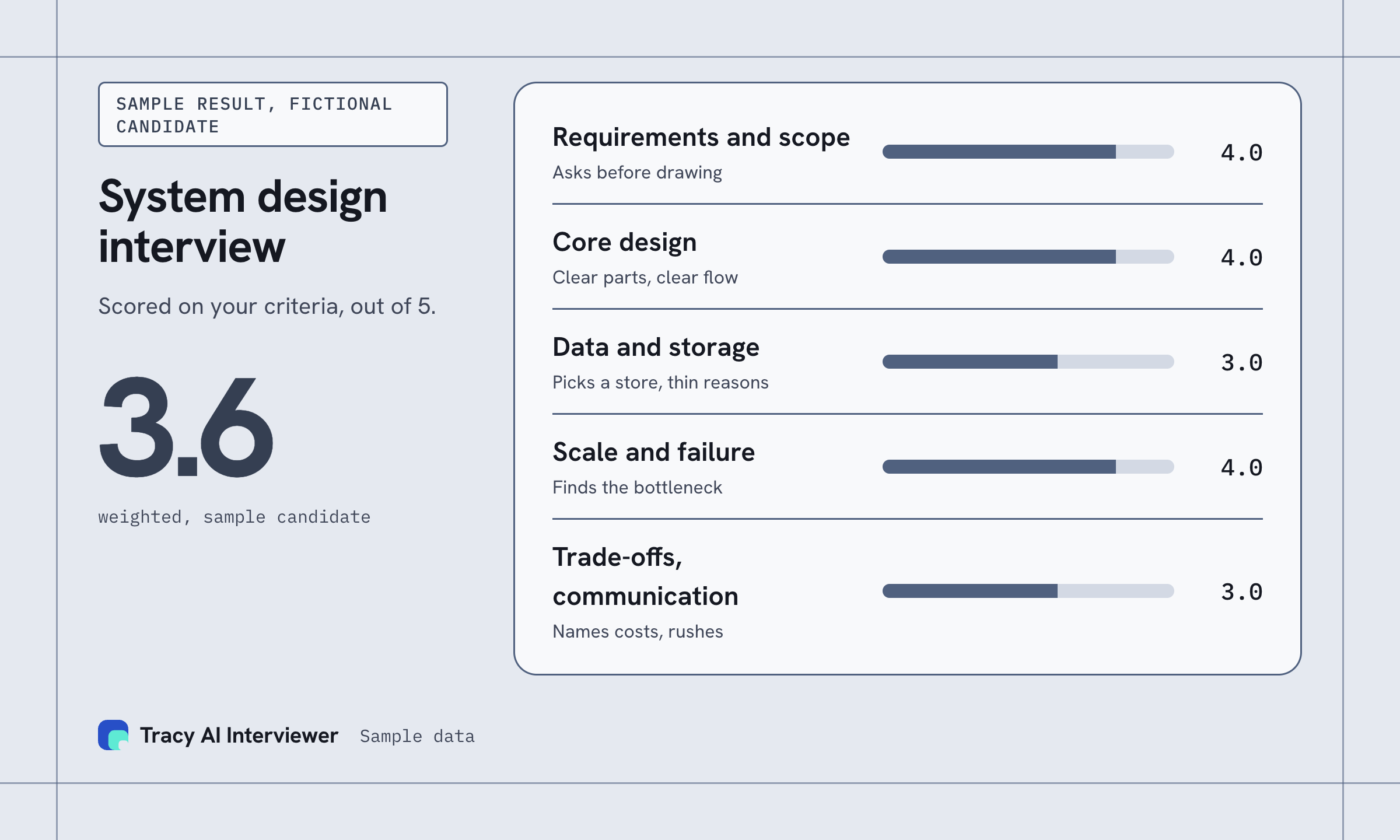
Five scores on your criteria become one weighted result a hiring lead can compare across candidates.
Five prompts to use with the rubric
Pick one prompt per interview and give every candidate for the role the same one. Each has a follow-up that checks the data and failure rows, the two where thin answers hide longest.
- Design a service that shortens links and redirects visitors. Follow-up: what happens when one link gets a million visits in a minute?
- Design a rate limiter for a public API. Follow-up: where do the counters live, and what happens when that store is slow?
- Design a notification system for email and mobile push. Follow-up: what if the same event fires twice?
- Design a feed of the latest items for ten million users. Follow-up: when does one write turn into many?
- Design file upload and processing for large files. Follow-up: what happens when the processing step fails halfway?
For coding and debugging questions that sit beside this round, see our software engineer interview questions.
Run the first round with Tracy from this rubric
A person writes the rubric once. Tracy applies it to every applicant.
- Set up from the job description. Paste the description for the role and Tracy generates the questions from it. Edit them or bring your own, and choose a style from quick to deep, technical to behavioural.
- Score on your criteria. You set the skills and their weights for the role. Put the five rows above in as the skills and the weights as they are.
- Follow-ups that depend on the answer. Tracy asks in the candidate's own field, follows up on what they just said and waits for the end of the thought. That is what the rubric's last column does for a human interviewer. Roy Junyoung Jang, Director, Residency & Investment at Antler Korea, said: "Tracy sometimes brings up exactly those questions I might have forgotten to ask, which has been a pleasant surprise."
- Evidence per result. Your team gets a recording of both sides, a timestamped transcript and a written assessment for each question with its reasoning, so a second engineer can check a score without sitting through the whole interview.
A person decides. Tracy runs a first-round design conversation, a two-way video interview on one prompt, scored on your criteria. The deep design round stays with your engineers, and it goes to the candidates who showed their reasoning. Our guide to AI technical interviews covers where the line sits, and how AI interview reports work shows what a reviewer reads.
Cost is $1 per credit, one credit for each started 20 minutes of an interview that produced a result. A 34-minute design interview takes two credits, which is $2. The first 3 results are free with no card, there are no seats and no upfront cost. See pricing. To see the rubric applied, set up one design role and run it as a Tracy interview.
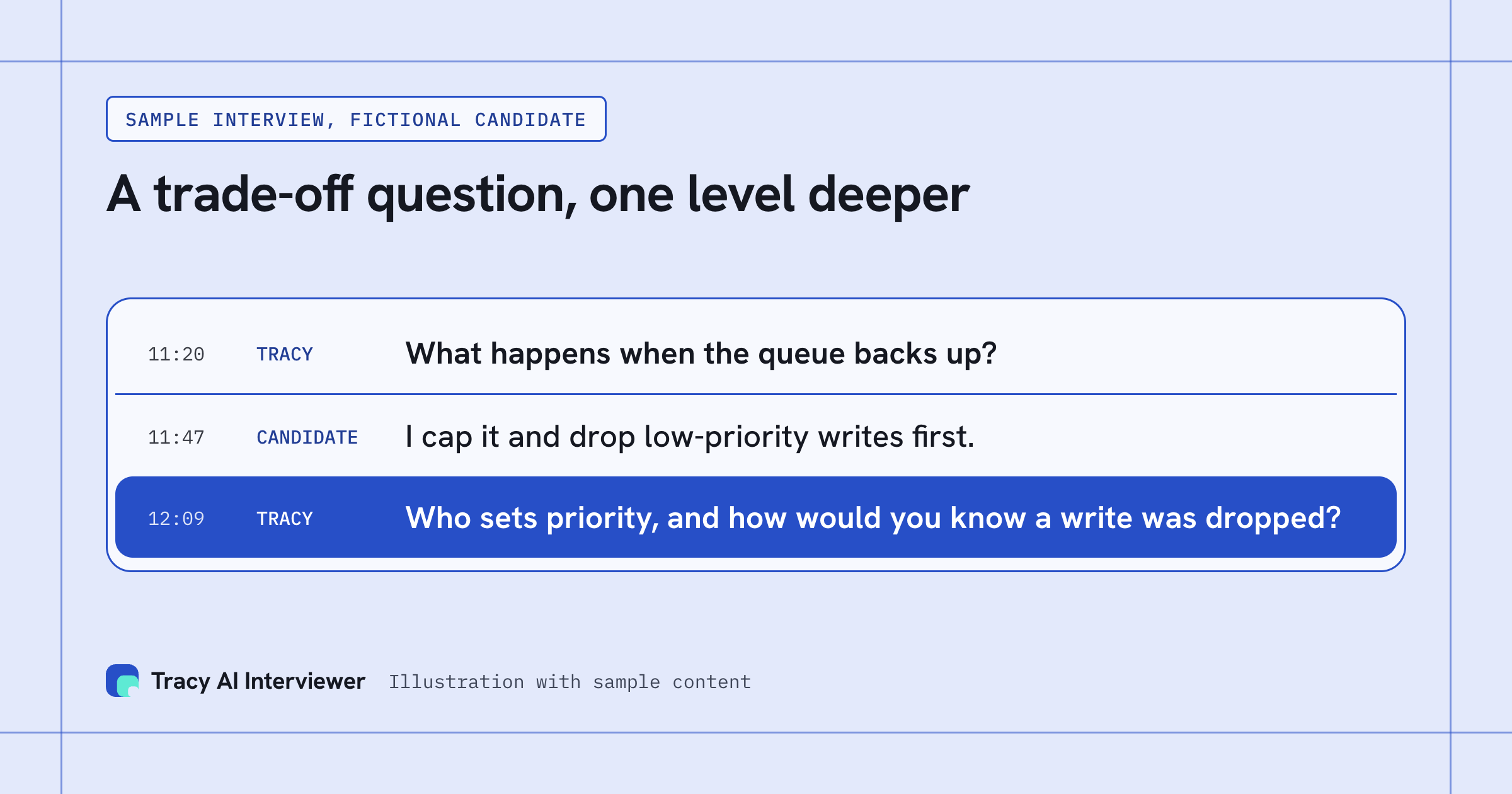
A follow-up built from the candidate's own answer shows whether they understood the trade-off or only named it.
Which path fits you
- Hiring engineers for a company: start with technical interviews.
- Many applicants for the same engineering role: see volume hiring.
- Approving engineers as experts for AI projects: see expert vetting.
Questions
What is a system design interview rubric?
How do you score a system design interview?
What should system design interview evaluation criteria include?
Which system design interview questions work with this rubric?
Can an AI interviewer run a system design first round?
Can I change the weights?
Copy the template, then run it as a Tracy interview. Send us one role and we will build the interview plan from it in days, with a recording and report you can check. Try it free · Book a demo
Sources
- Tracy AI Interviewer home page, customer quotes, retrieved 9 Nov 2026.
- Tracy AI Interviewer pricing, retrieved 5 Nov 2026.
- Tracy AI Interviewer Connect page, retrieved 5 Nov 2026.