In short
Tracy AI Interviewer can run a coding task inside the interview and follow up on the pipeline decisions behind it, so you hear how a data engineer handles a failed load, not only which tools are on the CV. Below are 15 data engineer interview questions, each with a follow-up and what a strong answer contains. Start with question 1: "A nightly job failed halfway and half the tables loaded. What do you do?" Each result keeps a recording and a timestamped transcript, with a written assessment per question; your data lead decides.
Say a data engineer role draws 180 applications. Every CV lists Spark, Airflow and a warehouse. The CV cannot tell you who has rerun a half-failed load without doubling the rows. Good data engineer interview questions ask what the candidate did when a job died at 3 a.m.
These 15 questions are for hiring managers, data leads and recruiters, and a candidate can read each follow-up as the second question they will be asked. Use them for a first technical conversation of 20 to 30 minutes; a pairing session on your own stack comes later.
Tracy AI Interviewer can run that first conversation with each applicant. For this role she starts from a question on your list, such as the half-failed load, waits for the full answer and then asks about something in it, for example how the rerun avoids duplicate rows. For the wider process, see how technical interviews run in Tracy. For the SQL side of the role, see SQL interview questions.
What should a data engineer interview test?
It should test how the candidate keeps data correct when things fail: reruns, late records, schema changes and slow queries. Tools and syntax come second.
Fifteen data engineer interview questions, grouped by what they test
Choose one or two questions per group. Keep the follow-up back until the first answer is in, and settle what a strong answer contains before the first candidate joins.
Group 1: Pipelines and failure
1. A nightly job failed halfway and half the tables loaded. What do you do?
- Follow up with
- What stops the rerun from loading the same rows twice?
- Listen for
- Idempotent loads: overwrite a partition or merge on a key. Checks before anything is published.
2. How do you handle a source that sends records late or twice?
- Follow up with
- Where do you set the cutoff, and who agrees it?
- Listen for
- Event time against arrival time, a lookback window, dedup on a key. The business owner agrees the cutoff.
3. How do you know on Monday morning that your pipelines are healthy?
- Follow up with
- What would you alert on that you do not alert on today?
- Listen for
- Freshness, row counts, volume swings. Not only "the job succeeded".
Group 2: Modelling and storage
4. How would you model orders, customers and refunds for analysts?
- Follow up with
- What changes when a customer changes address?
- Listen for
- States the grain first. Facts and dimensions, history for changing attributes, a reason for wide or normalised.
5. When do you keep data in a warehouse, and when in files on object storage?
- Follow up with
- What does your choice make harder?
- Listen for
- Query pattern, cost, governance, schema change. Names a cost without prompting.
6. A table has 2 billion rows and most queries filter by date. How do you lay it out?
- Follow up with
- What goes wrong when most queries filter by customer instead?
- Listen for
- Partition by date, cluster or sort on a second key. Skew, and partitions that are too small.
Group 3: Batch and streaming
7. When would you choose streaming over a nightly batch?
- Follow up with
- What would that cost your team to run?
- Listen for
- A latency need a user actually has. On-call load, replay, at-least-once delivery.
8. A stream consumer falls hours behind. What do you look at?
- Follow up with
- How do you catch up without corrupting the downstream table?
- Listen for
- Lag per partition, skew, a slow sink. Replays that are safe to repeat.
9. An upstream team changes a column type. How do you find out, and what then?
- Follow up with
- How would you hear before it breaks you?
- Listen for
- Data contracts, compatible changes, schema drift alerts, a conversation with the owner.
Group 4: SQL and scale
10. A report query is ten times slower than last month. What do you check?
- Follow up with
- What if the query plan has not changed?
- Listen for
- Plan, data growth, skew, concurrent load. Measures before changing anything.
11. How do you find duplicate rows and decide which to keep?
- Follow up with
- What if the duplicates differ in one column?
- Listen for
- Group by key, rank with a window, choose by timestamp or source. Asks what the differing column means.
12. How do you backfill two years of history without hurting today's jobs?
- Follow up with
- How do you check the backfill matches the old numbers?
- Listen for
- Chunk by partition, separate resources, a staging table. Reconciles totals.
Group 5: Quality and ownership
13. Tell me about a data problem users found before you did.
- Follow up with
- What did you change so it does not repeat?
- Listen for
- A real case, who found it, and the check they added.
14. How do you decide which tests a pipeline needs?
- Follow up with
- Which test has caught the most for you?
- Listen for
- Not null, unique, accepted values, freshness, volume. Chooses by the cost of a failure.
15. An analyst asks for a column you think is a bad idea. What do you do?
- Follow up with
- When would you say no?
- Listen for
- Asks what it is for, offers an alternative, documents the choice. A reason when they refuse.
Weak and strong answers to the same questions
Here are three of the questions answered two ways.
Table 6: Weak and strong answers to the same questions, written as examples.
| Weak answer | Strong answer | |
|---|---|---|
| Question 1, the half-failed load | "I'd rerun the job." | "Only after I know the load is safe to repeat. I write each run to a staging partition and swap it in at the end, so a rerun overwrites instead of appending." |
| Question 10, the slow query | "I'd add an index." | "I'd read the plan first. If the data grew, partitioning may help. If nothing changed, I'd look at skew and what else is running." |
| Question 13, the problem users found | "Our checks are good, it does not happen." | "A finance user spotted a gap in daily revenue. A source had changed its time zone. I added a freshness and a row-count check on that table." |
A follow-up chain on the half-failed load
The chain below is an illustration with sample data, not a real interview, and the candidate is fictional. It shows an opening question from your list, the answer, and a follow-up built on it, starting from question 1.
Tracy: A nightly job failed halfway and half the tables loaded. What do you do? Candidate (fictional): I find the cause, fix it and rerun the job. Tracy: What stops the rerun from loading the same rows twice? Candidate: Each run writes to a staging partition for its run date. At the end I swap the partition in, so a rerun replaces it. Tracy: What happens if two runs for the same date overlap? Candidate: The second one should fail on a lock for that run date, not write over the first.
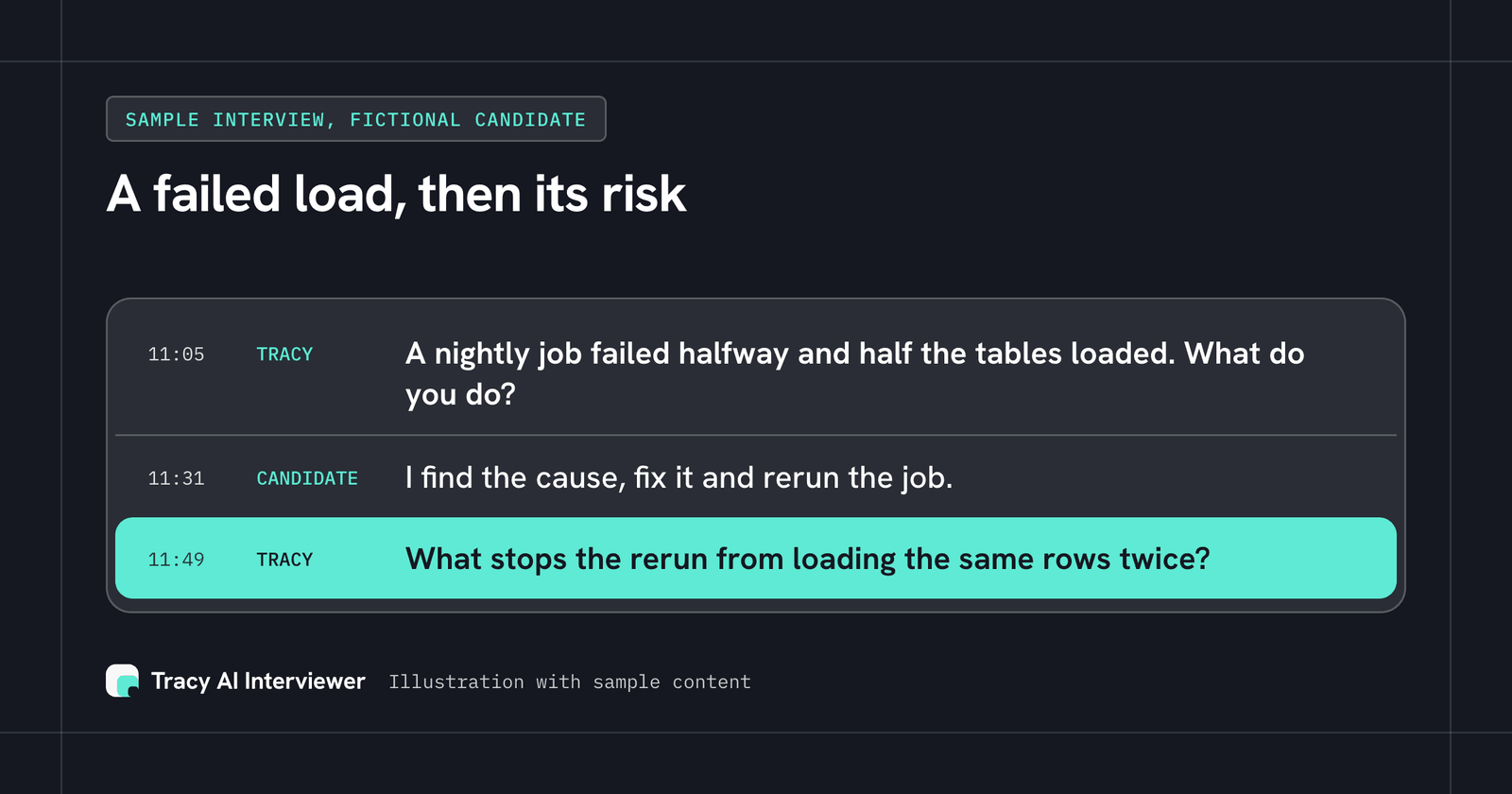
A second question built on the candidate's own answer shows whether the load is safe to repeat by design.
Run the data engineer interview for every applicant
When a role draws hundreds of applications, a live call for each one is hard to fit.
- The interview can include a coding task, and Tracy follows up on approach and trade-offs. See how Tracy runs a technical interview.
- Questions come from your list or from a draft: describe the role, and Tracy drafts questions from the job description for you to edit. See how the questions get drafted.
- A candidate needs only a browser link: no account, no calendar slot, any hour. The join screen tells them the conversation is recorded and transcribed. See what the candidate sees.
- Every result holds a recording, a timestamped transcript, what the candidate said to each question and the result fields. See what a result contains.
- Integrity signals cover tab changes, gaze, face detection, delay before answers, fullscreen exits and external screens. A person sees the evidence; a signal is not proof.
There are no seats. $1 buys a credit, and a credit covers each started 20 minutes of an interview that produced a result. The first 3 results are free with no card. See pricing.
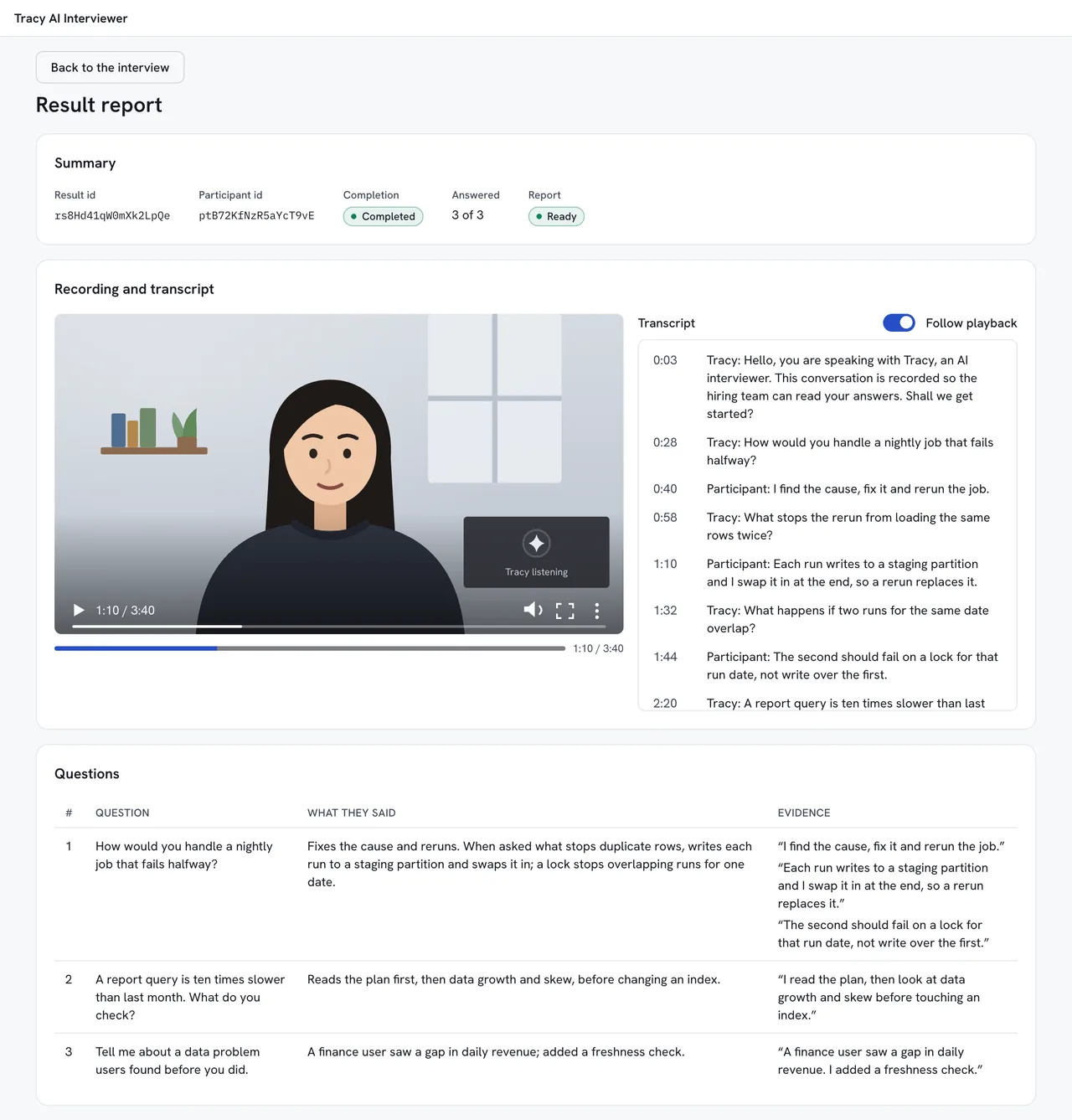
Your data lead can read what the candidate said to each question and open the recording and transcript behind it.
Keep three decisions with your team
- Who moves forward: your data lead reads each report and makes the call. What Tracy supplies is what the candidate said, with quotes.
- Calibration: ask a senior data engineer to read five transcripts without seeing your lead's notes. If their conclusions differ, rewrite the questions before you invite the next hundred.
- The hands-on round: a real pipeline on your stack, with your data model, stays with your team.
For three hires a year, a call with a senior engineer is simpler; see when a human interview is the better fit. Tracy earns its place when applicants outnumber your team's hours, as in volume hiring. To try it, put three of these questions into one open data engineer role and have your data lead read the first batch of reports. Python is the other common screen for this role: see Python interview questions.
Common questions
What are good data engineer interview questions and answers?
What data engineer interview questions suit an experienced candidate?
Can Tracy run a coding task in the interview?
Does Tracy decide who to hire?
Create an interview for this role
Create an interview for this exact role and read the report. The first 3 results are free.
Try it free (opens in a new tab) Book a demo (opens in a new tab)
Your first 3 results are free. No card needed.
Sources
- Tracy AI Interviewer home page, retrieved 14 Nov 2026.
- Tracy AI Interviewer pricing, retrieved 14 Nov 2026.
- Tracy AI Interviewer Connect page, retrieved 14 Nov 2026.