In short
These subject matter expert interview questions separate depth from polish: each of the 15 has a follow-up that asks for the case behind the answer. Tracy AI Interviewer asks them of every expert in their own specialty, picks up what each person said, and returns the recording, a timestamped transcript and the integrity signals for a person to review. Your reviewers decide.
What good subject matter expert interview questions do
Say a project needs 300 experts by Friday. Every applicant calls themselves a subject matter expert, and every CV lists the right years and employers. The CV cannot tell you who answers "where does that rule stop working?" from experience and who answers it from a search. A polished first answer costs an expert nothing, so each question below carries a follow-up that asks for the case behind it.
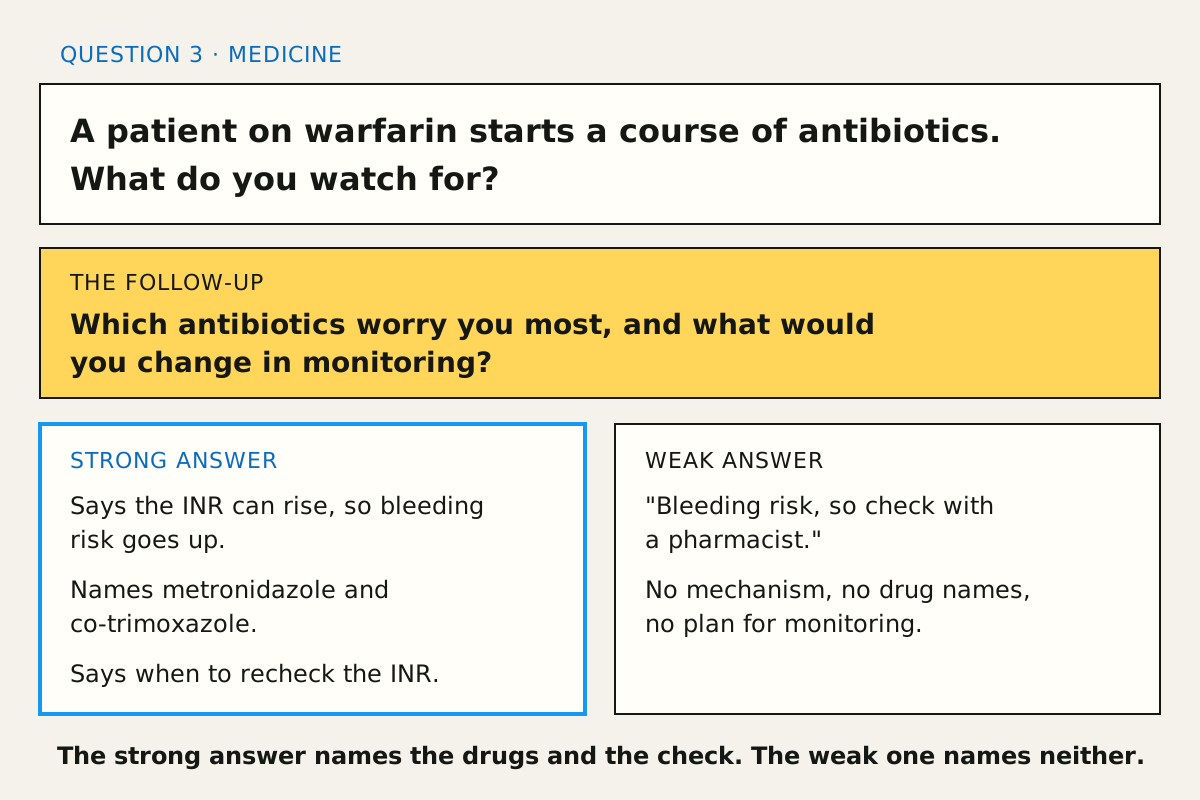
The page is for platform leads and expert-supply teams who approve experts for AI training and review work. The questions are domain-neutral, so swap in examples from your field, or start from the versions for finance experts, legal experts and medical experts. Experts can use the follow-ups to prepare. The questions test reasoning in the specialty; qualifications are checked separately, at their source.
Tracy AI Interviewer asks that follow-up of every expert in the pool, and your reviewers judge what comes back. For the wider process, see expert vetting.
Fifteen subject matter expert interview questions, grouped by what they test
Ask one or two per group, opening every expert with the same questions. Ask each follow-up once the first answer lands, and settle what good sounds like before anyone joins.
Group 1: depth in the specialty
1. Explain your specialty to someone one step outside it, then to a peer.
- Follow up with
- What did you drop for the first audience?
- Listen for
- Two clearly different levels. Precise with the peer, no jargon for the outsider, and knows what is essential.
2. What do most people in your field get wrong?
- Follow up with
- Where did you get it wrong yourself?
- Listen for
- A specific misconception and an honest case of their own. Not a slogan.
3. What is a rule of thumb in your field, and when does it fail?
- Follow up with
- How would you spot someone applying it where it fails?
- Listen for
- A concrete rule and a concrete failure case. Knows the boundary.
Group 2: judgment on real cases
4. Walk me through the last hard case you handled.
- Follow up with
- What did you rule out, and how?
- Listen for
- Real detail, the steps of the reasoning, the options ruled out. Not a polished summary.
5. Give me a case where the textbook answer was wrong.
- Follow up with
- What told you it was wrong?
- Listen for
- A real exception and the evidence they used to see it.
6. You have half the information. What do you do?
- Follow up with
- What would you refuse to conclude?
- Listen for
- Says what can be concluded, states assumptions, names the missing piece and asks for it.
Group 3: knowing the limits
7. What is a question in your specialty you cannot answer?
- Follow up with
- Who would you ask?
- Listen for
- A specific gap, said without discomfort, and a named source or peer. Does not bluff.
8. Where does your specialty end and the next one begin?
- Follow up with
- What do you do when a task crosses the line?
- Listen for
- Names the edge, flags the handover and does not guess to finish.
9. What did you last change in your work because something changed in your field?
- Follow up with
- How did you judge that source?
- Listen for
- A named source and a concrete change. Explains why they trusted it.
Group 4: reviewing other people's work
10. A model's answer in your field states a rule without saying where it applies. What do you do?
- Follow up with
- Would you reject it or mark it down?
- Listen for
- Scope: population, place, period. A correct statement can still mislead. Gives a reason for the choice.
11. How do you write a criterion that two experts would apply the same way?
- Follow up with
- Rewrite "gives a good explanation".
- Listen for
- Observable and yes or no, naming what to look for.
12. Two experts disagree about an answer. How do you settle it?
- Follow up with
- When do you hold your position?
- Listen for
- Compares reasons, not seniority. Holds for evidence and moves for taste.
Group 5: working as an expert
13. How do you explain a hard judgment to someone who is not an expert?
- Follow up with
- Do it now with a case.
- Listen for
- Plain words, the reasoning shown, the caveat stated.
14. How do you check your own work?
- Follow up with
- What does that check catch most often?
- Listen for
- A routine, and knowledge of their own usual errors.
15. Do you hold a role or interest that could conflict with this work?
- Follow up with
- What do you do when a task names your employer or a client?
- Listen for
- Discloses without being asked, hands the task back, keeps non-public information out.
Ask question 15 of everyone. Hours and time zone are better collected in the application.
What depth sounds like next to polish
The pairs below are our own wording for three of the questions. They are not taken from real experts.
Table 6: Weak and strong answers to questions 4, 7 and 10.
| Weak answer | Strong answer | |
|---|---|---|
| Question 4, the hard case | "It was a complex case with many factors, and I handled it according to best practice." | "A refund dispute where two clauses conflicted. I ruled out the first reading because it made the second clause meaningless, then asked for the amended version, which settled it." |
| Question 7, the unanswerable question | "I can answer most questions in my field." | "Rare interactions outside my sub-area. I would ask a colleague who works on them every day, and I would flag the task instead of guessing." |
| Question 10, the answer without scope | "Every statement is correct, so I would approve it." | "It is true for adults in one country and the answer does not say so. I would mark it down for scope." |
"Best practice" can be said by anyone. A named clause, a ruled-out reading and a document asked for come from someone who did the work.
A rule of thumb, followed up until a real case appears
Everything in this exchange is invented, including the expert. It begins at question 3, and each Tracy follow-up takes the previous answer as its starting point.
Tracy: What is a rule of thumb in your field, and when does it fail?
Expert (fictional): In claims review, a missing signature means the form is invalid. It fails when the claim was filed online and consent was recorded separately.
Tracy: How would you spot someone applying the rule where it fails?
Expert: They would reject online claims with an empty signature box. I would check for a consent record first.
Tracy: Tell me about the last time that happened.
Expert: A reviewer rejected forty claims in a morning. I found the consent records, we reopened them, and I added a line to the checklist.
By the third question you know whether the rule was ever applied in real work.
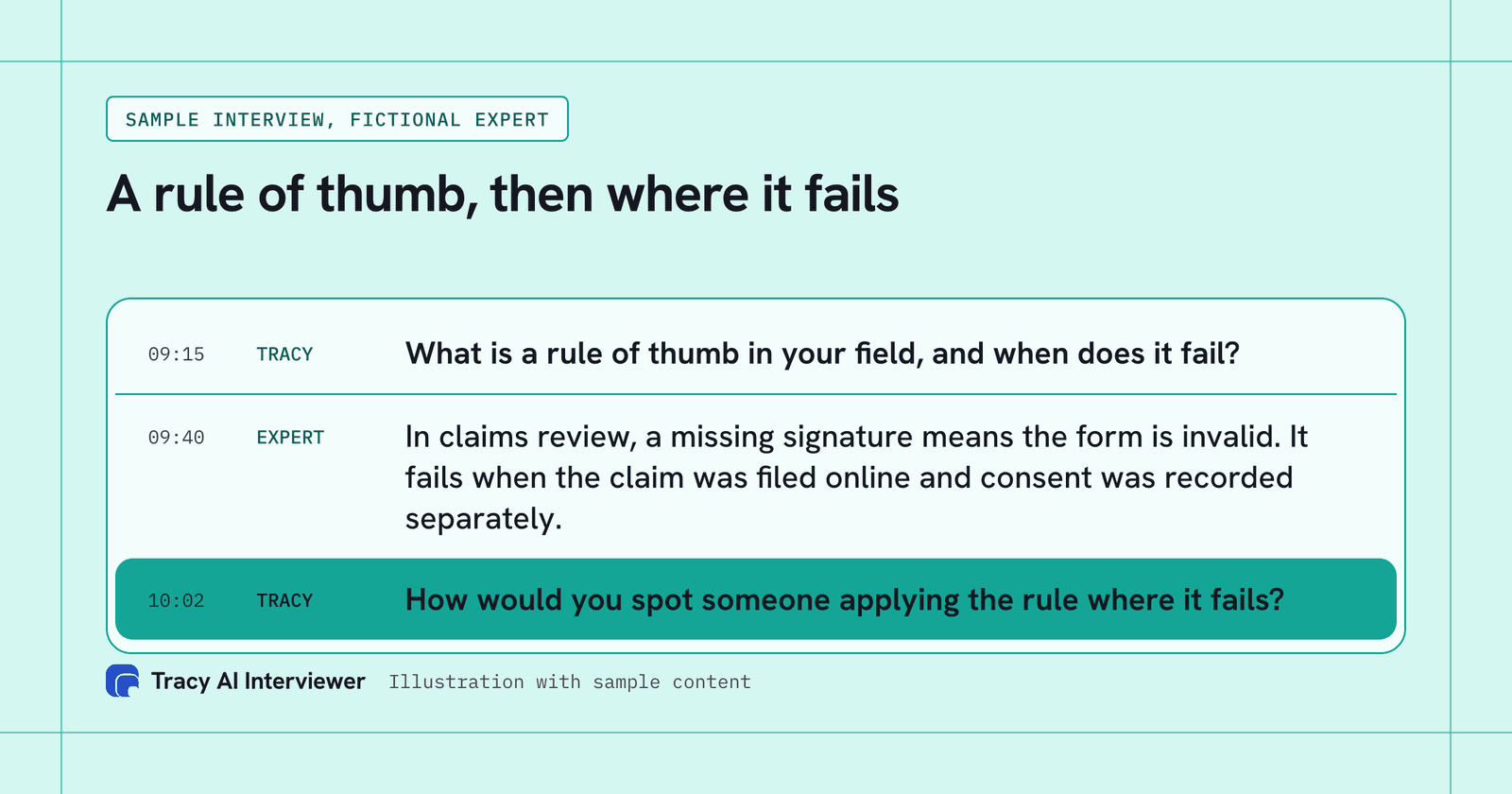
Whether the expert has applied the rule in real work shows in the follow-up.
What a list of questions cannot do alone
The exchange above reaches a real case because each Tracy question took the previous answer as its start: the rule of thumb, how to spot its misuse, then the last time it happened. A list can print the first question, and the rest depend on what the expert says. For 300 experts at 20 minutes each, asking them yourself is about 100 hours of reviewer time, and a platform that needs the pool by Friday runs out of reviewers first. Tracy asks each expert as they join, in their own specialty, and your reviewers spend their hours on the recordings and transcripts.
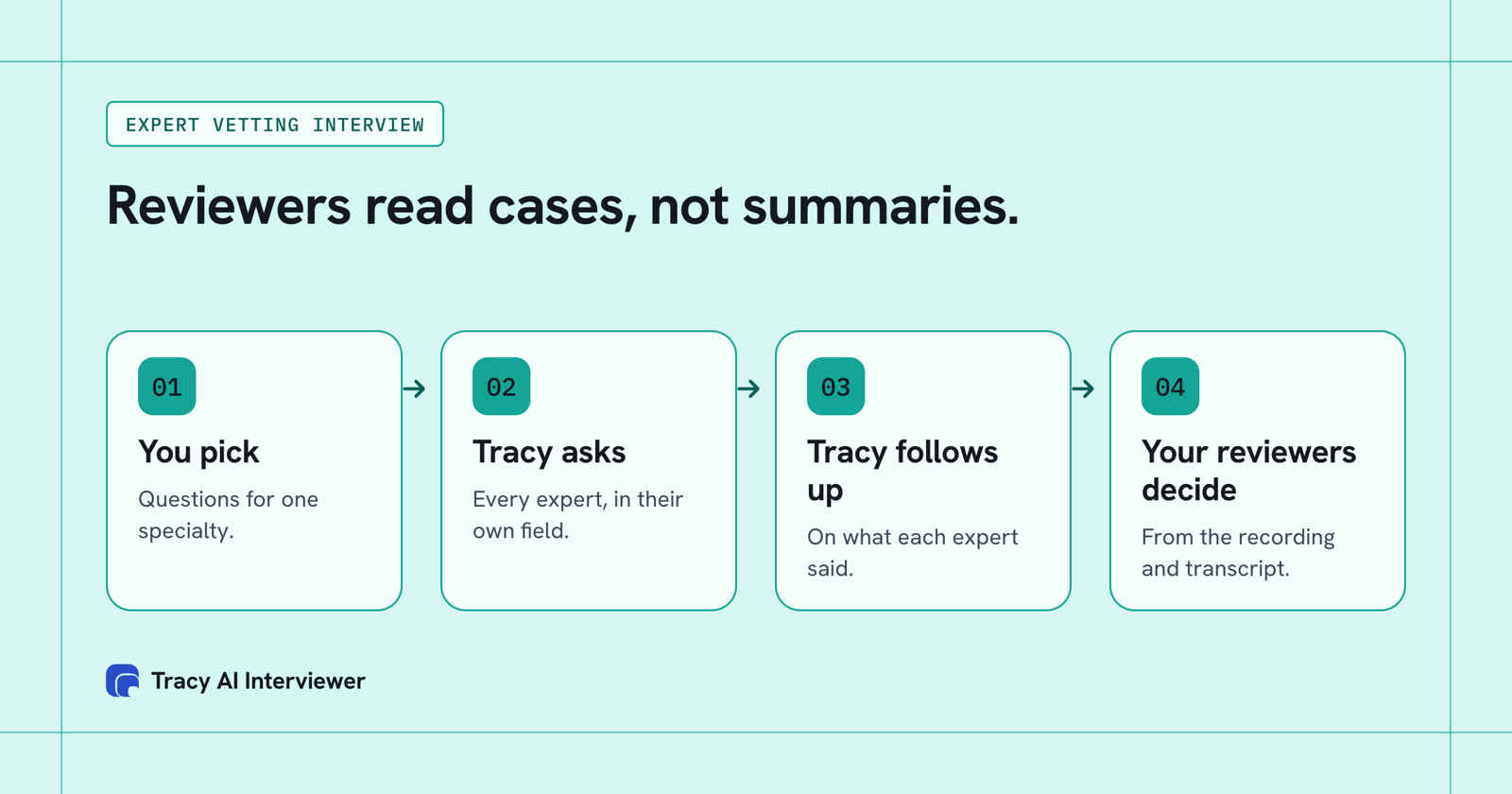
Reviewers read the case behind each answer instead of holding the calls.
What Tracy adds to subject matter expert interviews
01
Reach every expert
Each expert can start on click, whenever they like, with no scheduling and no recruiter on the call. They join from a link with no account and no calendar slot. The join screen states that recording and transcription are on; what experts see is explained.
02
Ask the next question
Tracy asks in the expert's own specialty, follows up on what they just said and waits for them to finish. Give Tracy the role and it drafts questions from your brief, which you edit; see the product page.
03
Keep the evidence
Each result opens to the recording and transcript, with the case the expert gave and a note for your ATS; a result report shows how it is laid out. Tracy has completed 100K+ interviews for 300+ clients, with 99% interview completion.
In a video interview Tracy also captures gaze, tab changes, face detection, fullscreen exits, external screens and delay before answers, and shows them to a person with the evidence. You can turn them off. A signal is not proof and Tracy makes no automated decision. See how integrity signals are reviewed and proxy interviews.
At $1 a credit, with one credit per started 20 minutes of a finished interview, 300 experts at 20 minutes or less come to $300, and your reviewers need no seats. The first three results are free; pricing has the details.
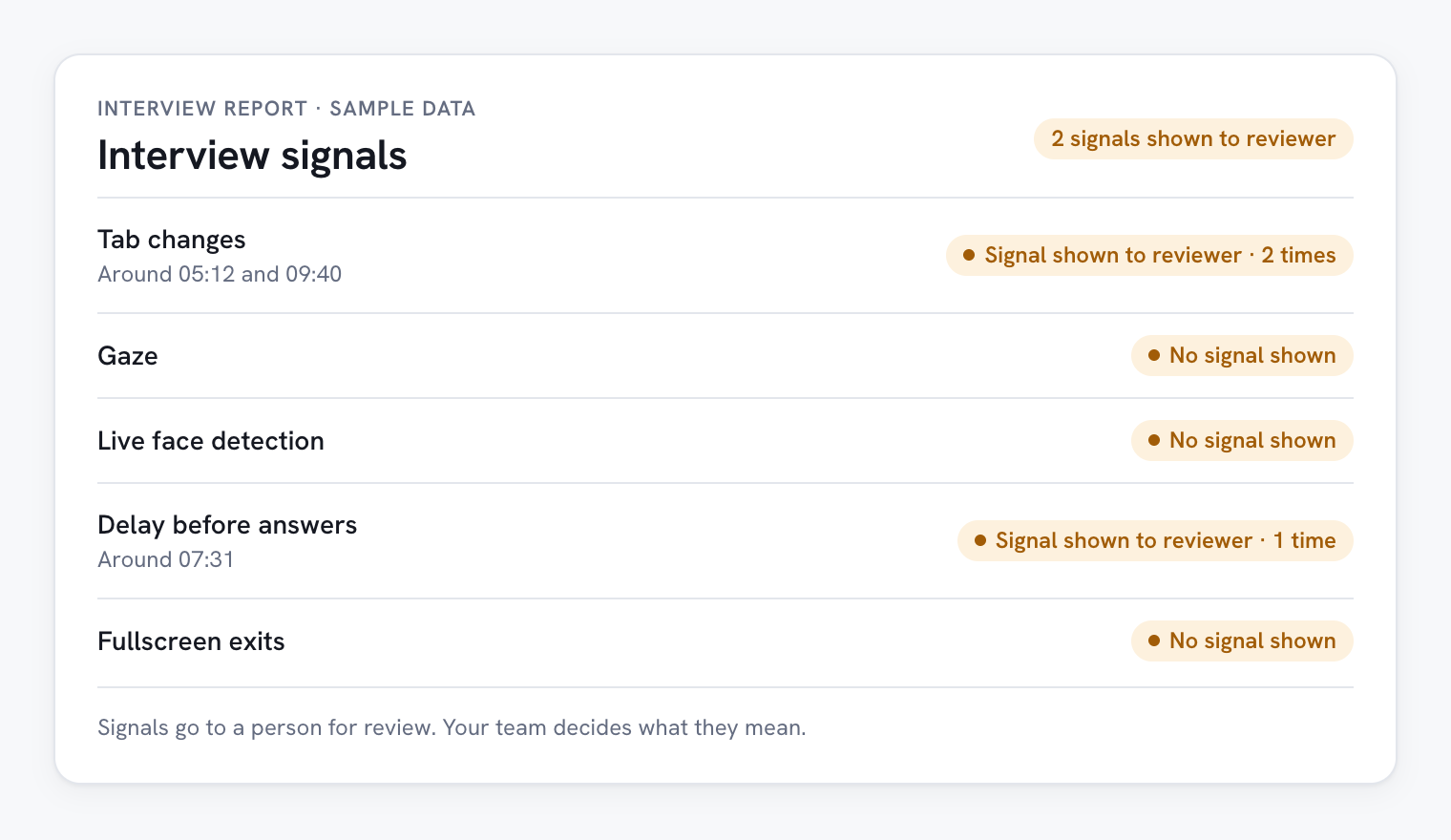
A reviewer sees which moments to open in the recording, and what the signal is, before deciding what it means.
Keep four checks with people
- Credentials: verify a qualification, licence or registration separately, at the source that applies in the expert's country.
- A senior reviewer: ask one of your own experts to read five transcripts cold. If their view of an answer departs from the report, rewrite that question before the next hundred invitations.
- Integrity signals: a flagged moment is a reason to open the recording. Ask the expert about it before deciding.
- The decision: a person makes it from the evidence.
For ten experts a month, a senior reviewer on a video call is enough: AI interview vs human interview compares the two. Once a platform vets 300 experts, reviewer time runs out first.
Common questions
What are good subject matter expert interview questions?
How do you interview a subject matter expert?
How do you tell depth from polish in a subject matter expert?
What questions should a subject matter expert expect in an interview?
Can an AI interviewer interview subject matter experts?
How many questions should I ask a subject matter expert?
Run this interview for your specialty
Turn these questions into an interview for your specialty and read what the first experts said. The first 3 results are free.
Try it free (opens in a new tab) Book a demo (opens in a new tab)
Your first 3 results are free. No card needed.
Sources
- Tracy AI Interviewer home page, retrieved 14 Nov 2026.
- Tracy AI Interviewer pricing, retrieved 14 Nov 2026.
- Tracy AI Interviewer Connect page, retrieved 14 Nov 2026.