In short
Tracy AI Interviewer puts every finance applicant through an interview in their own specialty and follows up on what they said, so reviewers see how they reason, not only what they know.
Use the 18 finance expert interview questions below, grouped by what they test.
Each result keeps a recording, a timestamped transcript and an assessment per question, with integrity signals and their evidence for a person to review.
Next step: paste these questions into a Tracy interview.
We make Tracy AI Interviewer.
A finance review project lands on a Monday. By Wednesday you have hundreds of applicants whose CVs say CFA, ex-bank or Big Four, and two senior reviewers who can interview them between other work. The CV says where someone trained. It does not say whether they will catch a model that quotes a margin without saying which one. Finance expert interview questions for AI training projects have to test that gap.
These ask for finance reasoning applied to review work: reading a model's answer, writing the criteria for judging it, and knowing where an answer should stop short of advice. Each has a follow-up and a note on what a strong answer contains. They are for heads of expert supply and talent teams approving analysts, accountants and risk officers; job seekers can use them to prepare. They test reasoning only: they are not investment, tax or accounting advice, and the Tracy result is interview evidence, not a credential check, so verify credentials separately.
Tracy AI Interviewer runs the part that does not scale. She asks each expert in their own field, follows up on what they just said and waits for the end of the thought. A recording, a timestamped transcript and a written assessment per question go to your reviewers, who decide. For the generalist version, see AI trainer interview questions, and for the wider process, expert vetting.
Eighteen finance expert interview questions, grouped by what they test
Pick one or two from each group. Ask the follow-up only after the first answer, write down what a strong answer contains before the first expert joins, and give everyone the same opening questions. Questions that quote a model's answer should keep the quote to a sentence.
Group 1: reasoning with missing information
1. A user asks a model "Is this company a good investment?" and pastes one line about revenue growth. What do you want to know first?
- Follow up with
- Which answer would change your view most?
- Listen for
- Margins, cash, debt, valuation, time horizon, who is asking. Ranks by impact.
2. Revenue grew and operating cash flow fell. What do you test first?
- Follow up with
- What would you open to tell a slow payer from early revenue booking?
- Listen for
- Working capital, receivables, one-offs. Names a document: receivables ageing, revenue policy note.
3. Tell me about accounts where your first read was wrong.
- Follow up with
- What would you have needed to see earlier?
- Listen for
- A real case, a named turning point, a check they now run.
Group 2: reviewing a model's answer
4. A model says "Margin improved from 12 to 15 percent, so profitability rose." What do you check first?
- Follow up with
- What would make you reject it if both numbers are right?
- Listen for
- Which margin, one definition and period, margin versus absolute profit.
5. What separates a wrong answer from a misleading one?
- Follow up with
- An example from your own reviewing?
- Listen for
- A defensible line. A correct figure can mislead through what it leaves out.
6. A model gives a discounted cash flow value to two decimals. How do you grade it?
- Follow up with
- What would you want instead?
- Listen for
- Assumptions stated, a range, discount rate and terminal growth named. Calls out false precision.
7. A model quotes a figure "from the latest annual report". How do you check?
- Follow up with
- Which year, entity and accounting basis?
- Listen for
- Opens the filing. Checks period, currency, restatements, group against parent, reported against adjusted.
Group 3: scope, advice and confidentiality
8. When should an answer decline to say what to buy or sell?
- Follow up with
- A case where declining is too cautious?
- Listen for
- A view on both failures. Explaining factors can help; "see an adviser" can say nothing.
9. What do you do when a task is outside your specialty?
- Follow up with
- How would your lead know the flag was fair?
- Listen for
- Flags it with a one-sentence reason. Does not guess to keep the queue moving.
10. What would you never put in a task or chat about a client or employer?
- Follow up with
- How do you build a realistic rubric case?
- Listen for
- Invents the numbers, removes names, keeps non-public information out.
Group 4: rubrics and agreement
11. Pick a question small investors ask. Write three criteria for judging an answer.
- Follow up with
- Which could two reviewers read differently?
- Listen for
- Criteria scorable yes or no. Spots their own vague wording.
12. A rubric line says "mentions relevant risks." What is wrong with it?
- Follow up with
- Rewrite it so a second reviewer scores it the same.
- Listen for
- "Relevant" hides the judgement. Splits into named, checkable risks.
13. You and another reviewer score a valuation answer far apart. What now?
- Follow up with
- When do you hold your score?
- Listen for
- Compares reasons, not numbers. Holds for a fact, moves for taste.
Group 5: specialty depth and currency
14. What rule of thumb do people apply where it does not hold?
- Follow up with
- How would you spot a model doing it?
- Listen for
- Something specific, such as a ratio that misleads for loss-making or heavily leased businesses.
15. What did you last change in your work because a standard or rule changed?
- Follow up with
- How did you judge that source?
- Listen for
- A named source and a concrete change.
16. Where does treatment differ between countries or accounting frameworks in your field?
- Follow up with
- How would you mark an answer that fits only one?
- Listen for
- A real difference known first-hand. Marks down answers that do not say where they apply.
Group 6: working on the project
17. Tasks arrive in batches against one rubric. How do you score the 200th the way you scored the fifth?
- Follow up with
- What did you do when you last saw drift?
- Listen for
- A routine: reread the rubric, spot-check early scores, report gaps.
18. Do you hold a role, position or restriction that could conflict with this work?
- Follow up with
- What do you do when a task names a company you cover or hold?
- Listen for
- Discloses unasked, passes the task back, keeps non-public information out.
Ask question 18 of everyone. Hours and time zone are better collected in the application.
A strong answer names what it would check, and a weak one stops at the fact
The difference shows up in the second answer. These pairs are written by us as examples of how it sounds, not quotes from real experts.
| Weak answer | Strong answer | |
|---|---|---|
| Question 4, the margin claim | "The numbers match the report, so I'd score it high." | "They match, but one is gross and one is operating margin. I'd ask for the same measure in both years." |
| Question 6, the single-number valuation | "The method is right, so it's fine." | "Two decimals on a number that moves with the discount rate says more than the inputs support. I'd want a range and the assumptions." |
| Question 18, conflicts | "No, I don't think so." | "I cover two listed software companies. If a task names either, I'd tell you and hand it back." |
Listen for ownership. "The team signed off" tells you about the team. "I checked this, and this is what I do now" tells you about the person.
One follow-up chain shows where the real answer starts
This is an illustration with sample data, not a real interview. The expert is fictional and nothing they say is financial advice. It shows the shape of what Tracy runs: an opening question from your list, the answer, and a follow-up built on it. It starts from question 2.
Tracy: Revenue grew and operating cash flow fell. What do you test first?
Expert (fictional): Working capital. Receivables usually explain it.
Tracy: What would you open to tell a slow payer from early revenue booking?
Expert: The receivables ageing, then the revenue policy note. Ageing shows who is late. The note shows if terms changed.
Tracy: Tell me about the last time that was the answer.
Expert: A distributor whose sales rose after it moved to longer payment terms. Cash fell for two quarters. I asked for the contract terms before I scored anything.
The first answer is the textbook one. The third is where you learn whether it ever happened. A Director at a top-tier early-stage VC says Tracy "sometimes brings up exactly those questions I might have forgotten to ask, which has been a pleasant surprise."
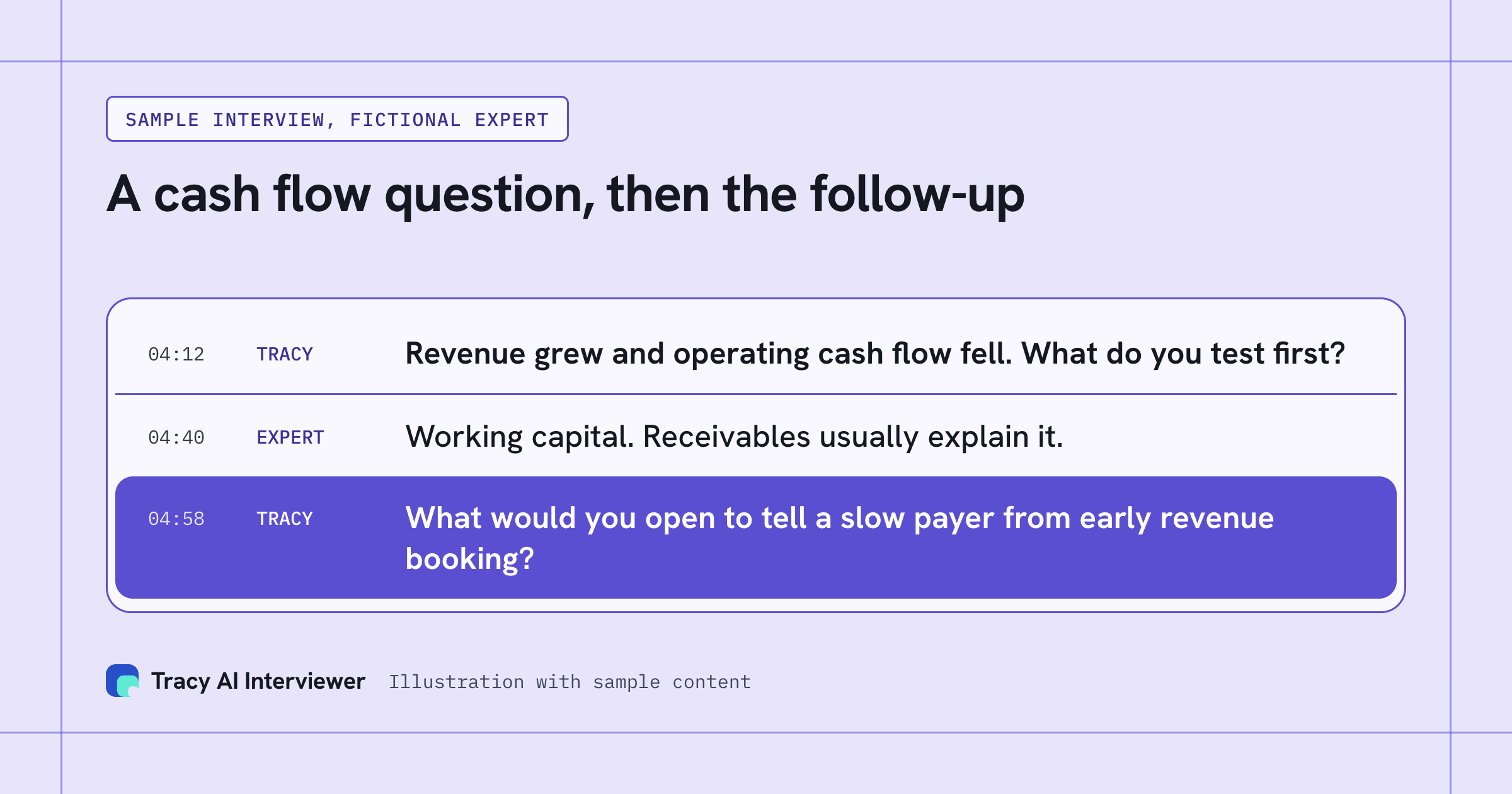
A follow-up built on the expert's own answer shows whether they have actually done the work.
Run the same interview for every applicant without losing the follow-up
A live call for every applicant does not survive a project that draws hundreds of them.
- Your questions or ours. Describe the role and Tracy drafts questions you edit (see the product page).
- CV check, as a setting. With it on, Tracy can read the CV and ask about what it claims, so a stated specialty becomes a question about it.
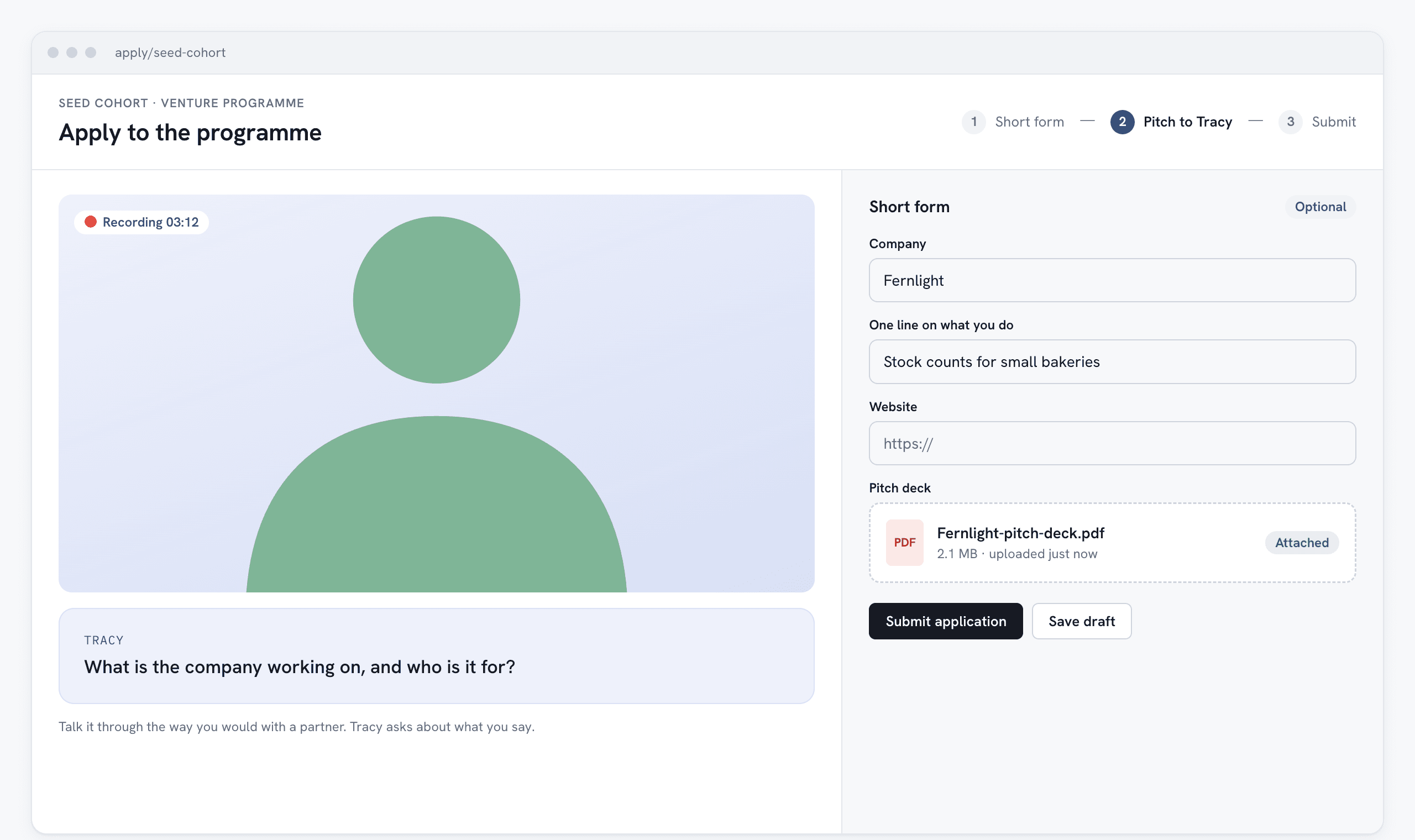
- Start on click. Each expert opens a link in a browser, with no account and no calendar, at any hour, and is told on the join screen that the conversation is recorded and transcribed. See the participant experience.
- A result you can check. A recording, a timestamped transcript and a written assessment per question sit behind every result.
- Integrity signals, with the evidence. Tracy captures tab changes, gaze, face detection, delay before answers, fullscreen exits and external screens, and shows the evidence to a human reviewer. A signal is not proof, and your team decides. See AI interview cheating detection.
It is $1 per credit, one credit per started 20 minutes of an interview that produced a result, so a 34-minute interview costs $2. The first 3 results are free with no card, there are no seats, and a session with no answers is never charged. See pricing. Customisation takes days: send us one role and we will build the interview plan.
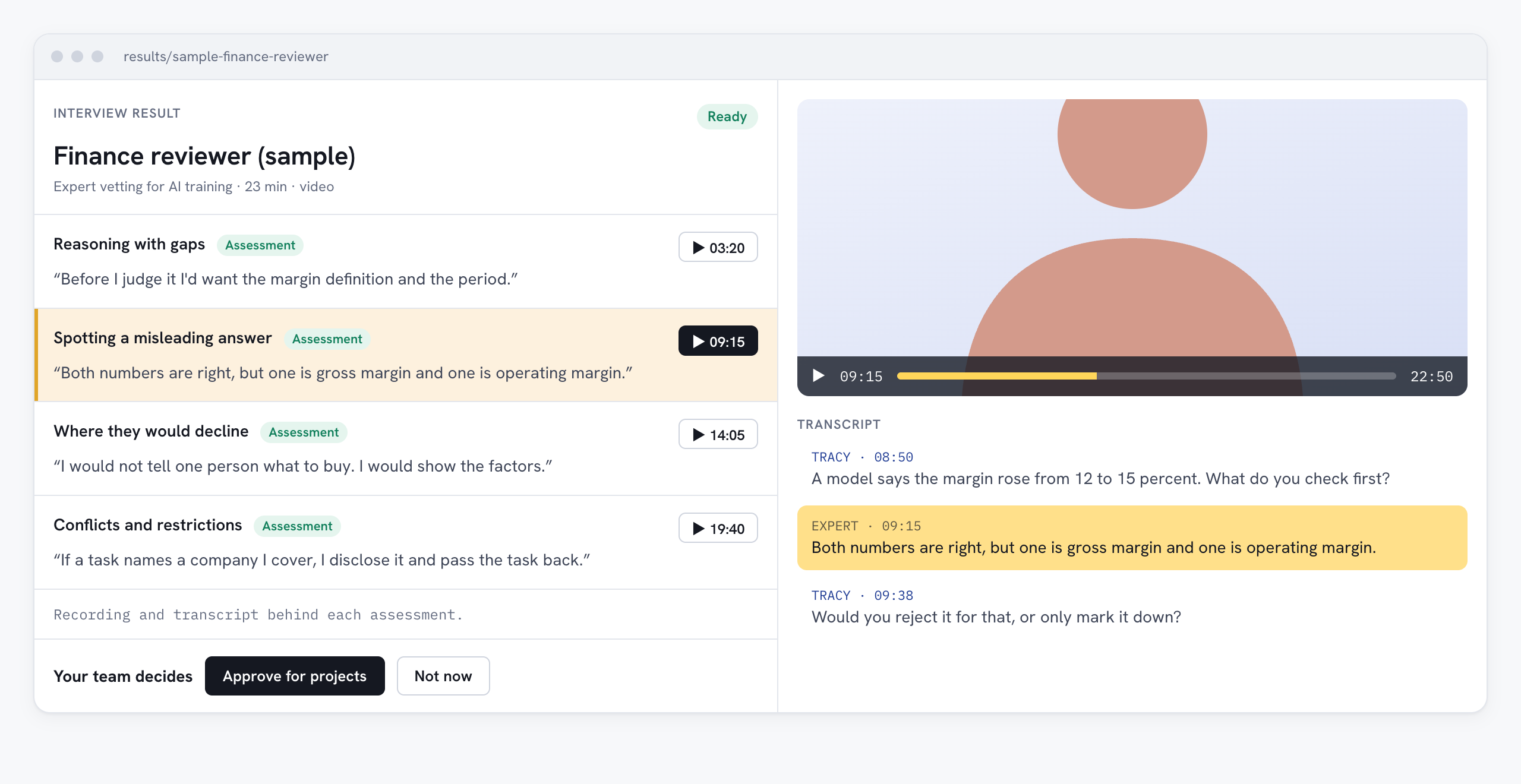
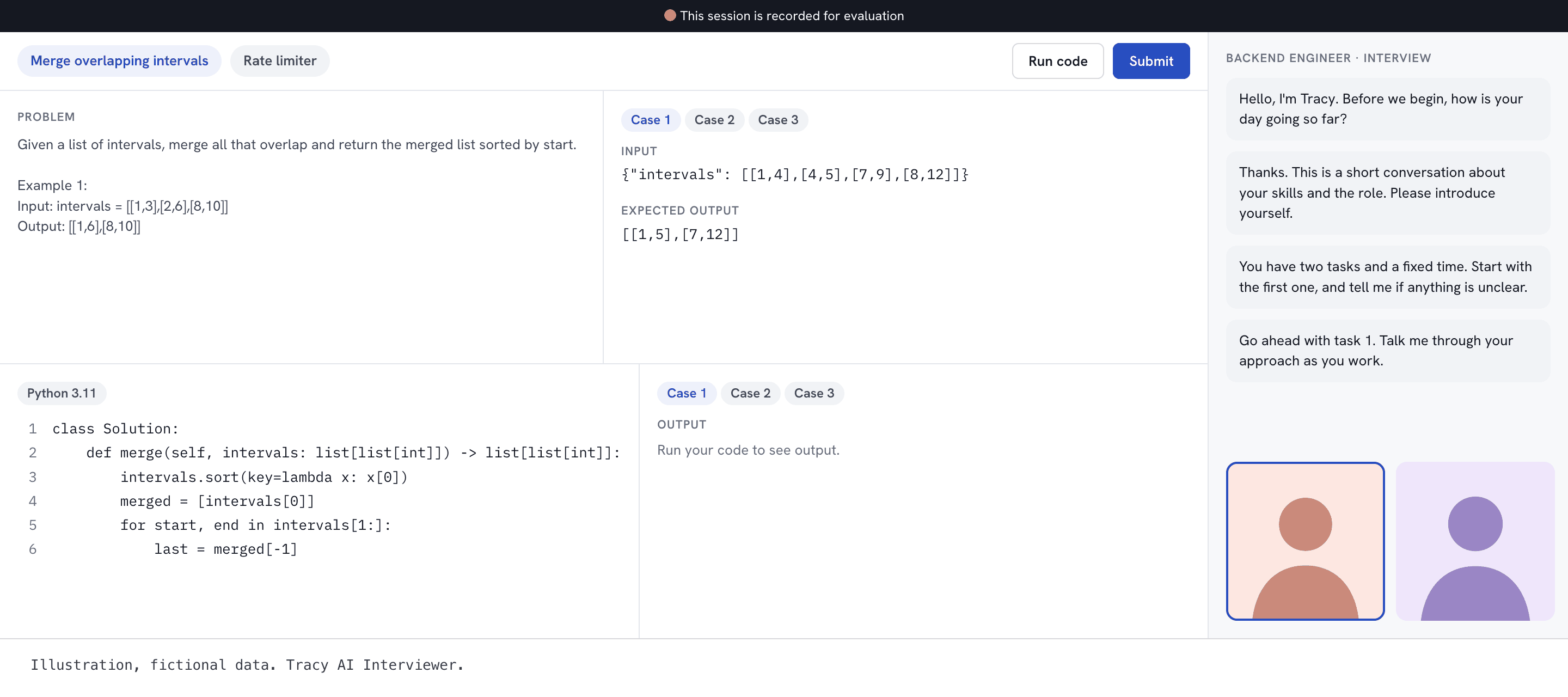
A reviewer can open the recording and transcript behind each assessment.
Keep four checks with people
- Credentials. Verify a qualification, licence or registration separately, at the source in the expert's country. The Tracy result is interview evidence, not a credential check.
- A senior reviewer. Have one of your own score five or six transcripts blind. If they disagree with the written assessments, fix the questions before inviting the next hundred.
- Conflicts and confidentiality. Whether a stated conflict rules someone out is your call.
- The decision. A person decides from the evidence.
For ten experts a month, a senior reviewer on a video call is likely cheaper and better than any tool; see AI interview vs human interview. The case for Tracy starts when applicants outnumber your reviewers' hours. Pilot on one specialty: 15 to 30 applicants, the same six opening questions plus question 18, and one reviewer. If that reviewer disagrees with more than a quarter of the assessments after fifteen, fix the questions first (our rule of thumb, not a researched figure). Measure completion, hours from application to result, reviewer agreement and integrity flags needing a closer look. See AI interview reports.
Common questions
What should you ask a finance expert in an AI training interview?
How do you test finance reasoning without giving financial advice?
Can an AI interviewer interview finance experts?
Does Tracy check a finance qualification or licence?
Are there finance specialist interview questions for different specialties?
Try Tracy on your next role
Tracy interviews every applicant, asks follow-up questions and sends you a ranked shortlist.
Try it free (opens in a new tab) Book a demo (opens in a new tab)
Your first 3 results are free. No card needed.
Sources
- Tracy AI Interviewer home page, customer proof, retrieved 9 Nov 2026.
- Tracy AI Interviewer pricing, retrieved 9 Nov 2026.
- Tracy AI Interviewer Connect page, retrieved 9 Nov 2026.